Colorado
Colorado commissioners from Douglas County visit Washington D.C. for President Donald Trump’s inauguration


A few member of Douglas County Board of County Commissioners recently traveled from one “D.C.” to another.
Republican commissioners George Teal, Abe Laydon and Kevin Van Winkle were in Washington D.C. for President Donald Trump’s inauguration.

It comes after the board unanimously passed an immigration resolution in the county last week, voicing support for Trump’s policies and “legal” immigration while affirming Douglas County’s status as a “non-sanctuary county.”
The commissioners returned to Colorado on Thursday evening.
CBS News Colorado spoke to those commissioners, who said it was a successful visit, meeting with new administration officials and congressional delegates. That included a meeting with Colorado U.S. congressional leaders Lauren Boebert and Gabe Evans with whom they spoke about shared priorities. They also said they spoke with Democratic Sen. Michael Bennet about working across the aisle.
But the goal of the trip was to let the Trump administration know it has an ally in Douglas County.
“We are the last real Republican county in the Denver metro area,” Teal said.
Teal and his fellow Douglas County commissioners say their message under a new administration is clear.
“We stood firm with President Trump, and we are going to provide the support he needs to execute his immigration policies, definitely in Douglas County,” Teal said. “But we stand prepared that if he needs help in the state of Colorado, he needs to let us know what he needs, and we will support him.”
The board has been vocal in opposing the immigration policies of their progressive neighbors. That has meant leading a coalition of conservative counties in a lawsuit against the state centering around two laws that limit cooperation between local government and federal immigration authorities.
“How do we end these sanctuary city, sanctuary state policies?” Teal suggested.
In December 2024, a Denver District Court judge dismissed the lawsuit, but Douglas County is persisting.
“We are planning on appealing. We will be announcing that shortly,” Teal said. “I think we have our ducks coming right in a row. We believe the laws that restrict the ability of local law enforcement to work with federal immigration authorities is federally unconstitutional. We think we have an argument where it is in Colorado constitution unconstitutional.”
Douglas County Sheriff Darren Weekly said in a statement to CBS Colorado, “Our top priority is to continue removing dangerous criminals from our community, regardless of their immigration status. Whether here legally or illegally, we will take decisive action to hold them accountable. If they are in our country illegally, we will work closely with our federal law enforcement partners to ensure they are not allowed to victimize the residents of Douglas County. We are committed to safeguarding our community and restoring law and order while following the letter of the law.”
Teal says the sheriff’s office and county staff are examining Trump’s executive orders to decide what policy changes to make locally. CBS Colorado asked commissioners whether they worry about possible impacts that could come to someone who has lived in Douglas County and the United States for decades and considers themselves an American. This was in reference to Trump’s executive order that could end birthright citizenship.
“There was never any intent with the 14th Amendment to truly support temporary residents. For parents then becoming permanent citizenship for any offspring that might be born in America, that’s not the intent,” Teal asserted. “The original intent of the 14th Amendment was, of course, providing citizenship to the freed slaves. It’s actually intellectually insulting to hear that argument applied on this matter, for anyone who’s actually studied the history of the Constitution. It was very specifically crafted so that, when parents were loyal to another nationality, citizenship would not automatically apply to any children. Quite frankly, given the makeup of the Supreme Court right now, I actually really look forward to somebody putting a good challenge forward, to challenge these in the court of law and see where the Supreme Court really does come down on it.”
Teal says, in some conversations on immigration, he suggested cutting federal transportation dollars to sanctuary cities.
Immigration wasn’t the only issue commissioners discussed. They also discussed county priorities such as wildfire mitigation, human trafficking, transportation and keeping Space Command in Colorado.
Teal says the visit to D.C. brought new partnerships and believes Trump’s leadership in the White House will mean a return to safety and security.
“We’ve sure worked hard, and we’ve sure tried to do a good job to keep Douglas County safe and try to build an environment of prosperity over these last four years. I feel like our job is going to get easier,” Teal said .



Colorado Consumer Health Initiative says at least 700,000 Coloradans are in collections due to unpaid medical bills. Under state law, debt collectors can seize their wages and even put a lien on their house.
“It’s just pushing people over the edge,” says Democratic state Rep. Junie Joseph, who says the medical bills are personal to her. These types of bills affected her as the daughter of a single mother and as a college student.
“They were constantly calling me, ‘Hey, Junie, you need to pay $1,000 here or $2,000 there,” Joseph explained.
Joseph and Democratic state Rep. Javier Mabrey are proposing legislation that bars providers from collecting medical debt by garnishing wages, seizing assets below $30,000, or placing a lien on a person’s primary home.
“You should not be at risk of losing your home just because yo get sick in this country, Mabrey told CBS Colorado.
Rocio Leal is among thousands of Coloradans in debt due to medical bills. She says she had a good job with insurance and thought she was financially secure. Then, her son got sick.
“When he was a toddler, around three, he had to have emergency surgery,” Leal told CBS Colorado.
Leal was still paying the hospital that delivered her son when another hospital began billing her for the surgery. Despite being insured, she says she owed $7,000. When Leal couldn’t pay, she says, the hospitals began garnishing her wages.
“There was so many times my electricity was shut off,” Leal said. “There was times I was almost facing eviction.”
Desperate, Leal took out high-interest payday loans. Twenty years later, she’s still paying them off.
“Just for being sick,” she said.
Mabrey says UCHealth is the biggest offender regarding wage garnishment.
But the health system insists it only garnishes wages as a last resort after repeatedly contacting patients, making sure they’re not eligible for assistance, and offering zero interest payment plans.
UCHealth says it provided more than $760 million in uncompensated care in 2025 alone.
The Colorado Hospital Association — which opposes the bill — says state laws require all hospitals to screen patients for discounted care, wait six months before garnishing wages, and provide 30 days’ notice. It’s also barred from reporting medical debt to credit bureaus and required to erase debt in some cases.
The Hospital Association says the bill could cause some rural hospitals to close. But Mabrey says other states have similar laws and hospitals are still in business.
The bill goes before the House Health and Human Services Committee Tuesday.
Leal, who is a diabetic, says she still worries about going in debt every time she goes to the doctor.
“I don’t want anybody else to go through what I’ve been through,” Leal said.

After losing star guard Isaiah Johnson and forward Bangot Dak to the transfer portal, the Colorado Buffaloes will need to build around Barrington Hargress, who announced his return for the 2026 season.
Additionally, Colorado athletic director Fernando Lovo announced that the NIL budget of the men’s basketball program will be doubled for the coming offseason. Following the College Basketball Crown tournament, the Buffs have a few key players to bring back alongside Hargress for next season.
Sebastian Rancik
Despite a down year for Rancik in 2025, with Johnson gone, there’s an argument to be made that he is still the future of Colorado basketball.
Rancik was given a three-star rating by 247Sports and a four-star composite rating in the 2024 recruiting class. He chose Colorado over offers from the likes of Arizona State, Mississippi State, Nebraska and others.
In his freshman season, Rancik emerged as a star in the making. This was primarily seen in Colorado’s road matchup against the then-No. 17 Kansas Jayhawks, as he recorded 19 points and nine rebounds, despite CU’s loss.
His up-and-down season in 2025 still featured multiple standout performances. One of which was a career-high 24-point performance against the Eastern Washington Eagles in Colorado’s second game of the season.
The flashes of stardom he’s shown could become more consistent with proper development in Boyle’s system, making him not only a star in the Buffs’ future, but an NBA prospect.
Ian Inman
With Johnson out as Hargress’s fellow shooting weapon, Ian Inman is the next in line for Colorado. While he didn’t see meaningful playing time until Colorado’s road matchup against the then-No. 8 Iowa State Cyclones, Inman quickly emerged as a capable shooter.
In Colorado’s matchups later in the season, first against Texas Tech on the road, and then against Kansas State at home, Inman shot a combined 9-for-12 from three, while totalling 29 points.
If Inman can see more playing time and develop more consistency in his shooting, he could be a crucial part of Colorado’s offense moving forward.
Jalin Holland
Defensively, freshman guard Jalin Holland is the future of the Buffaloes.
Despite getting limited minutes off the bench early in the season, Holland quickly emerged as Colorado’s best defensive player. By the end of the season, he was matched up defensively with the top scoring option of nearly every team the Buffaloes played.
Holland averaged five points, 2.5 rebounds and 0.8 steals per game during the 2025 season.
One concern in Holland’s game is his foul trouble. He plays aggressively, and with energy on defense, but that playstyle sometimes leads to foul issues. He racked up 71 personal fouls during the 2025 season.
However, that’s something that can be fixed with proper development, and if Holland remains at CU, he should see meaningful playing time to hone his skillset.
The Buffaloes’ loss of Dak is a hit to their paint defense. But that is a role the Buffs could explore moving Holland into in zone defense, as he’s already shown prowess as an on-ball defender.
Sign up to our free newsletter and follow us on Facebook for the latest news.

DENVER (KDVR) — A Colorado teenager who lost her leg in a shark attack isn’t just walking again; she’s sharing the spotlight with one of her favorite hockey players.
Seventeen-year-old Annabelle Carlson took the runway Sunday at the Colorado Avalanche’s annual charity brunch, an event that raises money for community programs supported by Kroenke Sports Charities. The fundraiser, now in its third decade, is considered one of the team’s most impactful events of the year.
Carlson walked arm-in-arm with Avalanche captain Gabriel Landeskog, drawing applause from a crowd of more than 450 attendees.
Standing tall again has been a long journey for the Colorado high school student. Carlson lost her leg after surviving a shark attack during a family trip to Belize in 2024. Since then, she has undergone multiple surgeries and extensive rehabilitation.
“I think being negative about things like this — it takes such a toll on how you view yourself and how you get through things,” Carlson said. “But I’d rather see everything like, not everything you lose is a loss.”
Carlson has now returned to skiing and hopes to pick back up with playing her favorite sport, lacrosse. But it took a lot of guts and resilience to get to where she is now.
“In my eyes, she’s extraordinary,” Landeskog said. “What she’s gone through at that age, it’s not easy to do.”
The charity event highlights children who have overcome serious medical challenges, pairing them with Avalanche players for a runway walk to spotlight their strength. Players also served brunch and helped auction off team gear and game tickets.
“It was really cool to meet him,” Carlson said of Landeskog. “It’s definitely a flex. Not everyone gets to meet the Avalanche. I’m super lucky and super excited to be here.”
Having gone through some injuries of his own, including damage to his knee, which took him out of play for several seasons, Landeskog said Carlson’s attitude is remarkable.
“She’s young, she’s brave,” he said. “I feel like she’s got a better head on her shoulders than I do, so I feel like I can learn a lot from her as well.”
The team said many players stay in touch with the children and their families long after the event ends, adding that the annual brunch is a day the whole team looks forward to each year.

Laura Dern will play journalist who investigated Jeffrey Epstein crimes in a new series

In a frenetic digital era, he’s helping Angelenos rediscover the classic cassette player
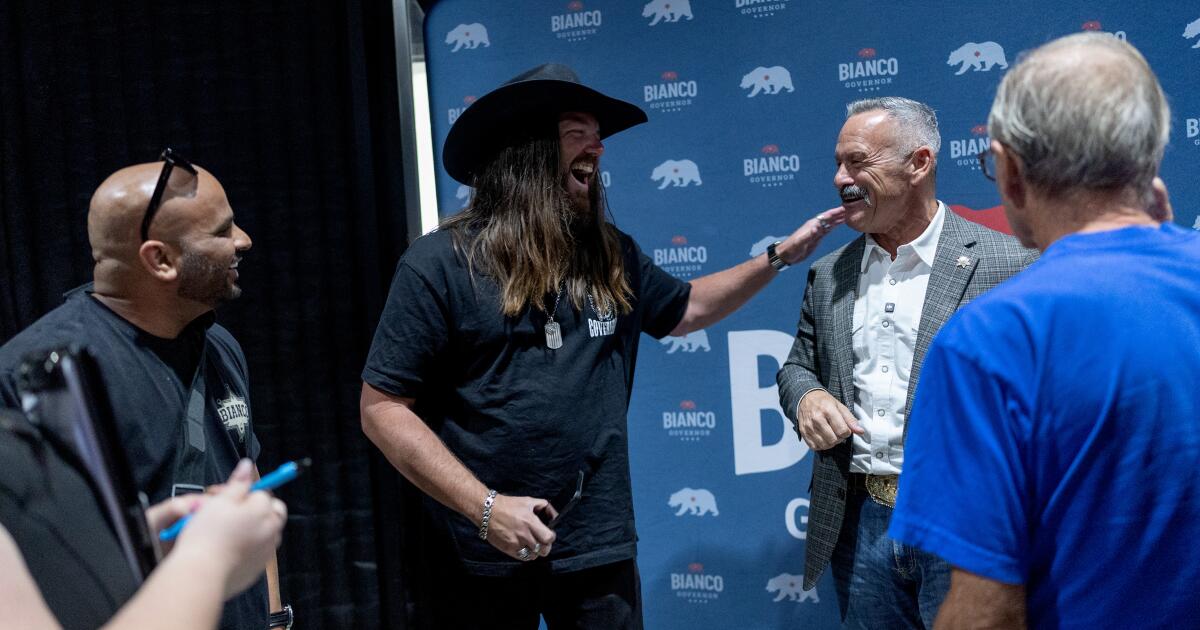
Commentary: Will or won’t he? A lot rides on a Trump endorsement in California governor’s race

A SoCal native is set to pilot NASA’s lunar mission — and become the first Black person to reach the moon

No Luka Doncic, no problem for LeBron James and Lakers in blowout win

Florida High School Football Rankings: Top 25 teams – Oct. 21

How old is Bo Nix? What to know about Oregon quarterback ahead of 2024 NFL Draft

Cleary's 21 help Le Moyne down Central Connecticut State 69-64 in OT

99th annual Pony Swim held in Virginia

Indiana Members Credit Union announced as new anchor tenant at Bottleworks District

EU to urge Israel to scrap death penalty bill as ‘grave regression’

Army reviewing after helicopters hovered alongside Kid Rock’s swimming pool as he saluted

Emanuel pushes back on ‘straight White man’ question, says ideas matter most in 2028

French police make two more arrests over foiled attack on Bank of America

‘What’s going on?’: US judge calls aspects of new Pentagon press policy ‘weird’
-

 Sports1 week ago
IOC addresses execution of 19-year-old Iranian wrestler Saleh Mohammadi
-

 Miami, FL5 days ago
Jannik Sinner’s Girlfriend Laila Hasanovic Stuns in Ab-Revealing Post Amid Miami Open
-

 South-Carolina2 days ago
South Carolina vs TCU predictions for Elite Eight game in March Madness
-

 New Mexico1 week ago
Clovis shooting leaves one dead, four injured
-

 Politics1 week ago
Schumer gambit fails as DHS shutdown hits 36 days and airport lines grow
-

 Minneapolis, MN5 days ago
Boy who shielded classmate during school shooting receives Medal of Honor
-

 Tennessee1 week ago
Tennessee Police Investigating Alleged Assault Involving ‘Reacher’ Star Alan Ritchson
-

 Science1 week ago
Record Heat Meets a Major Snow Drought Across the West