Colorado
10 iconic places in Colorado to have a drink


From the rowdy saloons of the 1850s to the roaring post-Prohibition days in the 1930s and ’40s to the craft brews and $25 cocktails of the moment, Colorado history has paired up with drinking culture in the same way that gin goes with tonic or beer goes with a burger.
But not all watering holes are created equal. While there are plenty of amazing place to tip back a bevvie, we rounded up a few of the most legendary spots in Colorado have a drink.
Columbine Cafe, Golden
A lot has changed in Golden over the past century. For starters, Prohibition ended in 1933, meaning that Coors Brewing got back into the business of making beer. But there’s also now a highway where the Arapaho tribe used to camp and fish, and there are houses and offices and restaurants and gyms where there used to be nothing but open space and elk.
Things have changed at the Columbine Cafe as well, but not by much. Founded as a restaurant by Mike Hatzis, who emigrated from Greece to the U.S., it became a bar in 1934, and a hangout for Coors employees, who would come down after work to trade rumors, tell stories and drink the beer they made — because for most of its existence, the Columbine only served Coors. And since some of those employees worked the third shift, typically 11 p.m. to 7 a.m., the bar opened at 7 a.m. to make sure that everyone could get a pint at the end of the “day.” In 1976, Hatzis gave the bar over to his nephew, Harry Artemis, who’d worked at — where else? — Coors since 1962. Harry continued the run the place past his retirement from the brewery in 1992 and into the 2000s.
It’s now owned by Harry’s kids, Chris, Steve and Tina. Today, the Columbine serves a few beers that aren’t Coors — Longmont’s Left Hand Brewing was on tap recently — and it showcases bluegrass music on Thursday nights in a park-like patio out back; Chris even runs a ski tuning shop in the basement. And it hasn’t opened at 7 a.m. for a decade or so. But the Columbine is still the place to come to trade rumors and tell stories about Coors Brewing, among other things, and it’s still the place to find someone to talk to at the bar, or behind it.
15630 S. Golden Road, Golden; facebook.com/ColumbineCafe

The Cruise Room, Denver
With an aura that jumps straight off of the silver screen, the Cruise Room looks like the kind of place where you might run into Humphrey Bogart drinking a gin martini or Bette Davis swilling an Old Fashioned. Opened the day after Prohibition was repealed in 1933, the Art Deco bar is in the historic Oxford Hotel and it features a long and narrow layout — like a train or a ship — with slick booths on one side and a gleaming, neon-lit bar on the other. While the dress code here should be elegant if possible, you’ll likely find all kinds drinking at the bar.
1600 17th St., Denver; theoxfordhotel.com/eat-drink/the-cruise-room

Flagstaff House, Boulder
There are plenty of rooftop patios in Colorado. And they’re all fantastic. But in Boulder, there’s a patio that feels as if it’s on the roof of the world. Perched on Flagstaff Mountain, just to the west of Boulder, Flagstaff House — owned and run by the Monette family since 1971 — is a fine-dining destination known for elevated food, an award-winning wine list and breathtaking views. While dinner reservations book up far in advance, you can also visit the newly renovated bar and lounge area for a cocktail, a canape, or a dessert. It is seated on a first-come-first-served basis. There’s even a cozy fireplace on colder days where you can watch the sun set with, say, a glass of Caviar Dreams, made with prosecco, lemon, grapefruit, bitters, caper liquor and a bump of caviar.
1138 Flagstaff Road, Boulder; flagstaffhouse.com

Gray’s Coors Tavern, Pueblo
Sit at the bar on in one of the booths at Gray’s Coors Tavern for just a few minutes, and you’ll feel as though you’ve lived your entire life in Colorado. Not only does this timeless Pueblo bar and restaurant mostly serve Coors beer (history tells us that the brewery worked with bar owners after Prohibition ended to put the family name above the doors at a few saloons), but the walls are covered in Denver Broncos memorabilia from at least seven different decades and photos of Gray’s beginnings in 1934. But back to the menu, where you’ll find the perfect pairing for your Coors beer: an open-faced, double cheeseburger smothered in green chile (Pueblo-grown, of course, rather than Hatch), known affectionately as a Slopper.
515 W. 4th St., Pueblo; facebook.com/grayscoorstavern

Minturn Saloon, Minturn
Holed up alongside the Eagle River, the Minturn Saloon — and its predecessor bars at the same address — have been serving drinks in the Vail Valley since 1901. The beautiful backbar itself was built in the 1830s and spent time in Leadville before being hauled down the mountain. But the saloon is perhaps best known as being the end destination for the Minturn Mile, an experts-only backcountry route down Vail Mountain. Recently renovated, the saloon has upgraded its menu and become quite the tourist draw. But it will always welcome locals with a discount.
146 Main St., Minturn; minturnsaloon.com
AAron Ontiveroz, The Denver Post
My Brother’s Bar in Denver. (Photo by AAron Ontiveroz, The Denver Post)
My Brother’s Bar, Denver
If you’ve been around for 150 years, you don’t need a sign to announce your presence. Such is the case on 15th and Platte streets in Denver. A watering hole since the 1870s, the building at 2375 15th St. has been home to My Brother’s Bar since 1970, when the Karagas brothers moved to town and took it over. It’s now owned by local preservationist Danny Newman, who has kept the legacy alive. Laid out like a darkened English pub — but with an unexpected oasis of a patio out back, My Brother’s is known for burgers and beer. And you can get that burger however you want it because it comes with a tray full of possible condiments. (We recommend the Jalapeño Cream Cheese Burger.) The bar is also one of several where Beat Generation writer Neal Cassady spent time while he lived in Denver. Visit, and you might feel enlightened as well.
2375 15th St., Denver; mybrothersbar.com

Oskar Blues Grill & Brew, Lyons
Beer has a long history in Colorado and there are plenty of storied places where that heady liquid has been brewed. One of the most unexpected, though, was a raucous Cajun restaurant founded in 1997 in Lyons by a homebrew-loving Alabaman. But Dale Katechis was also bold, and in 2002, he did something no one could believe: he started canning craft beer. Sure, the big guys — Coors, Bud, Miller — all canned their beer, but microbreweries were supposed to be better and more refined. Katechis was laughed at, but it didn’t stop him from building his business into one of the 10 largest craft breweries in the country. Katechis eventually sold the brewery, but he kept the restaurants, including the original in Lyons, which has hosted renowned blues musicians and jam bands going back in time to a more innocent era in this little town.
303 Main St., Lyons; oskarbluesfooderies.com

Silver Dollar Saloon, Leadville
In case you forget that the town of Leadville is 10,120 feet above sea level, a short and breathy walk down Harrison Avenue, to the front door of the Silver Dollar Saloon, will remind you. Once inside, though, it’s hard to forget the building’s 150-year history (it has been a bar for nearly that long), its antique fixtures and its many guests, like the 10th Mountain Division soldiers (who trained just down the road at Camp Hale), gunslinger Doc Holliday, and the miners, prospectors and Prohibition-era lawbreakers who enjoyed a drink here. Join them by choosing from an extensive list of Colorado-made whiskey, beer and wine, and revel in the fact that this is one of the highest-elevation bars in the United States.
315 Harrison Ave., Leadville; legendarysilverdollarsaloon.com

Woody Creek Tavern, Aspen
For nearly as long as college students have been absorbing the satirical chaos of “Fear and Loathing in Las Vegas,” it has been a Colorado rite of passage to visit the bar and restaurant in Woody Creek, just outside of Aspen, where the book’s author, Hunter S. Thompson, hung out — until his death by suicide in 2005. The rabble-rousing journalist would likely laugh at the Woody Creek Tavern’s legendary status today, not to mention the ritzy feel of Aspen. But that doesn’t mean you shouldn’t stop in to peruse the celebrity photos and memorabilia on the walls, drink a bloody Mary and offer up a toast to Raoul Duke and Dr. Gonzo.
2858 Upper River Road, Woody Creek; woodycreektavern.com
Helen H. Richardson, Denver Post file
The Wynkoop Brewing Company. (Photo by Helen H. Richardson/The Denver Post)
Wynkoop Brewing, Denver
When Wynkoop Brewing opened in 1988 — serving 25-cent beers that day to draw people to the then-desolate neighborhood — it was the first time a beer had been commercially brewed in Denver since Tivoli Brewing closed nearly 20 years earlier. Since then, the brewpub’s booths and bars have been many things: a gathering place for civic leaders, journalists and pot-stirrers; the launchpad for the career of former co-owner John Hickenlooper (now a U.S. Senator), the site of live pig races and pool tournaments and the catalyst for a neighborhood that would go on to become one of the hottest party spots in town. Across from Union Station and down the street from Coors Field, the Wynkoop is now a courtly grandfather among rowdy teenagers, but it’s also the only place you can find a beer made from Rocky Mountain oysters.
1634 18th St, Denver; wynkoop.com
Subscribe to our new food newsletter, Stuffed, to get Denver food and drink news sent straight to your inbox.
Originally Published:



DENVER — Five of the seven law enforcement officers in a rural Colorado county, including the sheriff, have been indicted in an investigation into allegations of misconduct, prosecutors said Friday.
A grand jury indicted Costilla County Sheriff Danny Sanchez and former Deputy Keith Schultz on charges of allegedly mishandling human remains discovered in October 2024, according to court documents. A man who found the remains and reported them to the sheriff’s office said Sanchez and Schultz took only the skull and left the other remains behind, including teeth, court documents state.
Two months passed before Schultz wrote a report, saying he left bones in a bag on his desk and went on another call, the documents state. A coroner’s official said he received the skull in an unlabeled paper bag from the sheriff’s office, the documents state.
Separately, Undersheriff Cruz Soto, Sgt. Caleb Sanchez — the sheriff’s son — and Deputy Roland Riley are charged in connection with the use of a Taser against a man who was suffering a mental health crisis in February and tried to leave when they insisted he go to the hospital, according to the documents. The man said he was “roughed up” by deputies and was left with broken ribs, according to the indictments.
Soto was charged with failing to intervene and third-degree assault, according to court documents. Caleb Sanchez and Riley were charged with second- and third-degree assault.
In announcing the indictments, 12th District Attorney Anne Kelly said she’s committed to investigating and prosecuting crimes no matter the offender.
“I cannot and will not ignore violations of the trust that a community should have in their police. No citizen of the San Luis Valley should have any doubts about the integrity of their police force,” Kelly said at a news conference Friday evening.
A person who answered the phone Friday at the sheriff’s office said it had no immediate comment but planned to post a statement online. Phone numbers listed for Danny Sanchez, Soto and Riley did not work. Caleb Sanchez did not have a listed number. An unidentified person who answered a number for Schultz referred The Associated Press to an attorney, Peter Comar. The AP left a message Friday for Comar seeking comment.
__

As a result of a snow drought and a heat wave that have both set records, some Colorado residents face the earliest restrictions on their water use ever imposed.
Denver Water announced Wednesday that it is seeking a 20% cut in water use, asking people to turn off automatic watering systems until mid-May and restricting the watering of trees and shrubs to twice a week.
“The situation is quite serious,” said Todd Hartman, a spokesperson for the utility. “We’re in such a dire situation that we could be coming back to the public in two or three months and saying you’re limited to one day a week.”
It is the earliest in the year that Denver Water has ever issued a restriction, Hartman said.
Colorado’s snowpack peaked at extremely low levels on March 12 — nearly a month earlier than usual — then cratered during the recent heat wave that cooked nearly every state in the West.
“We already had the lowest snowpack we’ve seen since at least 1981, and now, with the heat wave conditions, we’ve already lost about 40% of the statewide snowpack” since the March 12 peak, said Peter Goble, Colorado’s assistant state climatologist. “Conditions are looking more like late April or early May.”
The water restrictions are a harbinger of what’s to come in many Western states as officials try to manage widespread drought concerns. Nearly every snow basin in the Mountain West had one of its warmest winters on record and is well behind normal when it comes to water supply, according to the U.S. drought monitor. The dwindling snowpack is likely to raise the risk of severe wildfires, hamper electricity generation at hydropower dams and force water restrictions for farmers.
Hartman said nearly every community east of the Rockies, along Colorado’s front range, is in much the same boat as Denver.
City Council members in Aurora are considering similar water restrictions; reservoirs there stand at about 58%, according to the city’s website. In the town of Erie, officials declared a water shortage emergency on March 20 after they observed a massive spike in consumption.
Gabi Rae, a spokesperson for the town, said Erie was perilously close to having taps run dry because so many residents had started watering their lawns early amid the unseasonable heat.
“We were a day away from running out of water. That’s why it was such an emergency,” she said.
Erie officials demanded that residents stop using irrigation systems altogether.
Goble said this month’s heat wave has set records in every corner of Colorado, sometimes by double digits.
“I can’t remember seeing a single heat wave that broke this many records, and seeing it across such a large portion of the country is certainly eye-popping,” he said, adding: “I’m located in Fort Collins, and we got up to 91 last Saturday. The previous record for March was 81, so we smashed that record. And it wasn’t just one day, either.”
Denver Water, which serves about 1.5 million residents in the city and its surrounding suburbs, gets about half of its water from the Upper Colorado River Basin and the South Platte River Basin. The latter’s snowpack was at about 42% of normal Tuesday, the utility reported. The Upper Colorado River Watershed was at 55%.
Systemwide, Denver Water’s reservoirs are about 80% full, which is only about 5 percentage points lower than in a typical year.
“That sounds pretty good,” Hartman said. “Except that what we’re not going to be able to rely on is that rush of water that will bring those reservoirs back up, because the snowpack is so low.”
In other words, the snowpack — a natural water reservoir — is mostly tapped already and won’t replenish reservoirs later this spring and into summer, when runoff usually peaks.
In Erie, city workers plan to aggressively police water use until sometime next week using smart meters that monitor residential usage. Rae said the city is also sending utility workers to patrol neighborhoods and look for sprinklers that are turned on.
“People have been kind of annoyed with how aggressive we were, and I don’t necessarily think they understand the ramifications if we weren’t,” Rae said. “It is an actual serious emergency situation. We were so close to reaching empty, there would literally be no water coming out of the taps — hospitals, schools, fire hydrants, your home would have no water.”
Although the limits on outdoor watering will be lifted soon, Rae expects more restrictions later this spring and summer.
Colorado
Suddenly hazy skies in Denver prompt some residents concerned about wildfire smoke to call 911

Some people who live in the Denver metro area on Thursday afternoon were making calls to 911 after skies became noticeably hazy and winds kicked up. It was due to smoke from wildfires in Nebraska moving into Colorado. A cold front also was moving through the Front Range, and there is dust in the air.
The poor air conditions led to reduced visibility downtown after 3 p.m. Several of CBS Colorado’s City Cams showed dust or smoke in the air.
Temperatures were expected to drop by as much as 20 to 30 degrees with the cold front.
The suddenly dusty skies prompted at least one fire agency to put out a plea to residents to please only call 911 “if you see flames.” That warning was put out by South Metro Fire Rescue, which shared a photo on X of an office building with haze visible outside.
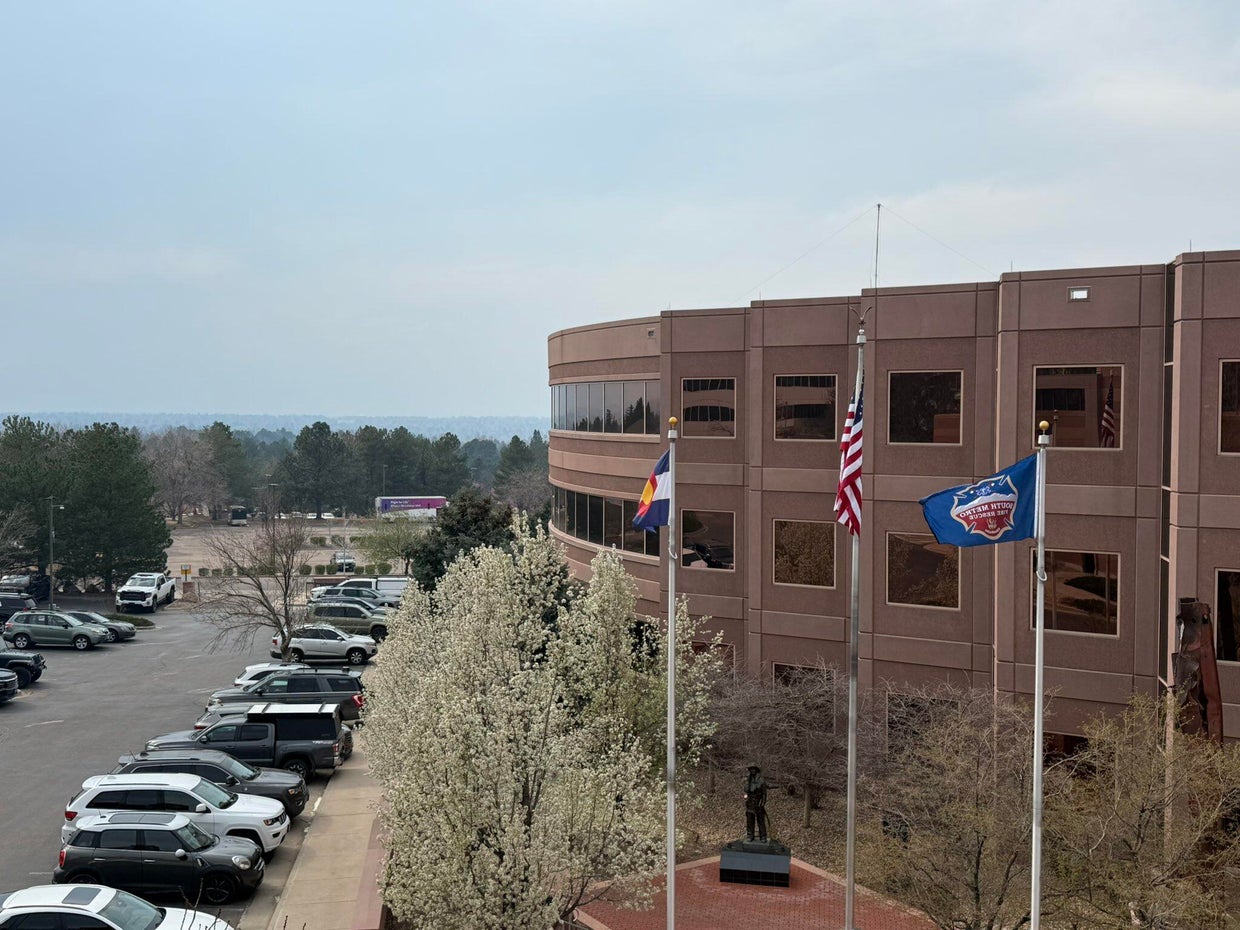
South Metro Fire Rescue said in their post that the smoke is from Colorado’s neighbor to the east. They called it a “significant haze” in the air.
Earlier this month, the Morrill Fire and the Cottonwood Fire burned a significant amount of Nebraska grassland and ranchland. They have mostly been contained by firefighters. Nebraska Gov. Jim Pillen said those two fires combined with several others have burned approximately 800,000 acres of land. On Thursday, Pillen announced that he is signing several executive actions intended to ease the burden caused by the fires.
There were no wildfires burning in the Denver metro area on Thursday afternoon.

Saints open with road victory in Indianapolis

Pittsburgh has rainiest March in nearly 60 years as flooding causes issues across area

Augusta’s Turpin neighborhood to get affordable homes with $1.85M federal grant

‘Strong smell’ shuts down flights at major DC-area airports for the second time this month

Miami Heat vs Cleveland Cavaliers Live Stream: How to Watch NBA

Florida High School Football Rankings: Top 25 teams – Oct. 21

How old is Bo Nix? What to know about Oregon quarterback ahead of 2024 NFL Draft

Cleary's 21 help Le Moyne down Central Connecticut State 69-64 in OT

99th annual Pony Swim held in Virginia

Indiana Members Credit Union announced as new anchor tenant at Bottleworks District

WATCH: Senate hearing goes silent after Angel Father confronts top Dem over daughter’s death

US diplomat Marco Rubio denounces settler violence, tolls in Hormuz strait

Iran-linked hackers have breached FBI Director Kash Patel’s personal emails | CNN Politics

Live: CPAC 2026 Day 2

Video: Will ICE Change Under Its New Leader?
-

 Detroit, MI1 week ago
Drummer Brian Pastoria, longtime Detroit music advocate, dies at 68
-

 Movie Reviews1 week ago
‘Youth’ Twitter review: Ken Karunaas impresses audiences; Suraj Venjaramoodu adds charm; music wins praise | – The Times of India
-

 Sports6 days ago
IOC addresses execution of 19-year-old Iranian wrestler Saleh Mohammadi
-

 New Mexico5 days ago
Clovis shooting leaves one dead, four injured
-
 Business1 week ago
Disney’s new CEO says his focus is on storytelling and creativity
-

 Technology5 days ago
YouTube job scam text: How to spot it fast
-

 Tennessee4 days ago
Tennessee Police Investigating Alleged Assault Involving ‘Reacher’ Star Alan Ritchson
-

 Texas1 week ago
How to buy Houston vs. Texas A&M 2026 March Madness tickets