News
A 3-D Look Inside Trump’s Revamped Oval Office


Mr. Trump spends a great deal of his public and private time in the Oval Office. Here, he fields phone calls from allies, hosts hourslong staff meetings and takes questions from reporters while cameras roll.
It’s not unusual for presidents to decorate the space to their own tastes. They often choose art or items meant to evoke meaning and a historical connection to past political eras.
But in his second term, Mr. Trump has placed a connection to his lavish decorating style above all else. His tastes veer toward the gilded, triumphal style of Louis XIV, a theme that shows up in his own properties.
Mr. Trump has regularly added to or swapped out items in the Oval, according to Karoline Leavitt, the White House press secretary. Some of Mr. Trump’s changes go beyond the decorative — he has installed a red button on his desk that lets him instantly order a Diet Coke.
Most objects on the walls are from the White House archive. But a few things, including gold angel statuettes placed above two of the doorways, were brought in from Mar-a-Lago, his estate in Palm Beach, Fla.
Donna Hayashi Smith, the White House curator, and several members of her team spend time pulling portraits and other items from an archive to show Mr. Trump for approval. The president has also traveled to a vault below the White House to see items in person before choosing to display them in the Oval, Ms. Leavitt said.
Mr. Trump was recently shown a portrait of the former first lady Jacqueline Kennedy, which now hangs near the fireplace. Ms. Leavitt said the president added this portrait, the only one of a woman in the office, because he “admires” Mrs. Kennedy.
The Oval Office makeover is among the many changes Mr. Trump has ordered at the White House, including paving the Rose Garden, remodeling the Lincoln bathroom and demolishing the East Wing to build a massive ballroom.
The Golden Stage
Why all the gold?
“He’s a maximalist,” Ms. Leavitt said, citing Mr. Trump’s background in real estate and hospitality. “So he loves showing people who come in, the renovations, his office, his gift shop.”
She added that when traveling overseas, Mr. Trump proudly talks about the White House to world leaders as he invites them to visit him in Washington. “This is the people’s house. It is also the epicenter of the world,” Ms. Leavitt said. “And he genuinely does have a great respect for the White House.”
Almost as soon as he took office, Mr. Trump began adding gold accents to the Oval. By his first bilateral meeting, with Prime Minister Benjamin Netanyahu of Israel in February, there were five gold-framed portraits surrounding the fireplace and nine gold antiques on the mantel. By his October meeting with President Alexander Stubb of Finland, the gold had proliferated.
Mr. Trump also added ornately framed mirrors on two doors leading to other parts of the West Wing. One of them, shown below, covers a peephole where the president’s aides have, in the past, looked through to monitor the progress of meetings.
Now, if the door is closed, they can no longer see what is happening inside the Oval.
The sheer amount of gilded appliqués on the walls of the Oval Office has sparked internet rumors that they are plastic furnishings purchased from Home Depot, painted in gold. Mr. Trump has denied those claims, saying that the appliqués are authentic gold.
A White House official, speaking on the condition of anonymity to describe the process, said that the underlying materials are made of plaster or metal, then covered with real gold leaf. A craftsman from Florida regularly travels to Washington to gild the appliqués by hand, often when the president is away on the weekends, that official said.
Gold is a metaphor the president uses to visually show his success, said Robert Wellington, an art historian at the Australian National University and author of “Versailles Mirrored: The Power of Luxury, Louis XIV to Donald Trump.”
“He’s really setting up a kind of stage — a gilded stage for his presidency,” Mr. Wellington said. “His style is to amass things together to make this look of ‘rich.’ ”
Aside from the gold, Mr. Trump has hung more than 20 portraits in the Oval Office. In addition to Mr. Washington’s above the fireplace, portraits of John Adams, Benjamin Franklin, Andrew Jackson, William Henry Harrison, Abraham Lincoln, James Monroe and Franklin D. Roosevelt are also on the walls.
Mr. Trump has ruminated about the fate of Mr. Harrison, who died shortly after he was inaugurated, to people who have visited the Oval Office. He has said that the portraits of his predecessors are there to remind him of how quickly fate can change.
Most other presidents had just a few portraits or scenery paintings in the Oval.
George W. Bush, June 2005
Barack Obama, October 2014
Even the lighting in the Oval has not gone untouched.
During his first term, Mr. Trump had lights replaced in the Oval to make sure he was better lit during televised appearances.
Now, between the gold and the overhead lights, the room is very bright. The president has recently discussed installing chandeliers, a White House official said.
The Resolute Desk
In this space, Mr. Trump has ceremonies, like awarding medals to the Kennedy Center honorees or the 1980 Olympic hockey team. He has also hosted business leaders, like Apple’s Tim Cook, or other politicians, like New York City’s mayor-elect Zohran Mamdani.
Mr. Trump has recently taken to sitting at the Resolute Desk while people stand behind him at events.
Other presidents have used the Oval Office in a more structured, organized way than Mr. Trump does.
President Joseph R. Biden Jr. used it as a space for briefings with his staff; the list of attendees was tightly controlled by his senior aides. President Barack Obama often arrived at the office in the late morning, worked there until dinner and continued his evening working in the executive residence. President George W. Bush would reach the Oval by early morning, and in the days and months after the Sept. 11, 2001, terror attacks, the office became the backdrop of some of his most significant national addresses.
Mr. Trump treats the Oval Office as something akin to a boardroom or center stage. His most loyal aides are often in the room with him, helping workshop social media posts or fetching documents at his request. Meetings often run long, and sometimes get folded into unrelated events, because the president enjoys looping in more people as the day goes on.
One day this month, Mr. Trump welcomed a conga line of reporters, political allies and at least one cabinet secretary for meetings. He took phone calls and diverted to other subjects, including his plans for the East Wing ballroom. By the end of the day, he was several hours behind his official schedule, according to a person familiar with his schedule.
Smaller details in the Oval Office were still in the works recently. A gold statuette of an eagle flying over the Constitution was added last month near the flags behind the desk.
But Mr. Trump is most likely finished putting up new items, Ms. Leavitt said.
The Oval Office in 360
Tap and drag the image to explore on your own.
Additional photo credits:
George Washington portraits above the fireplace: White House Historical Association (Richard Nixon, Gerald Ford and Ronald Reagan administrations); Everett Collection, via Alamy (Jimmy Carter administration)
Photo of gold coasters and Diet Coke button: Doug Mills/The New York Times
Gifts to Trump: Doug Mills/The New York Times (plaque from Apple); Tom Brenner for The New York Times (FIFA Peace Prize trophy); Eric Lee/The New York Times (Washington Commanders football); Doug Mills/The New York Times (Rolex desk clock)



News
ICE should do traffic stops despite recent shootings, Trump says, seeming to oppose new suspension

WASHINGTON (AP) — The Immigration and Customs Enforcement agency should continue vehicle stops after recent fatal shootings, President Donald Trump said on Wednesday, seeming to oppose a new suspension of the practice used as part of his immigration crackdown.
ICE is “doing a GREAT job, one that has to be done,” Trump wrote on his social media site.
The Republican president said that to remove criminals he claims were let into the country under the previous Democratic administration “we must be strong, tough, and smart, and we CANNOT give up one of ICE’s most important and effective Crime Fighting tools, THE TRAFFIC STOP!” Trump said, “Once we do, we are playing right into the criminal’s hands.”
Trump administration officials have told Immigration and Customs Enforcement officers to suspend most vehicle stops after two deadly shootings within a week, people familiar with the decision said Tuesday.
The suspension was ordered after an ICE officer shot and killed a Colombian driver Monday in Maine and a week after another officer shot and killed a motorist in Houston, renewing criticism of the agency’s enforcement tactics that were widely condemned last winter after the killings of Alex Pretti and Renee Good in Minnesota.
In Florida on Tuesday, a third man in roughly a week died during an encounter with immigration officers. This time, a 28-year-old man was killed after he was hit by a tractor trailer while running from immigration and other federal officers, authorities said.
It’s a narrative that has been repeated again and again since the Trump administration’s immigration crackdown began, with federal officers confronting drivers and then saying they opened fire when the drivers’ vehicles became a danger. That’s despite decades of warnings from policing experts that shooting into moving cars presents a danger of its own and should almost always be avoided.
There have been at least 10 deaths involving encounters with immigration agents since Trump launched his deportation campaign. At least four of those deaths involved people in vehicles, including the one last week in Houston, a trend so troubling that U.S. Sen. Susan Collins, R-Maine, said Tuesday that she had urged Department of Homeland Security Secretary Markwayne Mullin “to cease all non-urgent vehicle stops.”
John Sandweg, who was acting director at ICE, which is part of DHS, during President Barack Obama’s Democratic administration, estimated recently that there have been roughly 18 traffic stop shootings during the Trump immigration crackdown.
The office of Maine Sen. Angus King, an independent who caucuses with Democrats, was told by DHS that ICE was suspending traffic stops, office spokesperson Matthew Felling said.
ICE, which has been under pressure to beef up arrest and deportation numbers, often says people it’s trying to arrest are increasingly resistant to leaving their homes. ICE officers blame immigration advocates who advise immigrants to stay in their homes unless ICE produces a warrant signed by an independent judge instead of the administrative warrants the agency generally uses that are signed by another ICE officer. So, ICE officers say, they’re forced to find other areas in which to make arrests.
Shooting angers Maine
Hundreds of people in Maine protested Tuesday over the fatal shooting of Johan Sebastián Durán Guerrero, a 25-year-old Colombian national. Advocacy groups said Guerrero, who had a wife and a young daughter, was authorized to work in the United States.
DHS said Monday that an officer, “fearing for public safety,” shot and killed Durán Guerrero while officers were watching the home of someone they believed was in the U.S. illegally and facing a final order of removal from the country. It said in a post on X that when ICE tried to stop a car driven by someone who came from the home, the person attempted to flee in the vehicle and the officer fired.
That was a shift from how King earlier described the encounter, when he said Mullin told him the officer opened fire after the man tried to use his vehicle as a weapon. King said Mullin told him the officers were trying to serve an arrest warrant but not for the man who was shot.
In a scathing post on X, outgoing Colombian President Gustavo Petro called the shooting a targeted killing “at the hands of the U.S. government.”
Petro, who has openly quarreled with Trump, urged Trump to provide an explanation and accused ICE officers of treating Durán Guerrero as “an inferior being without rights.”
In Wednesday’s social media post, Trump told ICE to be “judicious, fair and smart, and go back and do your very important job.”
Maine’s congressional delegation on Tuesday demanded a “comprehensive, transparent, and expedited investigation.”
Questions surround the shooting
Photos showed bullet holes in Durán Guerrero’s car windshield, but the officers involved in the shooting didn’t have body cameras, leaving many questions. Among them are how close the officer was to the vehicle when shooting, whether officers told Durán Guerrero to stop and why ICE believes he had put the public in danger.
Border czar Tom Homan told reporters Tuesday that the investigation needs to play out and that officers will be held accountable if they are found to have acted inappropriately or illegally.
Maine’s attorney general’s office, which said it is working with federal agencies to investigate, said initial statements suggest the driver was trying to flee in the direction of the officer, whose name hasn’t been released and who was placed on leave.
Collins said Mullin told her the DHS inspector general is investigating in cooperation with the FBI.
Democrats seeking to unseat Collins in November have sought to connect her with ICE’s methods, which have drawn public scrutiny and derision. Collins later said in a statement that although ICE needs to improve, eliminating the agency would make the nation less safe.
Maine Secretary of State Shenna Bellows, a Democrat who is vying for Collins’ seat, called the ICE officers at the shooting “thugs” during a vigil Tuesday in Lewiston.
___
Whittle contributed from Biddeford, Maine; Brook from New Orleans; and Sisak from New York.
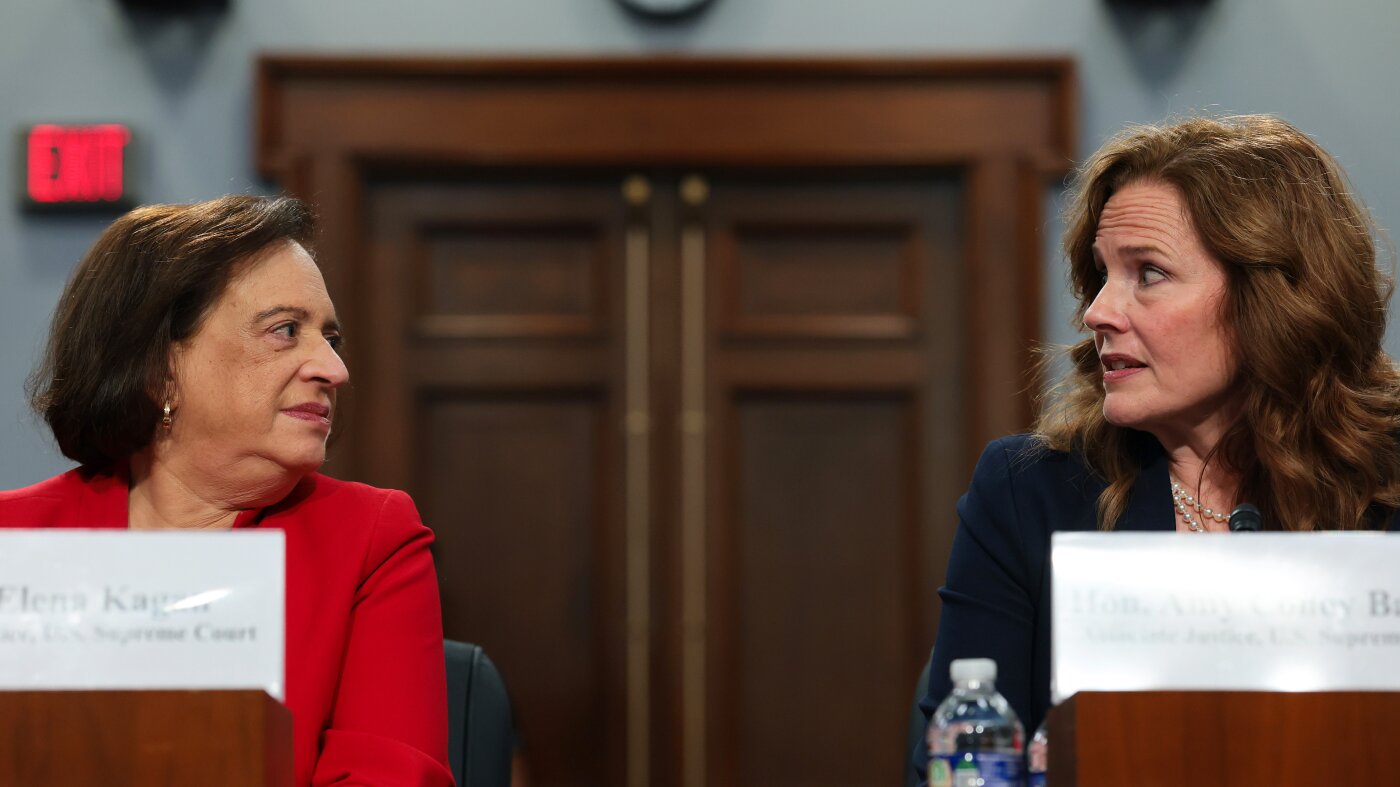
Supreme Court Justices Elena Kagan and Amy Coney Barrett testify before the House Appropriations Committee on Capitol Hill on July 14, 2026 in Washington, D.C.
Anna Moneymaker/Getty Images
hide caption
toggle caption
Anna Moneymaker/Getty Images
The Supreme Court did something Tuesday that it has not done in seven years. It sent two of the justices to Capitol Hill to testify about the court’s budget request for the coming year. The budget has grown dramatically in recent years because of the equally dramatic rise in the number and intensity of threats to the justices’ safety.
Designated as the court’s representatives were Justice Elena Kagan, appointed by President Obama, and Justice Amy Coney Barrett, appointed by President Trump.
As Kagan pointed out in her testimony, it was Republican Darrell Issa and Democrat Elijah Cummings who insisted that the court beef up its security ten years ago after Justice Antonin Scalia died in his sleep on a hunting trip, with no security anywhere nearby to respond quickly.

“They said, kind of like, we think you’re crazy, you know, that that you have less security than director of the Office of Personnel Management does,” she recounted the Congressmen as telling the Court, “and we think that you have to do better.”
Before that, the justices basically had little to no security. They drove their own cars to work; went to the movies and shopped at supermarkets unaccompanied, and did their private travel on their own. And frankly, they liked it that way, because having security is personally invasive.
In recent years, however, the court has undertaken major changes, including continually expanding the court police force to protect the justices and their homes at all times, and funding additional cybersecurity measures.
And yet, as Justice Kagan pointed out, the Court’s $207 million budget request is less than one tenth of one percent of the entire federal budget.
The justices spoke at length Tuesday about how rising threats impacted their lives. Justice Barrett came prepared with two harrowing stories. First was the day she brought home a bullet-proof vest.
“My 12-year-old son was standing in the doorway of my bedroom and he wanted to know what it was,” she testified, “and I didn’t know how to respond. I didn’t expect that performing this service was going to put me in the position of explaining to my children what a bulletproof vest was and why I had to wear one.”
She also described how just six weeks ago, her house was swatted, with local police responding to a fake emergency call. Local police could have stormed her home, but for the fact that her own security detail was there to prevent it.
Indeed, threats have deeply affected judges across America. After U.S. District Court Judge Esther Salas’s 20-year old son was murdered by a gunman seeking to kill her, many federal judges have reported receiving packages bearing the name of her slain son. Those threats, Justice Barrett testified, “are meant to intimidate and they’re meant to harass.”
Sen. Jack Reed (D-R.I.), asked questions about President Trump’s furious response to adverse rulings in the tariff and birthright citizenship cases, and whether Trump’s heaping insults on the court could play a role in jeopardizing the safety of some justices. Kagan had a two-part reply.
“Criticism is fair game. I mean, go for it. You know, life in the big city is that you’re subject to all kinds of criticism. But intimidation is a different thing entirely. And when political figures of any stripe are trying to intimidate judges,” she said, “that’s where we really have crossed the line.”
The hearings were not confined to issues of safety. Congresswoman Rosa De Lauro (D-Conn.) asked about the Supreme Court’s ethics requirements, noting that members of Congress and the executive branch are limited to gifts under $50, while the Supreme Court has no such limit.
She is supporting a bill that would impose upon the Supreme Court the same restrictions on receiving gifts that apply to Congress. And she called for an enforcement mechanism for the ethics rules adopted by the Supreme Court itself.
But Justice Kagan, who said she favors an enforcement mechanism, added that creating such a system is “hard.” After all, as she noted, “you wouldn’t want either the President or Congress” imposing a system on the court because that could well lead to compromising the independence of the judiciary.
One idea that Kagan seemed to like would be to create a panel of distinguished retired judges to enforce the court’s ethics code. But Justice Barrett seemed unpersuaded.
“Who selects the judges? How is the panel composed? There’s just a lot of complexity,” that hasn’t been worked out, she said. The disagreement between the two was, if anything, illustrative of just how hard it was to get the court to finally agree on even the relatively porous ethics code it voluntarily adopted in 2023.
The Justices were also questioned about the court’s emergency docket, dubbed by critics “the shadow docket.” These cases were extremely rare until the Trump administrations.
The critical difference between the emergency docket and the so-called merits docket is that emergency docket appeals often leapfrog over the lower courts, allowing the high court to decide cases without full briefing and argument, and inevitably without much, if any, explanation.
Critics, including Justice Kagan, have often criticized these unsigned and unexplained emergency docket orders for making it difficult for lower courts to know what the law is. Some have in fact accused the court of inviting the Trump administration to treat the docket like a fast-pass to getting policy rubber-stamped.
Questioned by Senator Chris Van Hollen (D-Md.), Kagan observed that part of the reason for the Court’s increasing use of the emergency docket comes from the fact that “we’ve granted a number of these…And when people know that relief is available, there are a lot of smart lawyers out there in the world who are going to say, ‘Why don’t we take our shot at that?’” In other words, the court’s own behavior may have invited the existing problem to metastasize.

Mexico has begun filing criminal complaints with state prosecutors in the United States over the deaths of its citizens in U.S. immigration custody and during enforcement operations, the foreign mini

Maine ICE shooting caught on security camera
Surveillance footage from two local businesses shows a white car driving in circles at a street intersection.
MEXICO CITY, July 13 (Reuters) – Mexico has begun filing criminal complaints with state prosecutors in the United States over the deaths of its citizens in U.S. immigration custody and during enforcement operations, the foreign ministry said on Tuesday.
Mexico’s government has also sent cease-and-desist letters to U.S. detention centers where Mexican nationals have died, the ministry added in a statement.
The filings follow the deaths of at least 14 Mexican nationals in ICE custody and several others during arrest operations, including the recent fatal shooting of a Mexican citizen by an ICE agent in Houston.
President Claudia Sheinbaum announced Mexico’s intention to escalate its response to the deaths last Friday, as she claimed that the government “cannot turn a blind eye to the Mexicans who have died.”
In addition to the measures in the U.S., Mexico’s foreign minister also contacted the United Nations High Commissioner for Human Rights regarding the deaths of Mexican nationals in ICE custody.
Mexico expects the U.N. office to gather information from U.S. authorities, analyze the events and “refer the case to the relevant special procedures of the Human Rights Council,” the statement added.
-

 Colorado5 minutes ago
CPW implements voluntary fishing closures on stretches of the Rio Grande
-

 Connecticut11 minutes ago
Connecticut Technical Education and Career System under investigation by U.S. Department of Education
-

 Delaware17 minutes ago
Delaware man identified after fatal pedestrian crash
-

 Florida23 minutes ago
Cyclosporiasis cases in Florida, US could be undercounted, health expert says
-

 Georgia29 minutes ago
Created in a small Georgia town, a cup has become 1 of the World Cup’s biggest souvenirs
-
Hawaii35 minutes ago
Kilauea eruption’s Episode 51 begins
-

 Idaho41 minutes ago
Idaho AG warns Idaho renters about growing scam targetting home seekers
-

 Illinois47 minutes ago
‘Mini Nerf football’: Hailstone produced during severe storms breaks Illinois record


