California
Why California is uniquely talented at raising more Olympians than any other state

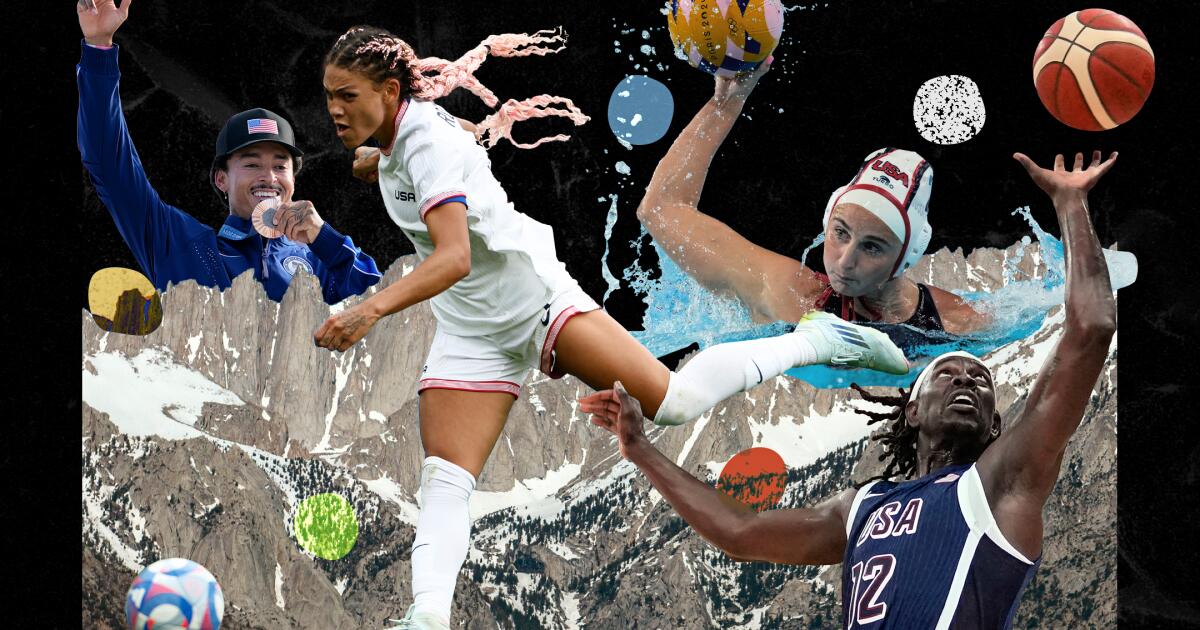
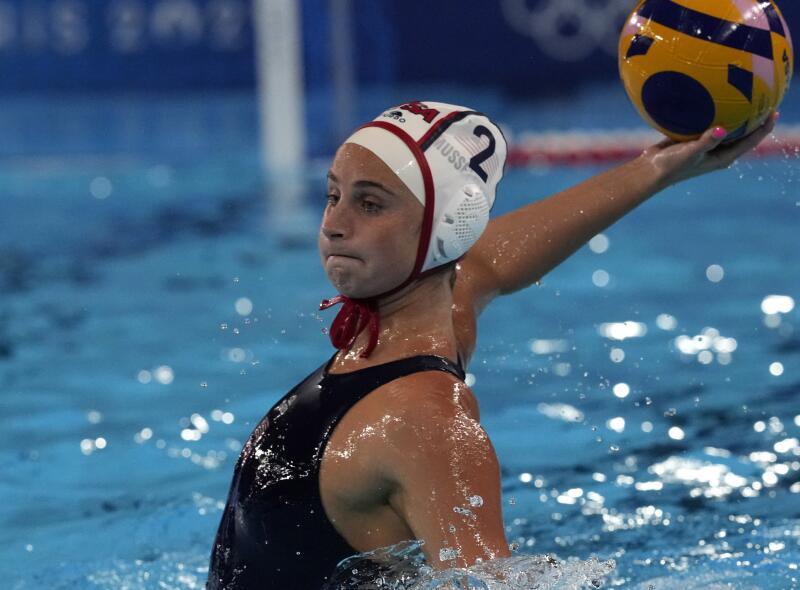
The U.S. soccer team, which will play in the women’s gold-medal game at the Paris Olympics on Saturday, has five players from California. All four U.S. beach volleyball players who advanced to the quarterfinals are Californians, as are 11 of the 13 women on the water polo team, who advanced to the bronze medal game.
In fact, everywhere Team USA has competed in these Paris Olympics, chances are a Californian or three were involved. One hundred twenty-one of the 594 athletes on the American team — more than one in five — are from the state. And that doesn’t include the California natives who competed for other nations, such as Trinidadian swimmer Dylan Carter, Filipina gymnast Emma Malabuyo and Japanese tennis player Ena Shibahara.
2024 Paris Summer Olympic Games
Not only is no state better represented in France than California — fewer than 24 countries have more Olympians in these Games than California. And the reasons are simple, said David Wallechinsky, president of the International Society of Olympic Historians and a native Californian.
“Obviously it’s the weather,” he said. “But also it’s the universities. People from other states come to UCLA, USC and Stanford and they stay. Having good coaching at the universities really helps attract people to California.
“And then the other factor, which I think is really important, is that it’s role models. You grow up in Minnesota or Vermont, your role model, if you have any in sport, is not going to be an Olympic summer sport [athlete]. But if you’re Californian, it’s going to be. Or it’s more likely to be.”
The population is also a plus. With 39.5 million residents, California has 10 million more people than the next most-populous state, Texas. As a result, the number of kids playing high school sports in California last year was larger than the number of people living in Wyoming, Vermont, Alaska or North Dakota.
Bob Larsen, a former track coach at UCLA, also credits the state’s geography, which allow athletes to train at sea level or on the slopes of Mt. Whitney, the highest mountain in the contiguous 48 states, on the same day. California, he said, also has excellent facilities and a robust system for finding and grooming young athletes.
“Youth clubs and middle and high school programs identify and encourage talented athletes early,” said Larsen, who coached at the club, high school and college level, helping Deena Drossin of Agoura Hills to a marathon bronze medal in 2004. “Many college and university teams with good coaches grow the sport.”
And the schools take that mission seriously, even if it doesn’t just benefit Team USA. Stanford, for example, sent 60 Olympians, representing 15 countries, to Paris. UCLA sent 40 athletes from 18 countries and USC 66 from 26 nations. Even UC Irvine had four former athletes in Paris and Santa Barbara City College one.
“We place a significant emphasis on the development of Olympians and other world-class competitors,” said Stanford athlete director Bernard Muir, whose school, if it were a nation, would have finished 11th in the medal count in Tokyo and 10th in Rio de Janeiro. “Several of our peer institutions throughout the state operate the same way. We take tremendous pride in things like leading the medal count among colleges.”
Mark S. Dyreson, professor of kinesiology and history and the co-director of the Penn State Center for the Study of Sports in Society, said California’s rise toward becoming an Olympic power took root about a century ago when the state — and especially Hollywood — began to alter the country’s culture.
California was seen as a land of affluence, fashion, celebrity and new ideas — no matter that much of that was a facade. So when Los Angeles hosted the 1932 Olympics, whose scale and quality were beyond anything that had come before, sports became an indelible part of that brand. Hollywood’s film industry, which heavily promoted the Los Angeles Games, then sold that brand to a global audience.
1
2
3
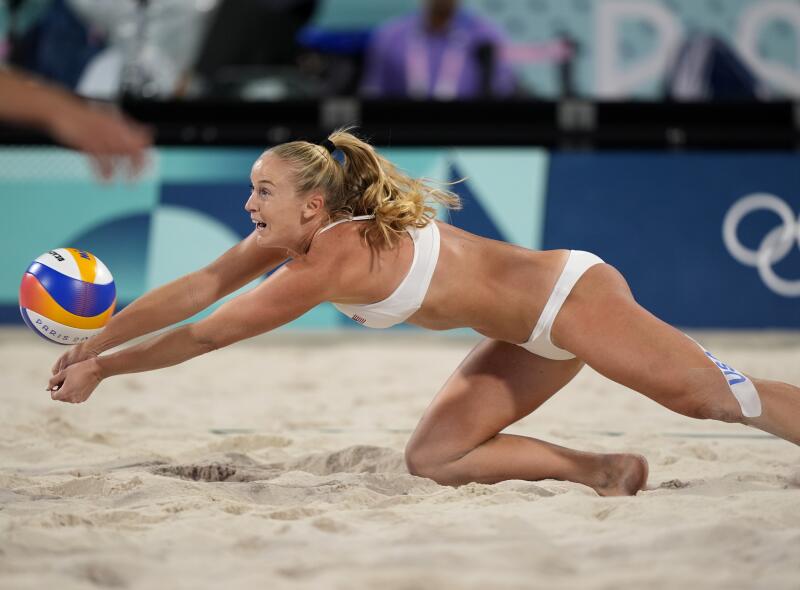
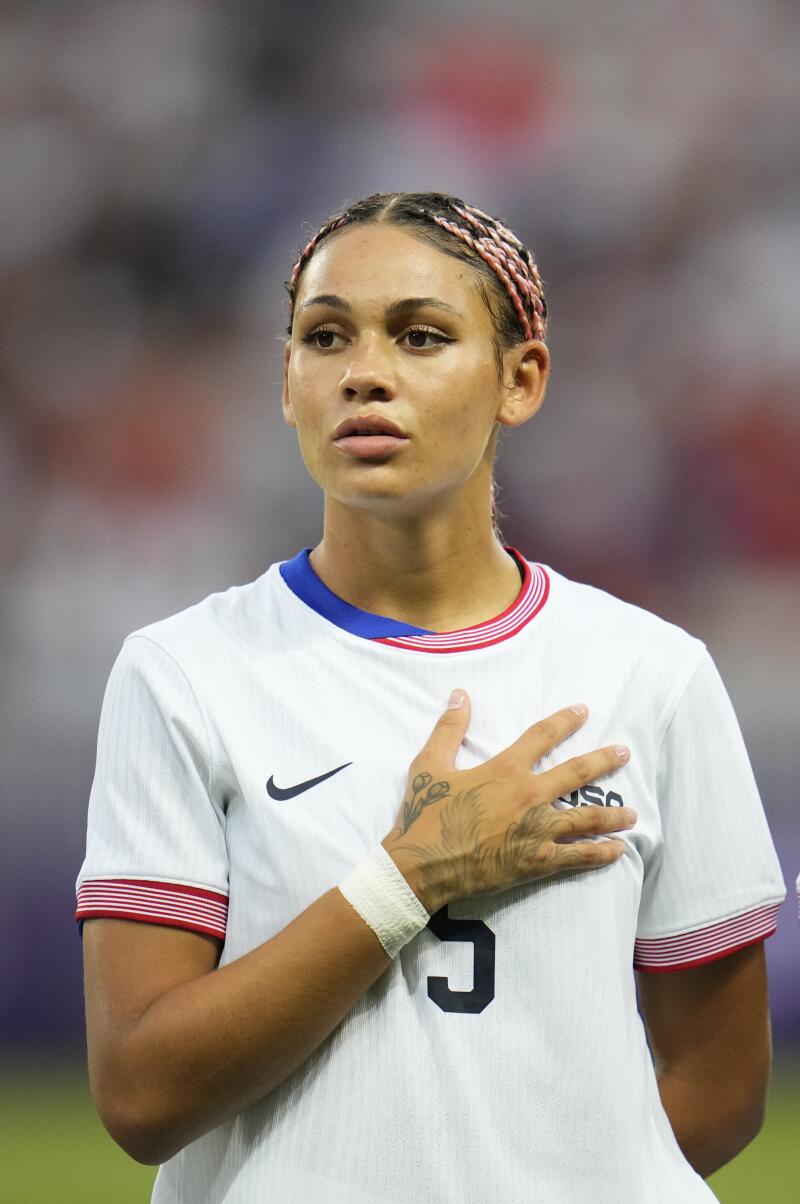
1. U.S. women’s soccer player Trinity Rodman stands during the playing on the national anthems before a match against Zambia at the Paris Olympics on July 25. (Julio Cortez / Associated Press) 2. U.S. water polo standout Maddie Musselman looks to shoot during a match against France on Aug. 2. (Luca Bruno / Associated Press) 3. U.S. beach volleyball player Sara Hughes dives for a ball during a match against a team from Italy on Sunday. (Robert F. Bukaty / Associated Press)
A boom in swimming pool construction tied to the post-war suburbanization of the state was another factor popularizing an idealized California lifestyle built around leisure and recreation. (It’s also why the state has traditionally produced more Olympic swimmers than any other, though just two Californians, male butterfly specialist Luca Urlando and relay medalist Abbey Weitzeil, were part of this summer’s team.)
More recently, the addition of sports such as skateboarding, beach volleyball, table tennis, badminton, golf and surfing, which have long been ingrained in the California culture, has also swelled the number of Olympians from the state. Thirty of the 44 U.S. Olympians in those sports come from California.
“You know, another thing is, I’ve been reading been reading a lot of the [athletes’] biographies. There’s one thing that comes up over and over again, and it’s very strong, which is the parents,” Wallechinsky said. “They’ve got an overactive kid, and they’ll just enroll them in five or six different sports, and then eventually one takes. It’s not so much that the parents are pushing them, they’re just giving them a lot of opportunities. And they find something they like.
“Part of it is the enthusiasm.”
And part of it is the competition. Trinity Rodman of Newport Beach, whose three goals in the Olympic soccer tournament are tied for the team lead heading into the women’s final Saturday, said it’s nice to have weather that allows you to play year-round. But what really made her better was being matched against talented players growing up in South Orange County.
“The clubs that I faced in California were good, like, really good, and top level,” she said. “I don’t know what it was. I can only speak to my experience. [But] we played a lot of good teams, which was nice.”
California just seems to breed stronger, healthier people, which even makes the non-athletes better, something Wallechinsky learned after taking a physical fitness test in junior high.
“I saw the results and I was way down in my school. Way, way down,” he said. “Then they released the national results and I was like, in the top 5%. Wow, I guess I’m not so bad after all.
“Even at the age of 13, it gave me a perspective how different California was than the rest of the country when it came to youth sport.”
Sixty-three years later, that hasn’t changed. And the US. Olympic team is reaping the benefits.



Fireworks Safety Guide
Essential safety tips for buying, handling, and watching fireworks to ensure a safe celebration.
With July 4 falling on a Saturday this year, many businesses and organizations are taking the day off Friday, July 3, to mark America’s 250th birthday. From banking to mail service, here’s what’s open and closed for the holiday weekend.
Most federal offices closed, mail service to continue
Non-essential federal offices will be closed on July 3. However, mail service will continue as normal, and post offices are scheduled to remain open.
Most California government offices to remain open
Most California government offices will be open on July 3, with some exceptions.
DMV offices throughout the state will be open. However, the Employment Development Department will be closed.
DMV offices that offer Saturday hours will be closed on July 4.
Private parcel services to remain open
UPS and FedEx are both scheduled to operate normally on July 3, but will suspend service on July 4.
Stock markets closed
Both the New York Stock Exchange and Nasdaq will be closed on July 3.
Most banks to stay open
While most banks were expected to operate normally on July 3, some may operate under modified holiday hours. All banks will be closed on July 4.
Online banking services should remain operational.
Grocery stores
Most major grocery chains will be open on both July 3 and July 4. Trader Joe’s locations will be open for regular business on July 3 but will close early at 5 p.m. on the Fourth of July.
Retailers
Many major retail stores, such as Walmart and Target, plan to operate under normal business hours on both July 3 and 4. All Costco warehouse stores operate under normal business hours on July 3, but will close on July 4.
Restaurants
Most major restaurant chains remain open on July 4, but some will have limited hours. All Raising Cane’s locations will close on July 4.

Bruce Lee Day aims to honour the San Francisco-born martial arts legend as a cultural bridge and Asian-American icon.
Published On 2 Jul 2026
Martial arts icon Bruce Lee will become the first Chinese American in California history to be honoured with an annual namesake day.
California Governor Gavin Newsom signed a law on Tuesday afternoon, officially designating May 17 as Bruce Lee Day.
Recommended Stories
list of 4 itemsend of list
Lee was born in San Francisco in 1940 and returned to the city on May 17, 1959, aged 18, after spending his childhood in Hong Kong.
His daughter, Shannon Lee, CEO of the Bruce Lee Foundation, said the honour reflects her father’s enduring legacy as a bridge between cultures.
“From young people who found confidence and possibility in his philosophy, to families who finally saw themselves represented on screen, to athletes who still draw on his teachings of discipline and inner strength, his reach is profound,” she said in a statement.
State Assembly member Matt Haney, who represents San Francisco, called Lee the “epitome of the best of California”.
“At a time when Asian Americans were too often absent from or stereotyped on screen, Bruce Lee helped generations see themselves represented with strength and dignity,” he said.
The Bruce Lee Foundation and Asian-American groups hope Bruce Lee will be celebrated each year with voluntary activities, including cultural exhibits, public events and classroom lessons.
Born to Chinese parents touring the US with an opera, Lee held birthright citizenship. He moved to Hong Kong as an infant, became a child actor, and studied Chinese kung fu before returning to the US in 1959.
He enrolled at the University of Washington in Seattle in 1961, but dropped out to teach martial arts.
In the 1960s, Lee appeared in Hollywood, most notably as Kato in the TV series The Green Hornet, but said studios typecast him in racist roles and paid him less than white actors.
He returned to Hong Kong and starred in martial arts films, including The Big Boss and Fist of Fury.
Lee died tragically in 1973 at the age of 32 after an allergic reaction to pain medication.
His name and likeness remain widely popular.
Fans gather on his birthday, and a treatment he wrote for a television series inspired the HBO Max show “Warrior”.

See the best High Desert fireworks through the years
Fireworks have long lit up the California High Desert, from community shows in Victorville and Apple Valley to backyard celebrations that filled the night sky. Revisit Fourth of July moments through the years.
Each year, fireworks light up the sky across the United States for the nation’s Independence Day. With 2026 marking the nation’s 250th birthday, fireworks shows may be a bigger draw.
With California being so fire-prone, the state has strict fireworks laws, but does that mean that people won’t enjoy fireworks without risking jail time on July 4?
Are fireworks illegal in California?
The California Department of Forestry and Fire Protection, or CalFire, is the agency in charge of managing fireworks and classifying which ones are safe to light.
The California Fireworks Law was passed in 1938 and designated the Office of the State Fire Marshal as the only fireworks classification authority in the state, according to CalFire.
The fire marshal’s office classifies fireworks through lab analysis and field testing. It also requires that all parties dealing in fireworks, such as pyrotechnic operators, manufacturers, and retailers, have licensing.
Along with the aforementioned law, the State’s Explosive Law authorizes the fire marshal to “adopt regulations for the safe use, handling, storage and transportation of explosives,” CalFire says.
“Safe and Sane” fireworks are less likely to cause injury and generally mean that the fireworks do not explode or fly, according to the City of Fontana.
There are almost 300 communities in the state that allow “Safe and Sane” fireworks.
It is illegal in the state to sell, transport, or use fireworks that don’t carry the “Safe and Sane” seal or use any in a nonpermitted community. If convicted, you can face a fine up to $50,000, a year in jail or both, according to CalFire.
All other fireworks are considered illegal in the state and are prohibited from being operated by unauthorized parties in most jurisdictions.
Some illegal fireworks include:
- Wire Core Sparklers
- Sky rockets
- Bottle rockets
- Roman candles
- Aerial shells
- Firecrackers
- Other fireworks that explode, go into the air, or move on the ground in an “uncontrollable manner.”
How to safely use fireworks
CalFire has put out a list of safety tips to avoid injury when handling fireworks.
CalFire recommends:
- Use only State Fire Marshal-approved fireworks
- Verify local ordinances before purchasing or using fireworks.
- Always read the directions on labels.
- Children should always have an adult present.
- Only use fireworks outdoors.
- Avoid using fireworks near dry grass or other flammable materials.
- Only light one firework at a time.
- Have a bucket of water and a hose nearby in case of fire.
- During a drought, it is recommended that you use a bucket of reused water to submerge your firework after use to ensure it’s completely extinguished.
- Never place any part of your body directly over a fireworks device when lighting the fuse.
- Back up several feet immediately after lighting a firework.
- Never point or throw fireworks at another person.
- Never attempt to relight or fix fireworks.
- Never experiment with fireworks.
- Do not wear loose-fitting clothing while lighting fireworks.
- Never carry fireworks in your pockets.
Ernesto Centeno Araujo covers breaking news for the Ventura County Star. He can be reached at ecentenoaraujo@vcstar.com, 805-437-0224 or @ecentenoaraujo on Instagram and X.
-

 Augusta, GA5 minutes ago
Augusta leaders hold public meetings on data center ordinance
-
 Washington, D.C7 minutes ago
Hegseth faces protests at ‘Safe and Beautiful’ Washington, DC ceremony
-
Cleveland, OH13 minutes ago
Nichole Milanovich Obituary Jul 1, 2026 – Slone and Co. Funeral Directors
-

 Austin, TX20 minutes ago
‘Rising Waters: One Year After the Floods’ airing Friday on CBS Austin
-

 Alabama22 minutes ago
Potential for Severe Storms Through Early Evening – Alabama Emergency Management Agency (EMA)
-

 Alaska28 minutes ago
Alaska is celebrating America’s 250th in the fast lane… off a cliff
-

 Arizona35 minutes ago
Arizona Chamber installs Monica Coury as board chair – Chamber Business News
-

 Arkansas38 minutes ago
Arkansas accumulates $655 million general revenue surplus, fifth-largest in state history | Arkansas Democrat Gazette

