California
What the death of local news actually means


Good morning. It’s Wednesday, July 24. I’m Gustavo Arellano, a metro columnist, which means I’m allowed to have opinions like:
Newspapers are cool.
But before I begin my rant, here’s what you need to know to start your day.
Whither the news industry in California?
Since I was a teen, I’ve lapped up newspapers.
I used to steal the sports section from the rolled-up newspapers on the driveways of homes on the way to Sycamore Junior High in Anaheim. When I realized there was more to life than just the Angels and Dodgers, I’d jump a fence every Sunday morning to buy copies of the Orange County Register and L.A. Times from news boxes in my neighboring apartment complex. Once I got a job my senior year of high school, I subscribed to those two papers along with the New York Times.
I went into journalism straight out of college despite earning a film studies degree — I’ve never regretted it. But as the years went on, I ended my print subscriptions because I could read for free on the internet most of what I used to pay for.
An empty news rack that used to sell the Spanish-language newspaper Excélsior still remains along Bristol Street in a small shopping area in Santa Ana.
(Genaro Molina / Los Angeles Times)
It’s people like me who launched the proverbial Little Boy that destroyed too many journalism outlets to count.
But the Fat Man remains companies like Craigslist, Google and Facebook, which eradicated the traditional business model of news organizations — advertising. This one-two punch has led to mass layoffs, shutdowns and a society where misinformation reigns.
Two bills currently in the California Legislature, Assembly Bill 886 and Senate Bill 1327, seek to confront this digital dystopia.
The former would require social media giants such as Facebook and search engines like Google to pay news outlets for using their content; the latter would use the revenue gathered from a proposed tax on user data gathered by Big Tech to gift news groups a tax credit for every full-time journalist they employ. The California News Publisher Assn., of which The Times is a member, supports AB 886, arguing it could give the state’s dying news industry — and local news — a lifeline.
(Tech companies vehemently oppose the bills, arguing it’s unfair to target them when the news industry hasn’t kept up with modernity and readers have more options to get their news than ever before.)
These bills aren’t merely a desperate money grab by the lamestream press, folks.
A limping media ecosystem affects society in many ways — few of them good.
Times reporters investigated the decline of local news and what it actually means. Here’s what we found:
- More big businesses control the narrative. The largest news source in Richmond, Calif., is owned by the Bay Area town’s largest business: Chevron. That means in a city where pollution concerns are real from the company’s refinery, its digital rag doesn’t say a damn thing, Jessica Garrison reported.
- News that serves disenfranchised communities is ignored. Santa Ana is one of the most-Latino big cities in the United States. Twenty years ago, dozens of local semanarios (weekly papers) and all sorts of sports, entertainment and lifestyle magazines covered the goings-on of the city. Today, just two publications focused on entertainment fluff remain. I looked at how important issues affecting residents now get ignored.
- Tech companies are intent on winning. Australia and Canada passed bills similar to what California legislators have proposed. Some money went to publishers, but tech bros created chaos by blocking news from their platforms, national correspondent Jenny Jarvie reported.
- AI is only making things worse. AI chatbots might openly lift local journalists’ work and either pass it off as their own or mischaracterize it. “The average consumer that just wants to go check [out a restaurant], they’re probably not going to read [our article] anymore,” L.A. Taco editor Javier Cabral told Wendy Lee on AI’s effects on his scrappy indie site.
- Even news nonprofits — long seen as a foolproof solution — are having a rough time of it: The Long Beach Post had eclipsed the 127-year-old Press-Telegram in readership and gravitas but now finds itself in tatters after nearly three-quarters of its reporters resigned over editorial and business disputes with management. Those defectors now have their own publication, the Long Beach Watchdog, James Rainey reported.
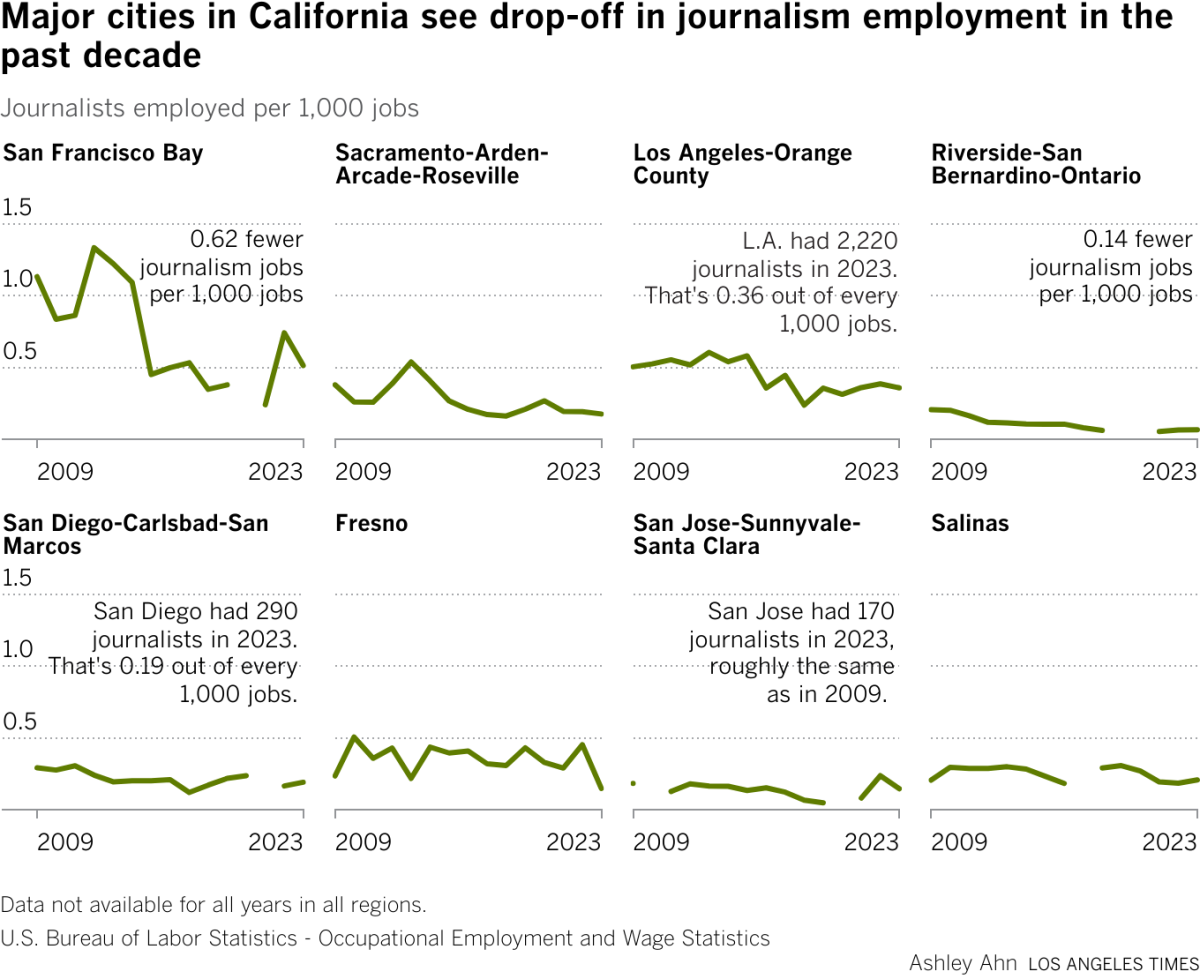
- There are fewer reporters to hold power accountable. The people paid to objectively find out what people in power are trying to hide from you … we’re losing jobs like the Halos are losing fans, Ashley Ahn showed.
I thank you, gentle reader, for reading this newsletter, offer you a virtual high-five if you subscribe to Essential California, and gift you a digital gold star if you are a Times subscriber. And if you read this without paying us? We pardon you — and ask you to subscribe. Hey, $1 for four months is a deal anyone can afford, amirite?
Today’s top stories

Vice President Kamala Harris campaigns at West Allis Central High School in West Allis, Wis.
(Kayla Wolf / Associated Press)
Kamala Harris hits the trail
Coronavirus in California
How clean is your weed?
Fentanyl
- The family of 3-year-old twins who died of a suspected fentanyl overdose is in shock. Relatives said they had no idea the boys’ mother used the opioid.
- Their mother has been charged with murder.
- Just last week, another toddler died of a fentanyl overdose. DCFS had trusted his mom’s friend to keep him safe
More big stories
Get unlimited access to the Los Angeles Times. Subscribe here.
Today’s great reads

A plate of tacos is displayed at the Industrial Downtown Night Market.
(Dania Maxwell / Los Angeles Times)
How L.A. reached peak taco. To understand how Los Angeles became the world’s most taco-diverse city, let’s start with the taco truck.
Other great reads
How can we make this newsletter more useful? Send comments to essentialcalifornia@latimes.com.
For your downtime

Tacos at Bandito Taqueria.
(Andrea D’Agosto / For The Times)
Going out
Staying in
And finally … from our archives
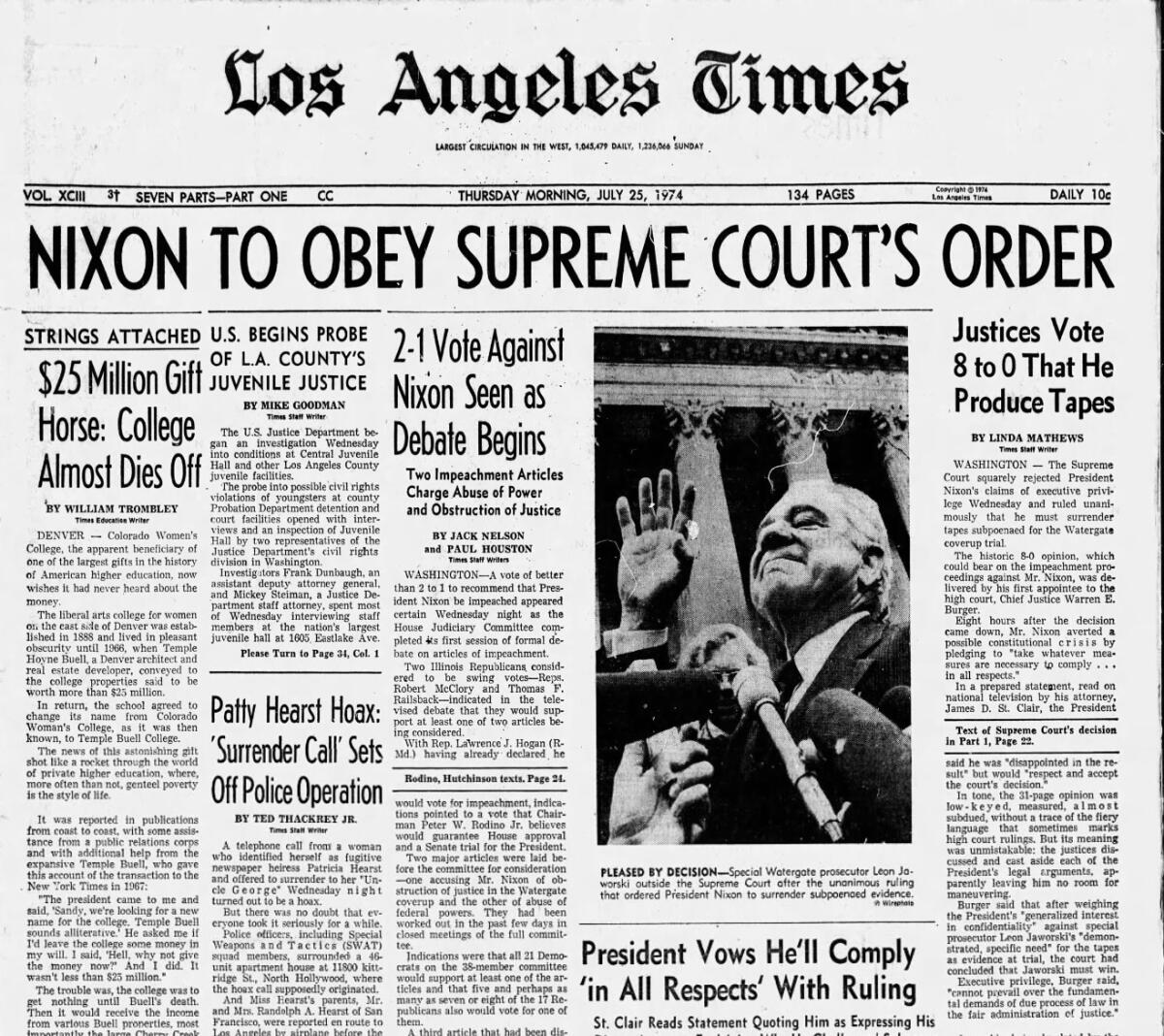
On this day in history, the Supreme Court voted 8 to 0 that President Nixon had to turn over transcripts of the Watergate tapes to Special Counsel Leon Jaworski.
Have a great day, from the Essential California team.
Ryan Fonseca, reporter
Defne Karabatur, fellow
Andrew Campa, Sunday reporter
Kevinisha Walker, multiplatform editor and Saturday reporter
Christian Orozco, assistant editor
Stephanie Chavez, deputy metro editor
Karim Doumar, head of newsletters
Check our top stories, topics and the latest articles on latimes.com.



Massive fire erupts at Boyle Heights cold storage facility
The blaze began on the roof’s solar panels before an interior ammonia leak and explosions forced rare, defensive aerial water drops on the 491,000-square-foot warehouse.
Fox – LA
A smoke advisory remains in place across Boyle Heights after a flare-up at a cold-storage warehouse fire, with officials urging residents to limit outdoor exposure as smoky conditions spread.
Public health officials warned Saturday that smoke from the South Los Palos Street blaze had drifted into surrounding neighborhoods, advising people to stay indoors, close windows, and avoid breathing in the smoke.
The blaze began shortly after 2:30 p.m. Wednesday at 1400 S. Los Palos St., and rapidly spread across the solar panels on the roof of the 491,000-square-foot warehouse, while an ammonia leak developed inside the building and thick smoke billowed into the air, prompting shelter-in-place orders for nearby residents and businesses.
LAFD officials said Saturday that crews spent the night working to prevent the fire from spreading to nearby homes and other units in the complex, including an adjacent cold storage facility.
“The good news is, all of our air monitoring that has been done by our department, Hazmat, LA County Hazmat, as well as AQMD, has shown that there are no additional toxic chemicals or hazards within that smoke other than normal structure fire smoke,” LAFD Capt. Branden Silverman said. “That said, no smoke is good smoke. We know that people are being affected by this in our city as well as LA County’s jurisdiction, and we do want you to take precautions to avoid that smoke whenever possible.”
This is a breaking news story. Check back later for more details.
Smoke advisory in effect; residents urged to limit exposure
The South Coast Air Quality Management District has extended a particle pollution advisory through at least midday Saturday as smoke from the fire continues to drift across Boyle Heights, East Los Angeles and nearby communities.
While shelter-in-place orders issued earlier in the week have been lifted, officials emphasized that smoky air remains a concern.
Fire officials said visible smoke may increase at times as crews continue suppression efforts, though there is no additional hazard beyond the smoke itself.
- Health guidance remains consistent:
- Use air purifiers or air conditioning if available
- Stay indoors with windows and doors closed
- Avoid outdoor activity, especially for sensitive groups
Fire reignites after wind shift; crews brace for ongoing flare-ups
The fire, which began Wednesday afternoon at a roughly 500,000-square-foot cold-storage facility, flared up again Friday evening after a shift in wind conditions, sending black and white smoke billowing into the sky.
Los Angeles Fire Department officials have described the incident as complex, warning the fire will likely “ebb and flow” due to deep-seated flames inside the structure and difficult access conditions.
Firefighters remain largely limited to exterior operations due to safety concerns inside the building, continuing to pour water onto the structure and targeting hotspots.
No injuries have been reported.
Shelters open as precaution; officials stress safety
Although there are no evacuation orders, officials have opened temporary shelters for residents seeking relief from smoke or uncomfortable conditions, according to a statement by Los Angeles County Board of Supervisors Chair Hilda Solis.
Shelters include:
- City Terrace Park, 1126 N. Hazard Ave.
- Pecan Recreation Center, 145 S. Pecan St.
Los Angeles County leaders said the sites were opened “out of an abundance of caution” as firefighting operations continue.
Residents are also being urged to:
- Monitor air quality alerts
- Keep pets indoors
- Wear masks if going outside
What caused the Boyle Heights fire?
Officials and the facility operator, Lineage Logistics, say the blaze appears to be linked to rooftop solar panels on the warehouse, though the exact cause remains under investigation.
The blaze spread across rooftop solar panels before firefighters discovered flames burning deep inside the cold‑storage areas, complicating containment efforts.
Fire officials noted that the structure’s size and layout — along with hazards such as stored equipment and limited access — have required unusual tactics, including the use of water-dropping helicopters typically used on wildfires.
Where is Boyle Heights?
Boyle Heights is a densely populated neighborhood just east of downtown Los Angeles, bordered by major freeways including the 101 and 5. It sits near East Los Angeles and is home to residential communities, schools, and industrial sites, including the cold-storage warehouse where the fire is burning.
City News Service contributed to this report.

A California man was arrested on suspicion of committing lewd acts and exploiting minors through online platforms.
The Santa Barbara County Sheriff’s Office identified the suspect as Edward “Eddie” Alessandro Zarate, 20, of Santa Maria.
On May 28, authorities began investigating Zarate over allegations that he was communicating with underage girls online and exchanging sexually explicit material with them.
Detectives later learned that Zarate allegedly communicated with minor victims through mobile phone apps such as Whipd, Purp, Wizz and Snapchat, along with exchanging text messages.
Zarate’s profiles appeared to portray him as a juvenile.
“Once he established communication with minors, he would often encourage them to move conversations off the platform and continue communicating via text message,” the sheriff’s department said. “During these conversations, Zarate would disclose his true age and identity.”
So far, authorities are aware of two female juveniles who have met with Zarate in person and reportedly engaged in lewd acts.
He is accused of communicating with minors in multiple states including California, Florida and Illinois. In California alone, detectives believe Zarate contacted minors from Los Angeles, Oxnard, Santa Barbara, San Diego, Santa Maria, Lompoc, Paso Robles, Nipomo, Arroyo Grande and San Francisco.
“Based on the scope of the investigation, detectives believe there may be additional survivors who have not yet been identified,” authorities said.
On June 10, Zarate was arrested and booked on multiple felony charges including oral copulation with a person under 18 years of age, unlawful sexual intercourse with a minor, sending harmful matter to a minor, and two counts of possession of obscene material depicting a minor.
Anyone who may be a victim, has communicated with Zarate online or through text or has information on the case is asked to call Sheriff’s Detectives at 805-681-4150. Anonymous tips can be provided to the SBSD’s tipline at 805-681-4171 or online at SBSheriff.org.

Top universities reject Trump’s ‘compact’ over academic freedom
Massachusetts Institute of Technology, Brown University, University of Pennsylvania, and University of Southern California rejected Trump’s “compact.”
To the surprise of perhaps no Californians, several California universities appeared in the top rankings of the world’s best universities in the latest U.S. News and World Report rankings released on June 16.
Of the more than 2,250 worldwide research institutions that U.S. News & World Report evaluated for this list, six California universities ranked in the top 50 globally, with an even split among Northern and Southern California institutions.
The 2026 list includes universities from more than 100 countries, with the following countries receiving the most schools in the overall rankings:
- China: 409
- United States: 275
- India: 123
- United Kingdom: 93
- Japan: 86
Did your California alma mater appear among the top global universities?
U.S. News and World Report methodology
When determining a university’s placement on the list, U.S. News & World Report considered factors more relevant to research-oriented institutions than to undergraduate-focused metrics like bachelor’s degree graduation rates.
It focused on aspects like academic institutions’ research and reputation, number of publications, the quality of publications and citations. It considers other factors, including location, campus culture, the strength of particular programs, and cost, which are also very important.
“For students seeking universities with strong academic excellence and global recognition, the Best Global Universities rankings offer an essential comparative resource,” said LaMont Jones, Ed.D., managing editor for Education at U.S. News.
“Our methodology focuses on a school’s research mission and scholarly impact, helping students identify institutions that are truly at the forefront of global knowledge creation.”
Out of the top 10 global universities, two California institutions made the list:
- Harvard University
- Massachusetts Institute of Technology (MIT)
- Stanford University
- University of Oxford
- University of Cambridge
- Tsinghua University
- University of California Berkeley
- Yale University
- University College London
- Columbia University
How did California colleges rank in U.S. News and World Report’s Best Global Universities 2026 list?
Outside of the top 10 universities, California saw a handful of other institutions rank highly on U.S. News & World Report list.
Notably, the University of California – Los Angeles just missed the top 10 list, ultimately ranking as the 11th-best global university and the second-best public institution on the list. It was beaten out as the best public institution by its academic counterpart, the University of California, Berkeley, which was ranked the 7th-best global university.
Additionally, a number of University of California schools made the top of the list, ultimately reaffirming the quality of the institutions’ public campuses across the state.
“Research from the University of California is vital to work that benefits all Americans, from breakthroughs in the treatment of Parkinson’s to the science behind previously unimagined successes in fighting cancer and the development of quantum computers that will enable the critical advances of the 21st century,” the University of California said in a press release about its rankings.
Here’s the list of California universities that made the top 100 list:
- 3. Stanford University
- 7. University of California Berkeley
- 11. University of California – Los Angeles
- 22. University of California – San Francisco
- 23. (Tied) California Institute of Technology
- 23. (Tied) University of California – San Diego
- 74. University of Southern California
- 95. University of California – Davis
- 99. University of California – Irvine
- 100. University of California – Santa Barbara
Noe Padilla is a Northern California Reporter for USA Today. Contact him at npadilla@usatodayco.com, follow him on X @1NoePadilla or on Bluesky @noepadilla.bsky.social. Sign up for the TODAY Californian newsletter or follow us on Facebook at TODAY Californian.
-

 Kentucky35 seconds ago
Kentucky Colonels executive to speak at Florence Rotary Club on Monday, public welcome to register
-
Louisiana4 minutes ago
Louisiana Lottery Powerball, Pick 3 results for June 20, 2026
-
 Maine9 minutes ago
You drew a Maine moose permit. Here’s what to do right now.
-

 Maryland16 minutes ago
Maryland Gov. Moore champions the spirit of Juneteenth and togetherness at AFRAM 50
-

 Michigan19 minutes ago
Insider: Shaky polls cause uproar in Michigan Senate, governor races
-

 Massachusetts23 minutes ago
Swimmer pulled from Houghton’s Pond after search
-

 Minnesota31 minutes ago
Aurora clinches division championship with 4-1 win over River Light
-

 Mississippi33 minutes ago
Mississippi Lottery Mississippi Match 5, Cash 3 results for June 20, 2026

