California
California regulators propose plan that could close Aliso Canyon. Or is it just 'kicking the can'?

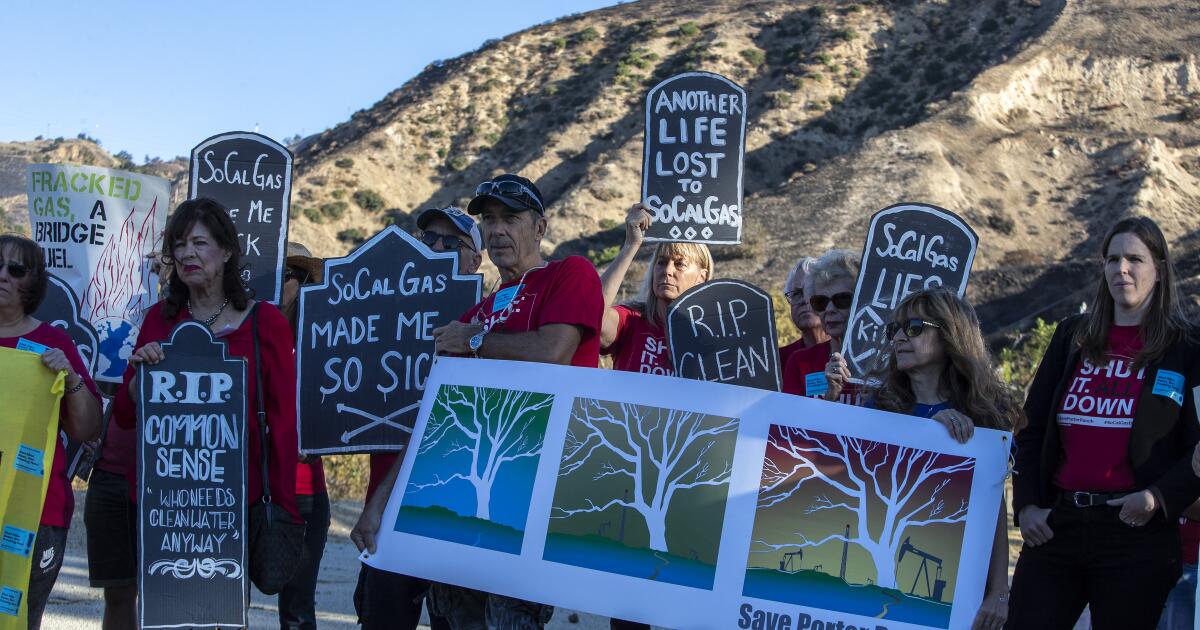
The California Public Utilities Commission this week unveiled a proposal that could potentially close the Aliso Canyon gas storage field in the coming years, but local activists and politicians say it doesn’t provide a fast or clear enough timeline to shut down the site of the largest natural gas leak in American history.
Residents in Porter Ranch and surrounding San Fernando Valley communities have been clamoring to close the Southern California Gas Co.-owned site ever since the leak took place over a four-month period in late 2015 and early 2016. The disaster spewed about 100,000 tons of methane and other chemicals into the air, forcing more than 8,000 families to flee their homes, with many reporting headaches, nosebleeds and nausea.
On Wednesday, the CPUC unveiled a proposed decision regarding the future of Aliso Canyon. The plan, which will be discussed at the commission’s Dec. 19 meeting, calls for moving ahead with potentially closing the site once Southern California’s demand for natural gas declines to a level at which peak demand can be served without Aliso Canyon.
Demand is expected to continue its downward trajectory in the coming years as California increases its utilization of renewable energy sources.
The CPUC proposes initiating proceedings to review and potentially close the facility once the peak demand forecast for two years out decreases to 4,121 million metric cubic feet per day — and a biennial assessment shows that doing so would not jeopardize natural gas reliability or reasonable rates. Current peak demand forecast is 4,618 million metric cubic feet per day, and that is expected to drop to 4,197 million in 2030, according to a CPUC information sheet.
“We continue to review the decision but share the commission’s view that Aliso Canyon is a necessary part of California’s energy infrastructure today,” SoCalGas spokesperson Chris Gilbride said in a statement Friday.
Several politicians who represent Porter Ranch and support closing Aliso Canyon said they are frustrated by what they see as a lack of urgency and clarity around when the site will realistically cease operation.
“The optimism part is that there is a path to shut it down,” Assemblywoman Pilar Schiavo (D-Chatsworth) said in a phone interview. “The skeptical side, however, is there really is no timeline. It’s unclear.”
State Sen. Henry Stern (D-Calabasas) said he wants the CPUC to provide evidence for why a gradual timeline is in the public’s best interest.
“The burden is on the CPUC to prove to the public that this proposal to extend the life of Aliso Canyon is not just a give away to the SoCalGas Company at the expense of the community,” he said in a statement on X.
Los Angeles County Supervisor Lindsey Horvath called the draft decision “unacceptable” in a statement, and said it “fails to prioritize the health and wellbeing of a community that bore the brunt of the worst natural gas leak in American history.”
“My position is unchanged: We need a clear end date and plan for full closure,” she said.
This sentiment was echoed by Matt Pakucko, the president of the advocacy group Save Porter Ranch, which has fought to close the storage facility since shortly after the leak.
He said the commission was “kicking the can down the road” with its proposed biennial assessment process.
“They’re checking every two years instead of immediately closing down the facility as residents and our group have been asking for for years,” Pakucko said.
The company has a contentious relationship with the Porter Ranch community and, in the aftermath of the leak, faced a litany of lawsuits alleging it knew about issues at the site and failed to address the problems. Firefighters also filed suits alleging that the company failed to inform them about the extent of their exposure to harmful chemicals when responding to the leak.
In 2016, SoCalGas pleaded no contest to a misdemeanor count of failing to immediately report the gas leak and, in 2021, agreed to pay up to $1.8 billion to settle the claims of more than 35,000 victims.
Since then, the company has implemented a number of safety improvements at Aliso Canyon as part of various legal settlements and agreements with government agencies.
This includes installing an infrared methane monitoring system, having a state agency complete safety tests on all 114 wells, hiring employees to operate new leak-detection systems 24 hours a day, adopting new reporting policies for releases of hazardous materials and increasing employee safety training.
Pakucko said he places the blame for the gas facility’s continual use on Gov. Gavin Newsom.
“This isn’t an energy issue, it’s a health issue,” Pakucko said.
In 2019, Newsom called on the CPUC to look into accelerating the facility’s permanent shutdown. But in 2023, his appointees to the CPUC voted 5-0 in favor of allowing SoCalGas to store far more fuel at the site to help bring down gas rates.
In a 2023 email, Newsom spokesperson Alex Stack said the governor “appreciates the [Public Utilities Commission’s] efforts to maintain affordable and reliable energy for ratepayers, and he continues to encourage the commission to expedite their work to permanently close the facility as part of California’s transition away from fossil fuels.”
Rising natural gas costs were a big issue last winter when SoCalGas said the average bill for its 21.8 million customers in January 2023 was about $300, more than twice the average of January 2022.
The company blamed unusually cold winter weather and constraints on pipelines and gas storage facilities for the spike in prices. Others blamed the company for mismanaging its inventory and increasing exports to Europe to take advantage of high prices due to the Russia-Ukraine war.



Rob Bonta, California’s attorney general, said his office will investigate a possible merger between Paramount Skydance and Warner Bros Discovery, hours after Netflix backed away from a planned takeover.
“Paramount/Warner Bros is not a done deal,” Bonta said in a post on X. “These two Hollywood titans have not cleared regulatory scrutiny — the California Department of Justice has an open investigation, and we intend to be vigorous in our review.”
Any acquisition of Warner Bros would require approval from regulators in the United States and Europe, including the US justice department’s antitrust division. The deal Paramount struck for Warner is valued at nearly $111bn.
The merger poses a risk for California’s economy. Paramount’s bid is likely to raise concerns about job cuts in the state, which also dogged Netflix’s bid. Paramount sees $6bn in cost “synergies” in the deal, which typically means massive layoffs, reducing the number of suppliers, squeezing existing contractors for better terms after the two companies merge or other reductions.
The chief executive of Paramount, David Ellison, said his company was pleased the Warner Bros board had “unanimously affirmed the superior value of our offer”, which he said delivered “WBD shareholders superior value, certainty and speed to closing”. Ellison is the son of Oracle co-founder Larry Ellison, a close ally of Donald Trump.
On Friday, Warner Bros Discovery reportedly agreed to be acquired by Paramount Skydance. Reuters and Deadline reported that the deal was announced in a global town hall by the company. Paramount and Warner Bros did not immediately confirm the deal to the Guardian.
A merger between the two media giants is also facing backlash from several lawmakers. Senator Elizabeth Warren, a key voice against growing monopolies, echoed Bonta’s concerns after Netflix walked away from the deal on Thursday, and noted that Netflix CEO Ted Sarandos was seen at the White House shortly before the company said it would bow out of the deal.
“A Paramount Skydance-Warner Bros merger is an antitrust disaster threatening higher prices and fewer choices for American families,” Warren said in a statement. “What did Trump officials tell the Netflix CEO today at the White House? A handful of Trump-aligned billionaires are trying to seize control of what you watch and charge you whatever price they want.”
The senator added: “With the cloud of corruption looming over Trump’s Department of Justice, it’ll be up to the American people to speak up and state attorneys general to enforce the law.”
On Friday, Bonta responded to concerns about the merger posted by actor Mark Ruffalo.
“Please let’s circle up all the State AG’s and talk about how this is going to kill completion in the industry and drive down wages, and product quality for consumers,” Ruffalo posted.
“There are lots of agents in Hollywood who can tell you how past mergers and consolidations have hurt their clients and business. There is lots of talent that can tell you the same.”
Bonta reposted the actor’s comments, responding that he is in “conversation with my AG colleagues about Paramount/Warner Bros”.
The California department of justice did not immediately respond to a request for comment from the Guardian.
The Writers Guild of America, the union representing thousands of television and film writers along with other media workers, has said a Paramount takeover of Warner Bros would hurt jobs.
Warner Bros canceled $2bn in content after merging with Discovery in 2022, and Paramount’s recent merger with Skydance led to 1,000 layoffs, the union said in written testimony to the US Senate.
California
Amid angry backlash, serial child molester is rearrested the same day he was set to be paroled

Following major backlash about the scheduled release of a serial child molester through California’s elderly parole program, the 64-year-old is now facing new charges that could keep him behind bars.
News that David Allen Funston was set to be freed was met by outrage among victims, politicians and others. The former Sacramento County district attorney who prosecuted Funston said she was strongly opposed to his release: “This is one I’m screaming about.”
Funston, granted parole earlier this month, was set to be released on Thursday from state prison — but was rearrested that same day on new charges from a decades-old, untried case. The charges he’s facing are from a 1996 case in which he is accused of sexually assaulting a child in Roseville, according to the Placer County district attorney’s office.
In 1999, he was convicted of 16 counts of kidnapping and child molestation and had been serving three consecutive sentences of 25 years to life and one sentence of 20 years and eight months at the California Institution for Men in Chino. The sentences followed a string of cases out of Sacramento County in which prosecutors said Funston lured children under the age of 7 with candy and, in at least one case, a Barbie doll to kidnap and sexually assault them, often under the threat of violence.
He was described by a judge at his sentencing hearing as “the monster parents fear the most.”
Prosecutors in Placer County, at the time, decided not to pursue the case against Funston in Roseville given the severity of the sentences he received in Sacramento County.
But given his scheduled release from state prison, prosecutors decided to file new charges against him. Placer County Dist. Atty. Morgan Gire said “changes in state law and recent parole board failures” led to his improper release.
“This individual was previously sentenced to multiple life terms for extremely heinous crimes,” Gire said in a statement. “When changes in the law put our communities at risk, it is our duty to re-evaluate those cases and act accordingly. David Allen Funston committed very real crimes against a Placer County child, and the statute of limitations allows us to hold him accountable for those crimes.”
He is now being held without bail in the Placer County jail, booked on suspicion of lewd and lascivious acts against a child, according to prosecutors. Funston’s attorney, Maya Emig, said she had only recently learned about his arrest and hadn’t yet had time to fully review the matter.
But she noted that she believes “in the justice system and the rule of law.”
Emig called the Board of Parole Hearings’ decision to grant Funston elderly parole “lawful and just.”
California’s elderly parole program generally considers the release of prisoners who are older than 50 and have been incarcerated for at least 20 continuous years, considering whether someone poses an unreasonable risk to public safety.
In Funston’s case, commissioners said they did not believe Funston posed a significant danger because of the extensive self-help, therapy work and sex offender treatment classes he completed, as well as his detailed plan to avoid repeating his crimes, the remorse he expressed and his track record of good behavior in prison, according to a transcript from the Sept. 24 hearing.
At the hearing, Funston called himself a “selfish coward” for victimizing young children, and said he was “disgusted and ashamed of my behavior and have great remorse for the harm I caused my victims, their families in the community of Sacramento.”
“I’m truly sorry,” he said.
But victims of his crimes, as well as prosecutors and elected leaders have questioned the parole decision and called for its reversal.
“He’s one sick individual,” a victim of Funston’s violence told The Times. “What if he gets out and and tries to find his old victims and wants to kill us?”
A spokesperson for Gov. Gavin Newsom said the governor also did not agree with Funston’s release and had asked the board to review the case. However, Newsom has no authority to overturn the parole decision.
Some state lawmakers also cited Funston’s case as evidence that California’s elderly parole program needs reform, recently introducing a bill that would exclude people convicted of sexual crimes from being considered by the process.

Thursday, February 26, 2026 7:21PM

BIG BEAR, Calif. — Stunning video shows a skier in Southern California hanging off a ski lift in Big Bear as two others held her by her arms.
The incident happened Tuesday. Additional details about the incident were not available.
At last check, the video had been viewed more than 13 million times on Instagram.
It appears the skier made it to the unloading area unscathed, thanks to her ski lift buddies.
Copyright © 2026 KABC Television, LLC. All rights reserved.

Delaware history in News Journal March 1-7: Fire rescue, power rate jump

Golf roundup: Austin Smotherman plays ‘boring, simple’ to expand lead in Florida

Ga. lawmakers propose changes to state’s early voting process

No. 3 Rainbow Warriors continue winning ways against No. 6 BYU | Honolulu Star-Advertiser

Town Hall to address future of Medicaid expansion in Idaho – Local News 8

Florida High School Football Rankings: Top 25 teams – Oct. 21

Cleary's 21 help Le Moyne down Central Connecticut State 69-64 in OT

How old is Bo Nix? What to know about Oregon quarterback ahead of 2024 NFL Draft

99th annual Pony Swim held in Virginia

Indiana Members Credit Union announced as new anchor tenant at Bottleworks District

ICE blasts Washington mayor over directive restricting immigration enforcement

Did the EU bypass Hungary’s veto on Ukraine’s €90 billion loan?

How the federal government is painting immigrants as criminals on social media

Where Iran’s ballistic missiles can reach — and how close they are to the US

Has India’s influence in Afghanistan grown under the Taliban?
-

 World2 days ago
Exclusive: DeepSeek withholds latest AI model from US chipmakers including Nvidia, sources say
-

 Massachusetts3 days ago
Mother and daughter injured in Taunton house explosion
-

 Montana1 week ago
2026 MHSA Montana Wrestling State Championship Brackets And Results – FloWrestling
-

 Louisiana5 days ago
Wildfire near Gum Swamp Road in Livingston Parish now under control; more than 200 acres burned
-

 Denver, CO2 days ago
10 acres charred, 5 injured in Thornton grass fire, evacuation orders lifted
-

 Technology7 days ago
YouTube TV billing scam emails are hitting inboxes
-

 Technology7 days ago
Stellantis is in a crisis of its own making
-

 Politics7 days ago
OpenAI didn’t contact police despite employees flagging mass shooter’s concerning chatbot interactions: REPORT