California
California regulators propose plan that could close Aliso Canyon. Or is it just 'kicking the can'?

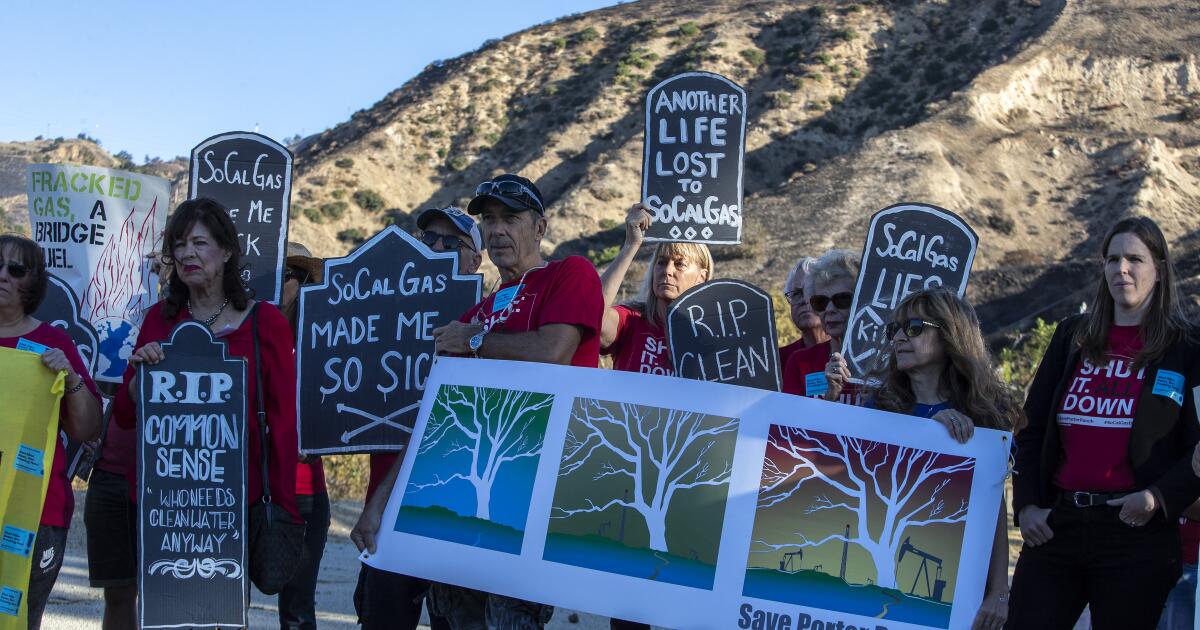
The California Public Utilities Commission this week unveiled a proposal that could potentially close the Aliso Canyon gas storage field in the coming years, but local activists and politicians say it doesn’t provide a fast or clear enough timeline to shut down the site of the largest natural gas leak in American history.
Residents in Porter Ranch and surrounding San Fernando Valley communities have been clamoring to close the Southern California Gas Co.-owned site ever since the leak took place over a four-month period in late 2015 and early 2016. The disaster spewed about 100,000 tons of methane and other chemicals into the air, forcing more than 8,000 families to flee their homes, with many reporting headaches, nosebleeds and nausea.
On Wednesday, the CPUC unveiled a proposed decision regarding the future of Aliso Canyon. The plan, which will be discussed at the commission’s Dec. 19 meeting, calls for moving ahead with potentially closing the site once Southern California’s demand for natural gas declines to a level at which peak demand can be served without Aliso Canyon.
Demand is expected to continue its downward trajectory in the coming years as California increases its utilization of renewable energy sources.
The CPUC proposes initiating proceedings to review and potentially close the facility once the peak demand forecast for two years out decreases to 4,121 million metric cubic feet per day — and a biennial assessment shows that doing so would not jeopardize natural gas reliability or reasonable rates. Current peak demand forecast is 4,618 million metric cubic feet per day, and that is expected to drop to 4,197 million in 2030, according to a CPUC information sheet.
“We continue to review the decision but share the commission’s view that Aliso Canyon is a necessary part of California’s energy infrastructure today,” SoCalGas spokesperson Chris Gilbride said in a statement Friday.
Several politicians who represent Porter Ranch and support closing Aliso Canyon said they are frustrated by what they see as a lack of urgency and clarity around when the site will realistically cease operation.
“The optimism part is that there is a path to shut it down,” Assemblywoman Pilar Schiavo (D-Chatsworth) said in a phone interview. “The skeptical side, however, is there really is no timeline. It’s unclear.”
State Sen. Henry Stern (D-Calabasas) said he wants the CPUC to provide evidence for why a gradual timeline is in the public’s best interest.
“The burden is on the CPUC to prove to the public that this proposal to extend the life of Aliso Canyon is not just a give away to the SoCalGas Company at the expense of the community,” he said in a statement on X.
Los Angeles County Supervisor Lindsey Horvath called the draft decision “unacceptable” in a statement, and said it “fails to prioritize the health and wellbeing of a community that bore the brunt of the worst natural gas leak in American history.”
“My position is unchanged: We need a clear end date and plan for full closure,” she said.
This sentiment was echoed by Matt Pakucko, the president of the advocacy group Save Porter Ranch, which has fought to close the storage facility since shortly after the leak.
He said the commission was “kicking the can down the road” with its proposed biennial assessment process.
“They’re checking every two years instead of immediately closing down the facility as residents and our group have been asking for for years,” Pakucko said.
The company has a contentious relationship with the Porter Ranch community and, in the aftermath of the leak, faced a litany of lawsuits alleging it knew about issues at the site and failed to address the problems. Firefighters also filed suits alleging that the company failed to inform them about the extent of their exposure to harmful chemicals when responding to the leak.
In 2016, SoCalGas pleaded no contest to a misdemeanor count of failing to immediately report the gas leak and, in 2021, agreed to pay up to $1.8 billion to settle the claims of more than 35,000 victims.
Since then, the company has implemented a number of safety improvements at Aliso Canyon as part of various legal settlements and agreements with government agencies.
This includes installing an infrared methane monitoring system, having a state agency complete safety tests on all 114 wells, hiring employees to operate new leak-detection systems 24 hours a day, adopting new reporting policies for releases of hazardous materials and increasing employee safety training.
Pakucko said he places the blame for the gas facility’s continual use on Gov. Gavin Newsom.
“This isn’t an energy issue, it’s a health issue,” Pakucko said.
In 2019, Newsom called on the CPUC to look into accelerating the facility’s permanent shutdown. But in 2023, his appointees to the CPUC voted 5-0 in favor of allowing SoCalGas to store far more fuel at the site to help bring down gas rates.
In a 2023 email, Newsom spokesperson Alex Stack said the governor “appreciates the [Public Utilities Commission’s] efforts to maintain affordable and reliable energy for ratepayers, and he continues to encourage the commission to expedite their work to permanently close the facility as part of California’s transition away from fossil fuels.”
Rising natural gas costs were a big issue last winter when SoCalGas said the average bill for its 21.8 million customers in January 2023 was about $300, more than twice the average of January 2022.
The company blamed unusually cold winter weather and constraints on pipelines and gas storage facilities for the spike in prices. Others blamed the company for mismanaging its inventory and increasing exports to Europe to take advantage of high prices due to the Russia-Ukraine war.

California
Mother, daughter found ‘alive and well’ after going missing on Southern California hiking trail

A mother and daughter who went missing after going for a hike on a difficult trail in San Bernardino County’s San Gorgonio Wilderness have been found “alive and well,” the sheriff’s department announced Friday.
The San Bernardino County Sheriff’s Department told KTLA they were uninjured and “walked out on their own.”
Krystal Meyers, 41, and her daughter Alexis Meyers Martinez, 21, were hiking on the Vivian Creek Trail Thursday but didn’t return, according to the San Bernardino County Sheriff’s Department.
They were last known to be at the 10,300-foot elevation mark above the High Creek switchbacks at 11 a.m., according to the San Gorgonio Search and Rescue team.
The Vivian Creek Trail is widely considered one of the more strenuous and hazardous routes in the San Gorgonio Wilderness.
The U.S. Forest Service says it’s the shortest and steepest route to the summit of Mount San Gorgonio and requires experienced mountaineering skills.
Officials did not provide any further details about the circumstances surrounding their disappearance.

BAKERSFIELD, Calif. (KBAK/KBFX) — The California Highway Patrol is urging drivers to stay focused on the road as they head out for Fourth of July celebrations.
The holiday weekend can be a dangerous time on our roads as millions of drivers are expected to travel.
CHP Officer Jorge Toro joined Eyewitness News Mornings to share how drivers can stay safe behind the wheel.
Officer Toro also highlighted the importance of sober driving over the holiday.
BE THE FIRST TO COMMENT
He says anyone hosting a party should make sure all of their guests get home safely, ensuring anyone who may be impaired doesn’t drive.

California is returning a stretch of rugged Mendocino County coast to the Indigenous nations whose ancestors once stewarded its shores.
State transportation officials recently approved the transfer of Blues Beach and the surrounding bluffs to Kai Poma, a nonprofit founded by representatives of the Sherwood Valley Band of Pomo Indians, Round Valley Indian Tribes and Coyote Valley Band of Pomo Indians.
The transfer of 136 acres just south of the community of Westport will mark the first time land managed by the California Department of Transportation has been returned to Indigenous tribes.
“This is beyond huge,” said J. Carlos Rivera, tribal chairman of the Sherwood Valley Band of Pomo Indians. “It’s enormous from our tribal perspective that we are basically obtaining the land that our people once lived on before colonization.”
California purchased the swath of rocky cliffs and windswept shoreline in the 1960s to expand the construction of Highway 1 and create a scenic viewpoint for highway travelers, according to a California Coastal Commission report.
More recently, public access has been largely unregulated, and summer weekends and holidays have drawn large groups who camp and party on the beach, at times driving through sensitive areas, damaging cultural sites and leaving behind trash, the report states.
Kai Poma plans to conduct cultural and archaeological resource studies and environmental surveys and then prepare a resource management plan for the property, according to planning documents. The nonprofit and the Coastal Commission have drafted a public access management plan that states the land will be open from sunrise to sunset.
Rivera described the entire property as a sacred site. The coastal waters are used by tribal people for seaweed and abalone gathering, and the shores host youth cultural camps, he said. “Protecting the land, it has a deeper meaning for us because we’re connected to the land,” he said.
The effort to acquire the land took years — and required a change in state law. Caltrans lacked the ability to transfer land to tribal governments until 2021, when Gov. Gavin Newsom signed a bill sponsored by state Sen. Mike McGuire (D-Healdsburg) that enabled the transfer, according to a news release issued at the time. The law also bars commercial activity on the property and requires public access be maintained.
“With 136 acres now officially transferred into tribal stewardship, one of the most spectacular stretches of the Mendocino Coast will be forever protected,” McGuire said in a statement.
“This agreement, the first of its kind in California, gives these three dynamic Native American tribes the rightful opportunity to reclaim sacred lands and cultural traditions on this special piece of earth. And it’s about damn time.”
The land transfer cleared its last regulatory hurdle June 26 with the approval by the California Transportation Commission, said Neil Thapar, an attorney who works as an advisor and legal consultant to Kai Poma. Caltrans staff will next record the deed transferring the title from the state of California to Kai Poma, which is expected to happen any day, he said.
-

 Indiana4 minutes ago
Storm chance late on the Fourth, then heat tones down early next week | July 4, 2026
-

 Iowa7 minutes ago
Storm puts a pause to Savannah Bananas game at Kinnick Stadium
-
 Kansas12 minutes ago
Colombia fans in Kansas City celebrated victory Friday over Ghana in the Round of 32 World Cup match
-

 Kentucky19 minutes ago
Kentucky Democratic Senate candidate says voters deserve ‘honest answer’ about McConnell’s health
-

 Louisiana20 minutes ago
Louisiana Supreme Court recalls Liz Murrill’s arrest warrant in late-night emergency ruling
-

 Maine27 minutes ago
Where did Maine’s 24/7 restaurants go?
-

 Maryland34 minutes ago
Maryland Lottery Mega Millions, Pick 3 results for July 3, 2026
-

 Michigan37 minutes ago
What to know about cyclosporiasis as Michigan health officials investigate 300+ cases in outbreak

