West
California wildfires: Suspect arrested in connection with brush fire quickly quashed by firefighters

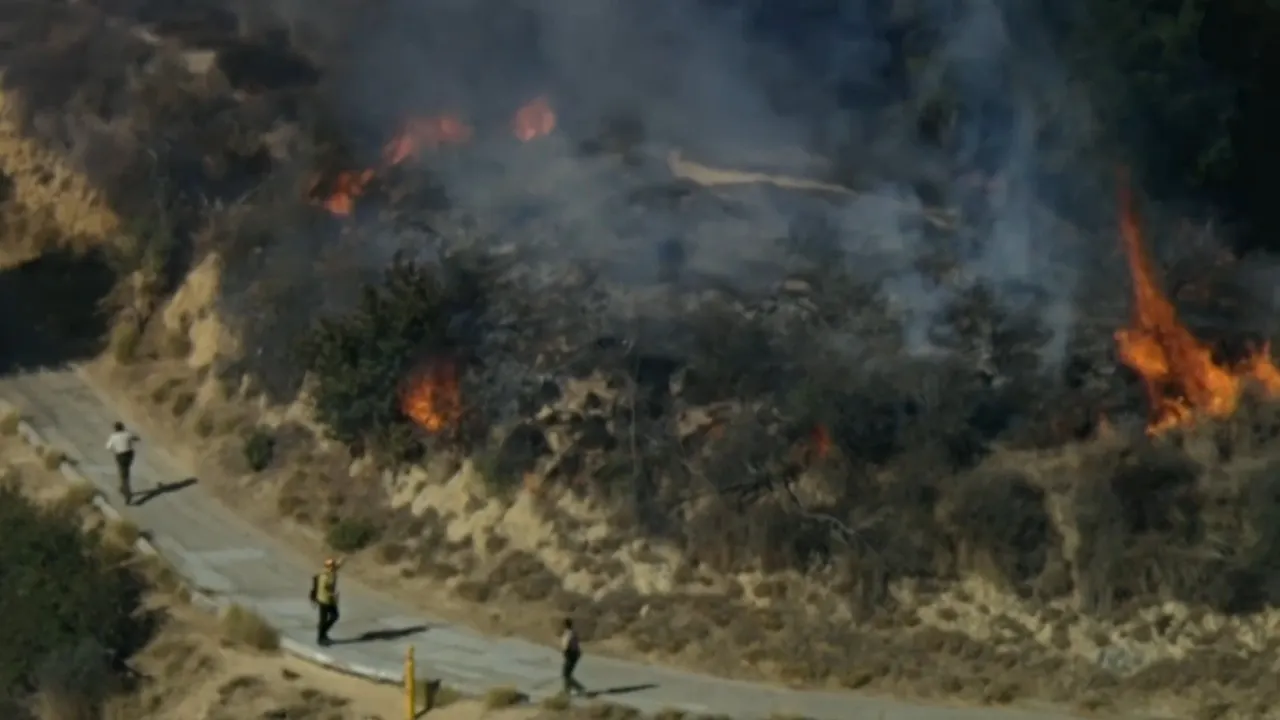
Los Angeles authorities arrested a man after a brush fire broke out Monday afternoon in the Griffith Park neighborhood.
Kevin Caledron, 26, faces two misdemeanor charges of tampering with a vehicle after authorities responded to reports of a possible arson incident off the 2700 block of Glendower Avenue on Monday around 1 p.m., a Los Angeles Police Department spokesperson told Fox News Digital.
County records show Caledron is being held on $30,000 bond.
LAPD and Los Angeles Fire Department officials quickly put out the brush fire near the Griffith Observatory after it was reported, according to FOX 11 Los Angeles.
LA WILDFIRES REKINDLE ‘ECO-TERROR’ ARSON SUSPECT MANHUNT AFTER FAKE FIREFIGHTERS ARRESTED
A suspect has been arrested in connection with a brush fire that broke out Monday in the Griffith Park area of Los Angeles. (FOX 11 Los Angeles)
A witness reportedly alerted the LAPD to a man who appeared to be homeless setting a fire in the area, but an LAPD spokesperson told Fox News Digital Caledron is not facing any arson charges. It is unclear exactly how Caledron’s vehicle-tampering charges are related to the fire.
The LAPD and LA County Sheriff’s Department have made dozens of arrests in evacuation zones since destructive wildfires erupted across the area earlier this month, killing 27 people so far.
COUPLE WITH FAKE FIRETRUCK BUSTED FOR IMPERSONATING FIREFIGHTERS NEAR PALISADES FIRE IN LA: SHERIFF
The LAPD and Los Angeles Fire Department officials quickly put out the brush fire near the Griffith Observatory after it was reported, according to FOX 11 Los Angeles. (FOX 11 Los Angeles)
Charges against those arrested amid the ongoing wildfires include arson, looting and price gouging, among other crimes.
“These are the people who are seeking to exploit this tragedy for their own benefit,” Los Angeles County District Attorney Nathan Hochman said during a Monday press conference. “These are people who have engaged in looting and arson. We’ve also investigated price gouging and will be investigating internet scams and the like.”
LOS ANGELES WILDFIRES: ARMED HOMEOWNERS PATROL FOR LOOTERS INSIDE EVACUATION ZONE
The LAPD and LA County Sheriff’s Department have made dozens of arrests since destructive wildfires erupted across the area earlier this month, killing 27 people so far. (FOX 11 Los Angeles)
One such arson suspect, Jose Carranza-Escobar, was arrested last week. Escobar, who is homeless, is accused of attempting to light a large tree on fire that had fallen to the ground at Pioneer Park. He was seen “standing next to the flames” and was promptly detained, police said at the time of his arrest.
The 27 people who have died in the California wildfires so far include 10 who lost their lives in the Palisades Fire and 17 who died in the Eaton Fire.
Fox News’ Louis Casiano contributed to this report.
Read the full article from Here


Blink, and you might miss it.
Adobe Falls isn’t Niagara Falls — or anything close — but after winter rains, a seasonal waterfall briefly appears in a narrow Del Cerro canyon, hidden beneath streets, homes, and San Diego State University property.
The waterfall forms along Alvarado Creek, which drains parts of eastern San Diego, including the SDSU area and surrounding neighborhoods. In wet months, runoff moves through a steep canyon and drops over a short rock ledge known locally as Adobe Falls. In dry periods, the flow often fades to a trickle or disappears entirely, leaving exposed sandstone and a shaded canyon bed.
What makes the site stand out is its setting. Above the canyon are Del Cerro residential streets and university property tied to San Diego State. Below it, Alvarado Creek continues west as part of the Mission Valley watershed, eventually feeding into the San Diego River system. Like many urban drainages in San Diego, its flow is shaped by stormwater runoff, paved surfaces, and altered drainage patterns tied to development.

Access is restricted. The canyon sits on a mix of SDSU and city-managed land and has long been closed to the public due to safety concerns, including steep terrain, erosion, and unstable footing after rain. Although widely referenced in maps and online posts, it is not an official trail or recreation site.
The canyon itself pre-dates modern development in Del Cerro. It is part of a broader network of inland waterways and canyon corridors used for thousands of years by the Kumeyaay, whose presence shaped movement and settlement patterns across the region.
In the mid-20th century, as Del Cerro developed, homes and roads were built along canyon rims rather than through them, leaving Alvarado Creek intact as a drainage system. Adobe Falls remained within that corridor even as surrounding hillsides filled with residential and institutional development.
Today, Adobe Falls remains a small but persistent reminder that San Diego’s natural drainage systems still function within a heavily built environment — appearing briefly after storms, then receding back into the canyon until the next rain.
Read more history stories here, and do you have a story to tell? Send an email to DebbieSklar@cox.net.
Sources:
City of San Diego – Stormwater & Watershed Division (Alvarado Creek / Mission Valley watershed)
San Diego State University – planning and environmental impact documentation for adjacent canyon areas
U.S. Geological Survey (USGS) – San Diego County watershed and hydrology mapping (Alvarado Creek / San Diego River system context)
San Diego History Center – Kumeyaay regional land use and inland canyon corridor history
City of San Diego Planning Department – land use records and access restrictions for Adobe Falls area
California State Historic Landmark files – Adobe Falls (Landmark No. 80)

For months, high-ranking Russian officials insisted that a path to ending the war in Ukraine – largely on Moscow’s maximalist terms – had been decided at a meeting between President Vladimir Putin and President Donald Trump last August in Anchorage. Only Ukraine’s intransigence stood as an obstacle.
But that narrative has unraveled – perhaps because the only way to get the United States to help broker a new deal is admitting there never was a previous one.
In recent days, three top Russian officials accused the White House of not honoring the Alaska agreement. Foreign Minister Sergei Lavrov even speculated that the summit was a U.S. “ploy to buy time to rearm the Kyiv regime.”
Secretary of State Marco Rubio, however, pushed back. “If there had been an agreement, we would have had an end of the war,” Rubio told reporters.
“Russia wants the entirety of Donetsk to be turned over to them, among some other things,” he said, explaining Russia’s demand for more Ukrainian territory.
After days of back-and-forth, Putin conceded the point, saying on Sunday that “there were indeed no agreements reached in Anchorage.”
“The spirit of Anchorage – although it wasn’t expressed in any formal documents, and no one put any signatures down – in Anchorage we discussed certain possibilities for ending the crisis in Ukraine,” Putin told a state television reporter Sunday. “And the compromises discussed were precisely the proposals the American side made to us.”
The contradictions started in Alaska immediately after the summit. Putin said an agreement that will “pave the path toward peace in Ukraine” was reached, while Trump said that while the meeting was “extremely productive … there’s no deal until there’s a deal.” Trump also told Fox News afterward that it was “up to Zelensky” now to get a deal done, referring to Ukrainian President Volodymyr Zelensky.

The Russian leader’s decision now effectively to bury the Alaska summit, which the Kremlin and its propagandists had mythologized as a turning point, comes as Russian forces are largely stalled on the battlefield in Ukraine – a sharp change from the previous four summers when they made gains.
Instead, the skies over Russia and the Ukrainian territory it occupies are increasingly crowded with advanced Ukrainian drones, signaling a new phase in which Russia is playing technological catch-up and regular Russian citizens are feeling the war intrude on their lives with gasoline shortages and disruptions to summer travel, including to occupied Crimea.
Russian political analysts have interpreted the indirect spat between Rubio and Lavrov over the alleged deal as a sign that Ukraine has convinced Trump it can keep fighting – and that it can pose a serious threat to Crimea, which Russia illegally annexed in 2014, rather than surrendering the Donbas region, as Russia has demanded.
Trump probably arrived in Anchorage believing that Ukraine’s defeat was inevitable and that the sooner it accepted terms, the better for everyone, Fyodor Lukyanov, a prominent foreign policy analyst who advises the Kremlin, wrote in an op-ed in a Russian publication.
“The goal of Kyiv and the collective Brussels was to convince Trump that the belief in Ukraine’s inevitable defeat was mistaken,” Lukyanov wrote. “Ten months after the Anchorage summit, they succeeded in persuading him.”
Since Alaska, no major breakthrough has materialized in Russia’s favor, Europe so far has managed to sustain its military and economic aid to Ukraine, and Trump has become distracted by Iran.
“Diplomacy in the midst of hostilities is shaped by their outcome,” Lukyanov wrote. “If the balance of power – or the perception thereof – shifts, the understandings reached at an earlier stage lose their validity.”
Ukraine’s push to impose a “logistical lockdown” on Crimea and Kyiv’s growing capability to strike deep inside Russia seem to be part of a 40-day blitz declared by Zelensky to “influence” Moscow to end the war.
Continuing that pressure, Ukraine overnight launched dozens of drones at the Moscow region and struck Russia’s Dubna satellite communications center north of the capital. Zelensky said Russia uses the Dubna site for reconnaissance and coordination of its military activities in Ukraine.
Andrei Vorobyov, governor of the Moscow region, confirmed the attack had occurred but said that an “administrative building was damaged by drone debris.”
Amid chaotic scenes in Crimea, the Russia-installed authorities imposed a state of emergency in response to strikes on highways and bridges. There have also been blackouts that have prompted many summer visitors to return home.
“He’s holding his own at least,” Trump said of Zelensky last week, speaking to reporters at the White House. “A lot of people dying on both sides, but I think he’s doing pretty well. You have to say he’s courageous, he’s got great equipment, he’s got great men, he’s got fighters.”
Ukraine seems to have scaled drone production to a level that can sustain strikes on Russian cities hundreds of miles from the border and that keeps the frontline kill zone stable. This means that ground action is drying up.
“The war has markedly changed this year,” said Ruslan Leviev, an analyst with the Conflict Intelligence Team, a group that uses open-source data to track the Russian military.
“It’s hard to say the battle initiative is on the Ukrainian side,” Leviev said, “but time is on Ukraine’s side – more problems keep arising for Russia, economically, politically and militarily, and it’s all adding up.”
Russian budget data indicates that its military recruited 71,216 men during the first quarter of 2026, compared with 89,601 over the same period last year, according to Janis Kluge, a Russia expert at the Berlin-based German Institute for International and Security Affairs.
Recruitment stabilized somewhat in the second quarter, returning to around 30,000 contracts per month. But local media reports suggest the overall stream of recruits has slowed compared with previous years as the pool of men drawn by the enormous pay packages that eclipse regional Russian salaries appears to be shrinking.
Rumors have circulated that Russia may declare a fresh mobilization after key parliamentary elections in the fall – the first since the war began – but politically that move could prove extremely costly for the Kremlin. The “partial mobilization” in 2022 drove tens of thousands of men to flee Russia. After four years of war, and mounting economic strain, the mood has soured considerably.
Leviev and other analysts said that they doubt Moscow would call for full mobilization, since this would require significant financial resources to set up new formations, and train and equip them, and that such a move fundamentally wouldn’t unfreeze the line of contact. “At this pace, the war on the ground looks to us as a dead end,” Leviev said.
This poses several challenges for Russia.
Russia still holds an advantage in manpower, conventional arms and ballistic missiles, which it continues to use against Ukrainian cities and infrastructure. But Ukraine’s relentless drone campaign, especially its use of medium-range drones, has chipped away at this advantage, complicating frontline logistics and driving up the costs for Moscow of supplying the front.
Russia’s flagship air defense systems were designed for high-altitude targets like jets and ballistic missiles, not slow, low-flying drones. Interceptor missiles also cost many times more than the drones they shoot down, draining stocks at a rate Western officials have said may be unsustainable.
In his remarks Sunday, Putin commented on the deteriorating situation in Crimea and the wider fuel shortage in Russia after weeks of silence.
Addressing Ukraine’s drone campaign, Putin said that Russia needed to “significantly ramp up production of air defense systems.” He also pledged to ensure the supply of fuel to Crimea by land and sea but did not say how this would be accomplished.
Putin also asserted that Kyiv had put forward what he called “new proposals” to curtail hostilities in four regions of eastern Ukraine – Kherson, Zaporizhzhia, Donetsk and Luhansk – and agree to mutually halt long-range strikes.
Putin, however, cast the offer as a distraction that would allow Ukraine to redeploy units from other regions to these four areas, relieving pressure along the nearly 800-mile frontline. He reiterated that Moscow aims to fight on.
“We have some certainty regarding the challenges facing Putin, but what we can expect from him in response to these challenges remains unclear,” said Vladimir Pastukhov, a Russian political scientist and honorary senior research fellow at University College London.
According to Pastukhov, Putin has several options to escalate the war, all fraught with risk. These include an attack on a NATO nation in the Baltics, the detonation of a tactical nuclear weapon in Ukraine or a mass mobilization of Russian soldiers. Moscow could also adopt a hybrid strategy, potentially striking European military facilities supporting Ukraine.
That would effectively be a limited, undeclared war on Europe, testing Trump’s loyalty to NATO allies.
Putin could also pressure its ally Belarus to allow Russian forces to attack Ukraine from its territory, opening a new northern front.
Putin on Sunday said Russia was expecting a resumption of U.S.-led peace talks and a visit to Moscow by U.S. envoys Steve Witkoff and Jared Kushner – once the “hot phase” of the Iran war is resolved.
Lukyanov, the analyst, said Russia believes that Trump’s position on the war in Ukraine will shift again – as it has many times. “But first,” he wrote, “the White House must be brought to the understanding that a military victory for Russia’s adversaries is impossible.”


The Arizona Republic. Here for it. Are you?
You can play a vital role in supporting local journalism that you and your community can trust. Subscribe today.
Arizona Republic
Flags were lowered in Arizona on Tuesday, June 30, in honor of the 19 Granite Mountain Hotshots who died fighting the Yarnell Hill Fire in 2013.
Gov. Katie Hobbs ordered flags be flown at half-staff from sunrise through sunset on Tuesday to honor them on the 13th anniversary of their death.
Sparked by a lighting strike, the Yarnell fire became nationally known as an emblem of tragedy. The crew, which was part of a unique municipal-level firefighting effort, was encircled by flames reaching 2,000 degrees with no way out. All but one of them died.
The blaze was the deadliest for U.S. firefighters since 1933 and the greatest loss of U.S. firefighter life since the Sept. 11, 2001 terrorist attacks.
“Hotshot crews take on dangerous and difficult firefighting to keep Arizona communities safe,” Hobbs wrote in her a statement. “We recognize and honor the sacrifice and bravery of the Granite Mountain Hotshots. This will always be a day we mark with mourning, reflection, and deep admiration for the members of this crew, their families, and the wildland firefighting community.”
Here’s when flags are traditionally lowered in the United States and the difference between half-mast and half-staff.
What is the difference between half-mast and half-staff?
The terms “half-mast” and “half-staff” both refer to lowering a flag to honor or mourn someone, but they are used in different settings.
“Half-mast” traditionally refers to flags flown on ships or at naval stations, while “half-staff” is used for flags flown on land. In the United States, “half-staff” is the term most commonly used for government buildings and public flag displays.
When are flags flown at half-staff in the US?
In the United States, flags are lowered to half-staff on certain national observances and following the deaths of notable public officials.
According to the Arizona state website, the U.S. flag is flown at half-staff on these days:
- Memorial Day, when the flag should be displayed at half-staff until noon only, then raised to the top of the staff.
- Peace Officers Memorial Day, unless that day is also Armed Forces Day.
- Patriot Day.
- National Pearl Harbor Remembrance Day.
- National Firefighters Memorial Day.
The president of the United States may also order flags to be flown at half-staff after the death of a notable public figure. In those cases, the length of time depends on the person’s role:
- 30 days from the death of the president or a former president.
- 10 days from the day of death of the vice president, the chief justice or a retired chief justice of the United States, or the speaker of the House of Representatives.
- From the day of death until the interment of an associate justice of the Supreme Court, a secretary of an executive or military department, a former vice president or the governor of a state.
- The day of death and the following day for a member of Congress.
The governor may also order flags lowered to half-staff after the death of notable current or former government officials or members of the armed forces who die while on active duty.
In Arizona, the governor can also require that the state flag be lowered at all state, institutional and educational buildings. The law also allows the state flag to be lowered on the death of an incumbent elected state officer for seven days beginning on the day following the death of the officer.
Arizona Republic reporter Laura Gersony contributed to this article.
-

 San Diego, CA2 minutes ago
Adobe Falls: The elusive waterfall that briefly returns after San Diego rains
-

 Milwaukee, WI4 minutes ago
Steve Czaban returns with new home in Milwaukee sports-talk radio
-

 Atlanta, GA10 minutes ago
Golestan brings a taste of Persian home cooking to Peachtree Corners – Atlanta Magazine
-

 Minneapolis, MN17 minutes ago
Minneapolis City Council abandons tax hike near George Floyd Square, revises development plan
-

 Indianapolis, IN19 minutes ago
Caitlin Clark not practicing Tuesday, to do individual workout
-

 Pittsburg, PA25 minutes ago
Pittsburgh area’s low jobless rate beats state, U.S. rates
-

 Augusta, GA31 minutes ago
Salvation Army of Augusta collects heat relief supplies
-

 Washington, D.C34 minutes ago
Washington Spirit Announces Midseason Roster Update

