West
California Park Fire grows to over 400K acres; hot, dry weather to challenge firefighters

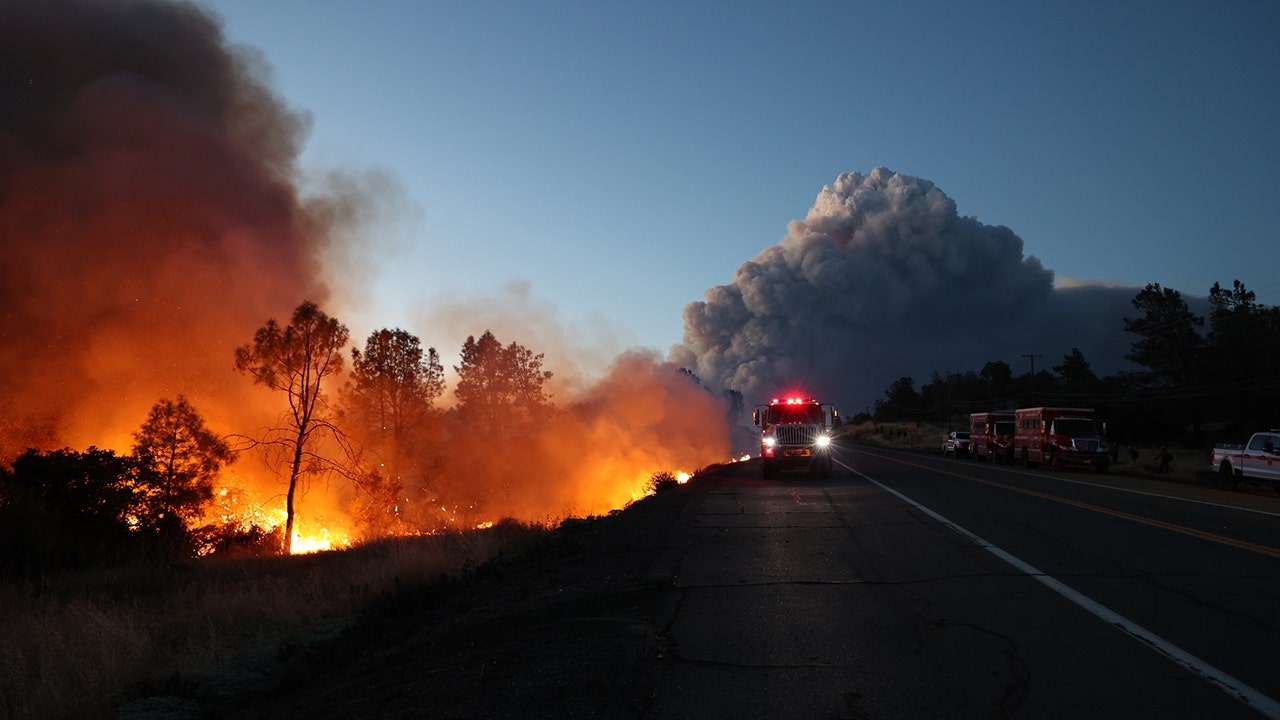
Firefighters fighting the Park Fire in northern California have the more than 400,000-acre blaze 34% contained, though hot and dry conditions are expected to present a challenge in the coming days.
As of Monday morning, the Park Fire had burned 402,042, or 628,000 square miles, according to the California Department of Forestry and Fire Protection (Cal Fire).
On July 24, 42-year-old Ronnie Dean Stout II of Chico, California, was allegedly seen pushing a vehicle that was on fire into a gully near the Alligator Hole in upper Bidwell Park, sending it down a 60-foot embankment.
Witnesses claim Stout was seen calmly leaving the area by blending in with other citizens who were in the area and fleeing the rapidly evolving fire.
CALIFORNIA MAN ARRESTED AFTER ALLEGEDLY PUSHING TORCHED CAR DOWN EMBANKMENT, SPARKING MASSIVE FIRE
Smoke rises above the roadway as the Park Fire jumps Highway 36 near Paynes Creek in Tehama County, California, on Friday, July 26, 2024. (AP Photo/Noah Berger)
Since the fire started, about 640 structures have been destroyed, and 52 other structures have been damaged between Butte and Tehama counties, according to Cal Fire.
Flames continue to burn from the Park Fire in Northern California, more than a week after it was started. (Cal Fire Butte County Facebook)
Fire officials said Monday morning that a large dry air mass with increasing temperatures was moving into the area, which will challenge crews on the northeast corner of the inferno.
The Park Fire in northern California was fought from the ground as well as from the air, as seen on Aug. 4, 2024. (Cal Fire Butte County Facebook)
FBI OFFERING $10,000 REWARD FOR INFO LEADING TO ARREST OF SUSPECTS IN DEADLY NEW MEXICO WILDFIRES
In a briefing on the fire, crews were encouraged to remain focused, flexible and aggressive as they battled the smoke and flames to close off gaps and strategically move resources around to areas where unfavorable conditions will likely increase the probability of fire activity.
THOUSANDS FLEE CANADA’S JASPER NATIONAL PARK AS WILDFIRE SPREADS TO TOWN
Crews continued to battle the Park Fire in Northern California this week. (Cal Fire Butte County Facebook)
There are currently about 6,600 crew members battling the fire, along with 44 helicopters, 536 fire engines, 196 bulldozers, 154 water tenders and 132 crews, Cal Fire notes on its website.
On Saturday, the Park Fire burned its way into California’s history books as the fourth-largest fire on record.
Reuters contributed to this report.
Read the full article from Here


SEATTLE — With national firefighting resources already stretched to their limits, statewide fire restrictions remain in effect for all Bureau of Land Management public lands throughout Washington and Oregon, with some local regions also implementing additional emergency closures.
As the Independence Day holiday weekend approaches, officials warned that people responsible for starting wildfires could face up to $100,000 in fines, 12 months in prison, and liability for all firefighting suppression costs.
SEE ALSO | Washington braces for earlier wildfire season due to low snowpack: ‘Worse than normal’
“There are serious consequences for starting a wildfire, including fines and possibly imprisonment, which we hope everyone can avoid through careful choices,” said Josh O’Connor, Northwest Geographic Area Fire Chief for the U.S. Wildland Fire Service. “We have already experienced excruciating loss this season. I cannot stress the gravity of the situation enough. Please help protect our firefighters and communities.”
Officials urged visitors to research their destinations in advance, noting that local restrictions can determine when power tools may be used, what kinds of stoves or campfires are allowed, and what safety equipment is required.
The BLM said the following items remain strictly prohibited on all BLM lands in Oregon and Washington: fireworks and sky lanterns; exploding or metallic targets; tracer or incendiary devices; and steel component ammunition, including core or jacket.
“Lighting a firework or leaving a smoldering campfire creates significant wildland fire risk. Under the right conditions, they easily start wildfires,” said Kim Prill, BLM Oregon/Washington acting state director. “Don’t risk it. Let’s work together to prevent every wildfire possible.”
More information on seasonal fire restrictions and fire closures is available HERE.

The Lakers kept pointing to the summer of 2026 as when they would make their big move. It’s when they would have the cap space to radically reshape the roster around Luka Doncic and better fit his style of play.
They have done exactly that — starting with trading for the center they desperately needed.
The Utah Jazz are trading 24-year-old center Walker Kessler to the Lakers for two unprotected first-round picks (2031, 2033) and two first-round pick swaps (2028 and 2030), a story first reported by Shams Charania of ESPN. The Lakers are signing Kessler, a restricted free agent, to a four-year, $130 million contract (averaging $32.5 million per season).
This is a huge win for the Lakers. Luka Doncic has said getting a center who can set picks and roll hard to the rim was key to his success, and Kessler may be the best one he has ever played with. Kessler has been at the top of the Lakers’ wish list for a while, but he was a restricted free agent, and the expectation in league circles was that Utah would pay up to keep him.
However, the price the Lakers agreed to pay — essentially four first-round picks — was just too good for Utah to pass up. Utah still has Jaren Jackson Jr., who can play center, which slides Lauri Markkanen over to the four, with Keyonte George, No. 2 pick Darryn Peterson and Ace Bailey likely rounding out the starting five. That’s still a very good team, and the Jazz now have picks they can use or trade to add around that core. Danny and Austin Ainge — the Utah brain trust — did very well in this deal, setting the Jazz up for the future.
The Lakers’ gamble here is health — Kessler played in just five games last season due to shoulder surgery and just 58 games the season before that. When healthy, he has shown his potential on both ends, and last season averaged 14.4 points and 10.8 rebounds per game when he did play. For his career, he averaged 2.4 blocked shots per game and is one of the few centers in the league equally capable of blocking shots with either hand.
Utah wanted to keep Kessler and reportedly offered four years, $140 million ($28 million a year on average). Kessler and his agent went looking for a larger deal and secured it with the Lakers (their offer is $32.5 million per season on average).
Kessler was the big splash, but it wasn’t the only move the Lakers made. Soon after that trade was reported, a series of other Lakers deals were announced:
• Guard Quentin Grimes is leaving Philadelphia to come to the Lakers on a four-year, $60 million deal.
• Floor spacing big man Sandro Mamukelashvili agreed to come to Los Angeles on a four-year, $52 million deal. He will serve as a backup big but provides the shooting the Lakers need to space the floor around Doncic and Austin Reaves.
• Point guard Collin Sexton to join the Lakers on a two-year, $19 million deal with a player option on the second year.
• All of that on top of previously having re-signed Austin Reaves to a four-year, $184.8 million deal that locks him in as the secondary guard and shot creator next to Doncic.
The Lakers have gone all-in. The only draft capital they have left to trade is a 2032 pick swap and a 2033 second-rounder. That’s it. This is their core.
But like another professional sports team in Los Angeles, the Lakers essentially said “f*** those picks” and leaned into win-now players. It worked out when the Los Angeles Rams did it, winning a championship, and the Lakers are hoping for that same level of success.


How Fourth of July became a celebration of history and hope
From revolution to massive fireworks, July Fourth evolved into a celebration of history, heritage and America’s values.
With 150,000 people expected to attend Saturday’s Fourth of July festivities on the National Mall in Washington DC, locals and tourists alike may be looking for alternative options to view fireworks on America’s 250th birthday.
Washington DC will offer a secondary firework show on the 4th, and there will be plenty of areas in the city and surrounding neighborhoods to catch the big firework display at the National Mall.
Here’s a look at some of the best places to watch the July 4 fireworks in Washington DC.
Where can you watch fireworks in Washington DC on July 4th?
The National Mall will be the most popular area to watch fireworks, with President Donald Trump promising “the largest fireworks show in history.” Officials say 850,000 firework shells will be launched, potentially breaking a Guinness World Record.
But you don’t need to be at the crowded mall and its strict security measures in order to watch the display.
The organizers of the firework show, Freedom 250, say there will also be viewing spots at Hains Point, Columbia Marina, Gravelly Point, RFK Stadium, Meridian Hill Park, Union Station, Lower Senate Park and Upper Senate Park.
Other popular areas to watch the fireworks include the Cardozo Education Campus in Columbia Heights, the Washington National Cathedral in northwest DC, Lady Bird Johnson Park off the Potomac River and the steps of the U.S. Supreme Court Building on Capitol Hill.
Washington DC officials have also released an interactive map that allows you to see your view of the fireworks from any place in the city.
Are there any other fireworks shows in Washington DC on July 4th?
Anacostia Park will serve as the viewing area for a separate fireworks display that will be concurrent with the National Mall fireworks, which are expected to begin at 11 p.m.
DC officials say you can enter the park through Marion Barry Ave. SE, Nicholson St. SE or the Anacostia Riverwalk Trail near the Skate Pavilion.
The event is free to the public, as is the National Mall’s show.
-

 North Dakota50 seconds ago
WATCH LIVE: Trump speaks in North Dakota ahead of July Fourth
-
Ohio6 minutes ago
Children found in ‘deplorable’ Ohio home were part of same family
-

 Oklahoma13 minutes ago
Oklahoma opens Taiwan Regional Trade Office at State Capitol
-

 Oregon16 minutes ago
Strict fire restrictions in effect on BLM lands in Washington, Oregon ahead of July 4
-
Pennsylvania21 minutes ago
From Chocolate Avenue to the World Cup, how Hershey, Pennsylvania, shaped Christian Pulisic
-

 Rhode Island28 minutes ago
Christ on a Crackuh! Liz McGraw Is Leaving RHORI.
-

 South-Carolina31 minutes ago
South Carolina Lowcountry Community Calendar of Events
-

 South Dakota43 minutes ago
Transparency, data protection laws take effect July 1


