West
California officials reopen certain Palisades Fire zones, cops to use planes to monitor looting

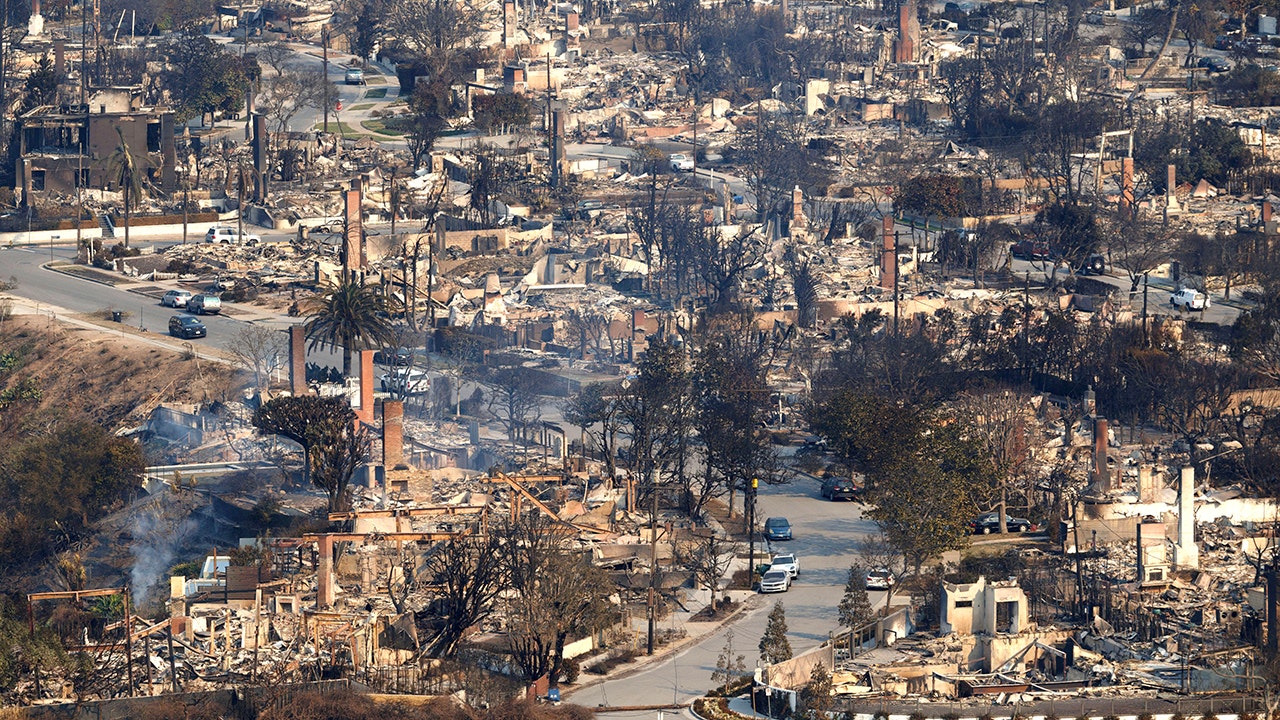
California officials on Tuesday announced residents in certain Palisades Fire evacuation zones will be allowed to return home, as the Los Angeles Sheriff’s Department increases security measures to address looting incidents.
Zones C-111A, C-112B and U-030B, near Malibu, reopened to residents Tuesday afternoon, with the requirement that they pass through a Malibu checkpoint, according to the Los Angeles County Sheriff’s Department.
The operation comes after the department announced it is enhancing operations in the Altadena Eaton Fire burn area to support recovery and ensure community safety.
Aftermath of fire in Pacific Palisades and along Pacific Coast Highway.Officials said that at least 10 people were killed in all of the Los Angeles fires and 5,300 structures were destroyed in the Palisades fire. January 10, 2025, Los Angeles, California. ( David Hume Kennerly/Getty Images)
COUPLE WITH FAKE FIRE TRUCK BUSTED FOR IMPERSONATING FIREFIGHTERS NEAR PALISADES FIRE IN LOS ANGELES: SHERIFF
Officials said they are intensifying their efforts and “strategically” shifting operations, from strictly enforced containment measures to community support.
The department said it is prioritizing the safety and recovery of residents as they begin to return to their homes and neighborhoods, and announced the creation of a specialized “Looter Suppression Team.”
“This dedicated unit is composed of personnel drawn from multiple LASD divisions, each bringing specialized expertise to combat looting and other criminal activities that can arise during times of community vulnerability,” according to a statement from the department.
The team will operate with additional deputy personnel assigned to increase patrol operations, officials noted.
Workers pull a burnt car out of the wreckage of a home destroyed by the Palisades Fire, Tuesday, Jan. 14, 2025, in Malibu, Calif. (AP Photo/Ethan Swope)
The agency’s AERO Bureau will conduct aerial patrols, providing enhanced surveillance and rapid response capabilities to ensure comprehensive coverage of the affected areas, according to the statement.
“Together, these efforts ensure continuous 24-hour patrolling to provide a consistent and visible law enforcement presence, particularly in neighborhoods still dealing with utility outages and heightened security risks,” officials said.
The curfew order issued by Los Angeles County remains in effect, but is limited to areas under active evacuation orders, according to the agency. Those under evacuation warnings are no longer subject to the restrictions.
Tim Murphy, with the San Francisco Fire Dept., puts out hot spots in a burned property in the aftermath of the Palisades Fire in the Pacific Palisades neighborhood of Los Angeles, Monday, Jan. 13, 2025. (AP Photo/John Locher)
LOS ANGELES WILDFIRES: ARMED HOMEOWNERS PATROL FOR LOOTERS INSIDE EVACUATION ZONE
“As residents return to their properties, LASD is committed to assisting them during this challenging period,” officials said. “The department’s efforts aim to facilitate a smooth transition back to normalcy by ensuring safety, preventing criminal activity, and reassuring the community.
“The LASD extends its gratitude to the residents of Altadena for their patience, resilience, and cooperation during these difficult times. The department remains steadfast in its commitment to ensuring the safety, security, and well-being of all communities across Los Angeles County as recovery efforts continue.”
Staging for residents returning home will take place at the Malibu Pier, located at 23000 Pacific Coast Highway.
Read the full article from Here


Streetsblog has migrated to a new comment system. New commenters can register directly in the comments section of any article. Returning commenters: your previous comments and display name have been preserved, but you’ll need to reclaim your account by clicking “Forgot your password?” on the sign-in form, entering your email, and following the verification link to set a new password — this is required because passwords could not be carried over during the migration. For questions, contact tips@streetsblog.org.
Nemanja Jokic, the older brother of Denver Nuggets superstar Nikola Jokic, has successfully transitioned from a protective family advisor into a credentialed professional by becoming a certified NBA agent, Serbian outlet Meridian Sports relayed on Tuesday. The middle of the three brothers had to navigate the strict licensing protocols dictated by the National Basketball Players Association, which stands as the sole governing body authorized to issue the official license required to negotiate contracts with league franchises. The former collegiate player turned team executive for Serbian club KK Joker Sombor completed the strict application process.
EuroHoops.net

The Seattle Seahawks are the defending champions, but that doesn’t mean their rookie class isn’t important.
If anything, it means the rookie class is more important because these first-year players will have to play at a very high level right from the jump in their careers. The Seahawks’ rookie class is going to be expected to help the team win a Super Bowl by replacing some key players on the roster.
“The world champion Seahawks, as I saw it, had three clear areas that became needs this offseason: running back, safety and corner, with the departures of Kenneth Walker III, Coby Bryant and Tariq Woolen,” Sports Illustrated reporter Albert Breer wrote.
“Accordingly, running back Jadarian Price, safety Bud Clark and corner Julian Neal were their first three draft picks, and all three will be guys to watch in late July and August. And another storyline, one that’ll tie back to Price, will be Zach Charbonnet’s return from a torn ACL.”
Jadarian Price
With Zach Charbonnet tearing his ACL during the divisional round game against the San Francisco 49ers back in January, first-round pick Jadarian Price will be thrown into the limelight in Week 1, assuming he gets through training camp in full health.
This will be an excellent opportunity for Price to get early reps, especially considering he was a backup in college to Jeremiyah Love, the No. 3 overall pick in the draft. He’ll compete with George Holani in training camp for the starting job against the New England Patriots on Sep. 9.
Bud Clark
Clark shouldn’t be expected to start over Julian Love and Ty Okada, but he should still have a handsome role in the secondary. Last year, the secondary proved how important depth is, and everyone in Seattle’s back line can play at a high level.
Clark is taking over for Coby Bryant, who signed with the Chicago Bears back in March. Those are tough shoes to fill, but Clark will be given an opportunity to show why he was a second-round pick.
Julian Neal
The Seahawks won’t have Riq Woolen this season after he signed with the Philadelphia Eagles. Josh Jobe and Nick Emmanwori will also need to fill in for Woolen’s absence, but third-round pick Julian Neal will have to shoulder some of the responsibility as well.
Woolen played in 78 percent of the team’s defensive snaps last season, which means Neal could hear his number early and often if he has a strong showing in training camp.
— Enjoy free coverage of the Super Bowl champions from Seattle Seahawks On SI —
Sign Up For the Seahawks Daily Digest – OnSI’s Free Seattle Seahawks Newsletter
 Add us as a preferred source on Google
Follow
-
 News3 minutes ago
Rep. Tom Kean returns to Congress, says depression is why he went missing for months
-

 Los Angeles, Ca1 hour ago
LeBron James informs Lakers he will play elsewhere next year
-

 Detroit, MI2 hours ago
5 realistic cornerback trade targets for the Detroit Lions after Terrion Arnold’s release
-

 San Francisco, CA2 hours ago
Headlines, June 30 – Streetsblog San Francisco
-

 Dallas, TX2 hours ago
LIVE | Ivory Coast, Norway meet for World Cup knockout match at Dallas Stadium
-

 Miami, FL2 hours ago
Every Dolphins head coach’s start in Miami from worst to best
-

 Boston, MA2 hours ago
Historian clears up one of the biggest myths about the Boston Tea Party
-
Denver, CO2 hours ago
Nemanja Jokic, the older brother of\u00a0Denver …

