West
California cult led by 'master manipulator' committed brutal murders, detective says: 'One body after another'


Detective Gary Deckard and his team walked into a real-life nightmare on Elm Street.
Shortly after midnight on May 21, 1990, police entered a house at 5223 Elm Street in Salida, a small farming town in California. Inside were the bodies of Dennis Colwell, Darlene “Emmie” Paris, Franklin Raper and Richard Ritchey. All the victims suffered blunt force trauma and multiple stab wounds. Paris had been nearly decapitated.
“When I got to the crime scene, we had two deputies who responded to the first 911 call,” Deckard, the lead investigator, told Fox News Digital. “All these deputies were spooked by what they saw. And these are very big deputies… When I entered the crime scene, I understood why.”
JONESTOWN CULT SURVIVOR RECALLS JIM JONES’ RAPID DRUG USE, PARANOIA BEFORE MASSACRE: ‘A LIVING NIGHTMARE’
Members of “The Cause,” led by Gerald Cruz, killed four people. The case is being examined in the true-crime series, “The Real Murders on Elm Street.” (Investigation Discovery)
“When they went to murder these people, they flipped off the electricity,” Deckard explained. “So it was completely dark in there… It was just a horrific crime scene. One of the female deputies told me it felt like Freddy Krueger was going to come out of the closet. It was one body after another in this small house.”
The quadruple homicide is being explored on Investigation Discovery’s true-crime series, “The Real Murders on Elm Street.” It explores chilling cases across the country that all took place on “Elm Street.” It features interviews with loved ones and investigators, among others.
“People have always wanted to know why anyone would go to a house and savagely kill people,” said Deckard. “Was this the act of an individual or a leader of a group?”
Detective Gary Deckard was the lead investigator in the case. (Investigation Discovery)
The police would soon get their answer.
There was one survivor, a woman named Donna, who managed to escape the attack. She described how the murders were committed by several people who had been dressed in camouflage and wore masks.
“I tried to get as much information out of her as possible,” said Deckard. “What I learned was that Donna arrived at the house. She had nowhere to go that particular night. She arrived with another individual who ended up being one of the victims. She was in one of the bedrooms when the murders started taking place. One of the suspects had taken off his mask. That allowed Donna to see his face.”
“As everybody was being murdered, Donna ran to the garage,” Deckard continued. “There were no lights inside, but she found a pile of clothes. She hid underneath the clothes and the suspects didn’t see her… When she had a chance, she ran down Elm Street and knocked on people’s doors, hoping somebody would hear her screams. Someone finally did. That’s how the 911 call came in.”
FOLLOW THE FOX TRUE CRIME TEAM ON X
Police would later learn that Gerald Cruz ordered everyone in the home to be killed. (Investigation Discovery)
Many in town gathered outside the crime scene. After getting a description from Donna of the suspect she saw – a Caucasian male with Afro hair – one of the locals said, “It sounds like a guy named Jason. He lives off ‘the Camp.’”
Police were familiar with the residential area known to locals as “the Camp.” Those who lived there kept to themselves.
When police headed there, pieces of camouflage clothing were found hanging on a clothesline. Investigators then headed to a nearby trailer that belonged to Gerald Cruz. He denied knowing anything about the murders but gave a few names of members of his commune.
Authorities soon identified Jason LaMarsh from “the Camp.” He matched the description of the suspect that Donna saw that night. As the investigation continued, police learned that Cruz was the leader of “The Cause,” a group that, according to court documents obtained by Fox News Digital, “was supposed to be the advancement of mankind.” LaMarsh was connected to the group.
Richard Vieira, pictured here, claimed Gerald Cruz ordered him to kill Darlene Paris. (Investigation Discovery)
“Gerald Cruz was a dynamic personality,” said Deckard. “He would take people off the street, those who were maybe unemployed, didn’t have any money. He would then become like their father, promising that he would provide for them. They became so emboldened… that they would do almost anything for him.”
Investigators got a search warrant for Cruz’s home. Inside they found masks, bomb-making materials, a receipt for a knife and satanic literature. Court documents revealed that Cruz’s journals had the signatures and fingerprints of those who were recognized as his followers.
There was also the “Wheel of Punishment.” Deckard said the device was used to torture Cruz’s followers if they ever disobeyed. Some of the punishments included eating off the floor, beatings and sodomy in front of the group.
SIGN UP TO GET THE TRUE CRIME NEWSLETTER
On May 20, 1990, Gerald Cruz gathered James Beck, pictured here, Richard Vieira and Jason LaMarsh. He gave them assignments and had them wear camouflage. (Investigation Discovery)
“When we found it at the property, we didn’t know what that wheel was about,” said Deckard. “I interviewed other people who were part of the group that Gerald Cruz oversaw. They described to me that the ‘Wheel of Punishment’ was used if you got in trouble for anything. And Gerald ruled with an iron fist. If you got in trouble, you had to toss up the wheel. Wherever your thumb landed on the wheel, that’s the punishment you got.”
“There were all sorts of punishments,” said Deckard. “But the most bizarre punishment would be having sex with somebody else of the same gender. But it could be a beating, it could be several things.”
According to court documents, Cruz was arrested for possession of explosives. Other followers were taken in.
Ronald Willey, pictured here, was among those ordered to storm Franklin Raper’s home. (Investigation Discovery)
“What we learned was that they had a meeting at ‘the Camp’ where they all mostly resided,” Deckard explained. “During that meeting, they were getting psyched up in preparation to go over and kill Franklin Raper. That was the motive. They did not know anybody else was going to be at the house. But Gerald Cruz’s instructions were to make sure there were no witnesses.”
Court documents revealed that in January 1990, Raper, who was about 50 years old, moved his trailer into “the Camp.” He would go on to have “an acrimonious relationship” with Cruz.
Cruz later told an acquaintance before the murders that he would “like to get his hands on” Raper. Following one dispute, Raper’s car was set on fire.
The episode revealed that Raper was never afraid of Cruz and would not think twice about standing up to him.
GET REAL TIME UPDATES DIRECTLY ON THE TRUE CRIME HUB
According to court documents, Michelle Evans entered a plea agreement. She was sentenced to one year in prison in exchange for her testimony. (Investigation Discovery)
The series also revealed that Raper was known for bringing people in who had no place to go.
Deckard said Raper was targeted by Cruz and his group. The other victims were simply at the wrong place at the wrong time.
According to the episode, Cruz and his followers ambushed Raper in his home. There, they gathered all the victims in the living room. Raper was beaten with a bat so badly that his head and face were “distorted,” said court documents. He had also been stabbed, and his arm was broken.
From left to right, James David Beck, Ronald Wayne Willey, Gerald Dean Cruz, Michelle Lee Evans and Richard John Vieira are seen here in the Stanislaus County courtroom. (Investigation Discovery)
Deckard said that when Paris was screaming and pleading for her life, Cruz told Vieira to “shut her up.”
“Gerald Cruz had so much power over him,” said Deckard.
The episode shared that LaMarsh and Ronald Willey were convicted of four counts of second-degree murder. Both were sentenced to 62 years in prison. Vieira is on death row at San Quentin, along with Cruz and James Beck. Michelle Evans pleaded guilty as an accessory to murder. She was sentenced to one year in prison in exchange for her testimony at trial. She served six months.
Detective Gary Deckard admitted that the case still haunts him decades later. (Investigation Discovery)
To this day, Deckard still has questions.
“Why would somebody forfeit their lives to please one individual, a master manipulator?” he said. “How could someone have so much authority and rule a whole camp as a father and provider for everybody? Why would people just sacrifice their whole lives and kill people they don’t even know? People who have never done anything to them? It was just appalling. I have no answers.”
“The Real Murders on Elm Street” airs Sept. 23 at 9 p.m. on ID. It will be available to stream on Max.
Read the full article from Here


Sick of the TSA lines? Tired of playing musical chairs at the gate? Rather sit as far from your fellow airplane passengers for as long as possible, in the comfort of your own private, luxury airport terminal?
Soon you may get your wish. And San Francisco international airport wants to be your genie – for a fee.
The airport is hoping to build a brand-new terminal exclusively for passengers who pay a premium, gaining access to a luxurious airport experience complete with private security lines and valet service from terminal to tarmac. It will service commercial flights, not business or corporate jets, and the terminal will have its own Transportation Security Administration (TSA) lines as well as Customs and Border Protection (CBP) lines for international travel.
SFO is seeking bidders to take on the development, construction and operation of the private terminal, which is planned for a 75,000-sq-ft site located across the runway from all current public terminals. The airport will accept proposals between late September and early October, and is looking to award a contract by early December with hopes of opening the terminal in late 2028.
SFO’s interest in a luxury development comes from what airport spokesperson Doug Yakel called a “high level of demand” for “premium experiences” in travel, citing the popularity of existing credit card and premium lounges. A private terminal is essentially the next step up in exclusivity from those lounges – and the best chance at avoiding airport crowds entirely.
“Somebody that uses this product really wouldn’t see the other passengers they’re traveling with until they’re taken up the stairs of the jet bridge and onto the aircraft,” Yakel said.
Spending on “pay-to-play” luxury experiences at large is on the rise, according to a new report by Bain & Company and Altagamma. The airline industry has bought in, revamping lounge and onboard experiences with chef-designed menus and expanded premium seating for the highest-paying passengers.
Many see a market in San Francisco, where an AI-driven wealth boom is already agitating the local housing market, with homes sold at the fastest pace in five years and the single-family median home price clocking in at $2.2m.
Yakel said SFO felt now was the right time to enter the market of luxury travel.
“We see the level of interest that’s being invested onboard aircraft, inside terminals, around airports, and clearly this is something that other airports are rolling out,” Yakel said.
The price to pay for a private airport experience will be decided by whoever wins the bid for operations, and will be offered on a membership or per-use basis. The traffic experienced at public terminals likely won’t change, Yakel said.
Private terminals have become popular worldwide. London Heathrow and Paris-Charles de Gaulle airports in Europe have long operated luxury terminals, and São Paulo/Guarulhos international airport recently opened the first private terminal in Latin America.
If SFO is successful, it would become the next major American airport to open a luxury terminal. Los Angeles, Dallas Fort Worth, Miami and Hartsfield-Jackson Atlanta international airports all offer a private terminal through PS (formerly known as the Private Suite), a company owned by security firm Gavin de Becker and Associates. Multiple representatives from PS and Gavin de Becker and Associates attended a June conference hosted by SFO about the private terminal, and PS has said it hopes to open a private terminal at every major US airport by 2030.
Access to existing PS private terminals can cost passengers $1,295 for a one-time experience, or up to $4,850 for a yearly membership. Heathrow’s private terminal costs thousands of pounds per person.

If you use Santa Fe Drive as a part of your daily commute, you will notice full closures this weekend on a popular section, from Florida Avenue to Evans Avenue, for the installation of a pedestrian bridge.
Once the 370-foot pedestrian bridge is completed, it will connect the east and west portions of Denver’s Overland neighborhood. This bridge will be used by pedestrians and bicyclists.
The Denver Department of Transportation and Infrastructure says this closure is needed to keep the traveling public safe. Large cranes will be used to set the two spans in place. Each one weighs about 215,000 pounds and is 180 feet long.
Once the bridge is completed in 2027, it will create a safer connection for pedestrians and bicyclists. It will link neighborhoods to trails, transit, parks, and local businesses without requiring residents to cross heavy traffic.
“Our neighborhood is quartered by transportation routes, so having a safe pedestrian bridge that can take people from one side to the other is an amazing development that neighbors have been asking for for years,” Jenn Greiving, President, Overland Park Neighborhood Association, said.
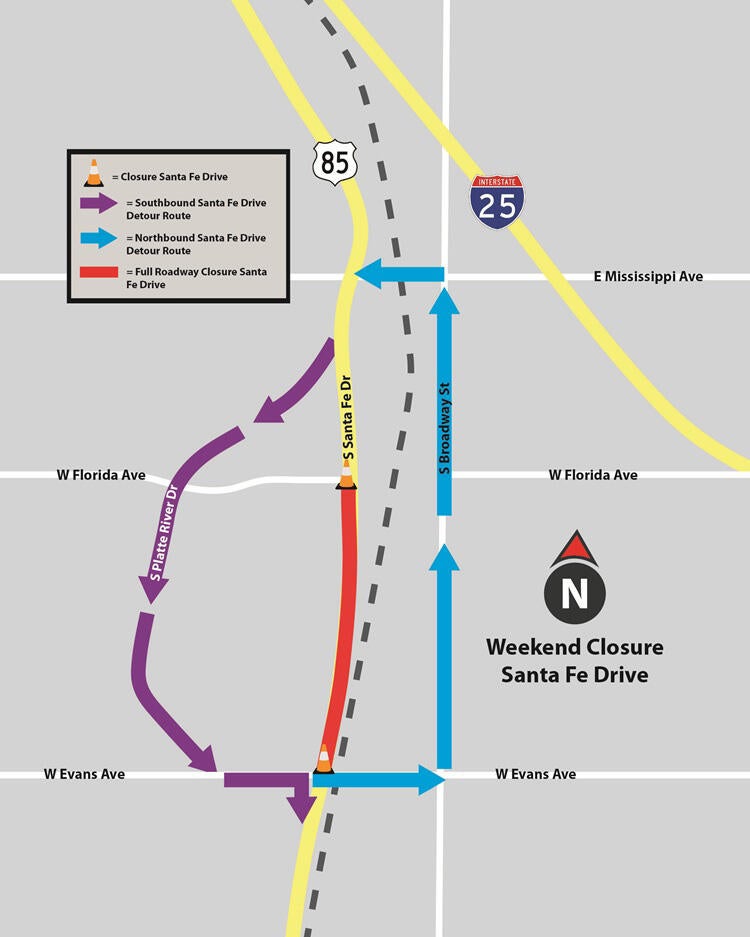
The Santa Fe Drive closure will begin at midnight on Saturday, July 11, and end on Monday, July 13, at 5 a.m. There will be detours in place. This includes:
- Southbound Santa Fe Drive Detour: Traffic will be routed to Platte River Drive to reenter southbound Santa Fe Drive at the West Evans Avenue on-ramp.
- Northbound Santa Fe Drive Detour: Access to northbound Santa Fe Drive will be at Mississippi Avenue via South Broadway Street.
- On-Ramp Closure: The West Evans Avenue on-ramp to northbound Santa Fe Drive will close at noon on Friday, July 10, to prepare for the full weekend closure and will remain closed until 5 a.m. on Monday, July 13. Traffic will be detoured to South Broadway Street to re-enter northbound Santa Fe Drive via Mississippi Avenue.
- Off-Ramp Closure: The southbound Santa Fe Drive off-ramp to West Evans Avenue will close for the full weekend period and remain closed until Friday, Sept. 11, while crews build new sidewalks and perform other concrete work at the southwest corner of the project. Detours will be posted to West Florida Avenue, West Dartmouth Avenue or West Hampden Avenue to bypass the ramp closure
During this closure, DOTI will reopen the underpass on Iowa Avenue. This is a new ADA accessible pathway that will be available between Santa Fe Drive and Acoma Street.

SEATTLE — A man accused of stealing copper wire from the West Seattle Bridge is wanted after prosecutors say he failed to show up in court this week, prompting a warrant for his arrest.
New police body camera video shows an officer arresting the man, who had bundles of copper wire in his arms.
Seattle police arrested Gregory Wayne Galitzeck after prosecutors say he was caught stealing copper wire from the bridge in the middle of the night.
Court documents say Galitzeck had four 100-foot coils of stolen copper wire, causing about $100,000 in damage that Seattle City Light customers will have to pay to repair.
Prosecutors say that when he was caught, Galitzeck claimed to be a Seattle City Light employee.
People in West Seattle called the alleged theft shocking, but not surprising.
“I feel like we live in an alternate timeline now anyway, so nothings really surprising to me,” said Lisa Coronado, who lives in West Seattle.
The case comes amid a string of similar crimes. This was the second copper wire theft along the West Seattle Bridge in just weeks. Similar thefts have also hit agencies such as Sound Transit, with thieves selling copper wire for cash.
Galitzeck is charged with theft and impersonating a City Light worker. He was supposed to come to court this week to answer the charges but did not appear. A $5,000 warrant has been issued for his arrest.
JOIN THE CONVERSATION (19)
King County prosecutors are again pushing for a new law that would require recyclers to upload photos of purchased copper to a database, a step intended to help investigators track stolen metal.
-

 Los Angeles, Ca1 hour ago
Heat advisory, beach hazards in effect as Southern California sizzles
-

 Detroit, MI1 hour ago
Teen on moped hit by car after cruising through stop sign in Detroit
-

 San Francisco, CA2 hours ago
Flight of fancy: San Francisco moves to build private luxury airport terminal
-

 Dallas, TX2 hours ago
Dallas’ digital creator economy is booming. Burnout is too.
-
Miami, FL2 hours ago
I went to 2 famous Miami restaurants, a flashy steakhouse and a Cuban hot spot. Here’s how they compared.
-

 Boston, MA2 hours ago
Pedestrian struck and killed in Roxbury – Boston News, Weather, Sports | WHDH 7News
-

 Denver, CO2 hours ago
Santa Fe Drive in Denver closed this weekend for pedestrian bridge construction
-

 Seattle, WA2 hours ago
Police video shows West Seattle Bridge copper wire theft suspect’s arrest


