West
Blue state county bucks trend on handouts – and homeless population craters

Due south of Denver’s homelessness crisis, a Colorado county has nearly eradicated its own unhoused population with a simple message to its citizens: “Handouts Don’t Help.”
Throughout Douglas County, there are about 70 signs with the message at intersections and roadways that were once popular hangouts for area panhandlers. Each sign directs citizens to DouglasHasHeart.org, where they can redirect their donations to the Douglas County Community Foundation. The county took to print media and advertisements online to spread the message through the community.
“The thought dawned on me from a common sense standpoint – I saw a lot of people like my daughter feeling conflicted at an intersection,” Republican Douglas County Commissioner Abe Laydon said of the initiative.
“If you see someone who appears to be down on their luck, it feels bad when you drive by and don’t do something – but the flip side is we all know the stories of those who maybe did not use all the funds they received in the most appropriate way. Maybe it’s going to food, maybe it’s going to drugs – you don’t know where the money is going.”
DENVER MAYOR TOUTS ‘AMBITIOUS’ PLAN TO GET HOMELESS OFF STREETS, TAKE BACK DOWNTOWN FOR FRUSTRATED RESIDENTS
Douglas County Commissioner Abe Laydon, surrounded my members of the Homeless Engagement, Assistance Resource Team, holds one of many “Handouts Don’t Help” signs displayed around the county. (Provided by Abe Laydon)
“It seems like the more you give at those particular corners, the more people it attracts. It becomes a conversation topic on the streets – if you go to this corner, you’ll get money there,” he continued.
Now, Laydon said, intersections and street corners where the homeless once loitered are clear.
Between 2022 and 2024, Douglas County saw a steep drop-off in people living on its streets, from 43 individuals to just six, according to their most recent point-in-time count report conducted by several nonprofits. Including those sleeping in their cars and in area shelters, numbers decreased from 96 total homeless people to 69, per the count.
On that day, July 29, there were no panhandlers or encampments spotted throughout the county’s five jurisdictions.
Based on its own point-in-time counts, which include those housed in shelters and on the streets, Denver counted 9,065 homeless individuals in 2023, up from 6,884 counted in 2022.
“I saw it coming from Denver – people would get off the light rail, not pay for a ticket, get off at Long Tree,” Laydon said. “Next thing you know they’re asking for money on a corner.”
‘ECSTATIC’ DENVER MAYOR SAYS CITY TRANSFORMED BY PUSH TO HOUSE HOMELESS, BUT CRITICS SAY JOB ISN’T DONE
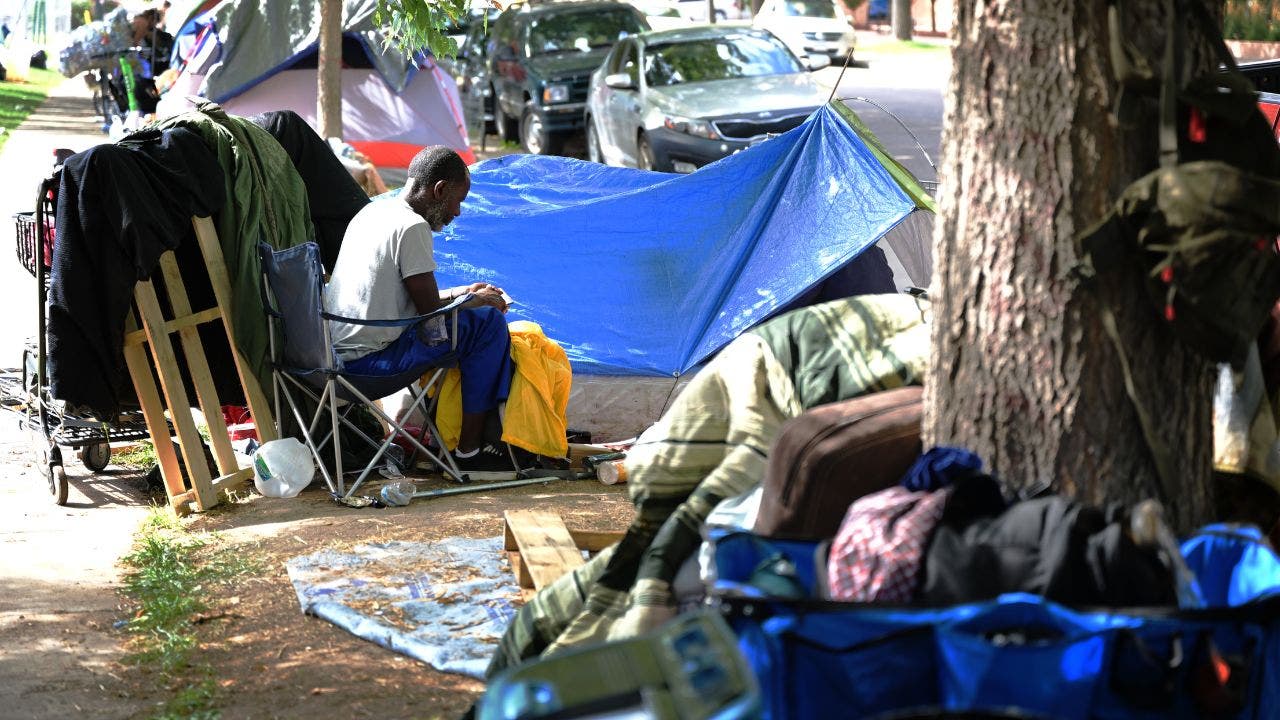
A homeless encampment in Denver on Aug. 23, 2023. (Hyoung Chang/The Denver Post)
Laydon said he first conceived of the “Handouts Don’t Help” concept when he was volunteering in the town of Lone Tree with his son and encountered a homeless encampment at the intersection of Lincoln and I-25 “littered with liquor bottles and drug paraphernalia.”
“It was kind of everywhere, but never as bad as downtown Denver – we started at a good place,” Laydon said. “[Our smaller homeless population] gave us the opportunity to nip this problem in the bud before it became really pervasive.”
Laydon said Douglas County’s Homeless Engagement, Assistance and Resource Team – which pairs behavioral health experts with area police officers in their interactions with the homeless – made 250 contacts with the homeless population when the initiative first started in 2022.
In five branded vehicles, the HEART Team approaches each homeless individual reported, offering them services to get back on their feet.
DENVER MIGRANT ADVOCATES SAY SIX MONTHS OF FREE RENT, FOOD NOT ENOUGH: ‘A SLAP IN THE FACE’ AND ‘OFFENSIVE’
Pictured is one of Douglas County’s signs redirecting citizen’s donations from panhandlers to the county fund. (Douglas County, Colorado)
“If people need services, they’re getting them. They’re getting hotel vouchers, we’re partnering with Ready to Work,” Laydon said. “If somebody needs a job, they will get one. If they need a bus ticket back to their family in Tennessee, we’ve done that. If someone needs food for a night or a week, they’ll get it.”
If the homeless refuse help, HEART team navigator Tiffany Marsitto said, their team keeps trying.
“I had an individual who was service resistant in the beginning during our first couple of interactions. He was going through a mental health crisis. [Four months later], when he was ready to reengage with our team we were there for him. We helped him fill out an application for a housing opportunity in the Metro region,” Marsitto said.
“People may not be ready today but could be ready in the future,” she said. “They see our face, they know that we’re there and they know that our team cares. They know that our community cares about them, us continuing to engage with these folks goes a long way.”
Moreover, camping is illegal in Douglas County – the HEART Team said they don’t often issue tickets, but instead use this to encourage their contacts to check into area homeless shelters.
“Our goal is compliance, to use the ordinance to get the unhoused individuals to find a better solution,” HEART team navigator Rand Clark explained. “Very rarely does someone want to intentionally break the law. We’ve been able to use that tool from a positive perspective, to say that our county ordinance is that you maybe can’t sleep here, so how can we help you find a shelter in a place where you want to be and are not breaking the law.”
However, Laydon said, “illegal activity is illegal activity, whoever you are.”
“If you are urinating, defecating outside, doing drug deals in our light rail system, it doesn’t matter if you have a home or not – you’re going to get arrested,” he told Fox News Digital.
Thus far, the Douglas County Community Fund has received $11,000 in donations, many from citizens who saw their signage. The Douglas County Homeless Initiative, which includes HEART, was funded with federal American Rescue Plan funds rather than tax dollars.
The “Handouts Don’t Help” initiative, Laydon said, could “be done everywhere from main street to Wall Street.”
“It is a behavior change that is systemic that could stem the tide of homelessness in every community throughout the country,” he said.
When asked whether such an approach could curb homeless populations in Denver, Colorado Coalition for the Homeless chief communications and public policy officer Cathy Alderman was less hopeful about the prospect.
“We applaud any jurisdiction working to address homelessness, but as they do not provide shelter or robust services, and we know they are bussing people to other cities and counties for help, it’s hard to believe that being unwelcoming to people experiencing homelessness is a true solution to the problem,” she wrote via email.
“Regrettably Ms. Alderman and the homeless industrial complex she is being paid by receive over $115 million a year of the people’s money while seeing a 31% increase in people experiencing homelessness according to the most recent point in time,” Laydon responded in a statement to Fox News Digital.
“Unfortunately we are accustomed to hearing negative rhetoric from those who choose to misrepresent Douglas County’s model of success via HEART and the tangible differences we are making in the lives of those we serve. Not only do we provide wraparound services and case management to 100% of the unhoused individuals we work with through local hotel vouchers, our mental health initiative, our opioid abatement council, and nonprofit partners, but we have
developed a regional approach that works and can be easily replicated at a fraction of the cost.”
Read the full article from Here



San Francisco Giants pitchers say they don’t feel MLB discriminated
Three San Francisco Giants pitchers say they did not feel discriminated against after the DOJ announced an investigation into Major League Baseball.
The San Francisco Giants have a lot to consider at this juncture of the MLB season.
There were mid-level expectations for the Giants at the start of the season. On paper, it seemed like the Giants could battle for a wild card berth.
The Giants won’t meet those expectations.
A week before the All-Star break, San Francisco has the third-worst record in baseball at 38-54. The Giants lost 10-0 to the Toronto Blue Jays on July 8, held hitless through eight innings.
It’s becoming increasingly obvious that this team won’t be competitive down the stretch, which has many of the Giants faithful singing a NxWorries tune, wondering what to do and where to go from here.
It’s evident that a shake-up is needed. It’s simply a matter of where they start and what they can realistically do to change things in the dugout. But one thing’s for sure: the Giants are sellers heading into the trade deadline.
What should the Giants do now?
The Giants have to accept their fate. Entering the season, they looked like a team that could compete with anybody, but then the baseball games were played and that proved to not be the case. So now San Francisco has to look itself in the mirror and figure out what went wrong and how to make things right – well, better than they have been going, anyways.
Here are a few ideas:
Get aggressive in the trade market, sell high
It’s easier said than done, but the Giants have to get off the expensive contracts eating up their salary. Reason being, you won’t be able to get any talent, let alone invest in your prospects, if there isn’t enough dollars to go around by the time negotiations occur.
It’s also a matter of how aggressive they plan to be and who will be prioritized. Who is untouchable? ESPN’s Jeff Passan has Giants outfielder Jung Hoo Lee as a top-ranked trade candidate. He plays all throughout the outfield. Offensively, Lee ranks top 10 in MLB in batting average and strikeout rate.
Lee, 27, makes $22.83 million this season and next, before going down to $21.33 million in both 2028 and 2029. Although not a star, the Giants can sell teams on Lee being a promising, solid all-around player.
Move on from veteran players
With a record like San Francisco’s, the best thing you can do for the fans is give them something to be hopeful for. That’s not aging veterans.
Examine the market for your guys who are age 30 and up, or are occupying a ton of salary space.
Rafael Devers turns 30 in October. His age isn’t so much a problem, but his contract … combined with the lack of expected production. Devers has had a down year so far, batting .244, registering 86 hits and 18 homers. He’s under contract through 2033 at a hefty price tag.
Others to consider moving on from are Willy Adames and Matt Chapman. They’re fan favorites, but based on age and dollars it all makes sense. Adames is under contract through 2031 at over $31 million per season. Chapman is locked up through 2030 at over $25 million per year.
It’s hard to say goodbye, but in the best interest of the Giants, they have to find new homes for these guys. And honestly, it wouldn’t be surprising if Devers, Chapman and Adames wanted to find a new home if it meant playing for a contender and a chance at a World Series title.
Retain young talent, bring in fresh faces
There’s promise for the future in this squad with guys like Bryce Eldridge, Blade Tidwell and Drew Gilbert. It’s a start.
“The San Francisco Giants, who would love to trade two of their infielders at the trade deadline, need to clear space for power-hitter Bryce Eldridge. They realize it’s stunting his growth as an infielder to keep using him as a DH at the age of 21,” USA TODAY Sports’ Bob Nightengale wrote.
Eldridge has had plenty moments as a designated hitter but none bigger than his walk-off grand slam against the Washington Nationals on June 10.
Another intitiative San Francisco needs to focus on is hanging on to guys like Logan Webb, Heliot Ramos, Casey Schmitt and Landon Roupp. The best bet is to hang on to them to help usher in a new era. Years from now, when the team has a new look, you can decide whether to leverage them for additional assets.
However, in the interim, hold on to those guys for dear life because teams will come knocking as MLB gets closer to the trade deadline.

DENVER (KDVR) — Two officers, one now formerly of the Denver Police Department, face multiple charges relating to separate incidents in the past two months.
According to a release, now-former Denver Police Officer Gabriel Lucero was issued a citation for third-degree assault, official misconduct and false reporting, while Officer Javon Leach was cited for reckless driving and eluding.
The incident involving Lucero reportedly occurred on May 22 just before 1 a.m. in the 500 block of 16th Street. According to a release, Lucero was involved in an assault at a business, as he allegedly assaulted a person and walked away as others continued to assault the victim.
Security guards and an off-duty officer escorted him and the group out; however, Lucero reportedly identified himself as a Denver police officer and attempted to re-enter by using his police badge.
Lucero reportedly provided a false name without any other information, and further investigation verified Lucero as the person involved. Lucero was hired in 2025 and, due to his current probationary status, was fired as of Wednesday.
The incident involving Leach occurred around 1:41 a.m. on June 21, when Leach was reportedly pulling out of a parking lot on Larimer Street, attempting to drive against traffic.
Leach reportedly refused commands to stop as he left the area. Officials said he was found just seven minutes later, traveling at high speeds northbound on Park Avenue West.
He reportedly fled a traffic stop and continued to drive away, and officials deemed Leach to be the suspect following an investigation. He was placed in an off-line assignment while the case progresses, as they are considered misdemeanors.
“The Denver Police Department’s administrative review of Leach’s incident will begin once the criminal case is adjudicated, and that process includes the Denver Department of Safety and the Office of the Independent Monitor, a civilian oversight agency,” the release said.

Breast milk samples from moms in the Seattle area contained chemicals linked to health problems, new research has found.
The chemicals are often used in beverage can liners, receipt paper, and other products, and they’ve been linked to reproductive problems, cancer, and immune problems like asthma.
Ryan Babadi is the science director at the nonprofit Toxic Free Future, which co-authored the research. He said breast milk is still the best food for most babies.
“The problem is not breast milk,” he said. “The problem is that we have chemical policies that are allowing these contaminants to end up in women and breastmilk and result in exposure to infants during a very sensitive time period of development.”
Researchers collected breast milk from 50 women and tested it for various chemicals. They found that the majority of the samples contained BPA and the related chemical BPS, triclosan, and melamine. All three of these chemical groups are known as “endocrine disruptors” because they can mimic, block, or alter human hormones and thus affect a large number of systems. BPA, for example, has been linked to diabetes, the early onset of puberty, and a number of cancers. Triclosan interferes with thyroid function and could increase cancer risk. And melamine has been linked to kidney problems.
“This isn’t a problem that mothers or people in general can shop their way out of,” Babadi said. “We need government decision-makers and policymakers as well as the corporate environment to come up with policy solutions that protect us.”
RELATED: Trump administration actions contradict MAHA rhetoric on toxic chemicals
Breast milk for the study was collected in 2019. In the years since, Washington state has started regulating some of the chemicals the researchers found.
For example, as of last year, beverage cans in Washington aren’t allowed to contain BPA and related chemicals. And as of January, those chemicals aren’t allowed in receipt paper in the state.
That’s because, under a state law passed in 2019, the ecology department prioritizes harmful chemicals, identifies consumer products that contain those chemicals, and writes new regulations to ban or restrict them.
So far, the state has regulated not only BPA and related chemicals, but also phthalates in personal care products and vinyl flooring, triclosan in cosmetics, and PFAS chemicals in carpets, rugs, and furniture. Those last are known as “forever” chemicals because they do not degrade over time.
RELATED: 5 ways to reduce everyday exposure to ‘forever chemicals’
The state is now looking at chemicals in cosmetics, jewelry, cookware, paint, and artificial turf, among other products, for possible future regulation.
The state has not looked at banning or restricting melamine, one of the chemicals the researchers found in breast milk.
Babadi said in an email that Washington’s law is the nation’s strongest for regulating toxic chemicals, but he said it needed to be improved “to be able to enact bans in urgent scenarios when, for example, we observe harmful chemicals in breast milk.” The process for restricting new chemicals currently takes at least five years.
Marissa Smith is a toxicologist and the former technical lead for the Safer Products for Washington program. She now works on chemical policies across the ecology department.
She said the state’s current process of chemical regulation helps build compliance by giving manufacturers and industries plenty of lead time and compliance assistance.
“We generally do see compliance with state laws,” she added. “Most manufacturers want to sell products that are compliant.”
RELATED: Trump cuts demolish agency focused on toxic chemicals and workplace hazards
Smith emphasized that state-level chemical regulations like those in Washington and California can have an effect across the country, as manufacturers switch over to safer alternatives for their entire supply chain.
And Smith sees other reasons for hope.
“ Products are getting safer over time,” she said. “ There were some toxic flame retardants that were used in kids’ pajamas and other products, and we banned those, and we actually saw concentrations in our bodies and in our environment go down.”
For another example, Smith pointed to the dramatic decline in how much lead was in children’s blood after the U.S. banned leaded gasoline in 1996.
“ There’s just a lot of examples where we have actually regulated products and we’ve seen reductions in people’s exposure,” Smith said.
-

 Los Angeles, Ca1 minute ago
Loved ones search for missing 34-year-old Southern California woman
-

 Detroit, MI21 minutes ago
Chickens, geese found at vacant home after nonprofit reports them stolen
-

 San Francisco, CA31 minutes ago
What’s next for San Francisco Giants as MLB trade deadline approaches?
-
 Dallas, TX36 minutes ago
Dallas millionaire files lawsuit against groundwater district
-

 Miami, FL43 minutes ago
7 more women arrested at southwest Miami-Dade massage parlors, accused of prostitution in undercover sting
-

 Boston, MA46 minutes ago
‘They’re my buddies’: 96-year-old Back Bay woman befriends French soccer team
-

 Denver, CO51 minutes ago
Denver officers cited for separate incidents, 1 fired
-

 Seattle, WA58 minutes ago
Study finds dangerous chemicals in the breast milk of Seattle moms

