Arizona
Navajo, Arizona attorney general question safety of newly reopened uranium mine

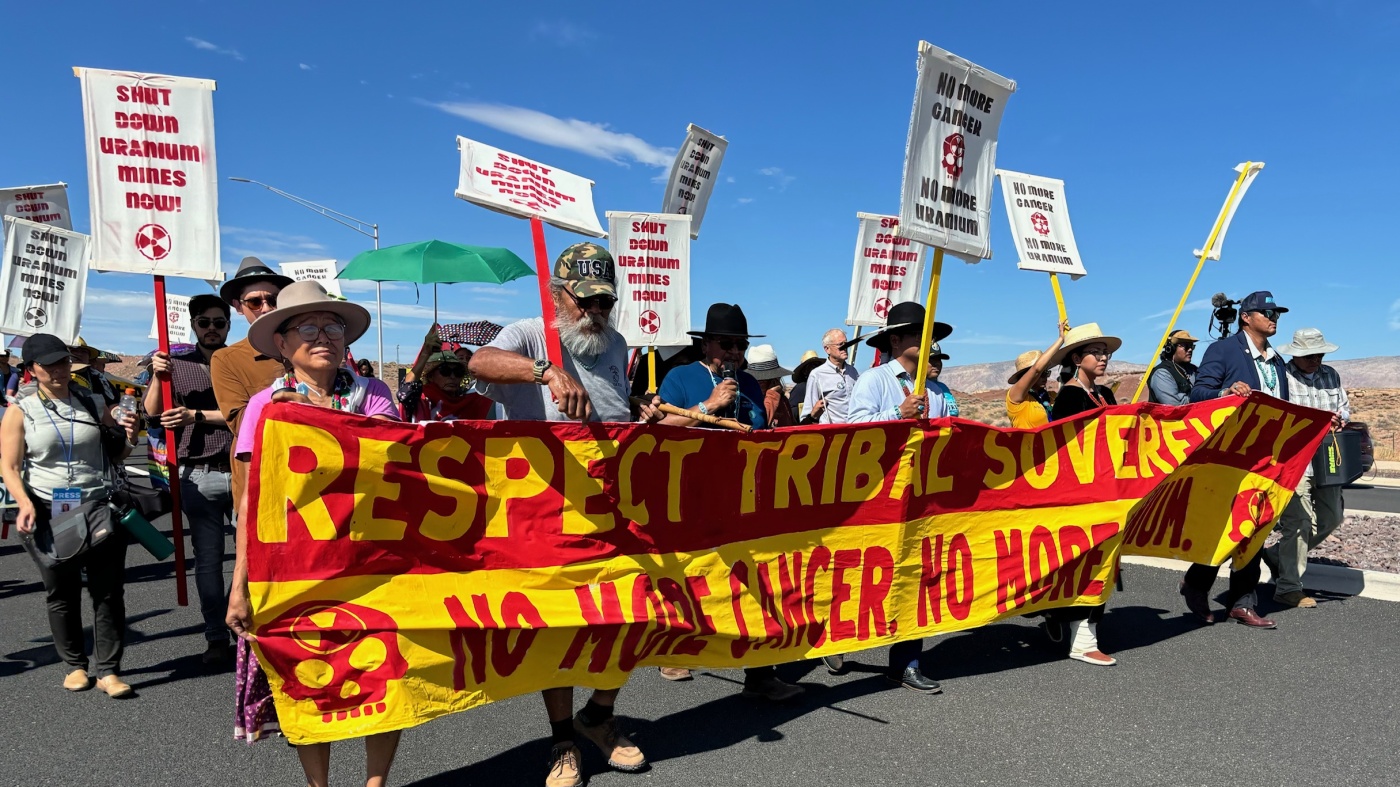
Protestors, led by Navajo Nation President Buu Nygren, marched along Highway 89 in Cameron on Aug. 2, 2024 to protest uranium hauling through the reservation. The highway was part of the route taken by trucks from the Pinyon Plain Mine near the South Rim of the Grand Canyon three days earlier when they began uranium ore transportation through a large swath of the nation.
Ryan Heinsius/KNAU
hide caption
toggle caption
Ryan Heinsius/KNAU
FLAGSTAFF, Ariz. — Uranium mining in the U.S. is picking up after the nuclear fuel’s price hit a 16-year high earlier this year. But now that a mine near the Grand Canyon is producing ore, Native American tribes, local officials and Arizona’s attorney general are questioning its safety.
Last year, on a remote stretch of northern Arizona forest, President Biden designated the Baaj Nwaavjo I’tah Kukveni—Ancestral Footprints of the Grand Canyon National Monument.
“From time immemorial, more than a dozen tribal nations have lived, gathered, prayed on these lands,” Biden said as he addressed an enthusiastic crowd of tribal leaders, members of Congress, Arizona Gov. Katie Hobbs and advocates.
The monument designation permanently banned new uranium mining claims on nearly a million acres adjacent to Grand Canyon National Park and blocks what could have been hundreds of new operations in an area that is culturally significant to the Havasupai, Hopi, Navajo and others.
“Our nation’s history is etched in our people and in our lands. Today’s action is going to protect and preserve that history,” said Biden, as Red Butte, one of the Havasupai Tribe’s most sacred sites, loomed in the background.
The declaration was also a recognition of a far darker history, the more than 500 abandoned uranium mines on and near the Navajo Nation left over from the Cold War era that are blamed for deaths, cancers and other grave health problems in many of the region’s Indigenous communities.
“When it comes to uranium specifically, I think there’s almost a moral obligation to say no and to make that message strong,” says Navajo Nation first lady and former Arizona legislator Jasmine Blackwater-Nygren.
She says radiation exposure killed two of her grandparents, one of whom was a uranium miner. It is an all-too-common story on Navajo and a hardship that’s touched nearly every family there. But one previously established mine that has been on hold for decades and is located within the national monument can legally still operate because of preexisting rights. And it started producing uranium ore earlier this year.

Inside the Pinyon Plain mine near the Grand Canyon in Arizona
Ryan Heinsius/KNAU
hide caption
toggle caption
Ryan Heinsius/KNAU
“It’s just you and the miners that you’re working with accomplishing a goal,” says Pinyon Plain Mine Assistant Superintendent Matt Germansen.
He has just stepped off a cage-like elevator after taking the five-minute ride almost 1,500 feet to the bottom of the mineshaft. A ventilation system whirs above a diesel front-loader and a small team of workers including miners, electricians and welders. They have their sights set on digging out a geological formation called a breccia pipe that contains some of the highest-grade uranium ore in the U.S.
“We have basically everything we need to operate down here from heavy equipment to first aid to electrical power systems,” Germansen says as he walks through the tunnels of the subterranean operation.
He and the mine’s owner, Energy Fuels, say the mine is safe and won’t affect the Grand Canyon’s groundwater or environment — something conservationists have challenged for years. The company says Biden’s designation has stymied the area’s potential for significant uranium development.
“To declare a national monument is certainly frustrating because it feels like it was done without the science backing it,” Germansen says.
But that science remains inconclusive. Hydrologists with the U.S. Geological Survey have studied the area for more than a decade and have sampled thousands of water sources throughout the Grand Canyon. They say there is no definitive evidence of water contamination from Pinyon Plain or other uranium mines. But they caution that they do not yet have a complete picture of its complex geology and many uncertainties remain.
Tribes in the region have been steadfast in their opposition and have fought uranium mining near the Grand Canyon for decades. The Havasupai, whose reservation is at the bottom of the canyon, worry that Pinyon Plain could pollute its sole water source. They, along with environmental groups, challenged a 1986 environmental analysis by the U.S. Forest Service that found almost no risk of contamination. But the 9th U.S. Circuit Court of Appeals ruled it valid and reaffirmed the company’s right to mine in 2022. Earlier this month, Arizona Attorney General Kris Mayes questioned the nearly 40-year-old science in the original study and asked the agency, which manages the land where the mine is located, to conduct a new one.
Carbon emissions-free energy
Energy Fuels maintains that Pinyon Plain, Arizona’s only currently operational uranium mine, is a key part of the global transition away from fossil fuels. It’s expected to produce about 2.5 million pounds of processed uranium over its lifespan of three or more years.
“If we’re going to address climate change, nuclear has to be part of that. There’s just no way to get there without nuclear. Uranium powers nuclear,” says Curtis Moore, Energy Fuels’ senior vice president for marketing and corporate development.
While interest in the U.S. for carbon emissions-free nuclear power is ramping up, a significant supply of uranium just became off-limits for geopolitical reasons.
“A big one is Russia’s unprovoked invasion of Ukraine and the ongoing atrocities in Ukraine,” Moore says.
Earlier this year, Biden signed a law that bans U.S. imports of uranium from Russia. It took effect in August. Previously, the U.S. had imported about $1 billion worth annually.

Last year President Biden created the Baaj Nwaavjo I’tah Kukveni—Ancestral Footprints of the Grand Canyon National Monument. This year he signed a law banning the import of Russian uranium
Ryan Heinsius/KNAU
hide caption
toggle caption
Ryan Heinsius/KNAU
Amid these changes in the global market, in late July Energy Fuels sent its first truckloads of ore from the Pinyon Plain Mine to its White Mesa Mill in southern Utah for processing. The route crosses a large part the Navajo Nation, and the unexpected move by the company ignited numerous protests in the region.
“Our people are still dying today. They’re suffering. There’s so much generational trauma that uranium has brought to our people,” says Navajo Nation President Buu Nygren.
He spoke to several dozen community members, activists and others in early August in the reservation town of Cameron, which is along the haul route on U.S. Highway 89, just days after the ore shipments passed through. Nygren then led a protest march along the highway, which backed up traffic as leaders sang traditional songs in the Diné language and held a large yellow and red banner calling for the closure of the mine and respect for tribal sovereignty.
The tribe outlawed uranium ore hauling in 2012, and Nygren has vowed to stop any future shipments. Energy Fuels, however, says it’s well within its rights to use state and federal highways through the reservation for its deliveries. And they are adamant that the ore has low levels of radiation and is safe to transport.
But soon after the first truckloads crossed the Navajo Nation, the company put the shipments on hold at the request of Gov. Hobbs, who is mediating talks between the Energy Fuels and tribal officials. There’s no timeline for when hauling may restart, but the pause has done little to quell opposition to Pinyon Plain as activists, tribal members and leaders continue to fight uranium mining near the Grand Canyon.
“It’s a humanitarian issue that we face here on Navajo because it’s killed thousands of our people,” Nygren says.


The University of Arizona and Tucson are known for yearlong warm weather, but when is it too much? With temperature reaching record highs in March, the city of Tucson has already reported increased temperatures for this year.
In the wake of the third annual Southern Arizona Heat Summit, integrating voices throughout the City of Tucson, community stakeholders and experts from UA gather to speak about possible solutions and policies to address rising temperatures and extreme heat.
The summit strives to ensure that the lived experiences of Southern Arizona residents are voiced. The first summit commenced in 2024, in response to the declaration of an extreme heat emergency in Arizona by Gov. Katie Hobbs, as part of a larger plan called Arizona’s Extreme Heat Response Plan.
With representation from organizations such as the American Red Cross, the National Council for Occupational Safety and Health, Arizona Jobs with Justice, Tucson Indian Center and many more, the summit emphasized the importance of the perspective and concerns of stakeholder groups throughout the community.
The summit included a variety of UA experts, including faculty representing the School of Geography, Development and Environment; the Udall Center for Studies in Public Policy; the Mel & Enid Zuckerman College of Public Health and the College of Architecture, Planning and Landscape Architecture.
One particular project, led by Ladd Keith at the School of Landscape Architecture and Planning, is a part of the Southwest Urban Corridor Integrated Field Laboratory, which is funded by the United States’ Department of Energy to explore extreme heat throughout Arizona. SW-IFL works in collaboration with other national laboratories including those at ASU and NAU.
The team works to analyze extreme heat in the southwest and rural areas, and how communities deal with heat by conducting interviews. The team has also prescribed policy to Pima County and the City of Tucson regarding more effective strategies to combat rising temperatures, such as green stormwater infrastructure.
Anne-Lise Boyer, a post-doctoral researcher with the Climate Assessment for the Southwest, shared that the team particularly analyzed extreme heat in three parts: heat mitigation, heat management and heat governance.
Mitigation deals with prevention through strategies such as green infrastructure and planting trees, while management includes cooling sensors and heat warning systems. Governance allows these measures to be enacted through policy.
In Tucson, some of the most meaningful work the team has engaged in has been drafting the City of Tucson’s Heat Action Roadmap in 2024, which outlines goals to mitigate and mandate extreme heat and its impacts while prioritizing community voices.
The goals of the roadmap include informing and educating citizens of Tucson on the adverse effects of extreme heat and cooling people’s homes and neighborhoods by incorporating heat risk in regional planning. These steps are essential to practicing heat management, especially as the city of Tucson grows.
“I think the most interesting thing about being based in Tucson is that because the heat has been here for a long time, it’s like a laboratory in itself,” Boyer said. “We have all this research and all this collaboration happening with local actors because it’s a pressing issue in Arizona.”
As the annual heat summit recurs, new ideas and perspectives continue to be shared throughout the community. Boyer shared that this year, the Southern Arizona Heat Summit focused on the youth perspective, highlighting middle school and high school students and how heat impacts their everyday lives. Many students spoke about how heat shaped their lives at home, school and sports.
“That’s one of the goals, to have community members participate and give their input in how they wish the city will deal with the heat,” Boyer said.
Boyer and Kirsten Lake, a program coordinator for the SW-IFL team, also shared how the impacts of extreme heat impact some neighborhoods and communities in Tucson more than others, and that their research often evaluates these factors to determine where heat management efforts would make the greatest impact.
“Its important when you’re putting into effect some of these measures, that you make sure you put it where it’s going to make the biggest difference,” Lake said.
The work of the SW-IFL team is not just locally known. The Brookhaven National Lab based in New York deployed a specialized truck to Tucson to collect information on the atmosphere and rising temperatures. The SW-IFL team hosted the Brookhaven team.
Additionally, Keith’s work has led to a guidebook called “Planning for Urban Heat Resilience” which focuses on the adverse effects extreme heat poses to marginalized communities across the country.
“It is so different from place to place and neighborhood to neighborhood because you have to take the whole context into account,” Boyer said. “They recommend first to document the heat impacts in your communities.”
Follow the Daily Wildcat on Instagram and Twitter/X

PAGE, AZ (AZFamily) — A person accused of making terroristic threats toward a northern Arizona medical facility was arrested Friday morning.
Just after 10:30 p.m., police received a report of a person calling the facility and threatening to kill staff and Native Americans, according to the Page Police Department.
Authorities said staff placed the facility on lockdown until officers identified the suspect and arrested them outside their home.
The suspect was booked on charges of disorderly conduct, threatening and intimidating, and making terroristic threats. Police have not publicly identified the person.
“The Page Police Department is grateful for and supports the medical staff’s decision to put the medical facility into lockdown until the suspect was arrested and the situation was rendered safe,” the department said in a Facebook post.
See a spelling or grammatical error in our story? Please click here to report it.
Do you have a photo or video of a breaking news story? Send it to us here with a brief description.
Copyright 2026 KTVK/KPHO. All rights reserved.

In these four-round projections, the Arizona Cardinals don’t get a tackle until the fourth round.
We are just days away from the 2026 NFL draft, and that means some final mock drafts. What direction will the draft take the Arizona Cardinals?
Draft Wire’s Curt Popejoy put together a four-round mock draft for the Cardinals. They go defense early but rebuild the offense for 2026 and moving forward, including landing their potential franchise quarterback.
Cardinals 4-round mock draft
Here are the players in the first four rounds Popejoy projects for Arizona.
- Round 1: Ohio State EDGE/LB Arvell Reese
- Round 2: Alabama QB Ty Simpson
- Round 3: Clemson WR Antonio Williams
- Round 4: Florida OT Austin Barber
What we think of the picks
The Cardinals want to trade out of the third pick and draft a tackle, so not getting a tackle until Round 4 seems unlikely, although they did meet with Barber. They do have options at right tackle for 2026 already on the roster.
Reese would be a great pick if they don’t trade back, as they badly need pass-rushing help off the edge.
Drafting Simpson seems inevitable at this point, so it has to be in a mock draft, although the feeling is they will need to go up into Round 1 again to get him.
Williams has speed and is almost six feet tall, but he does have short arms.
Get more Cardinals and NFL coverage from Cards Wire’s Jess Root and others by listening to the latest on the Rise Up, See Red podcast. Subscribe on Spotify, YouTube or Apple podcasts.
-

 Milwaukee, WI3 minutes ago
Milwaukee Wave learns its opponent for MASL championship series
-

 Atlanta, GA9 minutes ago
Philadelphia Phillies lose fifth straight game to end homestand, swept by Atlanta Braves
-

 Minneapolis, MN15 minutes ago
Motorcyclist killed in crash on I-35W in Minneapolis
-

 Indianapolis, IN21 minutes ago
IMPD: Man stabbed in downtown Indianapolis
-

 Pittsburg, PA27 minutes ago
From ‘Steel City’ to ‘eds and meds’: As Pittsburgh welcomes NFL Draft, it isn’t so easily defined anymore
-

 Augusta, GA33 minutes ago
Geoff Duncan campaigns in Augusta ahead of Election Day
-

 Washington, D.C39 minutes ago
The director of the Congressional Budget Office—known for its gloomy national debt data—is very optimistic that a crisis will be avoided entirely | Fortune
-

 Cleveland, OH45 minutes ago
3 seriously injured after crash on I-90 in Cleveland: EMS