Arizona
Arizona’s abortion ban is the biggest story in US. How media covered the ‘alarming news’


Arizona leaders react to Abortion ban ruling
Arizona leaders react to Abortion ban ruling
If there was any doubt that Arizona will play a major role in the 2024 election — and that what goes on in the state will be covered as big stories by national media — breaking news on Tuesday, April 9 dispelled it.
The Arizona Supreme Court upheld a 160-year-old law banning nearly all abortions in the state. News alerts went out immediately from all sorts of media sites. The decision was the lead story on the home pages of the New York Times, the Washington Post, the Wall Street Journal, the Hill and more. The Arizona Republic’s website, azcentral, used huge headlines of the sort reserved only for the biggest stories.
Which it is. And local and national coverage reflected that.
News coverage of Arizona’s abortion ban focused on politics
“It’s huge,” Brianna Keilar, co-host of “CNN News Central,” put it.
The coverage, whether on cable TV news shows or on newspaper and magazine websites, focused largely on two things.
First, 1864 was a long time ago — several commentators noted that slavery was still legal when the law went into effect, that women were not allowed to vote and that Arizona was not yet a state. Jake Tapper began his show saying, “Arizona going back to the Civil War-era for their abortion laws,” using a description heard a lot Tuesday, along with “19th Century” and, again in Tapper’s case, “kind of ancient.”
Second, and this is how the bulk of the coverage was framed, the decision has enormous political repercussions. Certainly, the practical application of the law and how it will (or won’t) be enforced, was covered, as well, but often in a political context. What will it mean in November?
For instance, this is how the Wall Street Journal began its story: “Arizona’s highest court on Tuesday revived a 160-year-old ban on abortion, a decision that ratchets up the political stakes in a state that could decide the 2024 presidential race.”
Karine Jean-Pierre, the White House press secretary, opened her daily briefing with the decision: “I want to start by addressing some devastating and alarming news from the Arizona Supreme Court.”
And Joyce Vance, a law professor and MSNBC contributor, posted on X, “Terrible news for Arizona women. Probably good news for Democratic candidates in the state including a vulnerable Senate seat.”
That race got plenty of mention, as well. Both Ruben Gallego, the presumptive Democratic candidate for a U.S. Senate seat in Arizona, and Kari Lake, the presumptive Republican candidate, quickly issued statements opposing the ruling.
Lake’s opposition stands in contrast to an earlier comment in which she called the 1864 ban “a great law that is already on the books.”
Tuesday was a big news day, but Arizona was the story
Of course, that was then, this is now; Donald Trump and other Republican candidates have seen the political fallout from the U.S. Supreme Court striking down Roe v. Wade, and have tried to adjust their stances accordingly.
Or, as Keilar said on CNN of Lake’s statement, “It seems like she’s looking at this, saying, ‘Wow, this may have just cost me this election if this stands.”
It actually took TV news a little time to get to the Arizona story. The parents of a Michigan teenager who killed four students in a 2021 school shooting were sentenced to 10 to 15 years in prison shortly before the Arizona Supreme Court announced its decision. Tuesday was a busy news day all around, with an appeals court judge denying a request from Trump to delay his criminal hush money trial, scheduled to begin Monday, April 15, in which the former president faces 34 felony counts of falsifying business records in connection with a $130,000 payment to adult film star Stormy Daniels.
Fox News didn’t devote a lot of time to the story, but most other outlets eventually did, even though so much else was going on. All roads lead to November eventually, it seems.
And through Arizona.
Star power: How national media turned Kari Lake into Trumpism’s ‘leading lady’
Reach Goodykoontz at bill.goodykoontz@arizonarepublic.com. Facebook: facebook.com/GoodyOnFilm. X: @goodyk. Subscribe to the weekly movies newsletter.
Subscribe to azcentral.com today. What are you waiting for?



A new study has ranked Arizona as one of the worst states to move to for two years in a row, largely due to what it calls a poor quality of life.
The study conducted by Consumer Affairs analyzed the best states to move to in the United States, putting Arizona at the bottom of the list.
Before Arizonans get too defensive about the Grand Canyon State, Consumer Affairs used factors such as affordability, safety, economic strength and education to measure each state, leaving out factors like entertainment, retirement benefits and other considerations that may be important to people living here.
Popular states such as California and New York also landed at the bottom of the list due to their lack of affordability, even though they both have some of the best health care and education in the nation, Consumer Affairs noted.
Here’s why the study says you shouldn’t move to Arizona. Do you agree?
Why you shouldn’t move to Arizona
Arizona ranked No. 10 out of the worst states to move to, scoring especially poorly in quality of life.
Quality of life was measured by the state’s Social Progress Index, average air quality, weather, environmental protection and number of national parks. Due to Arizona’s extreme summers and Phoenix’s consistently poor air quality, it’s easy to see why Arizona ranked No. 44 in quality of life out of 50 states, even though the Grand Canyon is one of the most popular national parks in the nation.
However, Arizona also ranked poorly in other categories, sitting at No. 42 in health care and education, No. 41 in safety and No. 34 in affordability out of 50 states.
There was one category Arizona did impressively well in, ranking No. 5 in economic strength even as one of the youngest states in the country. Still, Arizona’s economic power wasn’t enough to boost its ranking.
Top 10 worst states to move to
Arizona wasn’t alone; some of the biggest states in the country were also considered the worst states to move to in 2026.
- New Mexico
- Louisiana
- California
- Arkansas
- Oklahoma
- Nevada
- Alaska
- Mississippi
- Oregon
- Arizona
Top 10 best states to move to
- Utah
- New Hampshire
- Idaho
- Minnesota
- Massachusetts
- Maine
- North Dakota
- Pennsylvania
- Iowa
- South Dakota
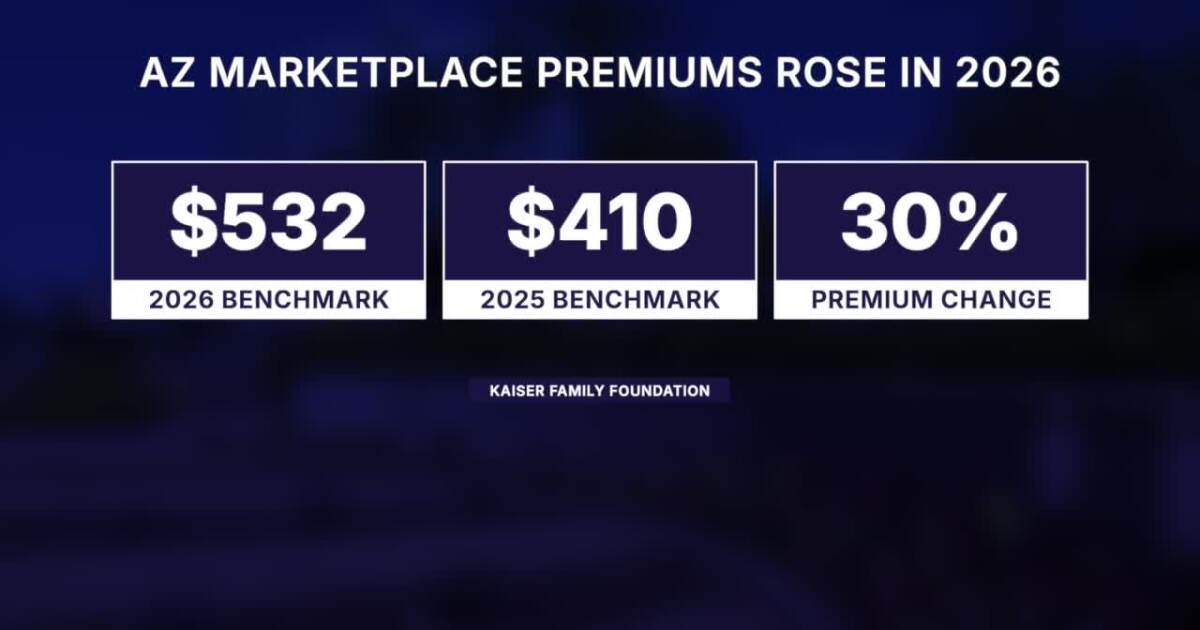
PHOENIX — Arizona’s ACA marketplace enrollment fell from 363,000 to just over 255,000 in a single year — a nearly 30% decline and the third-largest annual drop in the country.
Rising premiums and expired tax credits are driving the trend, with the average benchmark plan premium in Arizona now at $532 — up 30% from 2025.
In the player above, ABC15 Data Analyst Garrett Archer takes a look inside the numbers on how healthcare premiums are impacting health insurance enrollment.
This story was reported on-air by a journalist and has been converted to this platform with the assistance of AI. Our editorial team verifies all reporting on all platforms for fairness and accuracy.
Want more news in your community? Add ABC15 as a preferred source on Google below:

Arizona
Arizona man pleads guilty after illegally living in forest for years among ‘1,000lbs of trash’

A man in Arizona has pleaded guilty to violating federal fire restrictions and unlawfully residing in a national forest, after authorities said he spent years living at a makeshift campsite surrounded by what officials described as “approximately 1,000 pounds of trash”.
Mark Aaron Gatz was arrested on 25 June at his illegal campsite in Arizona’s Tonto national forest, according to court records. A United States Forest Service (USFS) officer wrote in documents submitted to court that Gatz had been operating an “illegal campsite” with a “hot wood burning campfire” despite fire restrictions and that he had told investigators that he had been living in the forest for about eight years.
The officer wrote that a records check found that Gatz had previously received multiple citations and was the subject of six outstanding federal arrest warrants for earlier violations, including for building fires during fire restrictions, constructing on national forest service lands, unsanitary conditions and occupying national forest as a residence.
Gatz “said that he knew about current fire restrictions but had to have fire to eat”, authorities said. The documents show that USFS officers made contact with Gatz multiple times over the last year or so, and issued him warnings as well as a violation notice for having campfires during fire restrictions.
Notes from officers’ previous encounters with Gatz earlier this year, submitted into the court docket, state that authorities observed “trash such as clothing, pans, tools, and plastic cups scattered throughout the campsite along with a structure that was four feet in height build using wood panels”.
During an encounter with Gatz in May, officers reported observing “approximately 1,000 pounds of trash” at the site, which they said included tires, plastic bags, trash bags, aluminum cans and other items. They also wrote that they found that the campfire site had been left unattended by Gatz the previous day while still hot.
In a separate report filed by law enforcement from an encounter in February, one officer wrote that “upon arrival at the camp, I was flabbergasted by the amount of debris in the area”.
Investigators said that during that encounter, the debris consisted of three ladders, six to eight totes “overfilled with debris”, five 55-gallon drums, eight tires, multiple bicycle frames, 5 gallons of motor oil, plywood and other “miscellaneous lumber”, and they wrote that trash was scattered over approximately half an acre of Forest Service land and creating what officers described as public safety concerns.
In a separate report from July 2025, officers said they observed what they described as a “large messy campsite” while patrolling the area due to complaints “from the district office abut one large messy camp”.
“There was roughly half an acre of resources ruined due to so much trash and goods on the ground for an extended period of time,” the officer wrote.
This week, after Gatz pleaded guilty, he was sentenced to time served and three years of probation, according to court records.
A representative for Gatz did not immediately respond to a request for comment.
-

 Milwaukee, WI55 seconds ago
Milwaukee shooting Wednesday; 1 wounded near 11th and Locust
-

 Atlanta, GA8 minutes ago
Mosquitoes in Atlanta neighborhood test positive for West Nile Virus
-

 Minneapolis, MN11 minutes ago
Minneapolis, Hamel women accused of stealing millions in federal funds due in court Thursday
-

 Indianapolis, IN16 minutes ago
Man dies after car crashes into pole on near NW side
-

 Pittsburg, PA23 minutes ago
John Valentine wants to start a Downtown Chamber of Commerce
-

 Augusta, GA26 minutes ago
Stabbing at Augusta McDonald’s leaves 1 hospitalized
-

 Washington, D.C31 minutes ago
Metro Red Line Summer Shutdown: Changes to shuttle bus service after concerns
-

 Cleveland, OH38 minutes ago
Guardians Lose Another Horrific Game

