Arizona
Arizona vs. BYU is a battle of elite defenses. Which one is better?


Overpaid and underpaid college football coaches in salary data
USA TODAY Sports’ salary database highlights Hugh Freeze, Billy Napier and Luke Fickell as overpaid, while Curt Cignetti stands out as a value pick.
By almost every statistical measure, the three best defenses in the Big 12 Conference so far this season belong to Arizona, BYU and Texas Tech.
Two of those teams happen to be facing each other on Saturday, Oct. 11, at Arizona Stadium.
Which one actually has the better defense?
That’s what we’re going to explore in this week’s “Cats Stats.” The answer might surprise you.
At first blush, one would give the edge to the Cougars. They’re first in the league in total defense (239.6 ypg) and second in scoring defense (12.2 ppg). The Wildcats are third (244.8) and fourth (15.6), respectively.
Even if you adjust the latter to account for the pick-six against Arizona last week, the Wildcats are still two points worse per game than the Cougars.
But we like to dig beneath the surface here at Cats Stats Inc. Other numbers better illustrate the effectiveness of the UA defense under Danny Gonzales.
The statistic most often cited to measure a defense’s worth is yards per play. Arizona has the edge in that category — over everyone else in the conference.
The UA has allowed 3.92 yards per play. Texas Tech is second at 3.94. BYU is third at 4.06. No one else is under 4.50.
If you separate run and pass defense, you can argue that the advantages each side has basically cancel each other out. But we would argue that the gap between BYU and Arizona against the run is narrower than the gap between the Wildcats and Cougars against the pass.
BYU allows 92.2 rushing yards per game and 2.8 per attempt; Arizona is at 96.6 and 3.0. Not much of a difference.
The Wildcats have the No. 1 pass defense in the conference in terms of yards allowed per game (147.2) and per attempt (4.9). The Cougars are barely behind them in the former (147.4). They’re nearly a full yard behind in the latter (5.8).
Arizona also has a sizable edge in completion percentage allowed (51.3% vs. 57.0%) and sacks per game (2.6 vs. 2.0). Overall, the Wildcats spend more time in the opposition’s backfield, averaging a league-best 8.60 tackles for loss per game. BYU is sixth at 6.20.
Conversion case
Still not convinced? Let’s dig deeper.
Two areas that are critical to team success are third-down and red-zone efficiency. Arizona’s defense has been better than BYU’s, both through five games.
The Wildcats have allowed opponents to convert 25.7% of their third downs. Only Texas Tech, at 25.4%, has been better in the Big 12. BYU is third at 29.7%.
(In a related development, Arizona has been slightly better at first-down prevention. The UA has allowed 13.2 first downs per game, tied with Texas Tech for the fewest in the Big 12. BYU is third at 14.8.)
Arizona is No. 1 in the conference at keeping the opposition out of the end zone once it crosses the 20-yard line. The Wildcats have allowed a touchdown on only 42.9% of opponents’ red-zone opportunities. The Cougars are tied for fourth in the league at 50%.
Who’s better at taking the ball away? Again, at least so far, it’s been Arizona.
The Wildcats average 2.2 takeaways per game, second in the conference behind Texas Tech (2.4). The Cougars are fourth at 1.8.
Even if you include fourth-down stops — Gonzales classifies those as takeaways, worthy of footballs being punctured by the Turnover Sword — Arizona has the edge. The Wildcats have 18 combined takeaways and fourth-down stops, an average of 3.6 per game. The Cougars have 15, or 3.0 per game.
BYU has been better at preventing big plays, but the difference is negligible. The Cougars have allowed 13 plays of 20-plus yards, per cfbstats.com, or 2.6 per game. The Wildcats have allowed 14 — 2.8 per game.
The real deal?
Both defenses have been elite at almost all of the above. BYU has a more extensive track record; the Cougars finished first in the Big 12 in total defense and yards allowed per play last season.
As such, it’s reasonable to believe that what BYU has accomplished so far on defense is real — and wonder whether Arizona is due for some regression. The Wildcats are new to this shutdown business, after all.
Skeptics also might question Arizona’s schedule so far. “U of A hasn’t played anybody.” About that …
We looked at three websites that calculate strength of schedule: ESPN, Sagarin and Massey. Arizona’s average SOS on those sites entering this weekend was 91. BYU’s was … also 91.
Both have faced an FCS opponent from the Big Sky Conference — Portland State (BYU) and Weber State (Arizona). Both have faced a Group of Five foe — East Carolina (BYU) and Hawaii (Arizona). Both have faced a Power Four opponent — Stanford (BYU) and Kansas State (Arizona). Both have played two conference games.
BYU has played one more road game; the ECU contest was in Greenville. Counterpoint: Arizona blew out Hawaii, which defeated Stanford the previous week. And although Stanford has a better record (2-3) than Kansas State (2-4), KSU is considered superior by most metrics. For example, ESPN’s FPI ranks K-State 43rd and Stanford 86th.
BYU coach Kalani Sitake, for one, doesn’t need any convincing. He believes Arizona’s defense is legit.
“Danny’s done a great job with the defense,” Sitake told reporters on Oct. 6. “They tackle well. They’re aggressive.
“Danny’s done a great job everywhere he’s been. He’s from that same lineage as Rocky Long, Bronco Mendenhall and them. So we’re very familiar with the defense.
“But the way he’s able to combine their base coverages with the pressures — he calls a really good game, and he can make things really difficult for any offense. So we’re going to have to be at our best.”



Don’t miss these 5 metro Phoenix hidden gem restaurants
From Ethiopian cuisine to mesquite-grilled chicken, check out these five restaurants in metro Phoenix that have flown under the radar for too long.
A former candidate for Gilbert mayor has opened the first Arizona location of a Founding Fathers-themed ice cream shop in Chandler.
Brooker’s Founding Flavors Ice Cream is a Utah-based ice cream shop centered around the early history of the United States. Female employees scoop cones in bonnets and dresses; male employees wear tricorn hats and coats. The ice cream flavors have names like Martha Washington’s Colonial Cotton Candy and Alexander Hamilton’s Not Throwing Away My Scoop.
On a trip to Utah in 2019, Arizonan Shane Krauser went to a Brooker’s and was blown away.
“I walked out of that, called my wife Janelle and I said, ‘We will own one of these,’” Krauser said.
The couple had no previous restaurant experience, but decided to open up the chain’s first location outside of Utah, choosing a storefront near the intersection of Chandler Boulevard and Dobson Road. The store opened on June 6.
Krauser loves how the shop creates conversation among customers about American history.
“I love history. I love the Founding Fathers. I love the ideals of America,” Krauser said. “It’s an amazing concept.”
Opening Founding Flavors isn’t political, it’s a ‘labor of love’
Krauser is a retired lawyer turned motivational speaker who addresses topics including “freedom, the proper role of government and the parameters of the U.S. and state constitutions,” according to his website.
In 2024, Krauser ran for Gilbert mayor, but withdrew his candidacy amid scrutiny over involvement with a past investment fraud scheme and his son’s appearance in a video with the Gilbert Goons, The Arizona Republic reported.
Although the shop plans to host events celebrating the 250th anniversary of the U.S., such as one for Constitution Day in September, Krauser said he does not see the ice cream store as related to his political career.
“The mayoral run was something to be involved in politically. This is more of a labor of love,” Krauser said. “This is not political in nature at all. It’s an ice cream shop with an American theme.”
Details: 2560 W. Chandler Blvd. #3, Chandler. brookersicecream.com, 480-881-6100.
Reach the reporter at reia.li@gannett.com. Follow @reia_reports on Instagram.

Arizona CEO accused of stealing millions
Jeffrey Gottfurcht, the now-former CEO of Mesa startupo Cyber Dive, is accused of stealing at least $1.5 million from the company to buy gifts for his girlfriend. FOX 10’s Brian Webb has more.
PHOENIX – An Arizona chief executive officer is facing major legal trouble after being accused of embezzling money from his company.
What we know:
Cyber Dive is an Arizona startup that sells child-safety smartphones, designed so parents can monitor their children’s online activity. The company is run out of a business complex in Mesa, but the startup is barely hanging on after the CEO allegedly took off with the money to spend on his girlfriend.
Jeffrey Gottfurcht is facing federal embezzlement charges. He stands accused of lying and doctoring documents to trick investors before running off with at least $1.5 million.
On the company Facebook page, Gottfurcht claimed to be the first rheumatoid arthritis sufferer to scale Mount Everest.
Local perspective:
Red flags first popped up at the company on Feb. 13, with strange occurrences coming into the office.
Derek Jackson, who co-founded Cyber Dive, recalled the moment the discrepancies came to light.
“They mentioned to me something about getting routing documentation for funds from an acquisition deal,” Jackson recounted. “They said ‘where are those documents?’ He said he was gonna send him at 3 p.m. today, and my response was what deal are you talking about?”
Dig deeper:
Court documents show Gottfurcht used the money to buy his escort girlfriend a Lamborghini, a four-bedroom house in Miami, and a diamond ring. The girlfriend has posted videos on TikTok, but her identity is hidden because she has not been charged with a crime.
When asked to confirm if Gottfurcht purchased the car, the diamond ring, and the house, Jackson responded, “Yes. So it gets deep. Yes, it gets very deep.”
“It’s a huge gut punch,” Jackson said regarding the impact on the startup. “I think it’s been challenging to stay motivated to keep the company going because when this happened, Jeff drained the account to zero.”
At the Cyber Dive headquarters, half the workforce was let go. Jackson is now serving as the interim chief executive officer, looking for new investors to keep the lights on while coming to grips with the loss of a partner and friend.
Jackson stated that the total amount of money taken is closer to $4 million.
“I was in the army. I was an intelligence officer. I was targeting people in ISIS. I don’t even hate terrorists as much as I hate Jeff right now,” Jackson said.
The other side:
No one answered the door at the Paradise Valley home Gottfurcht shares with his wife and three children. Court paperwork shows that his wife is seeking a divorce, and helped turn her husband in to the authorities.
What’s next:
Gottfurcht was previously arrested in Scottsdale in May over allegations of domestic violence. He remains behind bars on a $250,000 bond.
The Source: Information in this report was gathered from Derek Jackson, and from court documents.
-
 Science2 minutes ago
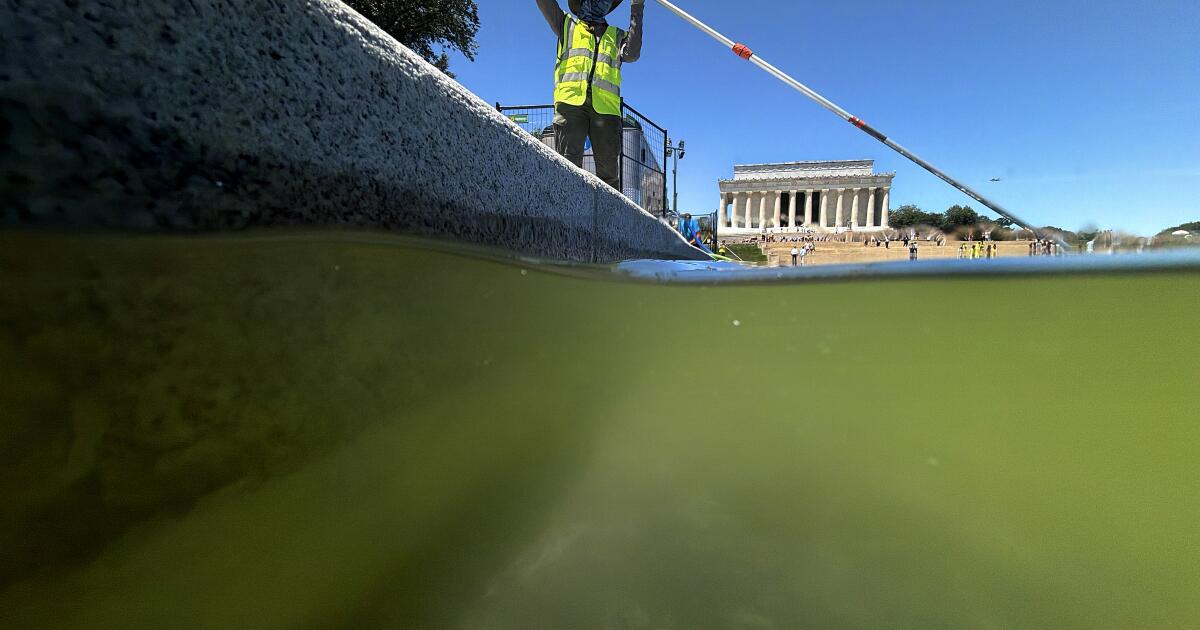
Here’s why the Lincoln Memorial Reflecting Pool went green so fast
-
 Sports5 minutes ago
Shohei Ohtani out of Dodgers’ lineup vs. Orioles for birth of his second child
-

 World17 minutes ago
Lebanese influencer organises World Cup event amid Israel’s attack on Leban
-
 News40 minutes ago
Air Force One, gifted to Trump from Qatar, arrives at Joint Base Andrews
-

 New York2 hours ago
Video: Fans Show Up to the Parade in Their Best Knicks-Themed Attire
-

 Los Angeles, Ca2 hours ago
Victims sought after man allegedly points gun at passing cars in Santa Clarita Valley
-

 Detroit, MI2 hours ago
Best barbershop in Metro Detroit: Finalists for this year’s Vote 4 The Best
-

 San Francisco, CA3 hours ago
How to watch San Francisco Giants vs. Miami Marlins

