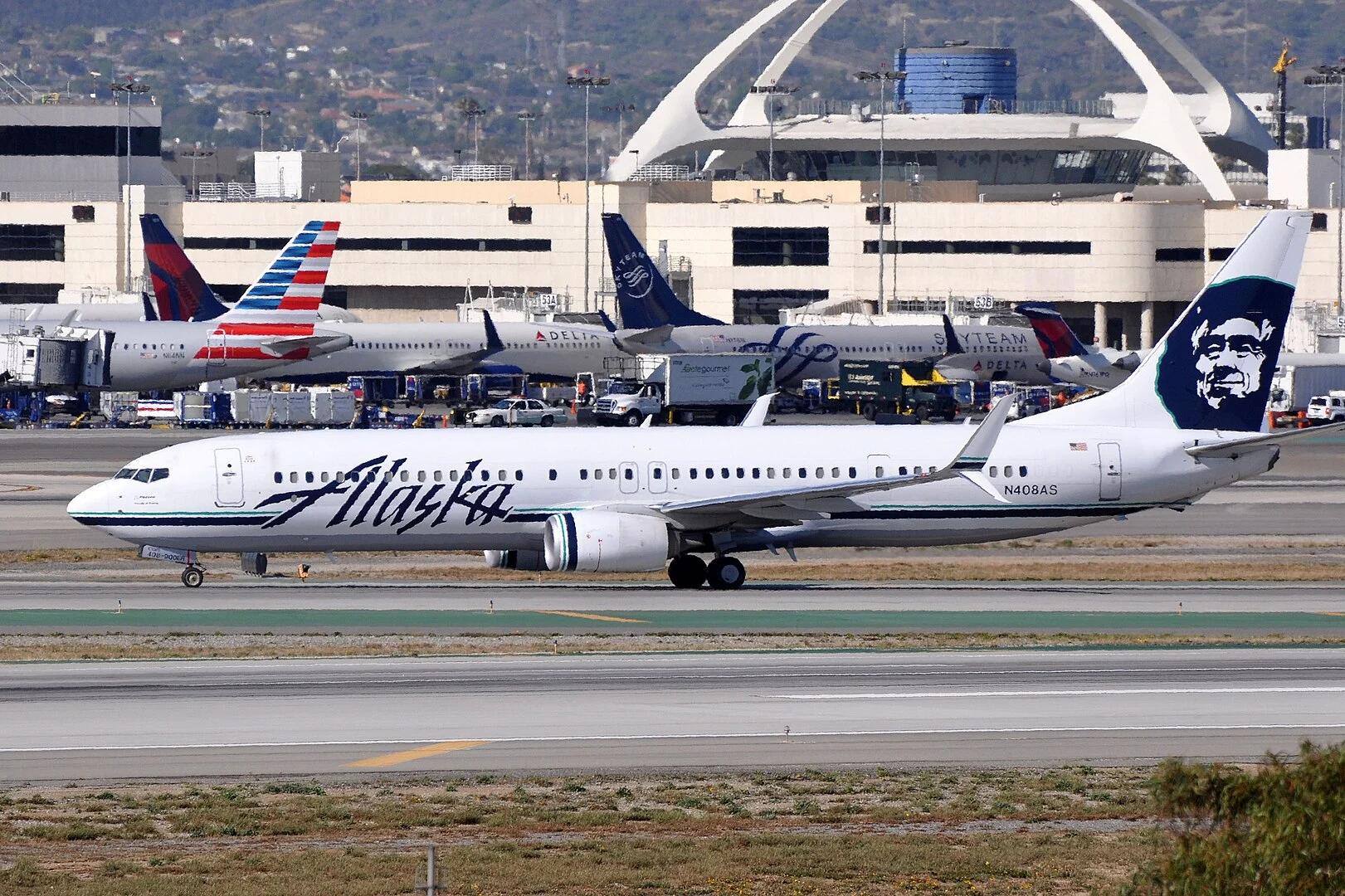
SEATTLE- Two Alaska Airlines (AS) planes collided while preparing for takeoff at Seattle-Tacoma International Airport (SEA), causing passengers to disembark and return to the gate. The incident involved a minor wingtip contact between a Boeing 737-800 and a 737-900, both scheduled for California destinations.
The collision occurred just after noon on Saturday (May 17, 2025) as ground-service tugs pushed the aircraft back from their gates. Flights to Orange County (SNA) and Sacramento (SMF) were impacted, though no injuries or significant delays were reported.
Photo: By Eric Salard – N408AS LAX, CC BY-SA 2.0, https://commons.wikimedia.org/w/index.php?curid=43543100
Alaska Airlines Planes Clip Wings at Sea-Tac
The wingtip collision between two Alaska Airlines Boeing 737 aircraft happened during a routine gate pushback at Seattle-Tacoma International Airport. The event occurred on a busy Saturday afternoon, a high-traffic period for departures.
According to Alaska Airlines, ground-service tugs were maneuvering both jets when the aircraft wings made contact.
Both jets were en route to California—one to Orange County John Wayne Airport (SNA) and the other to Sacramento International Airport (SMF).
Advertisement
While the incident did not result in any injuries, standard safety protocols required both aircraft to return to their gates. Passengers were promptly deplaned and later rebooked on alternate flights.
Kassie McKnight-Xi, spokesperson for the Port of Seattle, emphasized that the contact was minor and did not cause operational delays. The FAA confirmed it will investigate the circumstances surrounding the incident to assess compliance with aviation safety protocols and ground-handling procedures.
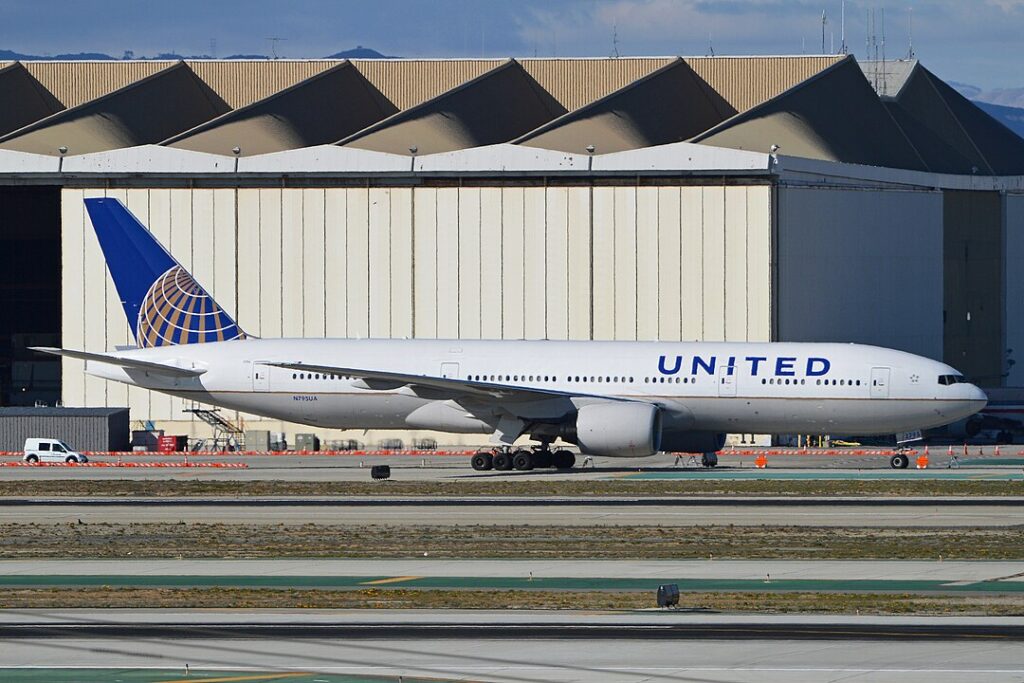
Photo: By Alan Wilson – Boeing 777-222 ‘N795UA’ United Airlines, CC BY-SA 2.0, https://commons.wikimedia.org/w/index.php?curid=33925191
Similar Incidents
Two United Airlines (UA) Boeing 777-300ER aircraft collided at San Francisco International Airport on May 6, 2025, forcing the cancellation of both trans-Pacific flights. The incident occurred at approximately 12:35 AM local time when the right wingtip of United Flight UA863 struck the left wingtip of United Flight UA877 during pushback operations.
UA863, scheduled to depart for Sydney Airport, hit UA877, which was bound for Hong Kong International Airport, as both aircraft maneuvered near Terminal 2, Gate 6. The collision happened in an area where air traffic controllers do not directly communicate with flight crews, instead relying on ground crew coordination.
The impact caused visible damage to both aircraft’s wingtips. All 522 passengers and 32 crew members across both flights escaped injury. United Airlines immediately deplaned passengers and began rebooking them on alternative flights.
On February 5, a Japan Airlines (JL) Boeing 787-9 collided with a Delta Air Lines Boeing 737-800 at Seattle-Tacoma International Airport. The Japan Airlines aircraft arriving from Tokyo struck a Delta aircraft preparing for departure to Puerto Vallarta.
Advertisement
In January, American Airlines (AA) experienced two separate collision incidents.
On January 10, two American Airlines Boeing 737s made contact at New York’s LaGuardia Airport when an aircraft under tow struck the wing of a parked plane.
Two days earlier, on January 8, an American Airlines Boeing 737-800 hit the tail of a United Airlines Boeing 787-10 during taxiing operations at Chicago O’Hare International Airport.
Stay tuned with us. Further, follow us on social media for the latest updates.
Join us on Telegram Group for the Latest Aviation Updates. Subsequently, follow us on Google News
By Alaska Division of Forestry & Fire Protectionon
The Starry fire picked up today and the Fairbanks Area initial attack helicopter dropped buckets of water during the heat of the day.
Despite the brief uptick in fire activity, the fire remained at 575 acres and resources were able to get hose completely around the fire.
Pioneer Peak Hotshots Forrest Boynton and Trapper Gephart, cut saw line around the west side of the Starry Fire. – Sam Allen, DFFP
Crews on the East and South side off the fire swept 200 foot outside of the fire’s edge, and found no heats. A grid is planned for tomorrow on the North side of the fire.
Advertisement
The City of Anderson is still at evacuation level, “Go.”
The Denali Borough has issued a ‘Ready’ evacuation order for “North 40” further west and across the Nenana River from Anderson, Alaska because of two other wildland fires in the wider area. The “North 40” includes residents north of Lightning Avenue and between the Teklanika River and the Nenana River.
The Type 3 Incident Management Team running the Starry Fire is prepared and planning to take on other wildfires in the area should it become necessary to engage.
‘Ready’ is the first step in the “Ready. Set. Go.” Statewide evacuation planning. Residents are encouraged to prepare necessary items such as pets, medication and important documents and monitor evacuation updates.
Firefighters completed a dozer line around the fire yesterday, they were helped in part by a burn scar from the 2013 Clear Air Force Base Fire, which helped slow the fire down.
Firefighters from Elmendorf Air Force Base helped secure a two-acre slop-over on the south side of the Starry Fire. – Sam Allen, DFFP
“The dozer line is not a scalpel,” Pioneer Peak Hotshot Sup. Kris Baumgartner. Fire activity could pick up and through embers across the line.
Advertisement
Two federal contract crews, Moose Heart and Clearwater, are expected to arrive Tuesday.
‹ DFFP responding to a new fire east of Delta
Categories: Active Wildland Fire, AK Fire Info, Alaska DNR – Division of Forestry & Fire Protection (DFFP)
Sign up for Task & Purpose Today to get the latest in military news each morning.
Advertisement
A Coast Guard search and rescue helicopter crashed Monday morning during a training flight in Alaska.
A Coast Guard MH-60 Jayhawk helicopter had four people onboard when it went down near Harbor Mountain in Sitka, a town in the Alexander Archipelago in southern Alaska several dozen miles south of Juneau. The Jayhawk and its aircrew are assigned to Coast Guard Air Station Sitka.
The crash happened Monday morning at around 10:07 a.m. local time, the Coast Guard said. It took nearly an hour for rescue crews to arrive on the scene. Rescue. However, no serious injuries were reported, a spokesperson for the Coast Guard Arctic District told Task & Purpose. All four crew members were taken by Sitka Fire and Rescue teams to Mt. Edgecumbe Medical Center in Sitka.
The cause of the crash isn’t known, and in a post on X, the Coast Guard Arctic District said that a “formal investigation will be conducted to determine the circumstances surrounding the event.”
Top Stories This Week
The Coast Guard Arctic District covers not only Alaska but the waters around it, including the Prince William Sound and waters in the Pacific.
Advertisement
Given Alaska’s remote conditions, local and military aircraft are often used to provide emergency search and rescue operations. Both the Coast Guard and National Guard regularly dispatch helicopters and fixed-wing aircraft to help people stranded or in crisis at sea.
In April, helicopters from Coast Guard Air Station Sitka and the National Guard conducted a mass casualty drill near the town, as part of what the Coast Guard called “a large joint exercise involving multiple government agencies and local organizations.”
Task & Purpose Video
Each week on Tuesdays and Fridays our team will bring you analysis of military tech, tactics, and doctrine.
Maureen Longworth and Lin Davis smile for a photo at their home on Douglas Island on Thursday, June 18, 2026. (Photo by Clarise Larson/KTOO)
It’s Pride Month and Juneau joins other communities nationwide in celebrating LGBTQ+ people.
One couple in Juneau, Maureen Longworth and Lin Davis, have dedicated their lives to advocating for LGBTQ+ rights. They met on a late-night dog walk at the Oakland Rose Garden in California in 1987. That was nearly 40 years ago, though Longworth remembers it clear as day.
“I had just gotten off work and was walking my dog, but it was like near midnight, I think, and bumped into Lin walking her dogs,” Longworth said.
A lot has happened since that first walk. The pair moved to Juneau in 1992 and now live on Douglas Island, retired with their dog, Reilly Wryly Raven. It’s been more than two decades since the pair joined a lawsuit that would change LGBTQ+ rights for state and municipal workers in Alaska.
Advertisement
It started because Longworth needed intensive dental work, and her employer wouldn’t cover it. Davis worked for the state’s Department of Labor and Workforce Development at the time, where straight married people could share employment benefits – like health insurance – with their partners.
Davis was denied the same benefits for her partner.
“We had to pay for it out of pocket, but my coworkers out at the Department of Labor and Workforce Development, they would have automatically had their marriage partners covered,” she said.
The women couldn’t legally get married in Alaska back then — Alaska was actually the first state to ban gay marriage through a constitutional amendment in 1998. And, though they’d gotten married in other states and held a ceremony with friends and family, it wasn’t recognized by Alaska.
So, in 1999, they, alongside eight other gay and lesbian couples and the Alaska Civil Liberties Union, sued the state government and the Municipality of Anchorage.
Advertisement
The lawsuit demanded equal benefits for domestic partnerships. It was filed right after the state amended its constitution to define marriage as only between a man and a woman.
Longworth said it felt necessary to take a stance.
“There was no protection for people to take care of their families,” she said.
In 2005 — six years later — they won. The Alaska Supreme Court ruled that denying spousal benefits for gay couples was an equal protection violation. It meant that local governments and the state were required to make employment benefits accessible to people in domestic partnerships.
It was unbelievable. We started screaming, and I was screaming at work, and telling all my coworkers,” Davis said.
Advertisement
“You called me, and I was in the library garage downtown, and I just started crying. We just couldn’t even believe it,” Longworth said.
Since then, the pair have spent decades continuing to advocate for LGBTQ+ rights in Juneau and Alaska, even after Davis was diagnosed with leukemia a year and a half ago. They do that in part by unapologetically sharing their relationship with the world.
“We come out to people like six times a day, just sharing what this is, as wife and wife, going through a pretty fatal diagnosis,” Davis said.
Davis said fighting for LGBTQ+ rights opened the door for them to live their lives openly and joyfully.
“In Hamlet, there’s that line, ‘to thine own self be true.’ So that’s what we’re all about. To thine own self be true,” she said. “Go forward, be brave. You may have to be brave every day, but steady forward.”
Advertisement
“You can see why I married her. Isn’t that the kind of person you’d want to live with?” Longworth said, laughing.
And they commend and appreciate the young LGBTQ+ people who are taking up the torch — to advocate for their community and live bravely.





 100vw, 600px”/><figcaption class=) Firefighters from Elmendorf Air Force Base helped secure a two-acre slop-over on the south side of the Starry Fire. – Sam Allen, DFFP
Firefighters from Elmendorf Air Force Base helped secure a two-acre slop-over on the south side of the Starry Fire. – Sam Allen, DFFP


