Alaska
Review: Alaska First Class Boeing 737 MAX (FLL-SEA)


For the first segment of my quick trip to Japan & Korea, I flew Alaska’s Boeing 737 MAX 9 first class on the 5hr50min midday flight from Fort Lauderdale (FLL) to Seattle (SEA). While I had reviewed Alaska’s Boeing 737-900ER first class before, this was my first time flying on one of the carrier’s MAX aircraft.
While of course not as good as a flat bed product (like JetBlue Mint), I otherwise consider Alaska first class to be as good as it gets in the United States when it comes to “standard” first class. The airline has more legroom than competitors, and on balance has better food, drinks, and service. While Alaska doesn’t have seat back entertainment, I appreciate the airline’s reasonably priced and fast Wi-Fi, plus the streaming entertainment.
So while it obviously isn’t to the level of business class on Asian or Middle Eastern carriers, Alaska is my first pick in the United States among non-flat bed products.
How I booked my Alaska first class ticket
This portion of my trip was about positioning to Vancouver, so I could catch my Korean Air Boeing 787-10 flight from Vancouver to Seoul Incheon. Since I was booking last minute, the best value was paying cash. So I booked the following in first class for $674.98:
10/05 AS517 Fort Lauderdale to Seattle departing 10:15AM arriving 1:59PM
10/05 AS1305 Seattle to Vancouver departing 2:59PM arriving 3:59PM
I’d consider that to be quite a good deal, given the distance of travel, plus that I was booking last minute. I also had an Alaska voucher to use, so my out of pocket was even lower than that. For what it’s worth, I credited these flights to American AAdvantage.
Alaska first class lounge & boarding
I arrived at Fort Lauderdale Airport at around 9AM. I headed through security, which took just a few minutes (thanks to TSA PreCheck), and found gate C9, where my flight would be departing from. My plane was already on the ground, as it had spent the night there, having flown in the evening before (12 hours is a long time on the ground!).
Boarding for my 10:15AM flight was scheduled for 9:35AM, 40 minutes before departure. Sure enough, that’s when boarding started, with first class being invited to board first.
I should mention that ordinarily Alaska first class tickets (paid with cash or miles) on nonstop flights of 2,100+ miles offer access to Alaska Lounges. However, there isn’t one of those in Fort Lauderdale. The good news is that thanks to this ticket I could use the excellent Alaska Lounge Seattle prior to my connection to Vancouver.
Alaska 737 MAX first class cabin & seats
Alaska’s Boeing 737 MAX 9 first class consists of a total of 16 seats, spread across four rows, in a 2-2 configuration. I’d say Alaska’s 737 MAX cabins feel fairly modern, though they’re definitely on the sterile side in terms of finishes. I selected seat 4F, the window seat on the right side in the last row (it was the last seat available to assign, though fortunately aligns with my preferences).

Alaska offers the Recaro CL4710 seat (since rebranded as the Recaro R5 seat) in first class, which is a pretty standard domestic first class seat. What sets this apart is how spacious it is — the seat has 41″ of pitch, is 21.3″ wide, and offers 5″ of recline.
As a point of comparison, other US carriers typically have 37-38″ of pitch in first class, and a few extra inches can make a big difference. In terms of seat comfort, two things come to mind. I appreciate how the seat has an adjustable head rest, which makes it easier to get comfortable. However, I do have to say that the padding in these seats isn’t as good as you’ll find on Alaska’s “classic” 737s, as those seats are very well padded.
Alaska doesn’t offer seat back entertainment, and instead on the seat back you’ll find a literature pocket plus a pouch for storage.
Underneath the pouch is a foot rest, which is such a simple but rare feature on a US airline, as I find it can help with getting comfortable if trying to rest in a seat like this.
In this configuration, the tray table folds out from the side armrest. You have to flip it over in order to extend the whole thing.
Alternatively, if you just extend half of it, then it can double as a personal device holder, for your own entertainment. I wish Alaska had installed a seat back device holder instead (or in addition to the one on the tray table).
Along the center armrest there are two cupholders, a small counter space, and also a pouch along the side of the seat.
Each seat has both a USB-A and AC power outlet, conveniently located along the front side of the center console.
As far as separation between cabins goes, there’s not a proper bulkhead between economy and first class, but instead there’s a partition above the seats, plus a curtain that’s used inflight.
As you’d expect on a 737 MAX, there are also individual air nozzles at each seat, plus large overhead bins.

While this product is hardly competitive globally, this is my favorite non-flat bed first class offered by a US airline, thanks to the extra seat pitch.
Alaska first class amenities
Waiting at each first class seat upon boarding was a blanket, which was pretty substantial. I like how Alaska offers these in first class, since many US airlines no longer do.
Furthermore, once settled in, pre-departure drinks were offered, with the choice of water, orange juice, or coffee. I had a cup of coffee, which was Alaska’s special Stumptown blend. I know this sounds silly, but I also love how Alaska has little creamer “sticks,” after taking three flights in a row in Latin America where there was no milk or cream.
Alaska 737 MAX first class entertainment & Wi-Fi
Alaska’s Boeing 737 MAX 9s don’t have seat back entertainment, but they do otherwise have a good setup. For one, Alaska has Viasat Wi-Fi on these jets, and a full flight streaming pass costs $8.
Perhaps this is a hot take, but I’ll take Alaska’s $8 Wi-Fi over Delta’s free Wi-Fi any day. Why? Well, because the speeds are much better, since not as many people use it. I do value being able to stay productive, so I’ll gladly pay $8 for better speeds, compared to an airline where almost everyone connects, and that greatly slows down speeds.
Alaska also has a large selection of streaming entertainment, with movies, TV shows, and more. While I can’t say I use streaming entertainment options often, I know others do value this.
Alaska 737 MAX departure from Fort Lauderdale
The boarding process was pretty efficient, despite a full flight. Boarding wrapped up by 10:10AM, at which point the main cabin door closed, and the captain added his welcome aboard, informing us of our flight time of 5hr50min.
Unfortunately it was a rainy morning in Fort Lauderdale, which made it difficult to take pictures out the window. We pushed back at 10:15AM, at which point the manual safety demonstration was performed.
We then started our taxi at 10:20AM.
The taxi out to runway 10L wasn’t very long, though we had to wait for several planes to land before we were cleared for takeoff. We finally got underway at 10:35AM. It was a long takeoff roll and a smooth climb out.
Despite the lack of turbulence ride, the seatbelt sign stayed on for roughly the first 40 minutes of the flight.
Alaska first class food & drinks
On this flight, lunch was the primary meal. Alaska allows meal pre-orders in first class, and you can find the selection for this flight below. Some of the options are only available via pre-order, and I appreciate the large variety of options available.
I also like how Alaska specifically publishes a drink list for first class (located in the seat back). Unlike American, Alaska has a legitimately interesting drink list, with everything from Straightaway Oregon Old Fashioned, to Crater Lake Hazelnut Espresso Vodka, to wines from the Pacific Northwest.
After takeoff, the flight attendant took drink and meal orders. I had a Diet Coke to drink, which was served with a pretty flavorful snack mix in a disposable ramekin.
The main meal was then served a little over an hour after takeoff. I had the linguine and shrimp, with linguine tossed in lemon, dill, and caper sauce, topped with grilled shrimp and green peas. This was served with a side salad that had mozzarella, sun dried tomatoes, and pesto, plus a bread roll. In terms of quality and presentation, I found this to be a significant cut above what I get on most US airlines.
After the meal, I decided to order an Old Fashioned. I’m not usually a drinker on domestic flights, but it was a Sunday afternoon, so why not. 😉
Once all passengers had finished lunch, the flight attendant came around with dessert, which was Salt & Straw ice cream, with the flavor being cinnamon snickerdoodle.

For the remainder of the flight, the flight attendant made multiple passes through the cabin with a snack basket, which had a variety of sweet and salty snacks.
Alaska 737 MAX first class lavatory
After the meal I checked out the lavatory. The first class lavatory is at the front of the cabin, and is tiny, as is standard on 737 MAXs.
Alaska first class inflight service
The flight attendant working first class on this flight was great — she was friendly and constantly checked on passengers, so that’s about all you can hope for on a flight like this. I do find Alaska flight attendants to be a bit better than their counterparts at most other US airlines, and I find they’re often a bit more personable.
Beautiful views enroute to Seattle
I spent most of the flight working and gazing out the window. I always select window seats when possible, since I’ll never take for granted just how gorgeous the world is from above. Crossing the United States on a daytime flight is such a lovely experience, watching the landscape evolve with each mile…
Alaska 737 MAX arrival in Seattle
This flight passed by surprisingly fast. At 12:45PM Pacific time, the captain was back on the PA to announce that we’d be landing in around 45 minutes. Around 20 minutes later, the seatbelt sign was turned on.
I’m sad I was seated on the right side of the aircraft, as the passengers on the left had an amazing view of Mount Rainier, which might just be the most gorgeous view in the lower 48.
At 1:25PM we touched down on runway 34L.
From there we had a roughly 10-minute taxi to our arrival gate, where we pulled in at 1:35PM, around 25 minutes ahead of schedule.
Once off the plane, I briefly visited the Alaska Lounge, and then took the quick flight up to Vancouver. I won’t be reviewing that flight, since there was no inflight service due to how short it is. So this series will pick up at the Fairmont Vancouver Airport, where I’d spend the night.
Bottom line
Alaska Airlines’ 737 MAX first class is a pleasant way to fly within the United States. The airline offers a bit more legroom than competitors, along with a foot rest and adjustable head rest. Alaska also has above average food, drinks, and service.
Obviously this product isn’t competitive globally, if you compare it to what you’d get on a comparable flight in some other regions. However, within the United States, Alaska is my favorite airline in markets without flat beds.
What do you make of Alaska first class on the Boeing 737 MAX?

Alaska
Man with same name as Alaska Sen. Dan Sullivan can appear on GOP primary ballot, state’s Supreme Court rules

The battle of the Dan Sullivans is on.
The Alaska Supreme Court ruled Monday that a man with the same name as Republican Sen. Dan Sullivan can challenge the sitting lawmaker in the state’s GOP Senate primary in August. The high court upheld a ruling from a lower court judge that cleared the way for Daniel J. Sullivan to appear on the primary ballot, reversing a decision by state officials earlier this month that he was ineligible because he was allegedly trying to confuse voters.
The state Supreme Court directed Alaska’s Division of Elections to decide how Daniel J. Sullivan should be listed on the ballot “within the confines of existing Alaska ballot design law.”
The conflict is taking place in one of the country’s most closely watched Senate elections. The sitting Sen. Sullivan is running for a third term, but former Democratic Rep. Mary Peltola is vying to challenge him, setting up what could be an unusually competitive race in a deep-red state that hasn’t elected a Democrat to the Senate in almost 20 years.
The senator has called his same-name competitor a “sham candidate” and accused him of trying to trick voters and help Democrats flip the seat. Daniel J. Sullivan — a retired teacher and former U.S. Forest Service employee from Petersburg, Alaska — has denied those allegations and insisted he is both qualified and genuinely interested in running for Senate.
About two weeks ago, the Alaska Division of Elections determined that the challenger Sullivan could not appear on the ballot, arguing his paperwork “was not filed in order to declare an actual good-faith candidacy, but was instead filed with a purpose to confuse or mislead.”
In a letter to the candidate, Director Carol Beecher pointed to the fact that Daniel J. Sullivan had initially requested to appear on the ballot as “Dan Sullivan,” the same name format as the senator. She also wrote that he hadn’t previously been affiliated with the state Republican Party, had a website design that “appears to be deliberate[ly]” similar to the senator’s campaign site and had worked with a political consultant with links to Democratic candidates.
Daniel J. Sullivan asked a state court to reverse the decision. On Friday, Judge Thomas Matthews ruled in his favor, finding the non-senator Sullivan met the requirements to run for U.S. Senate and the state didn’t have the authority to exclude him based on “good faith.”
“The court does not minimize the Division’s concern that voters should not be misled,” the judge wrote. But he added that “Alaska election law gives the Division tools to address that concern,” including regulating how candidates appear on the ballot.
With ballots set to be printed this week, the issue was appealed to the Alaska Supreme Court on an expedited basis, with both sides filing court papers over the weekend.
The state Division of Elections asked the high court to overturn Matthews’ ruling, arguing it would “leave Alaska constitutionally required to permit bad-faith ballot access.” The agency said it reached its conclusion about Daniel J. Sullivan after it received a complaint from the National Republican Senatorial Committee “credibly alleging” he was seeking to “cause voter confusion” and made a “bewildering” request to appear on the ballot with the senator’s middle initial.
If Daniel J. Sullivan is permitted to remain on the ballot, the state asked the Alaska Supreme Court to allow it to print his full name and list his party affiliation as “nonpartisan” to “ensure voters are not forced to guess between two nearly identical names.”
The Alaska Republican Party and several GOP-led states filed amicus briefs siding with Alaska.
Daniel J. Sullivan’s lawyers, meanwhile, argued the state “lacked any basis in Alaska law to exclude Mr. Sullivan from the ballot” and didn’t have the power to look into his “private motivations.” They wrote that state law doesn’t give officials the power to keep qualified candidates off the ballot due to potential confusion.
“[All] that Mr. Sullivan asks here is to be listed on the ballot, and the Division is obviously empowered to do so in a non-confusing manner,” his lawyers wrote.
Following oral arguments, the high court sided with Daniel J. Sullivan in a two-page order late Monday, and said it would issue a fuller opinion at a later date.
Jeffrey Robinson, an attorney for Daniel J. Sullivan, told CBS News his legal team is “grateful” for the Alaska Supreme Court’s decision to “affirm Judge Matthews’ well-reasoned, thorough order vacating the Division’s unlawful decision to exclude Mr. Sullivan as a candidate.”
“We expect that the Division will act in full compliance with existing Alaska ballot design law in its preparation of the ballots,” Robinson said in an email.
The senator’s campaign spokesperson, Nate Adams, said: “We’re disappointed in the court’s decision because as the sham candidate Dan J. Sullivan’s lawyers made clear in their legal arguments, the only reason he is running is to deceive voters and manipulate Alaska’s election system.”
“However, we are encouraged by the fact that the Director of the Division of Elections will be able to use her expertise to differentiate between the Petersburg fraud and the incumbent — Senator Dan Sullivan — to the benefit of Alaska voters,” Adams said.

The first Jesuit missionaries in Alaska sailed up the Yukon River in 1887. By the turn of the 20th century, the religious order of the Catholic Church had as many as 50 Jesuits in the state.
Now, only two remain. And by the end of June, there will be none.
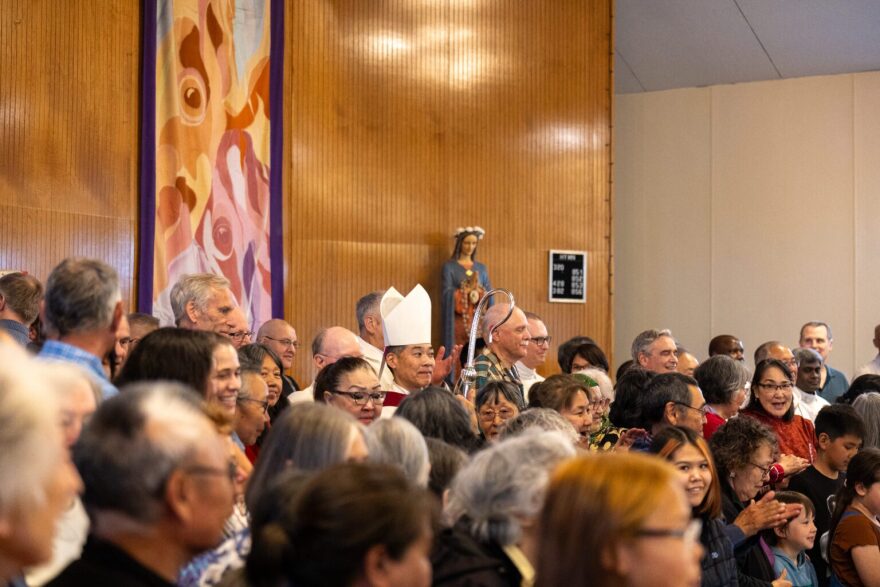
The Jesuits’ nearly 140 years in the state was honored at an event at Bethel’s Immaculate Conception Church on June 16. A procession of priests wearing long white gowns with red hems walked down the aisle to open the event. The Bishop of the Diocese of Fairbanks, Stephen Maekawa, thumped the ground with a shimmering silver staff known as a clozier as he approached the altar.
“My brothers and sisters, we gather together to celebrate this wonderful and blessed occasion to acknowledge the love of God and the work of God through the 139 year mission of the Society of Jesus of the Jesuit fathers,” Maekawa said to open the event.
A traditional Catholic mass followed, with readings in both English and Yup’ik. During the sermon, Maekawa acknowledged the vastness of the Fairbanks diocese, and the tremendous amount of work done by the Jesuits to establish it.
“All of the 46 churches of the Diocese of Fairbanks that we currently have were established by either the Jesuit fathers or by direction of a Jesuit bishop,” Maekawa said. “We have a long history of the Society of Jesus’ presence and ministry here in all of Alaska.”
The Jesuits are an order within the Catholic Church, akin to the Dominicans or Franciscans. They have a reputation for taking on some of the Catholic Church’s most remote assignments.
That missionary spirit brought the Jesuits to the Yukon River in 1887, where they built churches, schools, and ministries. Without their work, Catholicism may not have taken root in huge swaths of Alaska, particularly among Alaska Native communities.

But the Jesuits leave a complicated legacy. Their methods of converting Native people to the religion, particularly in the first half of the 20th century, created generational traumas still felt to this day.
Fr. Sean Carroll is the provincial of the Jesuits West Province, which oversees Alaska and nine other states.

“Thank you for all that you have taught us about who Jesus is and how to love and serve Him wholeheartedly,” Carroll said. “I also thank you for your patience with us. For there have been times when we have sinned and when we have hurt you.”
Missionaries, including the Jesuits, forcefully converted and assimilated Alaska Native people into Western culture and religion. Students at Jesuit-run boarding schools were forced to abandon their Native languages and physically punished when caught speaking languages other than English. Native dancing and drumming were also banned.
The Jesuits West Province maintains a list of 150 Jesuits with credible claims of sexual abuse against minors or vulnerable adults. A quarter of the accused Jesuits served in Alaska at some point in time.
“I ask for your forgiveness for all that we have done that was not rooted in Christ and love for Him, and for when we did not value your culture nor recognize the presence of God in you,” Carroll said.
Carroll gave the order to withdraw from the state last spring. A big issue was the recruitment of Jesuits willing to travel and serve in remote villages. He told the congregation that the Jesuits’ work would continue, just without a permanent presence.
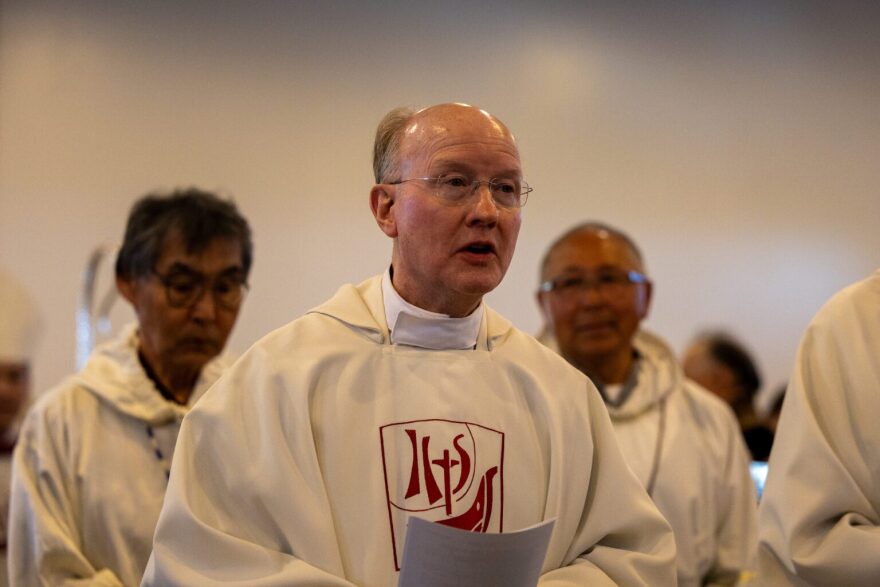
Fr. Rich Magner is one of the two remaining Jesuit priests in Alaska. His last day serving Chevak, Hooper Bay, and Scammon Bay is June 30.
“We all always knew coming in, or should have known, that we’re not going to be here forever. It’s going to be mission accomplished at some point,” Magner said. “And then we hand it off to the diocese that we’ve helped create, and so that’s a good feeling.”
Magner’s next stop is a Clinical Pastoral Education residency in Tacoma, Washington.
The other remaining priest, Fr. Tom Provinsal, first came to Alaska in 1968 to teach. A fond memory, he said, was meeting Elders that practiced traditional subsistence lifestyles.
“Some of the grandmothers, their fingers were just all bent with arthritis and stuff like that, you know, their whole lives they’ve been working out in the cold and the wet, doing food, sewing, all that kind of stuff,” Provinsal said. “I’d say I just feel very privileged to have come when I did come and to see that.”
Provinsal returned in 1975 as a priest and has served in the region ever since. After moving away, he plans to take a five month sabbatical. What happens next, he said, is in God’s hands.
Two lines formed in the aisle for communion at the end of the mass. After taking communion, Bethel’s Parish Administrator Susan Murphy gave a final thank you.
“It’s difficult to say goodbye to people who have been a part of our lives for so long,” Murphy said. “We know that you have done what was yours to do, and have taught us to do what is ours to do. We are grateful.”

Dominic Hunt, a Yup’ik deacon that flew in from Emmonak for the event, led the congregation through a final prayer.
“Bless them with your wisdom, that they may be a word of hope, a world in need. We ask this through Christ, our Lord. Amen,” Hunt said.
About 70 people posed for a photo on the altar – priests, deacons, parishioners, Elders and children — many of them smiling, some standing quietly.
The photo doesn’t tell the whole story. But it’s a moment when gratitude, grief, and memory all shared the same room.

JUNEAU, Alaska (KTUU) – The Supreme Court of Alaska will be taking up the case of the State of Alaska, Division of Elections v. Daniel J. Sullivan, Jr.
The oral arguments will be held Monday at 10 a.m. via Zoom, according to an order and opening notice.
The document also specifies that a decision is expected to be made before noon on Tuesday.
According to documents from the Division of Elections, the state must start printing ballots at noon on the same day.
This comes after an Anchorage Superior Court Judge ordered Dan J. Sullivan on to the ballot Friday.
See a spelling or grammar error? Report it to web@ktuu.com
Copyright 2026 KTUU. All rights reserved.
-
 Business3 minutes ago
Comcast is spinning off NBCUniversal media and entertainment assets
-
 Entertainment8 minutes ago
Alannah Keyser is latest fired ‘Love Island USA’ contestant to apologize for using a racist slur
-

 Lifestyle15 minutes ago
Chanel’s Bruno Pavlovsky on Reengineering an Iconic Brand
-
 Politics18 minutes ago
Supreme Court limits police use of cellphone data to find crime suspects
-
 Sports30 minutes ago
Teoscar Hernández returns, and Dodgers unleash 17-hit barrage in win over Athletics
-

 World38 minutes ago
DR Congo says 1,307 Ebola cases confirmed, including 377 deaths
-
 News1 hour ago
Michigan governor threatens to pull troops from D.C. if used for Trump task force
-

 New York2 hours ago
Metropolitan Diary Challenge Day 2: How to Write Your N.Y. Story

