Politics
Hilton and Becerra lead California’s unsettled governor’s race; Steyer faces elimination


As election officials continued tallying ballots Wednesday, Republican Steve Hilton and Democrat Xavier Becerra continued to lead in the unsettled race to replace termed-out Gov. Gavin Newsom, with billionaire Democrat Tom Steyer hoping for a surge in late-arriving votes to push him into one of the top-two spots to advance to the November general election.
Hilton, a British immigrant and former Fox News commentator, told reporters outside the state Capitol in Sacramento Wednesday morning that he was “very encouraged” by the latest results, though he stopped short of declaring victory.
“It does look as if change is coming to California, and that is good news for everyone, every small business, every working family, everyone who wants to see our state set back on track,” he said.
Becerra and Steyer did not hold public events as of Wednesday afternoon.
Election data analyst Paul Mitchell said it would be nearly mathematically impossible for Steyer to close the gap.
“As we start to get more data, the runway is going to get shorter and shorter,” he said.
He said Steyer, to finish in the top two in the primary, would have to get about 30% of the remaining uncounted votes while Becerra would need to be limited to 15%. The self-funded billionaire has “a very high hill to overcome, and the challenge gets steeper and steeper as we get more data from the counties,” Mitchell said.
Once mired near the bottom of a crowded pack of Democrats in opinion polls, Becerra, a former Biden administration cabinet member, rocketed ahead of his rival candidates after former Rep. Eric Swalwell dropped out of the race in April amid allegations of sexual assault and misconduct. The scandal triggered an upswing of voter interest in California’s once sluggish governor’s race and in Becerra, who seized the moment.
“Here in Hollywood’s hometown, we love a good underdog story,” Becerra told cheering supporters at his election night party at La Plaza de Cultura y Artes in downtown Los Angeles.
Becerra spoke about his Mexican immigrant parents and becoming the first in his family to attend college. Though a longtime California politician, Becerra said that his campaign for governor was outspent and that he faced calls to drop out of the race.
“The underdog stayed in the fight,” he said. “Like my parents, I never gave up. … Never stopped believing in the beacon-light goodness of California and thankfully, neither did you.”
Steyer, who spent more than $216 million of his wealth on the race, has not conceded defeat.
His campaign manager, Heather Hargreaves, wrote in a letter to supporters Wednesday that “we’re going to give democracy time to work. County election officials are still counting ballots and don’t expect to know how many people voted in total until” Thursday, when officials are required to report the estimated number ballots left to process.
The billionaire former hedge fund owner campaigned against the corporate and special interests that have a powerful presence in Sacramento and often spend heavily in elections, including this year against Steyer.
Billionaires “do everything they can to hoard their wealth and avoid paying taxes, and we see corporations continue to rig the system for themselves — raising your prices to juice their profits. Screw that,” Steyer said at his election watch party at the Regency Ballroom in San Francisco.
Other candidates in the race included Republican Riverside County Sheriff Chad Bianco and Democrats including former Rep. Katie Porter, San José Mayor Matt Mahan, former Los Angeles Mayor Antonio Villaraigosa and state Supt. of Public Instruction Tony Thurmond.
Villaraigosa, Mahan and Porter conceded the race Tuesday night.
California’s 2026 race for governor started slow but ended with a flourish, including the demise of a scandal-ridden Democratic favorite, the anointing of a Republican by Trump and Becerra’s unexpected rise from the depths of the candidate field.
Unlike gubernatorial elections in the last quarter of a century, this year’s race lacked a clear crowd-pleasing front-runner able to win over voters, such as movie star Arnold Schwarzenegger or Jerry Brown, a sage of the California electorate and scion of a storied political family. But it unfolded at a time when the state’s residents are overwhelmed by high housing costs, steep gas prices and overall unaffordability that threatens the “California dream” that once drew millions of people to the state.
“Normal people are not living and breathing politics on a daily basis,” said Tim Rosales, a strategist who ran Republican John Cox’s unsuccessful 2018 gubernatorial campaign. In today’s information-saturated environment, Rosales said, the race and its roster of “extremely milquetoast candidates” didn’t break through until the Swalwell scandal grabbed voters’ attention.
The 2026 gubernatorial primary has been one of the most unpredictable and expensive in decades and a race that was shaped early on by a number of heavyweight Democrats staying on the sidelines.
Though supporters urged them to run, former Vice President Kamala Harris, Sen. Alex Padilla and Atty. Gen. Rob Bonta passed on the race. It was in a state of limbo for months last year as Harris, one of the state’s most high-profile politicians, weighed whether to jump in.
“I don’t ever recall a playing field that looks like this one. Usually there’s a clear front-runner,” said veteran Democratic strategist Darry Sragow. “It’s easy to say that it reflects a lack of talent [but] that’s absolutely not true. Almost any of the candidates running could make a good governor.”
Still, candidates struggled for months to break through to voters.
In February, polls showed the crowded field of Democrats splitting liberal voters and opening a statistical possibility that the party would be boxed out of November under California’s open, top-two primary, which places all candidates on the same ballot. Only the first- and second-place finishers in the primary advance to the general election, regardless of their party affiliation.
Just when Swalwell appeared on the cusp of becoming the Democratic front-runner the San Francisco Chronicle and CNN published allegations that he sexually assaulted a former staffer and acted inappropriately with other women. Swalwell suspended his campaign.
It was Becerra who benefited the most. In less than two months, he vaulted from polling in the low single digits to the top of the field of candidates, according to surveys conducted by UC Berkeley’s Institute of Governmental Studies that were co-sponsored by the Los Angeles Times.
“Becerra caught lightning in a bottle,” Rosales said. “It could have easily gone to any of the other candidates,” but many had baggage. Videos of Porter losing her temper hurt her image, the source of Steyer’s wealth and his unbridled campaign spending weighed on voters’ minds, and Villaraigosa and Mahan were “more centrist than what most Democrats wanted, and so Xavier Becerra was really the safe choice,” Rosales said.
Before Democratic voters began to narrow down their choices, Trump endorsed Hilton in early April. It helped the former Fox News host break away from Bianco, his main GOP rival.
In the days before the primary election, the race solidified into a three-way contest involving Becerra, Steyer and Hilton.
Steyer stepped up his fight in the remaining days, seeking to squeeze into one of the top two spots by battering Becerra in ads and at campaign rallies as a politician propped up by corporate special interests.
“We cannot afford to have a governor who’s been bought off by Big Oil. Period,” he said at a Sunday rally in Los Angeles.
Corporations, along with labor unions and interest groups including the California Assn. of Realtors, had spent more than $18.7 million to boost Becerra, according to the election spending tracker California Target Book. Many of the same groups also gave money to a committee intended to attack Steyer.
As the election neared, Becerra sharpened his attacks against Steyer, calling the billionaire a “liar” and accusing him of trying to buy the election.
“We are not going to let a billionaire or Trump’s handpicked candidate take over this state,” he said during a Sunday rally in Long Beach.
If Becerra faces off with Hilton in November he’ll have a distinct advantage. Democratic voters outnumber Republicans nearly 2 to 1 in left-leaning California.
Winning the general election would make the 68-year-old Becerra the first elected Latino governor of California. At roughly 40% of the state’s population, Latinos are California’s largest ethnic group but have not been represented in the governor’s mansion since 1875, when then-Lt. Gov. Romualdo Pacheco was elevated to fill a 10-month vacancy.
Times staff writers Iris Kwok, Susanne Rust, Andrew Khouri and Christopher Goffard contributed to this report.

Supreme Court justices are asking lawmakers on Capitol Hill to increase their 2027 budget, with most of the additional funding earmarked for security. Ann E. Marimow, a New York Times reporter, explains why the justices say these measures are necessary to protect them from rising threats.

GOP scrambles to replace Sen. Lindsey Graham
Former Kevin McCarthy communications director Mark Bednar discusses the urgent political scramble to replace Sen. Lindsey Graham in South Carolina. He emphasizes President Donald Trump and Gov. McMaster’s need to quickly coordinate an interim appointment and rally around a strong Republican candidate for the impending special election. Potential candidates include Lt. Gov. Pamela Evette and Rep. Russell Fry, with warnings against infighting.
NEWYou can now listen to Fox News articles!
President Donald Trump teased who he may like to see as a long-term replacement for the late Sen. Lindsey Graham, R-S.C., as a special election to lock in a candidate for the seat fast approaches.
Private and public jockeying is already underway to snag Trump’s coveted endorsement in the special election, which is slated for Aug. 11, with two lawmakers already expressing interest in launching a campaign.
And as members of the South Carolina GOP congressional delegation and beyond line up for the race, the president hinted that he may already have a favorite: Rep. Russell Fry, R-S.C.
GRAHAM ALLY RIPS ‘THIRSTY’ REPUBLICANS JOCKEYING TO REPLACE LATE SENATOR
Sen. Lindsey Graham speaks with reporters aboard Air Force One with President Donald Trump and Secretary of Commerce Howard Lutnick on the way back to Washington, D.C., on Jan. 4, 2026. (Jim Watson/AFP via Getty Images)
“I think Russell Fry, a young congressman, is outstanding, and that could happen. I could see that happening,” Trump told Newsmax on Monday night. “I think he’s a very, very talented person.”
Trump backed Fry in his first bid for Congress in 2022, where he toppled former Rep. Tom Rice, R-S.C., in the primary. Rice was one of 10 House Republicans to vote to impeach Trump following the Jan. 6, 2021, riots on Capitol Hill.
‘THE HALLS OF THE SENATE ALREADY FEEL EMPTY’: TEARFUL THUNE HONORS LINDSEY GRAHAM AS SISTER TAKES HIS SEAT
“He took the place of somebody that was — I mean, he’s doing much better than the person that preceded him,” Trump said. “He’s been very popular in the state, so I think a name like Russell Fry is somebody you can watch out for and there are probably some others.”
Trump’s comments on Fry come after Politico reported that the lawmaker has been communicating with the White House about a run and was viewed as a top contender for the president’s stamp of approval. Fox News Digital did not immediately hear back from the White House or Fry on whether he’s being eyed for the special election.
LINDSEY GRAHAM’S SISTER APPOINTED TO SENATE AS GOP RUSHES TO PROTECT FRAGILE MAJORITY
Rep. Russell Fry, R-S.C., arrives for a House Republican Conference caucus meeting at the Capitol Hill Club in Washington on May 13, 2026. (Bill Clark/CQ-Roll Call, Inc. via Getty Images)
In the meantime, Trump threw his support behind Graham’s sister, Sen.-designate Darline Graham, to take over the lawmaker’s seat for the remainder of his term. South Carolina Gov. Henry McMaster appointed her on Monday, and she’ll be sworn in to the role Tuesday afternoon.
Trump said that he believed Graham would be there “only on an interim basis.”
CLICK HERE TO DOWNLOAD THE FOX NEWS APP
Meanwhile, Reps. Nancy Mace, R-S.C., and Ralph Norman, R-S.C., are eyeing the race, too. Norman has gone so far as to ask Trump for his endorsement.
Both Mace and Norman failed to clinch the GOP nomination for governor in South Carolina, which ultimately went to South Carolina Attorney General Alan Wilson, who toppled Trump-backed South Carolina Lt. Gov. Pam Evette.
Politics
Commentary: Two Lorenzos from Mexico. One fulfilled his American dream. ICE killed the other
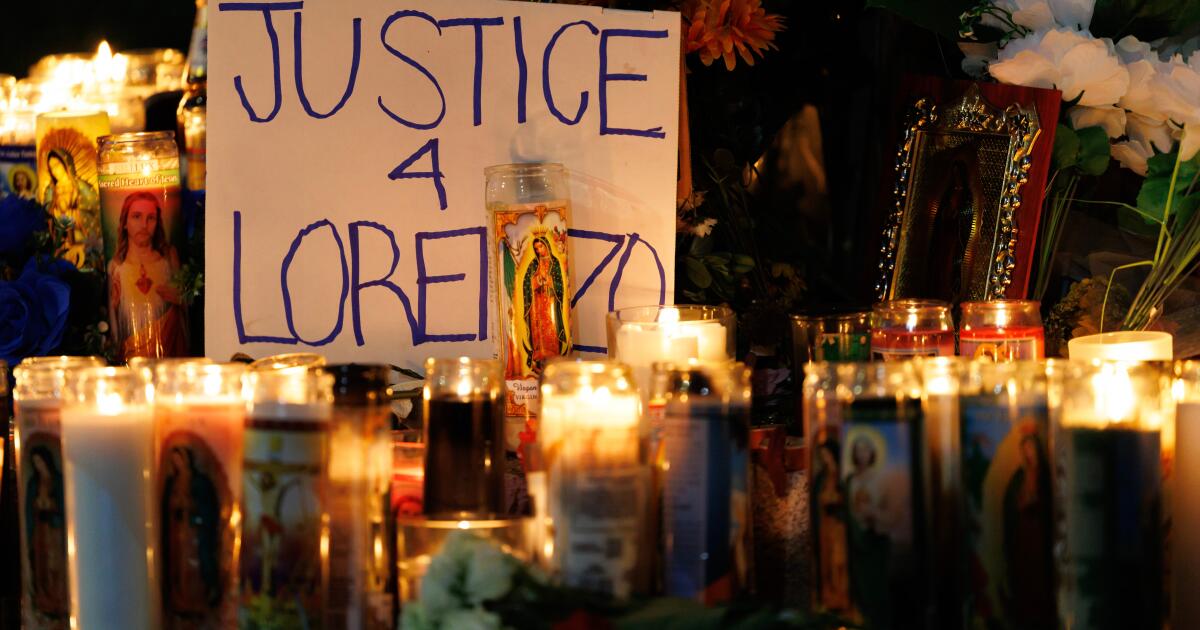
They were Mexican immigrants, both named Lorenzo.
They came to this country without papers as teenagers. Lack of legal status didn’t stop them from building beautiful lives — a wife, a home, a loving dog. A blue-collar job that paid the bills, weekend carne asadas with friends and family, children who followed their father’s example of hard work.
The Lorenzos enjoyed the fruits of their labor in their adopted land, even as they battled to become American citizens while politicians demonized immigrants as invaders and worse.
Lorenzo Arellano arrived in the United States in 1968 and didn’t get his citizenship until nearly 30 years later. Back then, the path to naturalization was far easier.
Lorenzo Salgado Araujo arrived in the early 1990s, when those opportunities were becoming severely limited.
Lorenzo Arellano is my father, a happily retired truck driver living in Anaheim.
Lorenzo Salgado Araujo, 52, who ran his own construction crew, was on his way to a job with his brother and two other men when an Immigration and Customs Enforcement agent shot him dead on July 7 in Houston.
When I see a photo of Salgado Araujo beaming in front of a cake with the number 52 on it at the well-kept home he built with his own hands, I’m reminded that we’ll be celebrating my father’s 75th birthday next month. When I see video of Salgado Araujo’s feet twitching on the ground with two ICE agents next to him as he bleeds out and moans for help, I weep.
Only geography, age and Donald Trump separated the Lorenzos. Even their children — he had three boys, while my father had two boys and two girls — are similar. The Salgado Araujos, like the Arellanos, are college-educated. The eldest son, Ronaldo, is a teacher like my sisters. He wears glasses like me and is now telling the story of his father to the nation, as I have for decades.
I write about my Papi as the puckish personification of immigrant America.
Ronaldo is eulogizing his dad way too soon.
“He wanted nothing else in life but to provide for his wife and see his sons become great people,” Ronaldo said proudly at a news conference the day after his father’s death — words I’ve always said about my Papi. “He did not deserve to be reduced to a headline of ‘Mexican man shot and killed by ICE’” — words I hope to never utter but can sadly see as a possibility given la migra’s unapologetic shoot-first approach and indiscriminate targeting of anyone brown.
Salgado Araujo’s killing came as part of the Trump administration’s newest deportation surge — the New York Times reported that the feds have arrested nearly 2,000 people a day since the end of June. The rate is higher than ICE’s campaign of terror last summer, yet it hasn’t drawn the same attention, fulfilling the promise of newish Homeland Security Secretary Markwayne Mullin that la migra would operate far more quietly and efficiently than under his reckless predecessor, Kristi Noem.
Those quiet times are over.
Ronaldo Salgado, son of Lorenzo Salgado Araujo, dries his tears while talking at a news conference on July 8 in Houston. His father was shot and killed by ICE agents the day before.
(David J. Phillip / Associated Press)
Vigils are popping up across the country in Salgado Araujo’s name. Stories about his life and death have replaced those about Mexico’s World Cup run on my social media timelines. They are heartbreaking, infuriating and a baleful reminder for Mexican Americans that these last five weeks of soccer, as joyful as they were, didn’t change our precarious status in this country under President Trump.
“He deserved to live a quiet life as a husband, a father and a job creator for dozens of men who also wanted the American dream,” Ronaldo said at the news conference through tears as his younger brother, Lorenzo Jr., comforted him. That their father never will — that the Department of Homeland Security is now smearing his name by claiming he “weaponized” his van by trying to run over an agent, even though video evidence proves no such thing — is the latest indictment against the Trump administration’s cruelty toward the undocumented.
Salgado Araujo wasn’t even the target of ICE’s operation. His family said he had applied for a work permit and was on his way toward finally obtaining legal status.
We should heed Ronaldo’s words about his father. As people protest and seek justice, we should also hail the life of Lorenzo Salgado Araujo the way we one day will hail the life of Lorenzo Arellano — as Mexicans who made it, challenges be damned. And we should continue to fight for immigrants who remain in legal limbo, afraid for their lives more than ever.
I called my father to ask how he felt about a tocayo — someone with the same first name — losing his life to la migra.
“I put myself in his place and lament that ese [that] Lorenzo couldn’t get the citizenship that I could,” Papi said in Spanish.
He remembered how immigration agents “did it with respect” when they caught him living in this country illegally in the 1970s and 1980s.
“They asked you for your papers, and if you didn’t have them, they put handcuffs on you, you got deported and that was that. None of these beatings or shootings that are happening now under Trump,” he said. The worst it ever got was when he said he was going to Los Angeles, and an agent snapped that he was going to L.A. but now had to return to Mexico.
Papi asked me what justification ICE has offered for killing Salgado Araujo.
“I hope they put those people who killed him in prison for many years,” he said with disgust. “Will they?”
I replied that probably wasn’t going to happen. ICE has shot and killed 11 people during Trump’s second term, both citizens and noncitizens, and scores more have died in immigration detention. No agents have faced charges for any of these deaths. The agents involved in Salgado Araujo’s killing didn’t even have dashboard cameras or body cameras, a convenient oversight that a Department of Homeland Security spokesperson blamed on “multiple government shutdowns.”
“Pues, Dios sabe que todo se paga en la vida,” my dad responded. Well, God knows you reap what you sow.

Ronaldo Salgado and Lorenzo Jr., sons of Lorenzo Salgado Araujo, hold a photograph of their father during a news conference July 8 in Houston.
(David J. Phillip / Associated Press)
Nothing can bring Lorenzo Salgado Araujo back to his loved ones. But I hope they find solace in his namesake, St. Lawrence. Tradition has it that Roman authorities roasted the Spanish deacon to death after Emperor Valerian demanded that he turn over the treasures of the Church. Instead, Lawrence presented the emperor with the city’s poor and maligned, insisting that he confront the oppression he had forced on them.
May we remember Lorenzo Salgado Araujo as a modern-day martyr, killed because our government refused to give him and so many others a chance at living in this country without fear.
May his name resonate through the ages as embodying the promise and tragedy of the American dream.
-

 Los Angeles, Ca30 minutes ago
Stabbing at Chino Hills liquor store ends in attempted murder arrest
-

 Detroit, MI54 minutes ago
A small group of citizens rally for mental health coverage in Detroit
-

 San Francisco, CA1 hour ago
1 dead, 2 missing after boat capsizes near Alcatraz in San Francisco Bay
-

 Dallas, TX1 hour ago
Death penalty off the table for man accused of beheading Dallas motel manager, prosecutors say
-

 Boston, MA1 hour ago
Chickadee, the popular Mediterranean restaurant in Seaport, is shutting down – The Boston Globe
-

 Denver, CO2 hours ago
Denver Nuggets 7-Year NBA Veteran Gets Honest On Peyton Watson
-

 Seattle, WA2 hours ago
Top 25 Seattle Seahawks Going into 2026 NFL Season: #17 Grey Zabel
-

 San Diego, CA2 hours ago
Tijuana earns spot in Little League World Series, hoping third time’s a charm

