Lifestyle
Vintage-obsessed millennial parents are driving L.A.’s booming kids’ clothing resale market


Kids’ vintage clothing sales are experiencing a remarkable boom at in-person markets and online, where prices for clothes for little ones have shot up on websites including Depop and Poshmark. Millennial parents are looking to outfit their kids in the clothes and TV and film characters they loved (or coveted) when they were kids.
The result? There’s a new generation of kiddos hitting the playground looking incredibly cool. Take Amari Case, a SoCal toddler who spent a Sunday afternoon this spring ambling around a vintage market in a West Hollywood warehouse clad in baggy jeans and a ’90s-era tee emblazoned with the “Dragon Ball Z” character Son Goku.
When she wasn’t scribbling on a Lorax coloring sheet, she’d been cruising around the market with her dad, Aaron Munoz Case, snapping up new pieces destined to make her the flyest kid at the preschool playground.
Neil Wright, from left, Kristine Nite Scalzo and Brandon Rosenblatt, co-founders of Elemeno Kids Vintage Market.
Showing off Amari’s new vintage satin L.A. Raiders jacket and tiny teal Grant Hill Detroit Pistons jersey, Munoz Case, who was also impeccably dressed, noted that while Amari went through a phase at about 18 months where she wanted to dress herself, eventually she gave up and went back to letting her dripped-out dad dictate her wardrobe.
Munoz Case found Amari’s first vintage piece at the Rose Bowl Flea Market and got the bug, going back every month to pick up something to add to his little’s wardrobe.
Trendspotters and researchers say Munoz Case isn’t alone in his quest. The market for kids’ vintage clothing has heated up precipitously over the last few years, perhaps hitting a boiling point in January when an Eeyore romper from the ’90s sold for over $3,000 on EBay. (It was new with tags, but one without tags still went for almost a grand about a month later.)
The thirst for tiny throwbacks is so popular that first-ever, all-kids market Elemeno — named after the “L-M-N-O” bit of “The Alphabet Song” and where Amari was toddling and shopping — drew 17 vendors and over 2,000 attendees over a single weekend in March. (There are plans for another Elemeno Kids Vintage Market pop-up later this year in New York, as well as plans to bring the event back to L.A. sometime next year.)

2

1. Cameron Scalzo, wearing a vintage McDonald’s T-shirt from the ‘90s, and mom Kristine Nite Scalzo. 2. Cameron Scalzo rocks an Avirex jacket from the ‘90s.
Eye Speak Vintage’s Kristine Nite Scalzo, who co-organized the event and is opening an all-kids vintage store in Pasadena this month, says she fell under the kids vintage spell in 2020 when she was pregnant with her son. She’d always been a vintage shopper for herself, so she knew she wanted to pass the passion down to the next generation. She started filling up her son’s closet, and soon enough, she found herself selling her other finds out of a bodega in her garage.
She has a by-appointment space in Pasadena now, where she draws everyone from Rihanna’s stylist to out-of-town moms who make a point to stop by on their way to Disneyland. “The community around kids vintage has really skyrocketed on Instagram over the past six years,” Scalzo says. “We want to know who we’re buying from. We want to know that we’re doing good with buying secondhand. And it’s a hobby for people that can turn into a possible business on the side. Because knowing there’s a big group that’s interested in vintage kids clothes, you can always pass an item [your kid outgrows] to someone else or resell it.”
Scalzo says some parents are out digging through bins at the Goodwill Outlet looking for the perfect piece, while others are content to pay up for, say, a ’90s Simpsons T-shirt or a mini-size Harley-Davidson jacket. Scouring the racks at the Elemeno market, most pieces cost $15 to $40, though there were special pieces pulled to the side in some booths with price tags that could make a parent’s eyes pop. (Think $275 for a set of well-worn Spider-Man overalls from the ’00s or $150 for a pair of Cross Colours denim shorts from the ’90s.)
In kids and adult vintage alike, mint condition is highly valued. No matter the era in which they were raised, kids tend to be messy. They get strawberry juice on their shirts or scuff up the knees on their Bugle Boy jeans. Vintage kids clothes that look pristine are more expensive, and while plain kids clothes do sell, items with characters on them or cool prints tend to draw more attention and dollars.
Brandon Rosenblatt, another of the Elemeno organizers, says he’s had his eye on a specific kids “Back to the Future” shirt for some time, but notes that it typically sells for about $1,000. He’s partial to McKids clothes for his daughter, from McDonald’s short-lived kids clothing brand, noting that he’s even snagged her a vintage official McDonald’s-themed aloha shirt from Hawaii, something he says he’s never seen anywhere else.
1

2

1. Siblings Amora and Milo Castilo wear vintage cowboy hats, jackets and chaps. 2. Thalia Castilo and her kids Amora and Milo.
Other collectors, he says, might be a little less obscure, leaning into mainstream characters such as Strawberry Shortcake or from ’80s and ’90s properties including “The Land Before Time” and “Rugrats.”
“A lot of millennials are having kids — like everyone who’s in their 30s and 40s — and they all want to put their kids in the same IP they grew up in,” Rosenblatt says.
“It’s the thrill of the hunt that gets everyone so excited,” Scalzo says. “Once you find that perfect nostalgic piece, you’re like ‘Holy s—,’ and you just want to chase that feeling again and again.”
Mia De La Rosa, a reseller who was at the Elemeno market, says that like Scalzo, she started buying kids vintage clothes when she was pregnant with her daughter, Liv, who’s 6 now, very into everything on PBS Kids and has a closet full of thrifted vintage garb covered in characters such as D.W., the annoying little sister from the ’90s show “Arthur.”
Everything Liv wears is “completely her style,” De La Rosa says. “She dresses herself every day and she gets compliments on what she’s wearing at school all the time.”
Other vintage-wearing kids — and in particular younger ones — might simply be sporting what their parents like or might just like the look of the shirt even if they don’t know what it’s advertising. (An 8-year-old boy at the Elemeno market, for instance, chose to wear a pristine T-shirt highlighting the ’90s Jim Carrey movie “The Mask” because it featured his favorite color: green.)
Derrick Broaster, a vintage enthusiast turned full-time reseller, says that while he chooses to put himself in clothes from the ’60s and ’70s, he outfits his two sons in clothes from the 2000s. (“How Bow Wow used to dress when he was a kid,” he says.)
Although his younger son tends to rebel against Broaster’s vintage picks, opting for whatever Spider-Man shoes happen to be in his eyeline, his older son has leaned in, letting his dad advise him on what vintage pieces could work and what would be the most stylish.
1

2

1. Julian, left, and Javier Gutierrez show off their vintage clothing. Javier says his mom always tells him to keep his vintage outfits clean. 2. Mom Priscilla Guzman, clockwise, Dad Javier Gutierrez and sons Julian and Javier Gutierrez enjoy the vibe of vintage clothing. Guzman says she’s been buying and selling kids’ vintage since her oldest son was born eight years ago.
Rosenblatt says a good portion of what vintage finds he sees in the market now has returned to the U.S. from places in Central America and South America or Asia where those pieces were likely sent decades ago after they were donated or given away.
“There’s a real underbelly of this vintage game with rag houses getting access to bulk product overseas and letting people sort through it,” he says. “There are companies now that rip through 20, 30 or 40,000 pieces of vintage clothing a week. It’s a really interesting ecosystem.”
For many kids vintage sellers, finding their stock is just as fun and interesting as getting it back into consumers’ hands. “Anywhere we can find clothes, we’re there,” says Matthew Carlos, owner of Long Gone Youth. He started selling vintage clothes 11 years ago, when he was 15, switched to kids vintage at 20 and has spent the last six years scouring flea markets, websites and swap meets.
“The kids market is definitely growing,” he says, “but I still feel like we haven’t even gotten close to where we can go. It’s just getting popular now, but the more events [like Elemeno] we can do, the more it’ll go mainstream.” Even now, some major brands like Gap and OshKosh B’gosh have recognized the interest in some of their styles from the ’80s and ’90s, moving to re-release the looks in limited runs.

Jackie and Frank Oropeza with daughter Rumi Mae shop at Elemeno Kids Vintage Market.
Kids resale is also leaning into streetwear culture. Rosenblatt, who worked in the streetwear industry, says that he’s noticed that a good portion of those interested in kids vintage — particularly, male shoppers — tend to be fans of streetwear brands like Supreme, Fear of God Essentials and Bape. At Elemeno, for instance, a good portion of the parents we saw pushing strollers were well-dressed dads seemingly on solo missions, something you don’t always see at kid-centric events.
“I just want my son to feel like I did as a kid,” said Justin Nguyen, while watching his toddler, Jayden, play with bubbles. “I want him to be happy, carefree and joyful, and I want to be able to spend time with him. My mom and dad were always working, even on the weekends. Now that I’m a dad, taking my son out on weekends to do stuff like this just seems like a blessing.”


California Attorney General Rob Bonta is one of several attorneys general seeking to stop the merger of Paramount and Warner Bros. Discovery.
Bloomberg via Getty Images/Bloomberg
hide caption
toggle caption
Bloomberg via Getty Images/Bloomberg
Stay up to date with our Up First newsletter, sent every weekday morning.
A dozen states, led by California, are suing to block Paramount from buying Warner Bros. Discovery in a Hollywood mega-merger that would unite some of the nation’s largest movie studios, television newsrooms, and other entertainment properties.
“The unlawful merger of these two entertainment behemoths would lead to higher prices, lower quality, and less content for film and television, harming movie theaters, basic cable distributors, and ultimately, audiences on every sofa and movie theater seat in the U.S.,” California Attorney General Rob Bonta said in a statement announcing the suit, which was filed in federal court in California’s Northern District.
The deal would give a wealthy family that has taken pains to show its allegiance to President Trump the effective ownership of the companies’ competing movie studios, streamers (Paramount+ and HBO Max), sports programming (CBS Sports and Turner Sports) and news divisions (CBS News and CNN) as well as a suite of cable channels, such as Comedy Central, VH1, MTV, TNT, TBS, HGTV and Discovery, among others.

The president has repeatedly praised Larry and David Ellison, the digital titan and his son who are the controlling owners of Paramount. And he has publicly urged the sale of Warner’s CNN to new owners.
“We’re trying to have CNN go in a normal path,” Trump told CNN anchor Jake Tapper yesterday at the end of an interview about the late Sen. Lindsey Graham.
In his statement Monday, Bonta said, “With this lawsuit, California and our sister states are fighting for free and fair markets, not rigged markets. America has no kings in government or our economy.”

Paramount is inviting in sovereign wealth funds from Saudi Arabia, Qatar and the United Arab Emirates as major investors who will forego voting rights. The financing proposal also envisions that the company will take on $80 billion in new debt. That will assuredly trigger major cuts throughout the combined company. Warner dramatically reduced its own debt after slashing budgets, but is still tens of billions of dollars in the red, which helped set the stage for Paramount’s unsolicited bid.
Bonta sees “red flags”
In late June, Bonta told MS NOW’s Jacob Sobroff that the deal presented “red flags in the air everywhere.” The acquisition is valued at approximately $111 billion, including debt and major (though nonvoting) investment stakes from Saudi and other sovereign wealth funds. Bonta has armed his office for potentially costly legal battles by hiring a new batch of lawyers, including some who left the U.S. Justice Department after Trump took office a second time. He also secured new funds from the state legislature specifically for antitrust enforcement.
The other states involved in the lawsuit are Arizona, Colorado, Connecticut, Massachusetts, Minnesota, Nevada, New Jersey, New Mexico, New York, Oregon, and Washington. An overlapping cadre of Democratic state attorneys general have sued to block the takeover of local TV giant Tegna by Nexstar, the nation’s largest owner of television stations. A federal judge in Sacramento has put the full integration of the two station groups on hold in advance of a trial that is scheduled to be heard a year from now.
Paramount has argued that the entry of streaming giants such as Netflix, Amazon and Apple into entertainment has altered the landscape, rendering such antitrust concerns obsolete. Anticipating the same vast shifts, Disney swallowed up most of Fox’s Hollywood holdings in 2019.
Any delay caused by the attorneys general could prove costly, securities filings show. Starting Oct. 1, Paramount has to pay Warner shareholders a “ticking consideration” of roughly $650 million for every 90 days the deal is set back. If the deal is not consummated by next June 4, Paramount will have to pay Warner $7 billion.
A Silicon Valley titan expands power in Hollywood
Though Paramount’s new chairman and CEO is Hollywood producer David Ellison, a past financial donor to the campaigns of Presidents Barack Obama and Joe Biden, the takeover bid was financed and guaranteed by Ellison’s father: Oracle co-founder Larry Ellison.
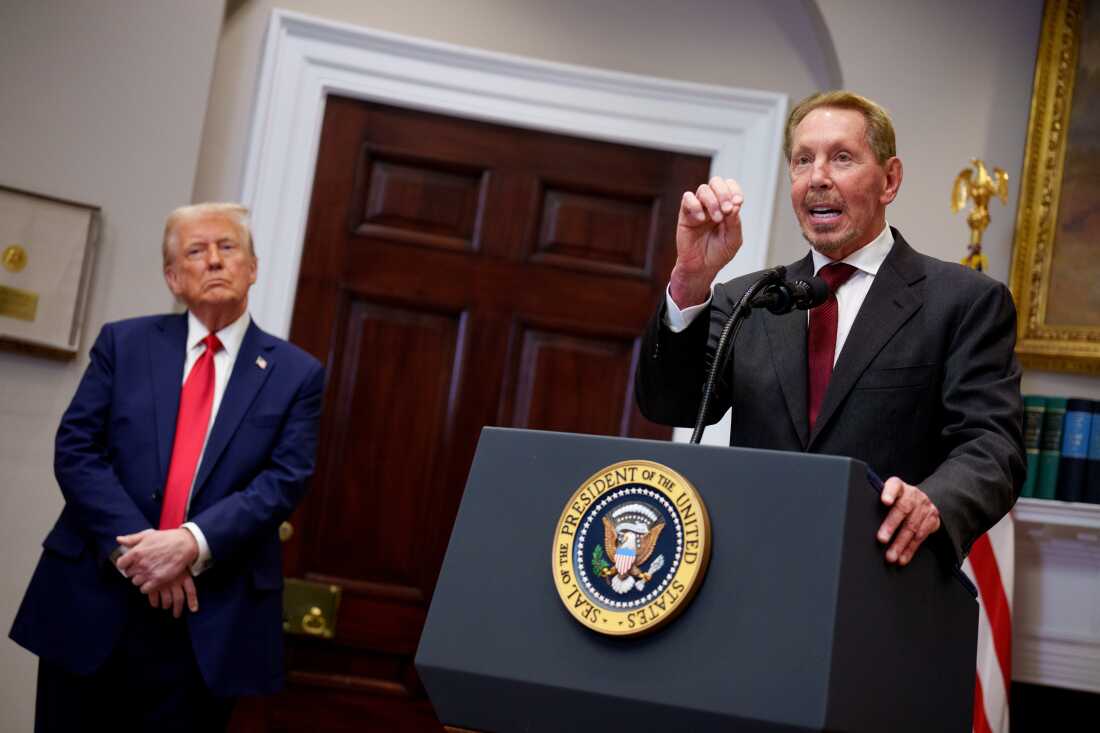
Oracle co-founder Larry Ellison, a friend and adviser of President Trump, is backing Paramount’s $111 billion plan to buy Warner Bros. Discovery.
Andrew Harnik/Getty Images/Getty Images North America
hide caption
toggle caption
Andrew Harnik/Getty Images/Getty Images North America
Larry Ellison is one of the richest people on Earth. He is also a Trump supporter and adviser — both formally and informally — serving, for example, on a board counseling the White House on artificial intelligence. Last fall, Trump made good on his plans to grant Larry Ellison and Oracle a controlling stake in TikTok’s U.S. operations.
The Ellisons took over Paramount just last summer, making concessions to Trump’s chief broadcast regulator and earning the president’s vocal support.
“The Ellison family, two great people, great people,” Trump said in March, ahead of a dinner David Ellison threw in Trump’s honor. “It’s a great family.”
David Ellison hired a new editor in chief for CBS News: Bari Weiss, founder of the center-right The Free Press. She arrived with a record of deeming mainstream media, including CBS News, to be too reflexively “woke” and anti-Trump. Her effort to reshape coverage has been met with a series of controversies, including firings and fiery resignations by CBS journalists accusing her of bias, which the network and Weiss deny. Bonta’s announcement did not focus on the combining of CBS News and CNN.
Given that Oracle provides the software skeleton on which much of the nation’s commerce and government runs, and that the Ellisons now control major media platforms and the digital data they gather, the family has the ability to create a vast reservoir of information about how people act online.
Trump’s remarks on the Paramount-Warner deal — and especially on CNN’s fate —represent a sharp break from past administrations. Predecessors both Republican and Democrat tended to respect the independence of regulators in the antitrust division of the Justice Department and the Federal Communications Commission.
Past Warner deals led to a trail of debt
Makan Delrahim, who is now Paramount’s chief legal officer, ran the Justice Department’s antitrust division during Trump’s first term. He led an ultimately unsuccessful effort to block AT&T’s takeover of TimeWarner, the precursor company to Warner.
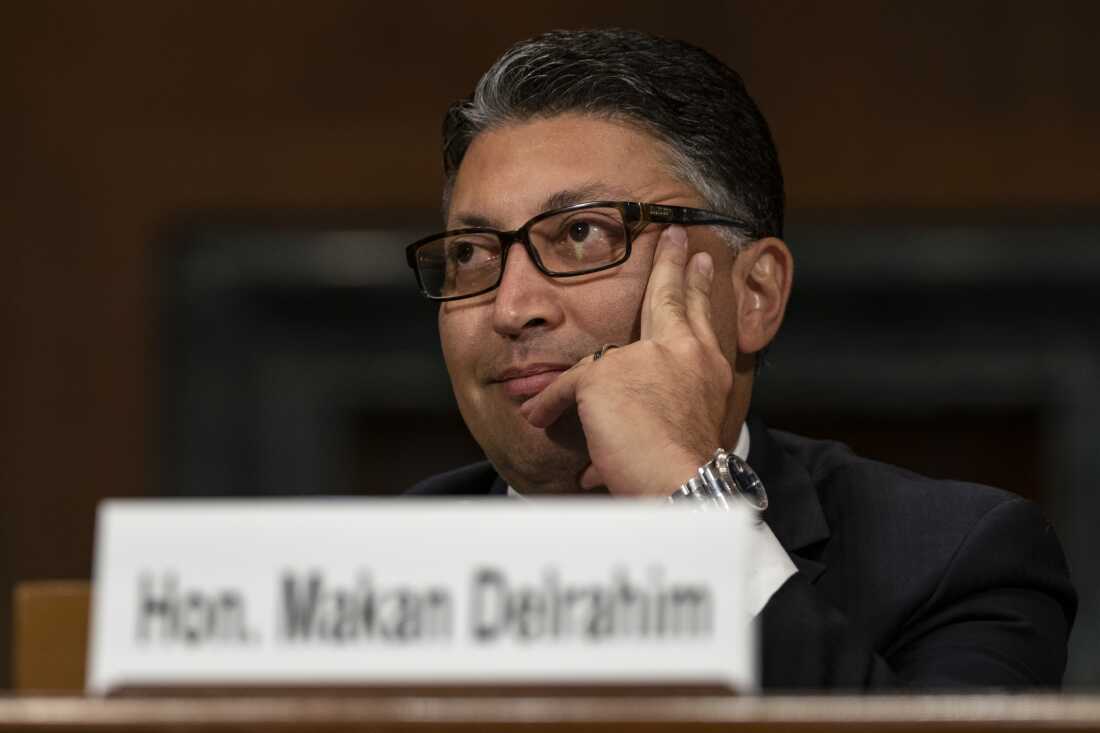
Makan Delrahim was U.S. assistant attorney general for the Justice Department’s antitrust division during President Trump’s first term. He is now the chief legal officer at Paramount.
Bloomberg/Bloomberg via Getty Images/Bloomberg
hide caption
toggle caption
Bloomberg/Bloomberg via Getty Images/Bloomberg
In retrospect, AT&T may have preferred Delrahim to prevail; the deal was brutally panned by analysts and the stock market. The telecom giant unloaded the media properties less than four years later. They were taken over by Discovery in a deal that burdened the new cable TV conglomerate with tens of billions of dollars of debt. Warner CEO David Zaslav was able to reduce it significantly, but not overtake it, and announced plans last summer to split the company in two in seeking to get ahead of an undesired offer from Paramount.
The Warner board initially struck a deal with Netflix valued at nearly $83 billion for much of the company, not including CNN and other basic cable channels. Then Paramount raised its offer for the whole company and Netflix pulled out rather than compete.
While the top British regulator has expressed qualms too, signaling a possible review that could delay the process, Paramount has won approval from the Justice Department and many regulators abroad. The Justice Department approved the acquisition last month after an eight-month review.
The Wall Street Journal reported senior officials at the Justice Department fast-tracked its process for approval before career attorneys, who were weighing filing suit to block the deal, could intercede. The outgoing antitrust chief denied that in an interview with Politico.
The FCC has not yet signed off. It is involved because Paramount holds broadcast licenses for the 28 local television stations it owns. The FCC is led by Brendan Carr, a Trump appointee and vocal ally who has endorsed Paramount’s bid.
“I think this is a good deal, and I think it should get through pretty quickly,” Carr told CNBC back in March.
Paramount has made minor concessions to try to win approval from officials in Europe. The European Union undertook formal reviews of both the consolidation of assets and its reliance on foreign investors, which are set to conclude soon.
The litigation from the states could tie Paramount up for far longer.
Lifestyle
As L.A. River morphs into impromptu stage for nature-loving musicians, gentrification fears remain

Yo-Yo Ma closed his eyes as he drew a bow slowly across his cello, playing the first notes of the Catalan lullaby “The Song of the Birds.” But this venue wasn’t like any vaulted concert hall he had toured globally.
At Maywood’s Riverfront Park, Ma was accompanied by the vroom of nearby traffic, cascade of a yucca rainstick and burbling hum of a water synth. An oblivious biker pushed past the world-renowned classical musician. The music flowed on.
Ma’s pop-up show in Southeast Los Angeles was part of his ongoing efforts to highlight people’s relationship to nature through music. He is among a new wave of artists who have been hosting shows along the L.A. River, a waterway with a complex history.
Yo-Yo Ma plays cello for a small group of artists and environmental advocates as part of the L.A. Phil Insight program, which aims to spark conversations around the arts.
(Halline Overby for InsightLA)
The river once terrorized Angelenos; its unconstrained flow was prone to flooding until most of its 51 miles were lined with concrete starting in the 1940s. While it’s been neglected, trashed and often forgotten over time, myriad governmental and nonprofit groups have been working for years to restore habitat, add park space and establish recreational elements (sometimes in conflict over the vision). And recently, creatives and activists, who dream of transforming it into a hospitable greenway, have been hosting arts events.
“Awareness around the river itself is changing,” said Maria Meija, executive director of L.A. River Arts, one of the organizations bringing attention to its history and cultural significance through public programming. She sees the serpentine stretch of the river as a natural highway that connects Angelenos from the San Fernando Valley to Long Beach. “We believe that if the river is properly activated as a green and cultural landscape, then Angelenos will fundamentally also get to experience Los Angeles in a different way.”

The River Solstice Festival was a family affair, with guests lounging on picnic blankets, watching puppet and opera performances and participating in birdwatching.
(Ariana Drehsler / For The Times)
Visions of those possibilities were realized on the summer solstice in mid-June at L.A. River Arts’ inaugural River Solstice Festival at an Elysian Valley park abutting a soft-bottomed area of the river known as the Glendale Narrows.
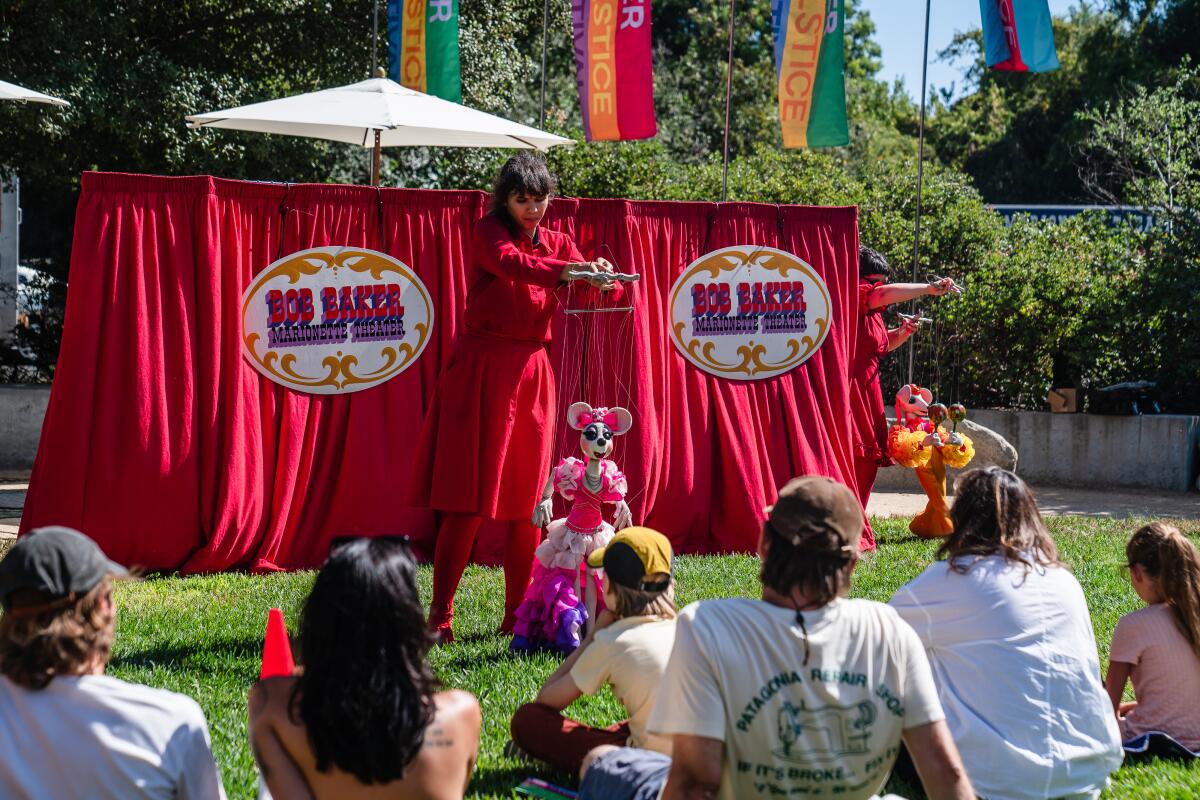
Children and parents applauded the performances by the Bob Baker Marionette Theater and opera singer San Cha at Lewis MacAdams Riverfront Park in what’s otherwise known as Frogtown. Attendees also gathered for guided bird-watching along the bike path by the water. Four-year-old Juni Wahab was entranced by the sight of the swallows and cormorants swooping low overhead and the rushing twists of water.
1
2

3

4

1. Bob Baker Marionette Theater performs at the River Solstice Festival, clockwise from top left. Meanwhile, attendees enjoy the park and river as skateboarders roll down the bike path. (Ariana Drehsler / For The Times)
“It’s going so fast,” Wahab said, wiggling and pointing as her aunt held on tightly for safety. “There are so many waves.”
A quick stroll upstream, a group of DJs unaffiliated with the family-friendly festival hosted a day party aimed at Gen Z and millennial attendees, perched on one of the channel’s outcrops. Roughly a dozen people at the if-you-know-you-know event grooved and shuffled to EDM music while kayak enthusiasts paddled by and locals fished for carp.
Dominic Tsoi drove from Orange County to spin at the open decks hosted by the DJ collective Helipad Society. “This event really resonated with me, because it mixes two things that I really love, music and being a part of nature,” said Tsoi, adding the commute was worth it. An indoors club setting can feel stifling, but outdoors is where Tsoi feels free.

DJs have been putting on pop-up events like this one at the L.A. River and sharing videos of their sets on TikTok.
(Ariana Drehsler / For The Times)
Just up the sloped bank, Antonio Solano and Erick Torres were sweeping outside their tent, where they live under the Glendale Freeway. Torres started noticing events at the river increase over the last three years.
“It gets people together,” said Torres, who’s been living above the river for over a decade. The music is a source of pleasure even as Torres and Solano stay vigilant to avoid city encampment sweeps. “It’s good, we enjoy it.”
Social media has driven interest in these DIY events as artists playing ambient music against a backdrop of verdant green have gone viral on TikTok.
“The attention has expanded to people who otherwise wouldn’t have given the L.A. River a second thought,” said Noah Klein, a lifelong Angeleno who has hosted popular river jams over the last two years through his Living Earth public art series.

Erika Apelgren wears a flower crown that she made at the River Solstice Festival.
(Ariana Drehsler/For The Times)
People don’t need approval to host these impromptu gatherings, said Dash Stolarz, director of public affairs at the Mountains Recreation and Conservation Authority. The park agency oversees commercial use of the L.A. River recreation zones in Elysian Valley and the Sepulveda Basin, another section of soft-bottomed riverbed.
In her 25 years on the job, this was the first time Stolarz had heard of people using the riverfront for mini concerts. She was excited by the ingenuity of artists; as long as people aren’t charging for events, they don’t need permission.
“It’s exactly how we envisioned people enjoying the river,” Stolarz said. “We want people to use the river like a park.”
Though unlike a regular park, the L.A. River is primarily treated as a flood control channel, so park rangers carefully monitor for rain when the recreation zones open for leisure, like kayaking, during the summer.
While appreciating the L.A. River can be a good thing, social media algorithms can flatten the context around the waterway, particularly when it comes to demographic changes in nearby neighborhoods.
“The City of L.A.’s greatest skill is the erasure of its own history, and the L.A. River kind of feels like the perfect encapsulation of this,” Klein said.
Once home to mostly working-class Latino families, neighborhoods along the river in northeast L.A. have seen home prices surge for years. To preserve the history of these neighborhoods, Clockshop, an arts organization, has been collecting interviews with locals as part of a multimedia oral history project since 2023. The project includes everything from videos of an Indigenous musician performing a song about water in the Tongva language to brothers worrying about the future of their family’s 60-year-old pickle business in the face of gentrification.
Jon Christensen, director of the Laboratory for Environmental Narrative Strategies at UCLA, said river revitalization can be part of a “green gentrification cycle” as new development pushes out old communities. Like the chicken-and-egg paradox, it’s hard to tell which comes first: the amenities surrounding the L.A. River or the more affluent people seeking them.
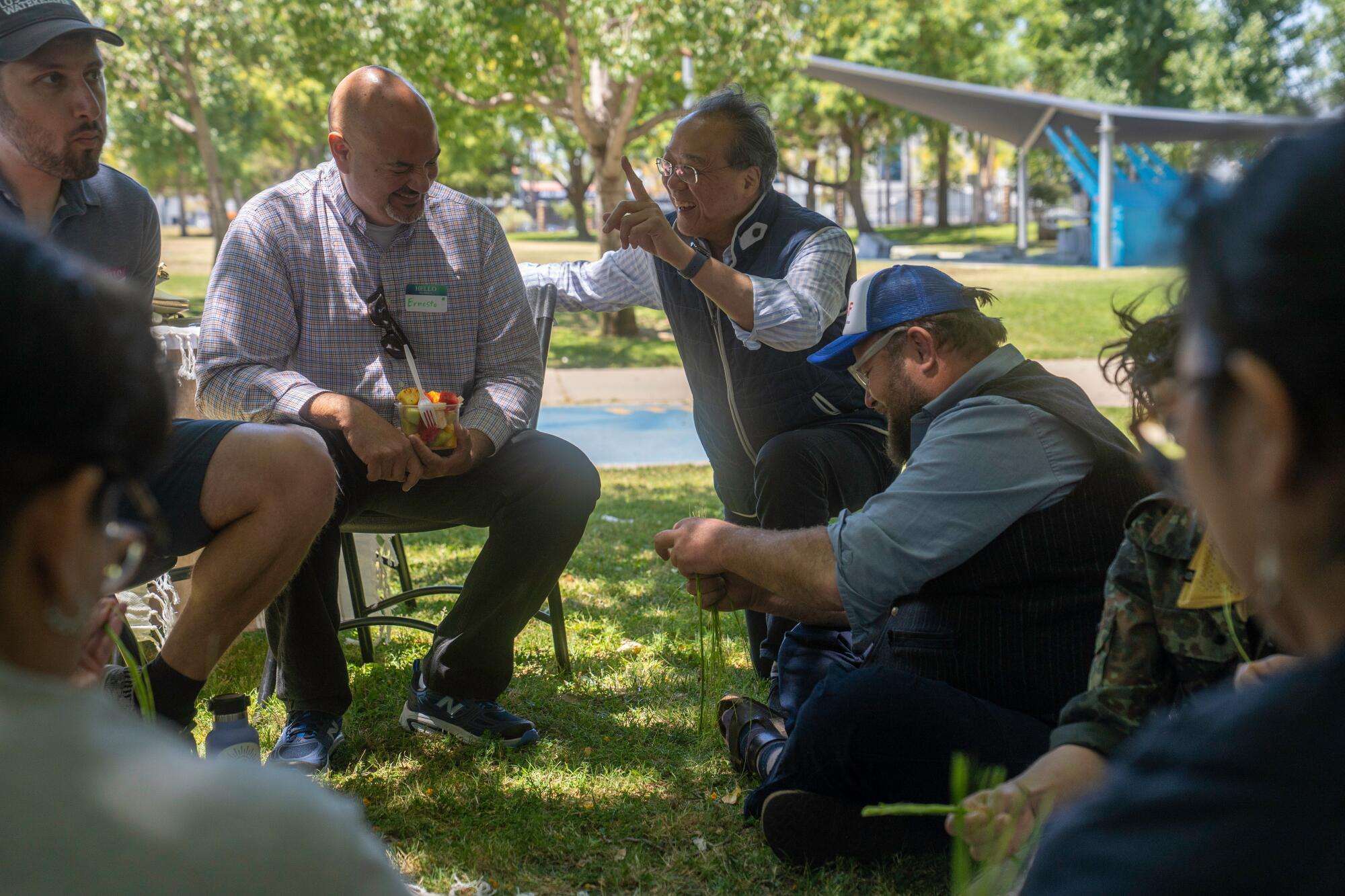
Yo-Yo Ma, who hosts a podcast called “Our Common Nature,” chats with attendees at his intimate river concert. Human connection to the natural world is among his passions.
(Halline Overby for InsightLA)
Christensen hopes artists engaging with the river spurs conversation for more equitable green investments that benefit communities and the environment. “When people are more connected to nature, they want to support nature more,” Christensen said of his studies on how people connect to the outdoors. “It’s really kind of a virtuous cycle there.”
Cindy Donis, a water organizer with East Yard Communities for Environmental Justice, said artwork can also raise awareness around inequities. While there are aspirations to turn the river into a greenbelt, nightmarish pollution incidents have still haunted Southeast L.A. communities.
Ma’s performance was nearly canceled in May due to 25,000 gallons of crude oil that spilled into the L.A. River after a pipeline rupture in Boyle Heights. Weeks later, the Lineage warehouse fire sent even more debris and pollution downstream. Donis said multiple people reached out with complaints of a foul smell emanating from the river. Miles away, some at the River Solstice Festival wore masks due to poor air quality caused by the fire.

Charles Kelley with his daughter Zirah Kelley pose along the L.A. River bike path near the River Solstice Festival.
(Ariana Drehsler/For The Times)
Earlier this year, East Yard Communities for Environmental Justice held an exhibition at Art Space Huntington Park called “We Are Water” to uplift local Indigenous artists. “Art really allows and embraces healing,” Donis said. “It’s another tool that allows us to process these feelings and get closer to the solutions as a community.”
The L.A. River inspired Arturo Gonzalez to found his arts education nonprofit that focuses on gang intervention among young people in East L.A. As Ma performed in the park, Gonzalez stood in the river basin, spray-painting in neon-pink blockbuster letters the name of his organization, East Side of the River, onto pillars under Slauson Avenue.
As a teenager in the early 2000s, Gonzalez was involved in gangs that would tag the gray walls of the L.A. River, but his passion for graffiti and Chicano art eventually led him out of those circles.
“The river was a safe place to paint, where you could sit and spend the day learning colors, composition,” he said of illicit tagging as a teenager, which eventually led to his public art work. “There’s a thin line between vandalism and art.”

Arturo Gonzalez spray-paints the name of his organization, East Side of the River, which focuses on gang intervention.
(Halline Overby for InsightLA)
This time, Gonzalez arrived with permission from the county and painted on a detachable fabric in case the mural needs to be removed.
“The opportunity to get into the river and paint again was like a dream,” he said. He seeks the input of local residents in his planned projects so they can participate in beautifying their neighborhoods. “We call it wall medicine for the community.”
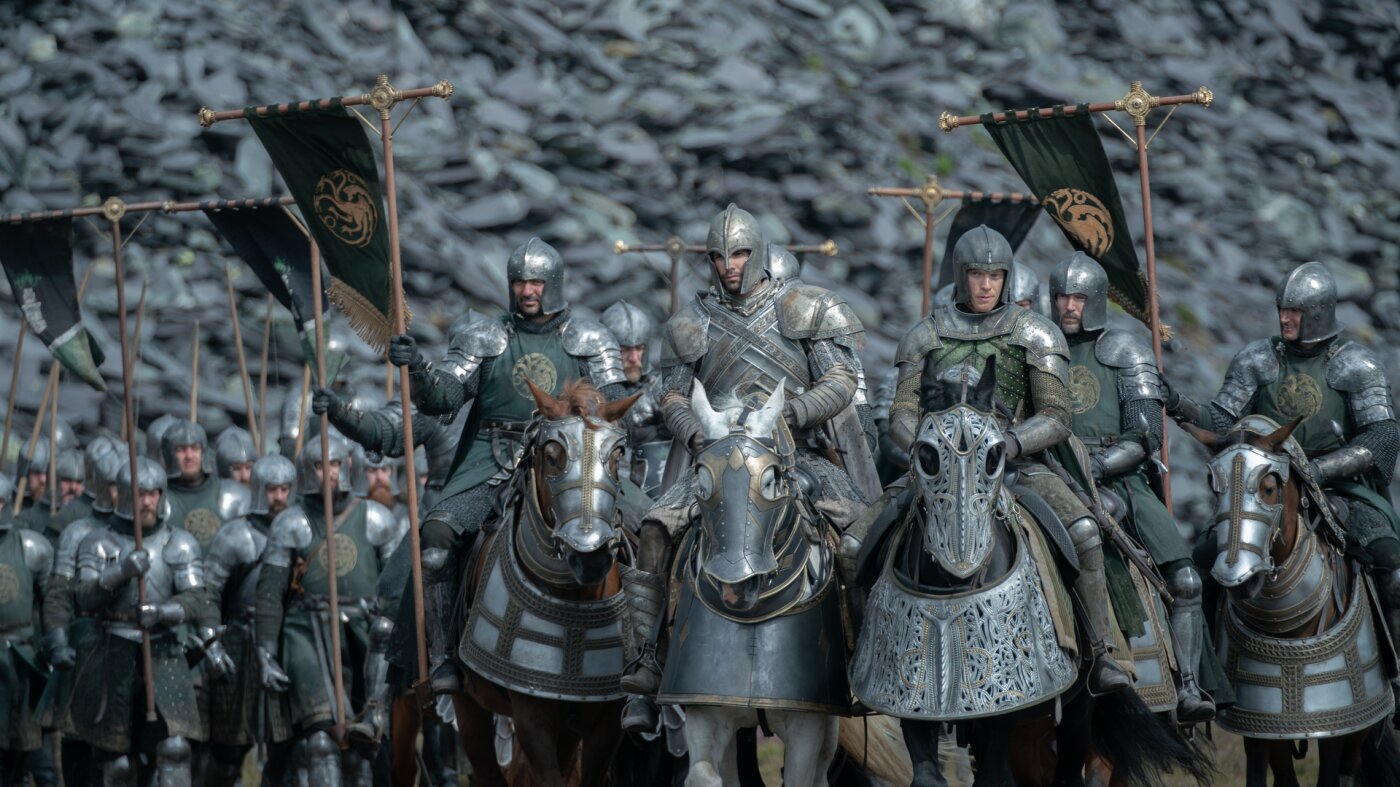
Sers Criston Cole (Fabien Frankel) and Gwayne Hightower (Freddie Fox) discuss their phalanx strategy. Heh.
Theo Whiteman/HBO
hide caption
toggle caption
Theo Whiteman/HBO
This is a recap of the most recent episode of HBO’s House of the Dragon. It contains spoilers. That’s what a recap is.
Credits! And the only addition to the Die, You! Tapestry we get this week is difficult to decipher at first. Looks to me like a woman whispering into the ear of a stout gentleman with a thin, John Waters mustache. Alys and Daemon? Alys and Aemond? Or — OK, no, wait, I see it now — it’s Aemond, murdering my sweet babboo Ser Simon Strong back in episode 2. Wow. Cold. Way to rub it in, you vindictive textile, you. Now I’m glad to see you get torn in half each week.
In the small merchant town of Tumbleton, the Hightower army is going house-to-house, forcibly quartering troops in private homes, ’cause Westeros don’t got a Third Amendment.
In the home of the local lord and lady, Ormund Hightower has set up shop — if we’re careful to define “shop” as “plopped his bathtub in the middle of their living room.” In a power move, he stands up from the bath he’s taking to show us his hindquarters (and show the nobles his frontquarters), while pompously instructing his young squire on the proper way to deal with “those beneath you.” Presumably he’s not referring to his frontquarters.
He receives some bad news — the Baratheons haven’t sent troops, and Aemond still hasn’t shown up to Harrenhal with Vhagar. (This last bit happened at the end of episode 2, but news-by-raven travels slow.) And that’s when we get the reveal the show’s been sitting on — this squire, the red-headed kid who’s been standing by Ormund’s side since the season began, is actually Daeron, youngest son of Alicent, brother to Aegon, Aemond and Helaena, and the rider of the dragon Tessarion.
RIP, spheres of the realm
At Rhaenyra’s Teeny Tiny Council chamber in the Red Keep, Orwyle suggests sending the riverlord army (which is currently marching to Kings Landing) to take Tumbleton back. It would cost fewer lives than raining down dragonfire, he argues. And with that suggestion, he’s back in the Queen’s good graces. (There’s a brief exchange where Orwyle reaches for one of those weird little billiard-ball token thingies to register his attendance or whatever, only to get shut down, and informed that they’re “relics of the old regime.” Too bad; I’ll miss those fetishistic, tactile bits of business, but I hope they find a place in a Kings Landing history museum. It was one of those tchotchkes, after all, that took out poor timorous Lord Beesbury, back in the day. Never forget.)
Mysaria reminds the Queen of their money troubles, and suggests appointing a Master of Coin to throw under the bus. Rhaenyra remembers meeting the toadyish Ser Torrhen Manderly last week; he’s about to fail upwards.
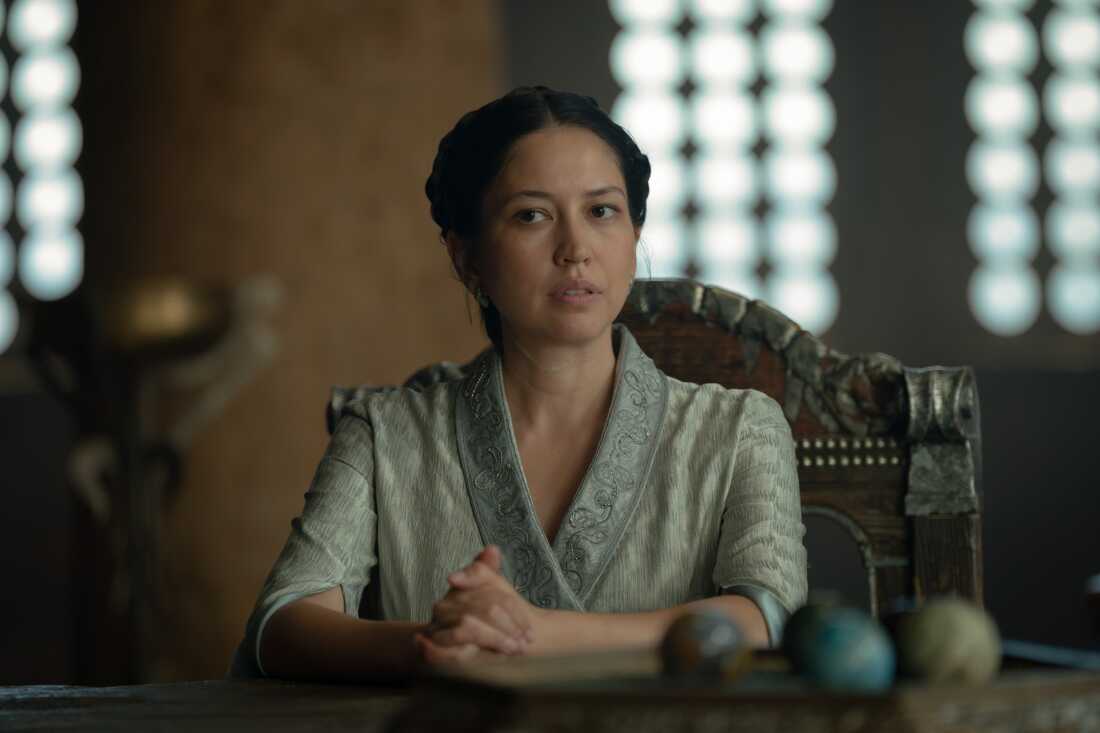
Mysaria (Sonoya Mizuno) is playing for all the marbles. Which are literally marble.
Ollie Upton/HBO
hide caption
toggle caption
Ollie Upton/HBO
We get a brief reunion between Rhaenyra and her prisoner Alicent (a Rhaeunion!) wherein Alicent explains that she sent Daeron away to Oldtown when he was a baby because she didn’t want him to grow up to be like his brothers. Which is all well and good, but if it means he instead grows up to be like the haughty Ormund Hightower, that’s one bullet that didn’t really get dodged so much as it missed vital organs as it passed through the torso.
As Rhaenyra leaves, Alicent tells her that Ormund has a strong sensitivity to odors. The show treats this information like he’s the Death Star and the smell thing is his tiny exhaust port, so it better come up later as the key to his undoing.
Corlys, still smarting from Rhaenyra’s snubbing of his sons, peaces out of the capital and back to his little island, telling Alyn to take over for him.
Don’t let the Sunfyre go down on me
Larys and Aegon make it back to Rook’s Rest, where they find the body of Aegon’s dragon Sunfyre. Aegon insists that the beast is still alive, while Larys counters that it is no more, it has ceased to be, it has expired and gone to meet its maker, it is a stiff, bereft of life it rests in peace, if you hadn’t nailed it to the perch it’d be pushing up the daisies, its metabolic processes are now history, it’s off the twig, it’s kicked the bucket, shuffled off its mortal coil, rung down the curtain and joined the bleedin’ choir invisible, this is an ex-dragon.
Or, you know. Words to that effect.
They head into the war-ravaged town, seeking food and shelter. Aegon is taken aback by the squalor — and by the decaying body of Meleys, the dragon he fought last season. They get jobs, despite Aegon totally beefing the interview with his imperious Aegonosity.
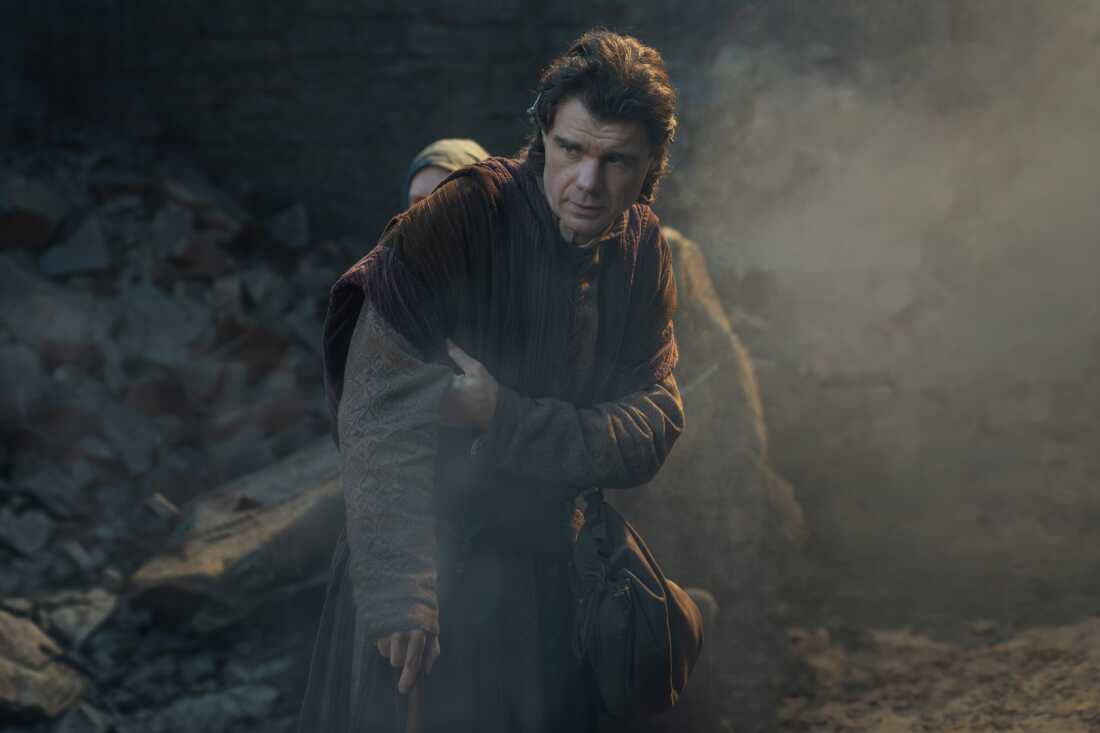
Have you seen Larys (Matthew Needham) do his Richard III? His discontent is hella wintry.
Theo Whiteman/HBO
hide caption
toggle caption
Theo Whiteman/HBO
Larys tries to convince him that Rhaenyra pronouncing him dead is a good thing, as it will make his eventual return to the throne a much better story. The ex-king then suffers a few more debasements at the hands (and feet) of the dude running the camp, and here’s where I started to worry that the writers are only subjecting him to all these indignities to set him on a redemption arc.
Will it all humble him? Will he suddenly realize how much the people are suffering, and will it move him to transform into a more just, caring, empathetic Aegon 2.0? I, for one, dearly hope not, because Shallow Jerkface Aegon is fun, and I have no confidence that some future Noble, Kind, Triumphed-Over-Adversity Aegon will be the same.
Criston Cole, Gwayne Hightower and the rest of their motley band of Team Green soldiers arrive at Harrenhal, expecting to celebrate the fact that Aemond and Vhagar have finally shown up. They do find the ashes of the small contingent of the Black garrison Daemon left behind, but are informed by Alys Rivers that Aemond hightailed it back to Kings Landing because Rhaenyra has seized the throne.
This news leaves Gwayne feeling wry and Criston feeling mopey. So, if you’re keeping notes, their respective statuses remain fully quo. Gwayne wants to head to Tumbleton to join Ormund, but Criston insists that they should take the few men they have and attack Daemon’s riverlords before they can reach Kings Landing. Because the riverlords (who were joined by the Winter Wolves back in Episode 1, remember) now so outnumber their army, Criston’s envisioning guerilla tactics, nighttime raids, anything to keep the battle man-to-man, instead of dragon-to-charcoal-briquette.
Back in Tumbleton, one of the Hightower soldiers assaults the family he’s billeted with. When the matter is taken before Ormund, he sides with the family, using the incident as another high-minded object lesson for young Daeron. Hey, maybe Ormund isn’t so bad! (Spoiler: Ormund is so, so bad you guys.)
Ulf claps (back)
Hugh asks Rhaenyra for permission to fly to the (Green-occupied) Tumbleton and keep watch, in case Aemond and Vhagar ever show up. His wife is living there now, you’ll remember; this will surely be important later. Rhaenyra agrees, but orders him to split his duty with Ulf, who’s spotted some anti-Rhaenyra graffiti on his way to Huzzah-it-up with his old drinking buddies in Kings Landing.
Later, Ulf goes to Rhaenyra to try and score some favors for those cronies, and we get a cute scene where Emma D’Arcy and Tom Bennett have a little fun bouncing off each other. Ulf is his usual Ulfish self, which Rhaenyra at first merely tolerates, but then she shuts him down, instructing him that he and his dragon are too valuable to the crown for him to be drinking in the streets.
Ulf is put out, and finds a typically obsequious, Ulfy way to needle Rhaenyra by mentioning the whole graffiti thing.
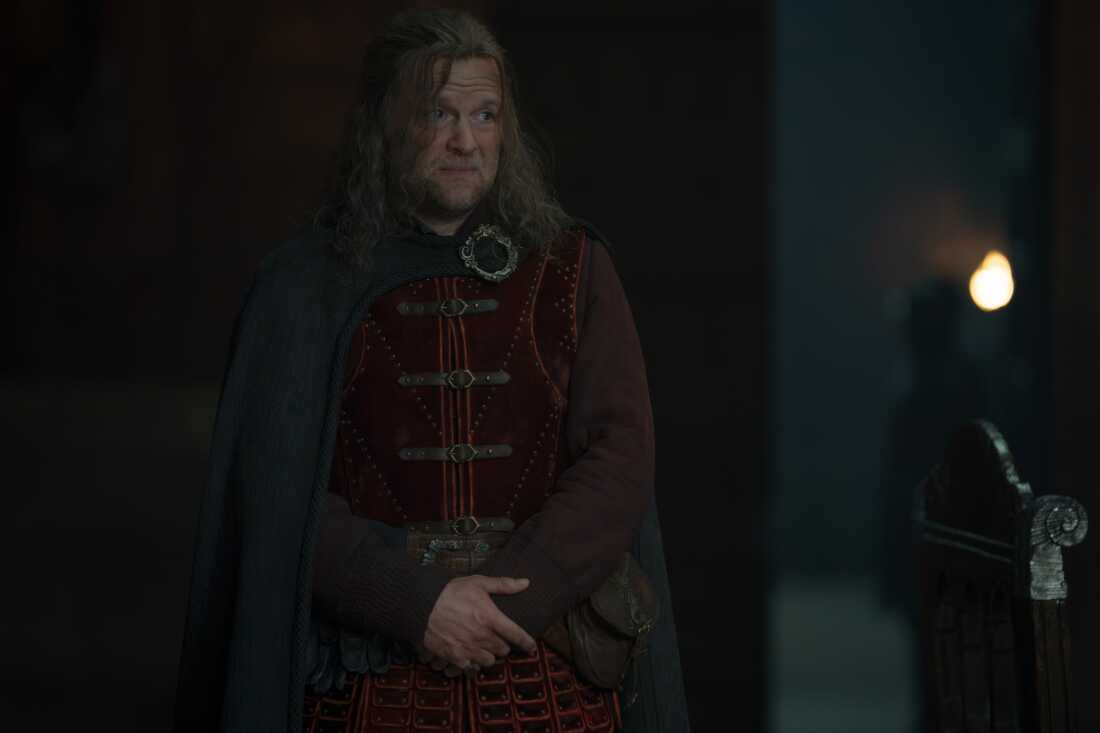
Ulf the White (Tom Bennett)? More like Oof the Slight, am I right, folks?
Theo Whiteman/HBO
hide caption
toggle caption
Theo Whiteman/HBO
Orwyle tries to convince Rhaenyra that it doesn’t matter if the High Septon refused to officially crown her — she’s got all the trappings of power already, and anyway she can’t move against the Faith of the Seven without having the faithful rise up in protest. There go the writers again, laying track, planting seeds.
Daemon heads to the Vale to ameliorate the crown’s solvency problem (read: to cadge some gold). Lady Jeyne Arryn, bless her stiff, haughty britches, manages to out-snooty Daemon Targaryen, the O.G. snoot himself. It’s really something to see. As they leave, Daemon’s dragon Caraxes smells something on the wind, and they find the cave where Rhaena’s holed up with Sheepstealer.
It’s Father-Daughter Day in the Vale, with Rhaena asking Daemon not tell Rhaenyra that he found her, or that Rhaena was involved in the death of Jacaerys. She points out his shortcomings as a dad, which are profound and varied and manifold. He agrees, and has Caraxes air-fry a poor sheepherder to pass off as the guy who rode Sheepstealer into the Battle of the Gullet, which I’m sure will have no ramifications whatsoever, because keeping secrets from one’s loved ones never does, in serialized fiction, and so this scene surely represents the end of this storyline forever.
Well, now it’s a drop-leaf table
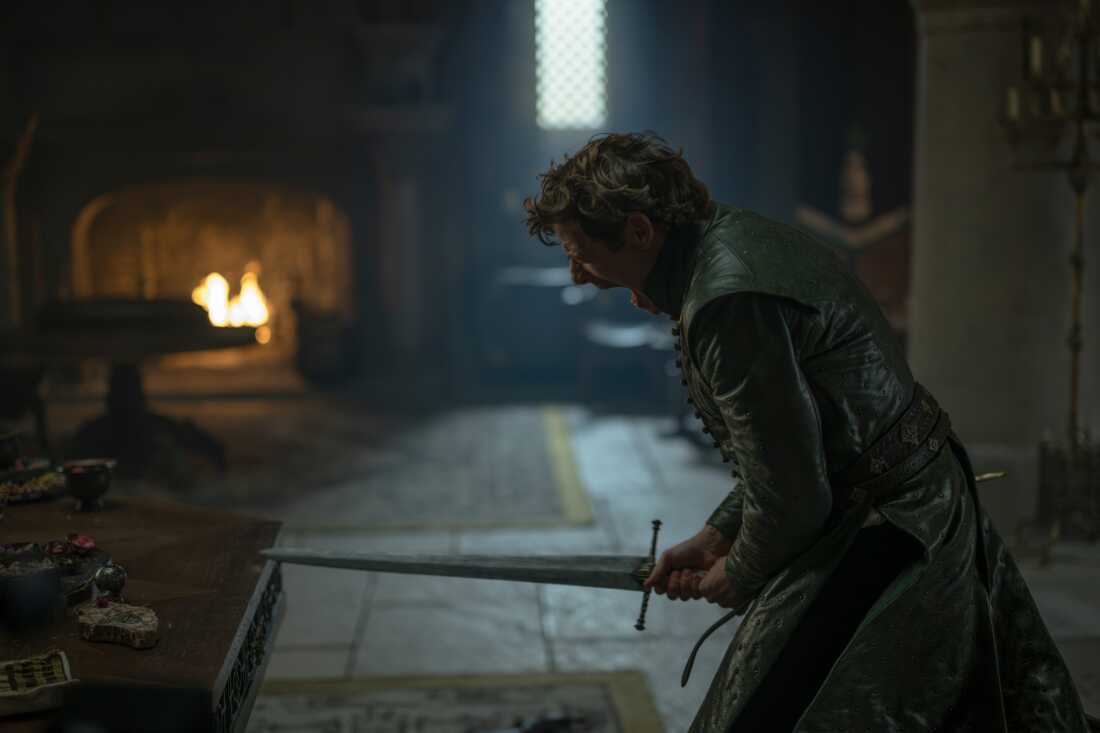
In Tumbleton, Ormund is mixing up a batch of personal potpourri when he gets news that Aemond has flown to Kings Landing and won’t be providing Ormund’s army any backup. He does not take it well, and there’s a nice characterizing moment in which we learn that Daeron is a highly observant little dude who can read Ormund like a book — he sends a servant away before Ormund’s tantrum can frighten or harm the kid. (The nicely appointed wooden pedestal table he’s sitting at doesn’t make it through unscathed, though — Ormund hacks away at it with his Valyrian steel blade, which is called Vigilance.) (Because calling it Petulance would be too on-the-nose.)
Back in Kings Landing, Rhaenyra’s council has added Ser Torrhen the Oleaginous, Master of Coin (and Lickspittling) so said council once again officially qualifies as Small. Daemon sweeps in with the flame-broiled head of the poor sheepherder and passes it off as some rando who managed to ride a wild dragon, which has now disappeared.
There is some squabbling, and Rhaenrya rebukes Daemon for killing someone so impulsively, which is a bit like rebuking the sun for shining.
Rhaenrya returns Otto’s signet ring to Alicent, and Alicent realizes that Helaena is pregnant with Aegon’s child. It’s a secret she has to keep if she wants to stay alive. If TV history is anything to go by, expect to see Helaena carrying around a big basket of laundry for the rest of the season.
Hugh arrives in Tumbleton and takes up a lonely vigil looking over the town, like a kind of hairy medieval Batman.
The Gold Cloaks scour the streets of Kings Landing, roughing up any potential taggers.
“Kill my boss? Do I Daeron live out the American dream?”
And in a small Tumbleton sept, Daeron is holed up with dragon Tessarion. Ormund shows up, dragging the citizen whose family got attacked by the Hightower soldier billeted with them.
And here’s where Ormund delivers a little monologue that explains his worldview — and explains why, even though he’s gotten a lot less screentime than other characters, James Norton is getting fourth billing in the credits.
Ormund Hightower (James Norton) very much does not love it at Levitz, thank you very much.
Kevin Baker/HBO
hide caption
toggle caption
Kevin Baker/HBO
Basically, Ormund is a Faith of the Seven guy, and as such he sees the Targaryens as evil, witchy, dragon-loving savages. He’s raised Daeron so that the kid will one day reject his family and claim the throne. To cement their bond, he bids Daeron kill the poor Tumbletonian, which Daeron does, following some — it has to be said — pretty feeble protests.
Tessarion fires up the grill, and Ormund intones, “And now we begin,” like he’s the clueless senior management guy who waltzes into the group project that the team’s been working on forever.
Which he … really kind of is, if you think about it.
Parting thoughts
- Earlier in the episode, Orwyle informed Rhaenyra that Ormund wasn’t in contact with Otto at all, so he must have been ruling Oldtown and the Reach like his own little kingdom. Feels like that’s a seed that could’ve been planted earlier in the season, cause it bore fruit really fast.
- With this episode, Operation: Daeronwatch definitively concludes. Some of you knew what was up with him all the way back in the first episode of the season. Yeah, okay, well spotted, but because the show wanted to fake viewers out with last episode’s Daeron decoy storyline, I didn’t want to spoil it.
- Aemond and Vhagar have been MIA for two episodes now — and it doesn’t take that long to fly from Harrenhal to King’s Landing. So he’s taken a detour — but to where?
- Ormund’s out here in these streets trying to stage a full-on coup when his real skillset lies elsewhere; Westeros is, after all, a famously a stinky place that could really use some Yankee Candle shops. We learned last week that there’s a candle shortage, so there’s your canonical demand in need of some supplyin’, and who better to do it than Oldtown’s own pompous pious perfumed pretty boy?
-

 California5 minutes ago
Mysterious puzzle on California building finally solved
-

 Colorado11 minutes ago
Colorado State football 2026 outlook from national experts
-
 Connecticut17 minutes ago
HBO casting in CT for neighbor dispute docuseries
-

 Delaware23 minutes ago
Heat watches, advisories issued for Delaware. How hot will it get?
-

 Florida29 minutes ago
South Florida scientists studying newborn sea turtles
-

 Georgia35 minutes ago
Georgia twins launch 3D-printed toy business
-

 Hawaii41 minutes ago
Guided tours take visitors into Honouliuli internment camp’s ‘Hell Valley’
-

 Idaho47 minutes ago
Idaho attorneys rebuff DOJ threat to prosecute Secretary of State in voter roll dispute

