A screenshot from the Alaska Future Ecology Institute website. (From Nathaniel Herz/Northern Journal)
As far as we know, the last time a woolly mammoth roamed mainland Alaska was almost 12,000 years ago. And even if it sounds like a fairytale, some people think mammoths might once again stomp around in the far north.
Northern Journal reporter Nat Herz went from fairytale to rabbit hole recently, trying to unearth an understanding of how woolly mammoths might be “de-extincted,” as they say. And it all started with a calendar.
Herz joined Alaska Public Media’s Casey Grove to explain.
Advertisement
Listen:
[Sign up for Alaska Public Media’s daily newsletter to get our top stories delivered to your inbox.]
This interview has been lightly edited for length and clarity.
Casey Grove: OK, you went on a little journey here. Maybe not a little one. A long one.
Nat Herz: A mammoth one.
Advertisement
CG: A mammoth-sized journey. Tell me how this all went. How did you get into this?
NH: You know, every month I try to review the public calendars of the key state department commissioners, the agency heads, and I was looking at the Department of Fish and Game commissioner’s. And there was a four-hour meeting that was just labeled “woolly mammoth.” It was actually spelled wrong. It was spelled like “Wally” mammoth. And I was like, “What the… heck?” for your listeners. And so I made a call, and I was like, “What’s going on with this? Is this real?” Because I had heard some kind of rumblings and gotten an email a while back about maybe some mammoth resurrection-related stuff. And I was like, :”OK, four-hour meeting, Department of Fish and Game commissioner, is there anything here?” So I ended up doing what reporters do, which was I just filed a Freedom of Information request, and I asked for every email in the Fish and Game commissioner’s inbox that contained the word “mammoth.”
CG: And what did that reveal?
NH: As it turns out, you go back 10, 15, 20 years, I think there are, in the words of one of the emailers to the Department of Fish and Game commissioner, there are these gonzo scientists in Siberia that had this idea that basically, permafrost, if it thaws, there’s a ton of methane in it, which if it thaws, then flows up to the atmosphere and makes global warming worse. So what if we could keep the permafrost frozen and stop all of that greenhouse gas from going up into the atmosphere?
And the idea that these Russian gonzo scientists had was, “What if we release a menagerie of herbivores out onto the tundra?” And the theory here that has been somewhat borne out by their, you know, fairly limited research, is that these herbivores go out, they tromp around during the winter in the snow — which normally insulates the tundra and actually keeps it warmer — if you trample the snow on the tundra, it actually allows the tundra to stay colder during the harsh winter climate and for less permafrost thaw to happen.
Advertisement
So it turns out there’s a guy in Haines, Alaska, who made a documentary about the Russians, who now wants to basically recreate what they’re calling a “Pleistocene park” in Alaska and basically introduce a bunch of herbivores out onto the tundra, probably near Denali, and basically do a bunch of scientific research to see if they can stop permafrost thaw.
CG: Scientific research, and I’m sure a few tourists would be interested in at least taking their pictures, right? Now, how does that connect back to the emails that you found? And I guess there’s a company that’s involved in the United States?
NH: Yeah, so, to be clear, the Alaska Future Ecology Institute, which is the one that wants to set up this kind of herbivore park near Denali, they are mammoth agnostic. They’re like, “Yeah, mammoths, you know, would be great snow tramplers, but really, you know, we’re more in the mode of like, musk ox, reindeer, you know, conventional charismatic megafauna.”
At the same time, there is a bioscience company called Colossal that is sort of a union of a tech guy and a very highly regarded geneticist named George Church. They have created this company that is getting into what they call the “de-extinction” business. And what they want is to take the DNA from a frozen mammoth, which generally can be fairly intact, because mammoths, unlike dinosaurs died off not that long ago. They want to take that DNA, take some of the kind of key mammoth traits — the wooliness, the fattiness, the tusks — and basically splice those in to an elephant genome and basically resurrect the woolly mammoth and have it kicking around.
And one of the justifications for doing this is that if you take the mammoth and you put it out on the tundra, in one of these kind of tundra environments, it can help with this process of trampling down the snow and preserving the permafrost. And they are saying they’re gonna have their first mammoth-elephant hybrid, I think, by 2028, and they’re interested in putting it in Alaska.
Advertisement
CG: Right, so it’s like, they need a place to do this. And some of us might think that that’s bonkers, but they say that they can do it. How seriously is the state of Alaska taking that, though?
NH: I interviewed the Fish and Game commissioner, Doug Vincent-Lang, for this story, and I think he understands that these guys are legit, and this could be also useful technology for Alaska species that are at risk, potentially, like King salmon. And I think, you know, he’s not going to discount it. If and when they get to the point of having, you know, something that they’d be ready to put out on the tundra here, which would not be, I think, for a long time, because it’s going to take years and then it has to grow up and be ready to live without, you know, supervision and support, but I think they would probably entertain it.
One of the most fun parts of the correspondence that I got ahold of was, you did also have this company, the Chief Animal Officer from Colossal, send another email to Doug Vincent-Lang that said, “What if we also could, like, resurrect a Pleistocene wolf? And, you know, we’d want to have the predator-prey balance right, and so could we set the wolf out on the tundra and have it chasing the mammoths around.” And Doug Vincent-Lang had this, like, very deadpan, serious response where he was like, “Yeah, that seems like a lot. Let’s stay focused on the mammoth for now.”
CG: There was another kind of funny part, I thought, in that conversation with Doug Vincent-Lang, the Fish and Game commissioner, where he said something like, “You know, we’re not trying to do Jurassic Park here.” But then he did describe doing something like this, at least a pilot program, like, on an island, which sounded to me like Jurassic Park.
NH: Yeah, that is actually correct. There’s been a discussion here. It sounds like the the the Fish and Game commissioner has talked with the president of the tribal government on St. Paul Island, like way out in the Bering Sea, about, you know, would this be an appropriate place to put a mammoth where it, you know, could not escape and run rampant through the streets of Anchorage?
Advertisement
So, you know, again, like, I think it’s out there, but it’s definitely something that people are really talking about. And I think, you know, that is, like, the bottom line of this story is that it is an irresistible concept and an irresistible conversation, and people are captivated by this idea. It is the OG, original charismatic megafauna, is the woolly mammoth. And I just think it’s impossible for people to not get excited when they hear that this could happen. It sounds science fiction, but it may not actually be science fiction anymore, given the technology that we have access to. And I think, you know, both because it is just compelling stuff and because it is at least technologically plausible, this is stuff that people are really sincerely engaging with.
CG: And then, one last thing, you mentioned something like they’re four years out, they think from maybe actually creating this woolly mammoth-elephant hybrid. But Alaska is maybe not the only place that they’re looking at doing this, right? I mean, is this kind of like how cities compete for the Olympics? Are we competing for the for the first woolly mammoth?
NH: Yeah, that’s a great question. I was actually really upset by this. You know, it’s like, you sort of think about it, and you’re like, “OK, someone’s gonna resurrect a woolly mammoth, and they’ll eventually need a place to release it into the wild. Like, obviously, it’s going to be Alaska.” And when I interviewed the company’s chief executive, he was like, “Nope, sorry. You guys don’t have a monopoly on mammoth territory. They actually kind of roam far and wide. And we’ve been having great conversations with North Dakota and the state of Wyoming about, you know, could we put a mammoth there.” And so, as I wrote in my story, Wyoming and North Dakota, get off our lawns. These are our mammoths. Stay away.
Advertisement
Advertisement
Casey Grove is host of Alaska News Nightly, a general assignment reporter and an editor at Alaska Public Media. Reach him at cgrove@alaskapublic.org. Read more about Casey here.
The first Jesuit missionaries in Alaska sailed up the Yukon River in 1887. By the turn of the 20th century, the religious order of the Catholic Church had as many as 50 Jesuits in the state.
Now, only two remain. And by the end of June, there will be none.
The Jesuits’ nearly 140 years in the state was honored at an event at Bethel’s Immaculate Conception Church on June 16. A procession of priests wearing long white gowns with red hems walked down the aisle to open the event. The Bishop of the Diocese of Fairbanks, Stephen Maekawa, thumped the ground with a shimmering silver staff known as a clozier as he approached the altar.
Bishop of the Diocese of Fairbanks, Steven Maekawa, walks toward the altar at the Immaculate Conception Church in Bethel.
“My brothers and sisters, we gather together to celebrate this wonderful and blessed occasion to acknowledge the love of God and the work of God through the 139 year mission of the Society of Jesus of the Jesuit fathers,” Maekawa said to open the event.
Advertisement
A traditional Catholic mass followed, with readings in both English and Yup’ik. During the sermon, Maekawa acknowledged the vastness of the Fairbanks diocese, and the tremendous amount of work done by the Jesuits to establish it.
“All of the 46 churches of the Diocese of Fairbanks that we currently have were established by either the Jesuit fathers or by direction of a Jesuit bishop,” Maekawa said. “We have a long history of the Society of Jesus’ presence and ministry here in all of Alaska.”
The Jesuits are an order within the Catholic Church, akin to the Dominicans or Franciscans. They have a reputation for taking on some of the Catholic Church’s most remote assignments.
That missionary spirit brought the Jesuits to the Yukon River in 1887, where they built churches, schools, and ministries. Without their work, Catholicism may not have taken root in huge swaths of Alaska, particularly among Alaska Native communities.
The Immaculate Conception Church in Bethel.
But the Jesuits leave a complicated legacy. Their methods of converting Native people to the religion, particularly in the first half of the 20th century, created generational traumas still felt to this day.
Advertisement
Fr. Sean Carroll is the provincial of the Jesuits West Province, which oversees Alaska and nine other states.
Fr. Sean Carroll, provincial of the Jesuits West Province, speaks at an event recognizing nearly 140 years of Jesuit service in Alaska.
“Thank you for all that you have taught us about who Jesus is and how to love and serve Him wholeheartedly,” Carroll said. “I also thank you for your patience with us. For there have been times when we have sinned and when we have hurt you.”
Missionaries, including the Jesuits, forcefully converted and assimilated Alaska Native people into Western culture and religion. Students at Jesuit-run boarding schools were forced to abandon their Native languages and physically punished when caught speaking languages other than English. Native dancing and drumming were also banned.
The Jesuits West Province maintains a list of 150 Jesuits with credible claims of sexual abuse against minors or vulnerable adults. A quarter of the accused Jesuits served in Alaska at some point in time.
“I ask for your forgiveness for all that we have done that was not rooted in Christ and love for Him, and for when we did not value your culture nor recognize the presence of God in you,” Carroll said.
Advertisement
Carroll gave the order to withdraw from the state last spring. A big issue was the recruitment of Jesuits willing to travel and serve in remote villages. He told the congregation that the Jesuits’ work would continue, just without a permanent presence.
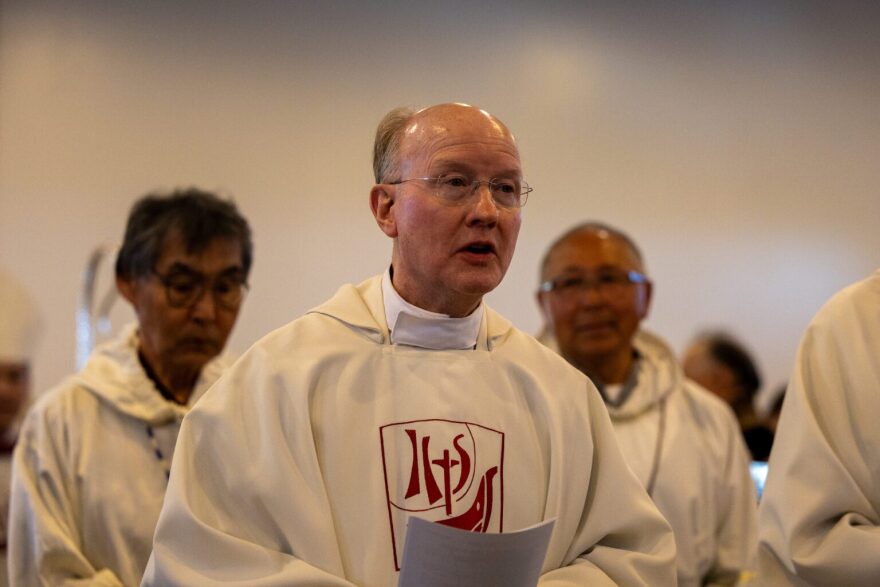
Fr. Rich Magner, one of the two remaining Jesuit priests in Alaska, attends a ceremony in Bethel.
Fr. Rich Magner is one of the two remaining Jesuit priests in Alaska. His last day serving Chevak, Hooper Bay, and Scammon Bay is June 30.
“We all always knew coming in, or should have known, that we’re not going to be here forever. It’s going to be mission accomplished at some point,” Magner said. “And then we hand it off to the diocese that we’ve helped create, and so that’s a good feeling.”
Magner’s next stop is a Clinical Pastoral Education residency in Tacoma, Washington.
The other remaining priest, Fr. Tom Provinsal, first came to Alaska in 1968 to teach. A fond memory, he said, was meeting Elders that practiced traditional subsistence lifestyles.
Advertisement
“Some of the grandmothers, their fingers were just all bent with arthritis and stuff like that, you know, their whole lives they’ve been working out in the cold and the wet, doing food, sewing, all that kind of stuff,” Provinsal said. “I’d say I just feel very privileged to have come when I did come and to see that.”
Provinsal returned in 1975 as a priest and has served in the region ever since. After moving away, he plans to take a five month sabbatical. What happens next, he said, is in God’s hands.
Two lines formed in the aisle for communion at the end of the mass. After taking communion, Bethel’s Parish Administrator Susan Murphy gave a final thank you.
“It’s difficult to say goodbye to people who have been a part of our lives for so long,” Murphy said. “We know that you have done what was yours to do, and have taught us to do what is ours to do. We are grateful.”
Jesuit priests form a row along the altar of Bethel’s Immaculate Conception Church as members of the congregation lift their arms and pray.
Dominic Hunt, a Yup’ik deacon that flew in from Emmonak for the event, led the congregation through a final prayer.
Advertisement
“Bless them with your wisdom, that they may be a word of hope, a world in need. We ask this through Christ, our Lord. Amen,” Hunt said.
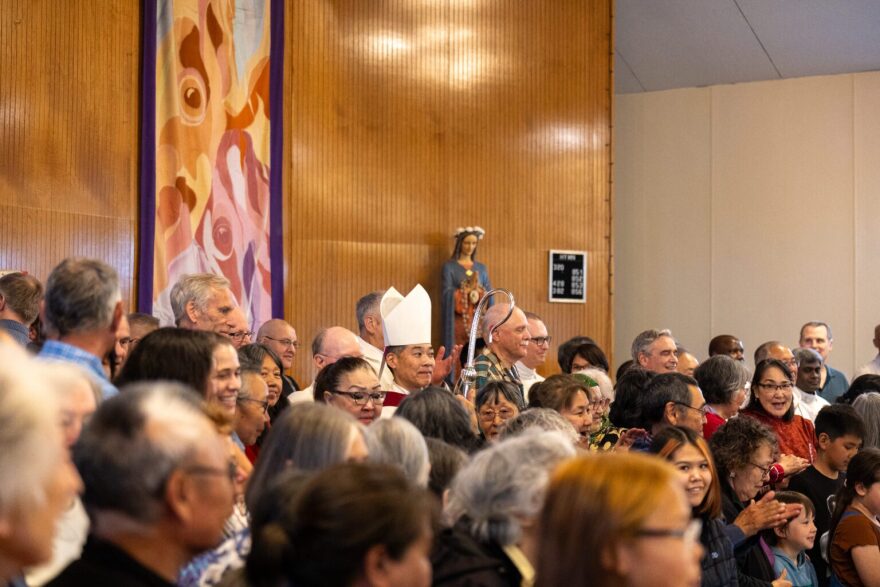
About 70 people posed for a photo on the altar – priests, deacons, parishioners, Elders and children — many of them smiling, some standing quietly.
The photo doesn’t tell the whole story. But it’s a moment when gratitude, grief, and memory all shared the same room.
Bishop of the Diocese of Fairbanks, Steven Maekawa, stands in the middle of a crowd waiting to take a photo at Bethel’s Immaculate Conception Church.
JUNEAU, Alaska (KTUU) – The Supreme Court of Alaska will be taking up the case of the State of Alaska, Division of Elections v. Daniel J. Sullivan, Jr.
The oral arguments will be held Monday at 10 a.m. via Zoom, according to an order and opening notice.
The document also specifies that a decision is expected to be made before noon on Tuesday.
According to documents from the Division of Elections, the state must start printing ballots at noon on the same day.
Advertisement
This comes after an Anchorage Superior Court Judge ordered Dan J. Sullivan on to the ballot Friday.
See a spelling or grammar error? Report it to web@ktuu.com