Sports
Women’s college basketball is growing so why isn’t the gambling industry betting on it?


One Tuesday morning in late February, a fan in New York who logged into FanDuel’s online sportsbook would’ve found 33 men’s college basketball games listed to bet on and zero women’s games. That fan could place an online wager on some midmajor men’s contests, such as Western Illinois vs. Lindenwood, Troy vs. Texas State and Bowling Green vs. Eastern Michigan. However, no odds were listed for women’s games involving power conference programs like Arizona vs. Texas Tech or Iowa State vs. UCF.
The following day wasn’t much different. FanDuel posted odds on 49 men’s college basketball games for New York state bettors, compared to only seven women’s games. There was a 50-11 discrepancy on another day. You can guess which sport had more betting markets.
Now it’s March, and the 2025 women’s NCAA Tournament begins later this week. March and April are the sport’s shining moments — for players, coaches, fans and even sportsbooks. March Madness (men’s and women’s) is the biggest annual betting event in the U.S.
But in women’s college basketball, the March Madness betting boomlet masks regular-season betting inequities.
Women’s college basketball is in the midst of a historic growth period. Last year, the women’s NCAA Tournament championship game outrated the men’s final in viewership for the first time. Caitlin Clark’s popularity also sparked new records for sports betting on women’s college basketball during the tournament. But, in the regular season especially, the differences between how legal online sportsbooks in the U.S. handle the two sports remain stark. It leaves some sports gamblers wondering why it’s so hard to bet on women’s college basketball.
Industry experts point to a number of factors. Resource allocation, product placement and questions about demand are among them. Some see it as a chicken-or-the-egg dilemma.
“How does it get more attractive if you only get people there if they search for it instead of pushing it more aggressively out?” asked Laila Mintas, a strategic advisor and longtime executive in the sports, sports betting & iGaming space.
Sportsbooks are interested in creating markets — a type of bet someone can make, including moneyline, point spread and totals — they think will garner interest and be profitable. They make daily choices about what to list, what betting limits they apply to prospective wagers and about lines themselves.
Historically, online legal sportsbooks in the U.S. haven’t been as interested in women’s basketball markets.
“You have to be intentional about wanting to do this,” said Brett Abarbanel, an associate professor and executive director at UNLV’s International Gaming Institute.
That seemed evident last March as sports betting involving Clark’s Iowa games showed what was possible when books were intentional in their women’s college basketball listings. Johnny Avello, the director of sportsbook operations at DraftKings, said women’s college basketball betting was “pretty stagnant” until Clark rose to prominence. Then, “(it) became very interesting to bettors, especially in-game wagering,” he said.
The 2024 NCAA women’s championship broke BetMGM’s record for the most-bet women’s sporting event of all time. Clark player props were their most-bet tickets in last year’s NCAA Tournament (men’s and women’s).
Talk about being intentional: Clark bets were displayed front and center, often fed to users as one of the most prominent tabs or pop-ups on a sportsbook’s online app.
Hannah Luther, the women’s basketball trader at BetMGM, said she was curious about whether the “Caitlin Clark Effect” would wear off this season. But interest has remained. “We’ve been shown that people are definitely interested even though she’s moved on to the WNBA,” she said.
Yet, there is still a noticeable difference between how men’s college basketball regular season games and women’s college basketball games are displayed on online sportsbooks, according to Ceyda Mumcu, a professor of sport management at the University of New Haven. While men’s college basketball games are often presented prominently on legal sportsbook apps — found via a simple tap of an NCAAB button, for example — finding women’s college basketball games often involves thumbing through an online sportsbook’s listings. It might take two, three or four taps of a button to find a women’s game, instead of one on the men’s side.
“It is not as accessible, and you have to dig and click around to find it if it is there,” Mumcu said.
Added Mintas: “They make it so hard for us to bet what we’re looking for by hiding it somewhere down in the tabs.”
But presentation is just one factor limiting women’s college basketball betting. Industry insiders point to sportsbook staffing discrepancies as another reason for the still-stark difference between men’s and women’s basketball betting.
Promoting a sport takes a commitment to resources. Fanatics, for instance, has five full-time traders who handle everything basketball, but no singular person focused on women’s college basketball. Not until the women’s NCAA Tournament will they have traders solely working on women’s games.
Luther began working at BetMGM in January 2024 in a general trading role. Amid a flood of interest in women’s basketball, the company quickly realized it needed somebody to focus on women’s sports. So Luther took the lead on women’s basketball trading and is the first person to hold that role at the company. BetMGM has increased its investment in the sport; the company says it went from offering 250 games in the 2022-23 regular season to 1,200 this year. And yet, there is still room for growth, and many books still don’t have a specific role focused on women’s basketball.
Staffing is just one aspect of sportsbook resource allocation, however. Focusing on one sport can mean diverting resources away from other aspects of sportsbook operations.
“Developing an emerging sport for betting requires the obvious work, like building and testing pricing models and rejiggering your sportsbook to include the markets,” Chris Grove, a partner at Eilers & Krejcik Gaming, a gambling research and consulting firm, wrote in an email. “Then there’s the less obvious work, like learning the who, how and why of betting on the sport, building sport-specific promotional and marketing strategies and identifying and accounting for any integrity components that might be unique to the sport.”
Risk management is another factor that accounts for listing differences between the two sports. In general, sportsbook operators can set their own lines with the raw data they are fed from providers or take ready-to-go products compiled by prominent data collectors. For most markets, sportsbooks establish an automated process where odds are set and adjusted algorithmically based on these inputs.
But for emerging or test markets, traders may choose to set the odds manually — with prices inputted fully by the trader — to gauge interest. Fanatics basketball trader Ethan Useloff said they sometimes receive requests through customer service for specific women’s markets that the book doesn’t yet have available. In that case, if they aren’t sure the market will be popular, they will have a trader set the lines manually, a process that can be more time-consuming.
At BetMGM, some of the processes they automate for men’s college basketball, they don’t automate for women’s basketball. “So putting up a smaller game is going to take more effort if it’s a women’s game rather than a men’s,” Luther said.
Useloff said another way that a sportsbook can reduce risk is by setting limits on the amount of money a bettor can put down, so the book isn’t on the hook for as much. Lowering the limit also mitigates the risk of a sharper bettor catching a line that’s been entered wrong or gone off-market. But it also might make a bet less appealing to a potential consumer.
“The bookmaker is always trying to balance the book,” Mintas said. “You have to make sure you have enough volume to make sure your book is balanced.”
But, for those committed to betting on women’s basketball, there are still avenues for it. Interest is apparent when comparing legal sportsbook markets in the U.S. with illegal (anyone who’s offering gambling and does not have a license for their jurisdiction) markets.
According to YieldSec, a leading technical marketplace intelligence platform, there were more than 4.1 times as many illegal women’s basketball bet market offerings last year (in college and the WNBA), not including predictors, than legal offerings in the U.S. They found there was nearly as much money bet last year on women’s basketball illegally ($1.49 billion) as on men’s basketball legally ($1.55 billion).
“The lack of betting offers from the legal industry is weirdly, inadvertently, unconsciously, unknowingly, maybe, driving people into illegal gambling because they can’t find the bets they want on legal sites,” said Ismail Vali, YieldSec’s founder and CEO. “(Illegal gambling companies) just see it as more content equals more money.”
Like other historical investment gaps in women’s sports, it’s unsurprising to see similar differences between men’s and women’s basketball gambling. YieldSec tracked $5.2 billion in bets placed on illegal and legal offerings on men’s basketball (NBA and college) last year, compared to $1.83 billion on women’s basketball (WNBA and college).
But as women’s college basketball ratings continue to demonstrate, the sport is a growing marketplace. Gambling industry experts still see women’s college basketball as an avenue legal sportsbooks aren’t taking full advantage of.
“I think it’s a loss of a big revenue stream that they could have had,” Mintas said.
Some sportsbooks have adjusted. Luther, the BetMGM trader, said the sportsbook has seen a 750 percent increase in the number of bets over the last two years.
“Some of our growth can be attributed to the fact that we’ve been putting up more markets and more games, but not all of it,” Luther said. “We haven’t been putting up 700 percent more markets for people to bet on, so clearly, there’s also more interest in the sport.”
Assuming interest continues to grow, BetMGM plans to keep expanding its markets and narrowing the gap between men’s and women’s offerings. Avello, the DraftKings executive, said he expects this year’s women’s NCAA Tournament to be as big as any before. Nevertheless, he said the men’s and women’s tournament betting totals aren’t comparable.
Abarbanel said that she doesn’t expect such a stark disparity between men’s and women’s college basketball betting in five years. And yet, for now, many industry insiders still believe that those who put a dollar value on the games themselves don’t value women’s college basketball enough.
“The mentality needs to change, and we can’t necessarily see that across the board just yet,” Mumcu said.
Future tournaments will also serve as check-in points for that growth. But perhaps the true sign of how much the disparity has decreased — and how much more opportunity sits in the gap — can be found by opening a sportsbook on an otherwise unmemorable regular-season night.
— The Athletic’s Hannah Vanbiber contributed to this report.
(Illustration: Dan Goldfarb / The Athletic; Photo: Jayne Kamin-Oncea / Getty)



NEWYou can now listen to Fox News articles!
In just his second season at the helm, Curt Cignetti led Indiana to its first national championship.
During the Hoosiers’ title run, Cignetti became known for his demanding coaching style. Indiana opened spring practice Thursday, and incoming transfer wide receiver Nick Marsh got a crash course in what it means to play for Cignetti.
Marsh, who transferred from Michigan State, arrived at practice in gold cleats. After noting Marsh’s productive two-year stint in East Lansing, Cignetti pivoted to the wideout’s footwear.
Nick Marsh (6) of the Michigan State Spartans runs the ball up the field during the first quarter of a game against the Maryland Terrapins at Ford Field Nov. 29, 2025, in Detroit. (Mike Mulholland/Getty Images)
“I didn’t love those gold shoes he came out in today,” Cignetti said. “He learned what getting your a– ripped is all about. I don’t know if that happened to him very often at Michigan State. That was before practice started.”
INDIANA’S CURT CIGNETTI SHUTS DOWN NFL COACHING SPECULATION: ‘I’VE ALWAYS BEEN MORE OF A COLLEGE FOOTBALL GUY’
Marsh totaled 1,311 receiving yards and nine touchdowns at Michigan State. TCU quarterback Josh Hoover also headlines Indiana’s transfer additions.
An Indiana Hoosiers helmet during a game against the Ball State Cardinals at Lucas Oil Stadium Aug. 31, 2019, in Indianapolis. (Michael Hickey/Getty Images)
Cignetti added that the coaching staff has “more work to do with this group than the first two teams,” noting the group is still learning more about players the team will likely rely on next season.
Indiana Hoosiers head coach Curt Cignetti during the second quarter against the Miami Hurricanes in the 2026 College Football Playoff national championship at Hard Rock Stadium Jan. 19, 2026, in Miami Gardens, Fla. (Alex Slitz/Getty Images)
Indiana went 16-0 en route to a thrilling win over Miami in the College Football Playoff national championship in January.
Cignetti framed his callout of Marsh’s cleats as an early message about expectations.
“That was a wake-up call,” Cignetti said of the receiver’s pre-practice cleats. “But he’s really worked hard, done a great job for us.”
Follow Fox News Digital’s sports coverage on X, and subscribe to the Fox News Sports Huddle newsletter.
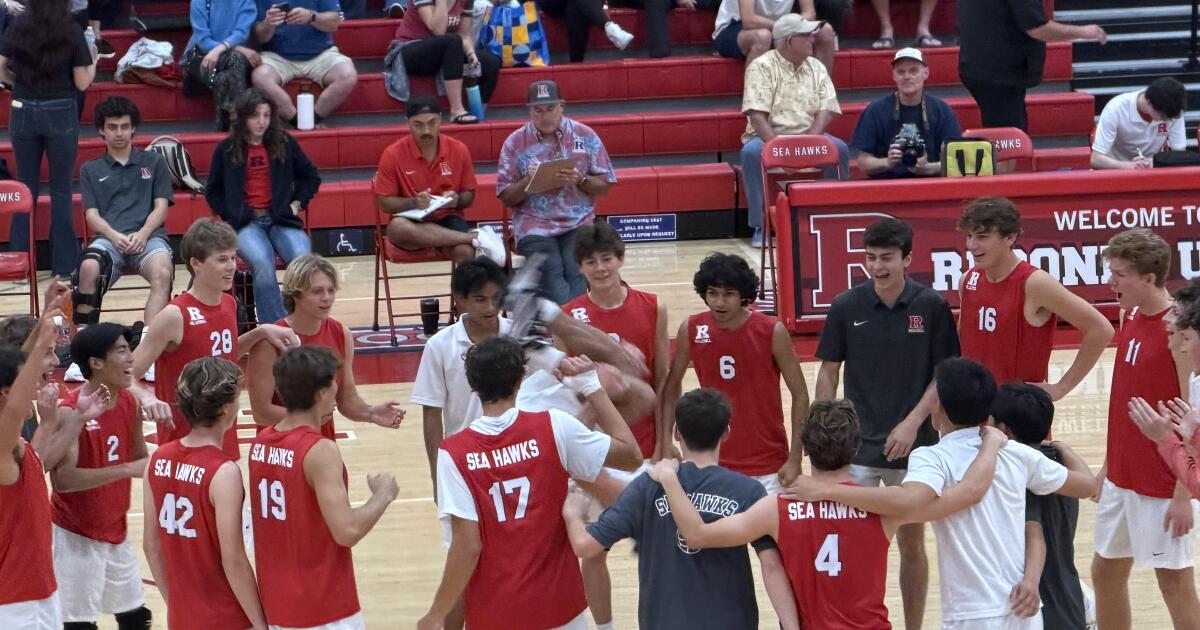
Redondo Union didn’t care that Mira Costa’s volleyball team was ranked No. 1 in California. This was their South Bay rival coming to their gym Thursday night, and anything can happen when a team digs deep and doesn’t fear losing.
The Sea Hawks (14-2) were aggressive from the outset and came away with a 27-25, 21-25, 25-22, 21-25, 15-13 victory.
“Chemistry,” setter Tommy Spalding said about the Sea Hawks’ triumph. He’s one of three players headed to MIT, and all three had big matches.
At one point on back-to-back plays, Carter Mirabal had a block and Vaughan Flaherty followed with a kill off an assist from Spalding. Chemistry.
JR Boice, a Long Beach State commit, was delivering kills, and Cash Essert’s serving and all-around play kept Mira Costa’s Mateo Fuerbringer looking frustrated. The Sea Hawks’ focus was on Fuerbringer, who came alive in the fifth set with six kills, but Redondo was able to come back from an 11-9 deficit.
It was only Mira Costa’s second loss in 25 matches. Redondo Union took over first place in the Bay League.
Baseball
Orange Lutheran 3, Jacksonville (Fla.) Trinity Christian 2: The Lancers advanced to the semifinals of the National High School Invitational in Cary, N.C., behind a walk-off single in the eighth inning by Andrew Felizzari. Brady Murrietta had tied the score with a squeeze bunt in the bottom of the seventh. CJ Weinstein had two doubles for the Lancers.
Venice (Fla.) 12, Harvard-Westlake 0: The Wolverines were limited to three hits at the National High School Invitational in Cary, N.C.
Casteel (Queen Creek, Ariz.) 3, St. John Bosco 2: The Braves suffered their first defeat in North Carolina. Jack Champlin threw five innings and also had two RBIs.
Chatsworth 6, Taft 3: Tony Del Rio Nava threw six innings and had two RBIs in the West Valley League win.
Granada Hills 4, El Camino Real 3: A two-run single by Nicholas Penaranda in the seventh inning keyed a three-run inning for the Highlanders in their West Valley League upset. JJ Saffie had three hits for ECR.
Cleveland 4, Birmingham 3: The Cavaliers pushed across a run in the top of the 10th inning to break a 3-3 tie in the West Valley League win. Joshua Pearlstein finished with three hits, including a home run.
Sun Valley Poly 4, San Fernando 2: Fabian Bravo gave up four hits in 6 2/3 innings for the Parrots, who are tied with Sylmar for first place in the Valley Mission League. Ray Pelayo struck out eight for San Fernando.
Verdugo Hills 15, Kennedy 1: Cutlor Fannon had two doubles and four RBIs in the five-inning win. Anthony Velasquez added two singles and four RBIs.
Westlake 9, Agoura 4: Jaxson Neckien hit a three-run home run to power the Warriors.
Thousand Oaks 7, Calabasas 5: Gavin Berigan, Jeff Adams and Cru Hopkins each had two hits for the Lancers.
Oaks Christian 11, Newbury Park 2: Dane Disney contributed three hits in the Marmonte League win. Carson Sheffer had two doubles and three RBIs.
Santa Monica 12, Simi Valley 4: Ryan Breslo and Johnny Recendez had two RBIs and a triple for Santa Monica. Ravi Chernack had three RBIs.
Dana Hills 7, Corona Santiago 0: Gavin Giese finished with eight strikeouts over six innings and gave up one hit for Dana Hills.
Softball
Sherman Oaks Notre Dame 10, Sierra Canyon 0: Kelsey Luderer contributed three hits and two RBIs while freshman Ainsley Jenkins threw five scoreless innings.
Chaminade 15, Louisville 2: Norah Pettersen had two hits and four RBIs.
Carson 10, San Pedro 0: Atiana Rodriguez finished with three hits, including a double and triple, and three RBIs.
Huntington Beach 6, El Modena 2: Willow Kellen had three hits for the Oilers.
Murrieta Mesa 15, Chaparral 0: It’s a 16-0 start for the Rams. Tatum Wolff hit two home runs.

NEWYou can now listen to Fox News articles!
The fiancée of Buffalo Sabres star Rasmus Dahlin received a roaring welcome home in her first appearance of the season Wednesday night, months after undergoing a lifesaving transplant after she suffered heart failure during a vacation in France.
Carolina Matovac, 25, was shown on the jumbotron during Wednesday’s game against the Boston Bruins. Fans cheered as she waved, and Dahlin, who was also shown on the screen in a split, cracked a smile at the crowd’s reaction.
Carolina Matovac and Rasmus Dahlin of the Buffalo Sabres pose on the red carpet at the Metro Toronto Convention Centre in Toronto, Ontario, Canada, Feb. 1, 2024. (Nicole Osborne/NHLI via Getty Images)
“Welcome home to Carolina Matovac, the fiancée of our captain Rasmus Dahlin,” the arena announcer said. “She is back with us, attending her first game of the season. The Sabrehood loves you, Carolina.”
In an open letter to fans in September, Dahlin shared that Matovac had been feeling ill for several days during their trip, which led to her experiencing “major heart failure.”
“Fortunately, she received CPR on multiple occasions, and up to a couple of hours at a time to keep her alive, which ultimately saved her life. Without her receiving lifesaving CPR, the result would have been unimaginable. It is hard to even think about the worst-case scenario,” he wrote at the time.
Rasmus Dahlin (of the Buffalo Sabres prepares for a faceoff during a game against the New York Rangers at KeyBank Center in Buffalo, N.Y., Oct. 9, 2025. (Bill Wippert/NHLI via Getty Images)
Matovac remained on life support for weeks before receiving the transplant in France.
JACOB WINTERTON, FORMER OHL PLAYER AND BROTHER OF NHL’S RYAN WINTERTON, DEAD AT 25 AFTER CANCER BATTLE
In January, Matovac revealed she was pregnant when her heart failed, adding that her unborn child was the reason she went to the hospital initially.
“You will always hold a special place in our hearts as our first baby, even though we never had the chance to meet. Our love for you is endless,” she wrote in a post on Instagram on what was supposed to be her due date.
“Though you didn’t get to experience this world, you played a vital role in ensuring that I could continue to be a part of it.”
Buffalo Sabres defenseman Rasmus Dahlin follows the puck in the first period against the Ottawa Senators at the Canadian Tire Centre in Ottawa, Ontario, Canada, on April 1, 2025. (Marc DesRosiers/Imagn Images)
CLICK HERE TO DOWNLOAD THE FOX NEWS APP
Despite taking some time to be with Matovac as she recovered in their native Sweden, Dahlin is second on the team with 65 points, and the Sabres are on the cusp of ending an NHL-record 14-season playoff drought.
The Associated Press contributed to this report.
Follow Fox News Digital’s sports coverage on X, and subscribe to the Fox News Sports Huddle newsletter.

Rubio meets G7 ministers in France as US leads on Iran — allies under fire for tepid response

DHS shutdown breakthrough comes at cost for Republicans as funding fights nears end

Dementia risk signals could lie in simple blood pressure readings, researchers say

Indiana coach Cignetti sends message to star transfer with pre-practice dress code lesson

Drone food delivery launches in New Jersey

Florida High School Football Rankings: Top 25 teams – Oct. 21

How old is Bo Nix? What to know about Oregon quarterback ahead of 2024 NFL Draft

Cleary's 21 help Le Moyne down Central Connecticut State 69-64 in OT

99th annual Pony Swim held in Virginia

Indiana Members Credit Union announced as new anchor tenant at Bottleworks District
DHS shutdown breakthrough comes at cost for Republicans as funding fights nears end

Rubio joins crucial G7 talks as Iran war set to dominate second day

A surprise resignation could open the door for an independent to win a Montana Senate seat

Video: Savannah Guthrie Says She Believes Her Mother Was Taken for Ransom

Stefanik grills University of Michigan leader on lack of audit after string of Chinese national arrests
-

 Detroit, MI1 week ago
Drummer Brian Pastoria, longtime Detroit music advocate, dies at 68
-

 Science1 week ago
How a Melting Glacier in Antarctica Could Affect Tens of Millions Around the Globe
-

 Movie Reviews1 week ago
‘Youth’ Twitter review: Ken Karunaas impresses audiences; Suraj Venjaramoodu adds charm; music wins praise | – The Times of India
-
 Science1 week ago
I had to man up and get a mammogram
-

 Sports6 days ago
IOC addresses execution of 19-year-old Iranian wrestler Saleh Mohammadi
-

 New Mexico4 days ago
Clovis shooting leaves one dead, four injured
-

 Texas7 days ago
How to buy Houston vs. Texas A&M 2026 March Madness tickets
-

 Tennessee3 days ago
Tennessee Police Investigating Alleged Assault Involving ‘Reacher’ Star Alan Ritchson