News
Democrat Spanberger wins Virginia governor race with message on DOGE, cost of living


Democratic candidate for governor Abigail Spanberger gives remarks during a rally on Saturday in Norfolk, Virginia.
Shaban Athuman/VPM News
hide caption
toggle caption
Shaban Athuman/VPM News
Democrat Abigail Spanberger will be Virginia’s next governor, according to a race call by the Associated Press.
Spanberger, who previously served three terms in the U.S. House, defeated her Republican opponent, Lt. Gov. Winsome Earle-Sears. She’ll be Virginia’s first woman governor.
The contest received national attention as one of the first major tests of voter sentiment in response to the Trump administration’s policies.
Virginia is home to around 320,000 federal workers and hundreds of thousands of federal contractors. On the campaign trail, Spanberger argued that federal layoffs, cutbacks by President Trump’s Department of Government Efficiency (DOGE), tariffs, and the federal shutdown were an attack on the Virginia economy — and pitched herself as a way for voters to push back.
“We need a governor who will recognize the hardship of this moment, advocate for Virginians, and make clear that not only are we watching people be challenged in their livelihoods and in their businesses and in communities, but Virginia’s economy is under attack,” Spanberger said at a stop on a campaign bus tour late last month.
That message resonated with Haley Morgan Wright, a voter whose husband is a federal employee currently working without pay during the federal shutdown. She wants Spanberger to use her platform as governor to uplift the stories of civil servants like him.
“He cares about his country, he wants to serve his country and has opted to do it in this way,” she said after casting a ballot in the Northern Virginia exurbs. “He’s not superfluous.”
Spanberger was backed by national Democrats
National Democrats had looked to Spanberger and Virginia Democrats for a boost heading into the 2026 midterms. Former President Barack Obama had campaigned for her and the party backed her in what was one of just two governor’s races this year.

Voters cast their ballots at Huguenot High School on Tuesday in Richmond, Virginia.
Ryan M. Kelly/VPM News
hide caption
toggle caption
Ryan M. Kelly/VPM News
“The DNC has been spending a lot of money and a lot of time in Virginia,” said DNC Vice Chair Rep. Malcolm Kenyatta at a meeting for party volunteers in Northern Virginia. “Because we know that what you all do and the momentum that is going to come out of your victories is going lead to us flipping the House of Representatives in 2026.”
In 2021, Republican Glenn Youngkin defeated Democrat Terry McAuliffe with 50.6% of the vote to 48.7%. Virginia governors are limited to one four-year term.
Spanberger, who served in the CIA before running for Congress in 2018, has cultivated a reputation as a pragmatic centrist. The theme of her run for governor was “affordability” — speaking to Virginians’ concerns about rising costs of housing, utility bills, pharmaceutical drugs, and the economic uncertainty she blamed on Trump’s tariffs and federal layoffs.
Earle-Sears, meanwhile, portrayed herself as an example of the American dream — a Jamaican immigrant who became a U.S. Marine and small business owner.
She accused Spanberger of backing policies on transgender rights that she said are a threat to girls’ safety in school bathrooms and locker rooms.
“Love is not having my daughter having to be forced to undress in a locker room with a man. That’s not love,” Earle-Sears said at a rally in late October. “Love is making sure that our girl children have opportunities in sports and are not forced to play against biological males.”
Earle-Sears’ stance on transgender students in girls’ bathrooms sounded good to Elizabeth Drake, a voter who said she works with youth at a church in Loudoun County.
“I feel like we’re actually going back and setting ourselves back a lot by endangering women,” she said. “I’m not saying that that doesn’t mean we can have alternative spaces for people, but the women’s locker rooms, women’s bathrooms, women’s safe homes are not it.”
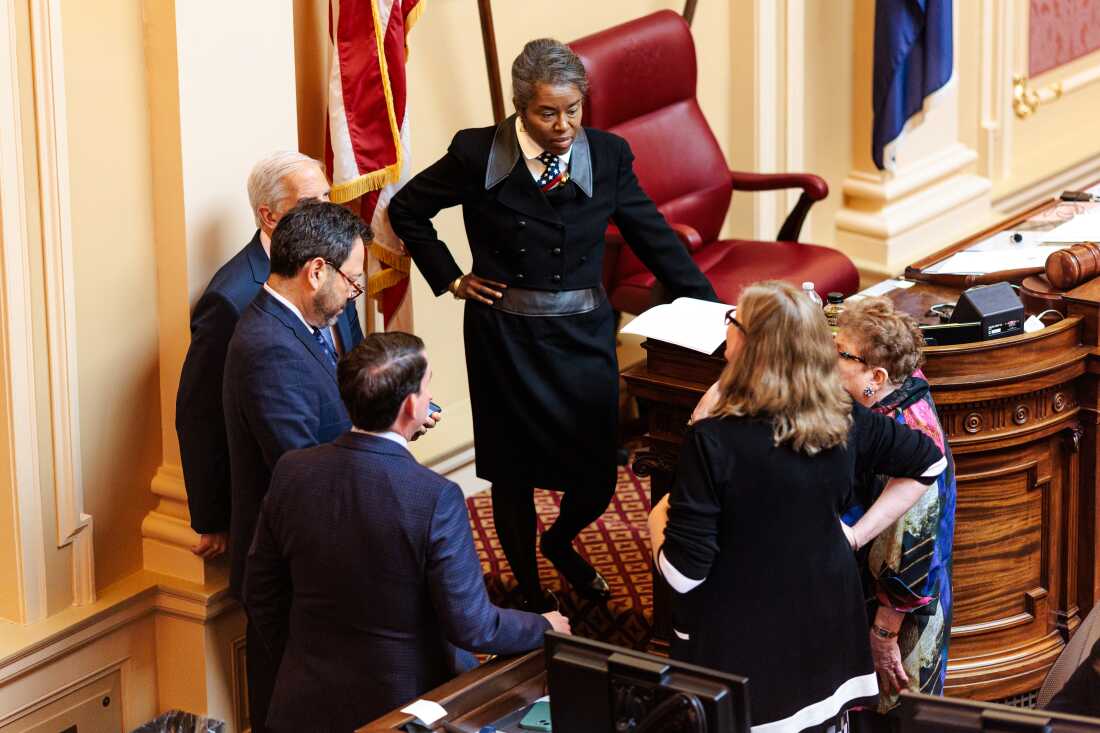
Winsome Earle-Sears, currently Virginia’s lieutenant governor, in the Virginia General Assembly last month.
Shaban Athuman/VPM News
hide caption
toggle caption
Shaban Athuman/VPM News
The race was jolted by late-breaking events
She also attacked Spanberger for supporting Biden administration policies. She vowed to continue business-friendly polices of outgoing Republican Gov. Glenn Youngkin. While she backed Trump’s policies, Trump did not endorse her.
Several developments impacted the final weeks of the race. The federal shutdown shadowed the final month of early voting, with both campaigns blaming the other party for the stalemate.
Virginia lawmakers began considering a plan to redistrict the state’s congressional districts to favor Democratic candidates in the 2026 midterm elections, as President Trump pushes Republicans in other states to move to favor their candidates. That could be an issue facing the next Virginia governor.

Former President Barack Obama campaigned for Spanberger over the weekend.
Steve Helber/AP
hide caption
toggle caption
Steve Helber/AP
And Republicans seized on revelations of text messages by Democratic candidate for attorney general, Jay Jones, in which he described the hypothetical shooting of a Republican lawmaker. Spanberger denounced the messages though Earle-Sears faulted her for not calling on Jones to drop out of the race.
Jones was in a tight race Tuesday against Republican incumbent Jason Miyares for the attorney general’s office.
Margaret Barthel covers Virginia politics for WAMU.




Folarin Balogun (r) of the U.S. celebrates scoring his team’s second goal with Weston McKennie during their World Cup match against Paraguay on June 12 in Inglewood, Calif. The U.S. defeated Paraguay and, later, Australia. The U.S. wraps up group play against Turkey on Thursday evening. Win, lose or draw, the U.S. has already won its group and will advance to the knockout round.
Richard Heathcote/Getty Images
hide caption
toggle caption
Richard Heathcote/Getty Images
INGLEWOOD, Calif. — For the U.S. men’s national soccer team, a loss in Thursday night’s FIFA World Cup game against Turkey wouldn’t change anything.
A win, though, would be history.

The squad’s earlier wins over Paraguay and Australia, plus two losses by Turkey to the same teams, mean the Americans have already won their group and clinched a favorable path in the knockout round, no matter the outcome of Thursday’s game.
But the American men have never won more than two games in a single World Cup. A third win would be new territory for this team, which has not been shy about its aspirations in this tournament and its confidence about living up to them.
“The group stage is not done yet. We want to end it the right way. We want to end it the way we came into it and continue to build off of the momentum that we’ve been creating,” said defender Mark McKenzie, speaking to reporters Wednesday.

Because the outcome of the game does not affect knockout-round placement, the U.S. can rest key starters who will enter the match with a yellow card. For those players — defenders Antonee Robinson and Chris Richards, midfielder Tyler Adams and forward Folarin Balogun — picking up a second yellow card against Turkey would result in a suspension in the Round of 32. (Any single yellow cards will be cleared after the group stage concludes.)
The team could also choose to ease in forward Christian Pulisic, who is expected to be available for the game after sitting out the U.S.-Australia game with a minor calf injury.
Turkey had come into the World Cup with high expectations. With talented young stars like the 21-year-old attackers Arda Güler of Real Madrid and Kenan Yildiz of Juventus, the team was thought by many — from analysts to the players themselves — to be a dark horse capable of a deep run.
Instead, they were eliminated last week when their loss to Paraguay followed the U.S. win over Australia, prompting apologies from Turkey’s despondent players to their fans after the game.
On Wednesday, Yildiz echoed that apology and promised to “give our best” in Thursday’s game against the U.S. “We had high expectations. I know because all of our country was supporting us and thought we will come very far,” Yildiz said. “Hopefully for the next game we can make a good result and go out with pride.”
The U.S. and Turkey last faced each other in an international friendly in June 2025, which Turkey won 2-1. The U.S. roster for that game was missing several key players, including Pulisic, Robinson, Balogun and midfielder Weston McKennie.
“We had a really young team, but we went out there and put in a good performance. I don’t think the result necessarily reflected how we played,” Richards said. “Whoever’s on the field, I know we’re going to go out there and give 110 percent.”

A federal judge on Wednesday permanently barred President Donald Trump’s administration from implementing most of his first executive order on elections, part of which sought to require people to show documentary proof of citizenship when they register to vote.
The ruling by U.S. District Court Judge Denise Casper in Boston effectively converts a preliminary injunction she issued a year ago, in which she temporarily blocked many of Trump’s efforts to overhaul elections, into a permanent ban.
Casper rejected the Republican administration’s argument that the lawsuit to block the changes brought by Democratic state attorneys general was premature because the rules had yet to be put in place. Instead, she agreed that the Constitution gives states and Congress the authority to regulate elections, and that Trump’s requirements violated the separation of powers.
The Constitution “does not grant the President any specific powers over elections,” wrote Casper.
Among other proposed changes, Trump’s order would have required people to provide documentary proof of citizenship when registering to vote, prevented mail ballots from being counted if they arrive after Election Day, even if they were postmarked by then, and punished states that failed to comply by withholding certain federal money.
In a statement, New York Attorney General Letitia James said she was grateful the court had blocked Trump’s “unconstitutional attempt to seize control of our elections” and would continue to defend voting rights in this year’s midterm elections.
“Generations of Americans fought tirelessly for the right to vote, and we honor their legacy by protecting that right against anyone who tries to undermine it,” said James, a Democrat.
A voter casts a ballot during New York’s primary election on Tuesday, June 23, 2026, in New York. (AP Photo/Ryan Murphy)
California Attorney General Rob Bonta, whose state was the lead plaintiff in the case, said the ruling reaffirmed the constitutional principle that it s up to the states and Congress to set election rules.
“While we are proud of this result, we are clear-eyed that President Trump’s attacks on voting rights and our elections show no signs of slowing down,” Bonta, a Democrat, said in a statement. “So let me be clear: we will keep fighting back every step of the way.”
Requests for comment sent to the White House and he U.S. Department of Justice were not immediately returned.
The ruling was the latest in a series against the elections executive order Trump signed just months after taking office for his second term. The Republican president has since signed another executive order on elections that seeks to create a national voter list and limit mail balloting. That directive also faces multiple legal challenges.
Last fall, a federal judge in Washington, D.C., overseeing a separate challenge to the first election executive order by civil rights and Democratic Party-aligned groups blocked the government from taking steps to include the proof-of-citizenship requirement on the federal voter registration form. That judge later barred Trump’s defense secretary from requiring documentary proof of citizenship when military personnel register to vote or request ballots.
In an apparent nod to the difficulty of implementing a proof-of-citizen requirement by executive order, Trump is pushing legislation in the Republican-controlled Congress to create such a mandate. The SAVE America Act has passed the House but has stalled in the Senate, leading Trump to advocate for eliminating the filibuster that is blocking the legislation.
On Wednesday, he abruptly canceled the expected signing of a bipartisan housing bill, saying he would not sign legislation until Congress passes his proof of citizenship requirement for voting.
The president and many of his Republican allies have been promoting the narrative that voting by noncitizens is a major problem, when in fact it’s quite rare. The federal voter registration form already requires people to attest that they are U.S. citizens. Violating that is punishable as a felony that can lead to prison or deportation.
In another major voting case, the U.S. Supreme Court is due to issue an opinion soon on whether mail ballots must arrive by Election Day. That could immediately change the rules in 14 states that allow grace periods ranging from days to weeks if the ballots are postmarked by Election Day.
Casper, who was nominated by Democratic President Barack Obama, is the chief judge for the U.S. District Court for the District of Massachusetts.

new video loaded: Mamdani Allies Sweep New York Primaries
transcript
transcript
Mamdani Allies Sweep New York Primaries
Mayor Zohran Mamdani’s progressive coalition had a big night on Tuesday. Brad Lander, Darializa Avila Chevalier and Claire Valdez won their Democratic House primaries.
-
“I see a New York that we can all afford. I see a New York that truly invests in its babies, not bombs.” Reporter: “What’s the first thing you’re looking forward to doing in Congress?” “Well, tomorrow — thank you — I mean, tomorrow morning, you know, I’m going to be back at 26 Federal Plaza doing court watching, and we want to carry that into Congress as well.”
By Julie Yoon
June 24, 2026
-
Utah7 minutes ago
Edwin Munk Woolley — Obituary | Larkin Mortuary
-

 Vermont10 minutes ago
Experienced pros have Vermont Green women’s team on cusp of USLW playoffs
-

 Virginia15 minutes ago
Virginia Lottery Powerball, Pick 3 Night results for June 24, 2026
-

 Wisconsin25 minutes ago
Wisconsin Lottery Powerball, Pick 3 results for June 24, 2026
-

 West Virginia30 minutes ago
Morrisey announces more than $700,000 to support rural domestic violence and sexual assault victims
-

 Wyoming36 minutes ago
Politics in the Park: GOP gubernatorial candidates share visions for Wyoming governor
-

 Crypto40 minutes ago
The cryptocurrency industry has entered the “Show Me” era: merely relying on vision is no longer enough | WEEX Crypto News
-

 Finance45 minutes ago
Quadient Recognized as a Leader in the 2026 SPARK Matrix for Accounts Receivable Applications

