Business
Waymo killed KitKat. California neighborhood mourns a corner-store cat


San Francisco has been mourning the death of KitKat, a beloved corner-store cat who died after being struck by a Waymo robotaxi last week.
KitKat graced the counters of Randa’s Market on 16th Street, near the historic Roxie Theater in the Mission District. KitKat was first introduced on the store’s Instagram page six years ago, quickly winning over the hearts of customers. He wasn’t a surly or suspicious cat — he could be seen playing with someone’s dangling hoodie drawstrings; snoozing in front of shelves with liquor bottles; inside a cardboard box marked with his name; greeting the neighborhood dogs; even dressing up as Santa Claus.
He shot to fame during the COVID-19 pandemic’s first year. Not only was he posted on the @bodegacatsofinstagram account (which now has more than 500,000 followers), but he also won a mention in a news story on beloved store cats. “The atmosphere in the store definitely changed after KitKat arrived,” Daniel Zeidan, the store owner’s son, told SFGate. Not only did he get treats from customers, but also “someone recently brought him a blanket so he would stay warm in the winter.”
More recently, he was caught curled up asleep on his own heating pad.
He even made appearances in the next-door bar, Dalva, where his arrival felt like “the president had arrived, making their rounds, shaking hands and charming everyone,” said one mourning Instagram commenter.
But he was fatally wounded around 11:40 p.m. on Oct. 27 just outside the market, Mission Local reported. Two witnesses, speaking anonymously, told the news outlet that they had just left Dalva and saw KitKat sitting in front of a stopped self-driving Waymo for about seven seconds. Then the cat walked under the vehicle, heading toward the sidewalk, as the car pulled away. The right rear tire ran over KitKat, the website said.
“It was an awful sight,” one of the witnesses told Mission Local.
Another person driving by saw the Waymo swerve and told Mission Local he thought the robotaxi was driving faster than he would expect a human would drive on a busy street. “Killed the neighborhoods baby,” a comment on the city’s 311 website said shortly after the collision.
A bartender from another nearby bar, Delirium, rushed KitKat to a veterinarian hospital, where he was pronounced dead, according to Mission Local.
The cat was 9 years old, the San Francisco Standard reported.
“We’re heartbroken,” Randa’s Market said on Instagram. “He brought warmth, smiles, and comfort to everyone who walked through our doors…. The store won’t be the same without his little paws padding around.”
KitKat was a beloved presence along 16th Street in San Francisco.
(Randa’s Market)
One mourner, responding to the post, called KitKat “the best city bodega cat anyone could ever ask for. His lil pet requests meant a lot for some of us passing through, whether we missed our own pet or just wanted to share some love with a neighbor.”
In a statement, Waymo said: “We reviewed this, and while our vehicle was stopped to pick up passengers, a nearby cat darted under our vehicle as it was pulling away.
“We send our deepest sympathies to the cat’s owner and the community who knew and loved him, and we will be making a donation to a local animal rights organization in his honor,” the statement said. “The trust and safety of the communities we serve is our highest priority.”
A Waymo has had a run-in with a pet before. News outlets in 2023 reported on a Waymo striking and killing a small off-leash dog in San Francisco’s Bayview-Hunters Point neighborhood; in that case, a test driver was in the vehicle, but the car was in self-driving mode.
In one close call, a Waymo narrowly avoided running over a runaway dog in Santa Monica in May. An 8-year-old Labrador mix, Trevor, had escaped his owner’s yard and ran into the street in front of a Waymo, which braked suddenly, KCAL-TV reported. The station broadcast video of the near-collision. The dog was uninjured, and his owner praised the car’s quick action.
The California Department of Motor Vehicles has received reports of 884 collisions involving autonomous vehicles dating to 2014.

A Waymo robotaxi in downtown Los Angeles in September.
(Gary Coronado/For The Times)
Waymo, owned by Google’s parent, Alphabet, has been expanding its footprint across California. The robotaxis — electric Jaguar I-Paces — don’t use a human driver and can be hailed on an app in San Francisco and a swath of northern San Mateo County, including Daly City, San Bruno and Burlingame. They’re also available in parts of Silicon Valley and surrounding areas, including Mountain View, Los Altos, Palo Alto and Menlo Park.
In Los Angeles County, Waymos can be hailed across a portion of central L.A., South L.A., and the Westside, including downtown L.A., Santa Monica, Beverly Hills, West Hollywood and Inglewood.
The self-driving cars are also available in Phoenix.



The electric vehicle company Slate Auto set out in 2022 to make the most affordable electric truck in the country. This week, it unveiled the price tag: $24,950.
At a time when demand for new electric vehicles is cooling and cars are getting harder to afford, Slate’s customizable truck could bring a fresh wave of excitement to the industry.
Deliveries will begin later this year and accelerate in 2027, the company said. Slate’s vehicle is built around a simple concept — pay only for what you actually want.
Buyers will start with a basic truck without power windows or even paint and can then customize it however they like. They can tailor-make their “blank slate” by paying extra for smart phone-compatible screens, speakers, colored wrap or paint. A $5,000 kit even converts the truck into an SUV.
Slate’s design team is based in Los Angeles County and recently moved into a new space in Carson, which employs about 50 workers. The company’s headquarters are in Troy, Mich., and its vehicles will be produced in Warsaw, Ind.
Squeezing out as much cost as possible while making it as easy as Legos to snap on different options has required complex engineering, which is why the company decided to set up its design studio in Southern California. The region is full of experts.
“Slate has done something smart,” said auto industry analyst Brian Moody. “Their EV isn’t only about price, there’s also a strong personalization element. In Southern California, the boxy, retro look will earn it a lot of attention.”


Slate is an EV startup that makes electric trucks and SUVs. Customers buy only the features they want. Photographed on Friday, Dec. 19, 2025. (Myung J. Chun/Los Angeles Times)
The company is building a marketplace of accessories for customers to choose from, including 54 basic wraps that cost less than $500 each. In contrast, a paint job on a car can cost thousands of dollars. The marketplace also offers roof stacks, zip-on seat covers and stereos.
For just under $30,000 total, customers can get a basic SUV in a fastback or squareback style. Whether it’s configured as a truck or SUV, the EV will have an estimated range of 205 miles and will be compatible with Tesla chargers.
“This is the first time in automotive history that consumers are going to get to choose,” said Slate Chief Executive Peter Faricy, who joined the company in March after 13 years with Amazon.
“It started with design, then engineering, and eventually manufacturing, and we figured out innovations in all three of those phases that make the vehicle less expensive,” he said.
For example, Slate vehicles were designed from the beginning to be wrapped instead of painted. The company will offer more than 100 colors of wrap at its launch, or customers can choose a custom color.
Slate did not disclose financial information or how much the vehicles cost to produce. However, Faricy said the company will generate a positive gross margin on its vehicles, meaning they are selling for more than what they cost to make.
“Whether Slate succeeds or fails, it has already influenced the conversation … forcing the industry to ask why affordable vehicles have become so rare,” said Jesse Toprak, an industry analyst and founder of OptiCar.ai. “They are betting on making higher profit margins on the accessories and do-it-yourself angle.”
Slate says it has already received more than 180,000 reservations. The earlier a customer placed their reservation, the sooner they’ll get their vehicle. Pre-orders opened Wednesday for $300, or $250 if the customer has already paid a $50 reservation fee.
Despite the hype, Slate is still a startup that has yet to prove itself in the market. The company has about 750 employees and has raised more than $700 million from Amazon’s Jeff Bezos and others.
“For the vehicle itself, the concept is brilliant,” Toprak said. “I think the execution risk is enormous.”
The EV industry has been under fire from the Trump administration, which has removed incentives for ownership and clean-car goals. Major automakers including Ford and Stellantis have pared back their EV offerings, and other startups have struggled to turn a profit.
The Irvine-based EV company Rivian, which hasn’t reached profitability since its founding in 2009, recently laid off hundreds of workers. It launched its highly anticipated R2 SUV earlier this month, which will eventually be available for less than $45,000.
Lucid, the luxury electric vehicle maker based in Newark, Calif., announced this week that it’s reducing its workforce by 18%. The cuts come just months after it laid off 319 Bay Area employees in February.
Faricy, Slate’s chief executive, said the company’s vehicle will appeal to a wide range of customers.
“There will be a lot of people that are attracted to the affordability but have never had an EV before,” he said.
According to Cox Automotive, the average transaction price for a new EV in the U.S. is $55,000, compared with $49,000 for a gas-powered vehicle.
“The EV market at this point doesn’t have a technology problem anymore,” Toprak said. “It has an affordability problem. Slate is one of the first companies built entirely around solving that.”
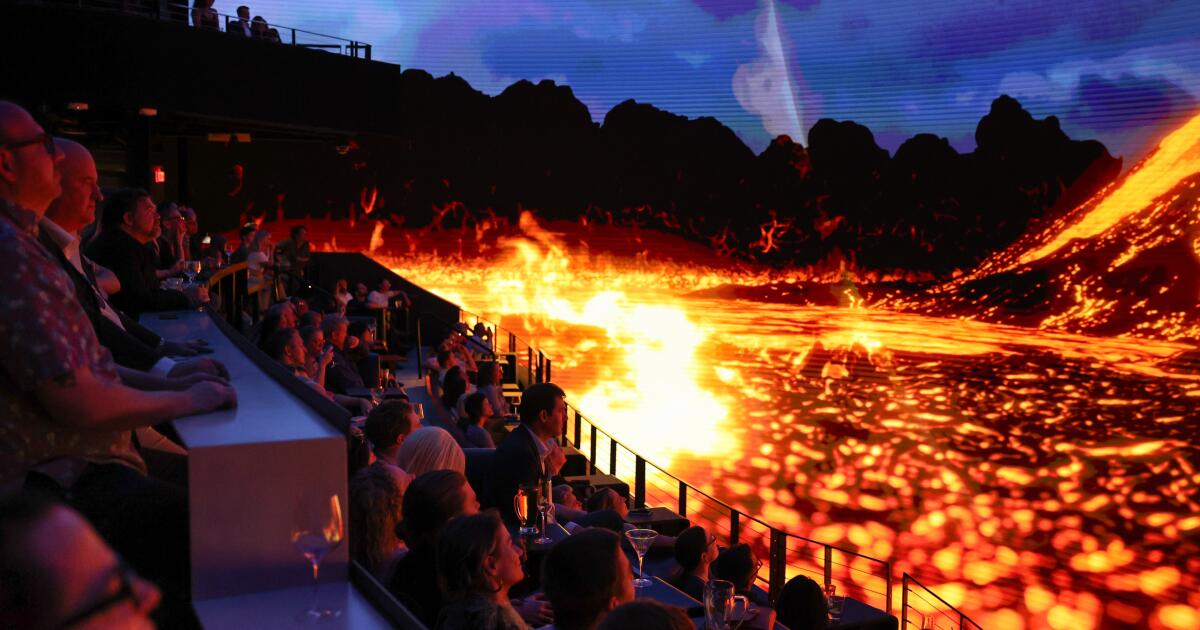
Sony Pictures will invest $100 million and take a minority stake in virtual reality venue operator Cosm, as the studio continues to build a business in communal experiences.
As part of the investment, Sony Pictures Chief Executive Ravi Ahuja will also join Cosm’s board of directors, the studio said Wednesday. The size of Sony’s minority stake was not disclosed.
The El Segundo-based Cosm currently operates three venues — one at Hollywood Park in Inglewood, and the others in Dallas and Atlanta. The company plans to open additional venues in Detroit and Cleveland.
Cosm bills itself as a “shared reality venue,” and its facilities center around a massive, wraparound screen that is intended to envelop viewers with additional digital effects. The company has largely focused on sports, though it has also shown Cirque du Soleil shows and done several collaborations with Warner Bros., including recent screenings of 2001’s “Harry Potter and the Sorcerer’s Stone” in honor of the film’s 25th anniversary.
“Cosm sits at the intersection of several trends shaping the future of entertainment,” Ahuja said in a statement. “We’ve followed Cosm since before launch and have been impressed with the quality of the experience and the enthusiasm it’s generating with audiences.”
The investment is Sony’s latest venture into experiential entertainment. In 2024, the Culver City-based studio acquired dine-in theater chain Alamo Drafthouse Cinema.

The Los Angeles City Council on Tuesday unanimously advanced an ordinance to halt new oil and gas drilling and phase out all existing production over the next 20 years. L.A. is home to more than 2,000 active oil wells.
The measure revives a similar ban passed in 2022, which was struck down by a judge following legal challenges from the oil and gas industry.
It must pass a second vote before final adoption later this summer, and would make L.A. the largest city in the United States to phase out existing oil wells.
“Today, Los Angeles is making a decision that aligns with our need to turn the page on urban oil drilling,” Councilmember Katy Yaroslavsky said during Tuesday’s council meeting. “The absence of an enforceable oil ordinance has had real consequences for our communities.”
The ban in 2022 was seen as a historic move for a region built on the petroleum industry.
But in 2024, a Los Angeles County Superior Court judge invalidated the law, ruling that the state, not the city, has jurisdiction over petroleum production. The legal challenge was brought by oil companies including Warren Resources, which operates a large oil field in Wilmington. Much of the field is beneath the city of Long Beach, but it also extends under Los Angeles.
Shortly after that, state legislators advanced Assembly Bill 3233, which reaffirmed city and county authority to regulate oil and gas activity. It was largely seen as the missing piece that made the original ordinance vulnerable.
“It’s now unequivocal that cities have the authority to regulate, limit and prohibit oil and gas operations within our jurisdiction,” Yaroslavsky said.
The new ordinance, written by the Department of City Planning, prohibits new oil and gas extraction, including drilling, redrilling or deepening existing oil wells for the purposes of production. It also designates all existing and active idle wells as “nonconforming uses,” meaning they may only operate during the phaseout period and are no longer compliant with current zoning.
Warren Resources, which led the lawsuit against the previous ban, did not immediately respond to a request for comment. The company previously argued that the 2022 ban was rushed and would lead to more oil imports to the area, causing increased emissions from tankers and trucks and other environmental consequences.
Many wells in the city operate near schools, homes and parks. Most are concentrated in low-income areas and communities of color, such as Wilmington and the harbor district, West L.A. and South L.A., where residents have long reported respiratory issues, headaches, throat irritation and other health problems. Studies have found oil wells can emit carcinogens and are linked to adverse health effects.
“This ordinance is such an important step toward giving every frontline community in Los Angeles access to clean air,” Silvia Esparza, a South L.A. resident and member of environmental justice group Stand-L.A., said in a news conference ahead of Tuesday’s vote.
Ashley Hernandez, a Wilmington resident and organizer with the nonprofit Communities for a Better Environment, said bloody noses and noxious fumes were a regular part of life in the neighborhood growing up.
She noted that in addition to oil drilling, L.A. residents continue to face other environmental hazards, such as the recent oil pipeline rupture that sent crude into the L.A. River or the ongoing cold storage warehouse fire in Boyle Heights that is spewing toxic smoke.
“I’m here to remind L.A. city and these toxic neighbors that Wilmington residents are more important than any ‘black gold’ under their homes,” Hernandez said. “We need our city to protect our families now and to stop the oil industry’s reign of power in our city. A passage of the oil phaseout ordinance today gives the city a chance to correct this wrong.”
Times staff writer Dakota Smith contributed to this report.
-
News24 minutes ago
Federal judge halts Trump’s election executive order seeking to create a federal voter list
-

 Los Angeles, Ca2 hours ago
Boyle Heights warehouse cleanup begins as crews face 85 million pounds of spoiled food
-

 Detroit, MI2 hours ago
Would Detroit Lions Salary Cap Be Wrecked If Terrion Arnold Gets Cut?
-

 San Francisco, CA2 hours ago
Two more Presidio Heights homes reach $10M range as luxury supply dwindles
-

 Dallas, TX2 hours ago
One Dallas Cowboys Contract That Will Age Poorly in 2026
-

 Miami, FL2 hours ago
Live updates: Today’s South Florida News
-
 Boston, MA2 hours ago
A federal judge in Boston has blocked parts of Trump’s order to limit voting by mail
-
 Denver, CO3 hours ago
Denver Transplant Games sets Guinness World Record for most living donors, recipients in one place at one time

