Sports
UCLA guard Gabriela Jaquez learned to handle bruising hits while leading Mexican team


When Gabriela Jaquez noticed three of her UCLA teammates passionately representing Serbia and Germany during Olympic qualifiers, she was motivated.
Emily Bessoir and Lina Sontag qualified to make their Olympic debuts playing for Germany. UCLA teammate Angela Dugalić, of Serbia, also qualified to compete during the Paris Games.
“I saw them and they inspired me,” said Jaquez, explaining why she decided to play for the Mexican national team.
Jaquez, 20, then talked with her father and older brother about playing for Mexico during the summer in her first international tournament. Mexican basketball federation officials had long sought her participation after her brother, former UCLA star and current Miami Heat player Jaime Jaquez Jr., played for Mexico during the 2019 Pan American Games in Lima, Peru.
“Mexico had always asked me to play with them, but I didn’t know if I was going to be ready,” Jaquez said. “I took the initiative to play with them and I’m super grateful I got to do it.”
Her dad warned her, “You’re not going to get the fouls at FIBA that you get at UCLA,” Jaime Jaquez Sr. recalled while laughing. Her brother told her the same thing.
But Gabriela was not intimidated and called the coach of the Mexican women’s team, Lindsey Harding, a successful Duke player and former pro, who welcomed her. Harding made Jaquez feel comfortable and told her that her first adventure with Mexico could be in August in the pre-qualifying tournament for the FIBA 2026 Women’s Basketball World Cup.
“It was very cool that she was the coach. I admire the way she is, how much I can learn from her,” Jaquez said of Harding, who was recently named an assistant coach with the Lakers, becoming the first woman to hold that title in Lakers history.
Jaquez had the support of UCLA coach Cori Close, who urges her players to seek international competition experience to broaden their repertoire of play.
Unlike college basketball, the FIBA game is generally more physical. Jaquez’s role on the Mexican team also was different from what she is used to with UCLA, a team on which she has very tall teammates. In Mexico, Jaquez, at 6 feet, is one of the tallest players.
“I knew it was going to be physical, but I tried to have fun and that’s what I did,” Jaquez said of the strong FIBA style.
“After every game, she had new bruises,” said Jaime Jaquez Sr., who accompanied his daughter to every game in Mexico City.
Harding said Gabriela Jaquez adapted quickly.
“The game is different than college basketball in the United States, it’s different than anywhere else you play. You’re allowed to do more things, more contact than you’re used to,” Harding said at the news conference after the first game, where she noted that it only took Jaquez one half of the game to adjust.
During the seven-day tournament in August, played at the Juan de la Barrera Olympic Gymnasium in the Mexican capital, the Mexican team was not the favorite but debuted with a win over Mozambique and then defeated New Zealand. Mexico then lost a competitive game to Montenegro and in the semifinals, they were eliminated by the powerful Czech Republic.
The Jaquez family gathered for a fundraiser benefitting the Jaquez Family Scholarship Fund. From left, Angela, Jaime Jaquez Jr., Gabriela, Marcos and Jaime Jaquez Sr. Gabriela Jaquez played for Mexico during the summer, following her brother’s path competing fo the country.
(Cortesía UCLA)
Jaime Jaquez Sr. said he was proud of how his daughter connected with her teammates, including Sofia Payan and Carla Martinez.
“I think they are going to be her friends forever,” he said.
Gabriela Jaquez is grateful she decided to play for Mexico.
“Honestly, it was a lot of fun, it was a great experience,” said Jaquez, who led the Mexican team in points and rebounds. “At the beginning, I was a little nervous. I didn’t want to think about it too much because I didn’t want to stress myself out. But at the end of the day, it’s basketball, it’s what I love to do.”
The competition exceeded the Mexican team’s expectations and confirmed how much Jaquez can help the team. The Camarillo native averaged 21.8 points, 7.8 rebounds and 1.3 assists per game.
“We are very happy. … Gabriela integrated very quickly with her teammates. The senior women’s national team had an outstanding pre-World Cup event,” said Modesto Robledo, president of the Mexican Basketball Sports Assn. “They played with a lot of grit.”
Jaquez said her teammates and coaches were very welcoming. The crowd also stole her heart.
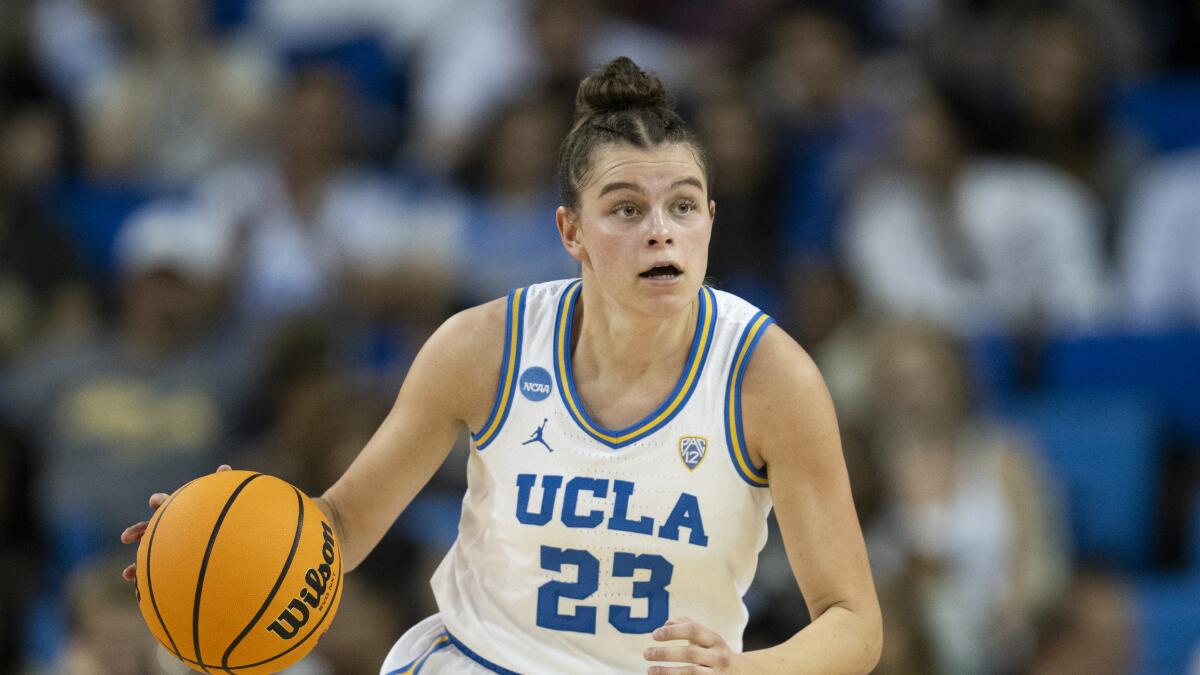
UCLA’s Gabriela Jaquez dribbles during a game against California Baptist on March 23 in L.A.
(Kyusung Gong/AP)
“The people from Mexico who went to our games were incredible. They were saying they were grateful that I would play for Mexico, but no, I was the one who was more grateful,” she said.
Omar Quintero, Mexico’s national team director, believes the Jaquez siblings can have a big effect on the Mexican national team.
“She came to revolutionize Mexican women’s basketball,” Quintero said of Gabriela. And he wants to see her brother return next summer to represent Mexico.
Last season, Jaquez and UCLA reached the NCAA tournament Sweet 16 before falling to Louisiana State. She averaged 10 points, 5.6 rebounds and 1.6 assists per game in 34 games, starting six of them and averaging 25.2 minutes per game.
Jaquez wants to help UCLA win the Big Ten and hopes the more physical play she adapted to during the summer will help her during the NCAA tournament.
“The Big Ten championship and being in the Final Four are always our goals,” Jaquez said.
During the tournament in Mexico, Harding learned she had landed the Lakers assistant coaching job. It is unclear whether she will continue coaching Mexico during international tournaments, but federation officials hope she still has time in her schedule.
Meanwhile, the Mexican Basketball Sports Assn. is intensifying the search for players for its national teams. A FIBA rule requires players who represent a national team be born in that country or have obtained their passport from that country before the age of 16. There is only one exemption spot on the roster for a player who got their passport after the age of 16. Jaime and Gabriela Jaquez both used exemptions.
Mexican federation officials are trying to process as many passports as possible for young Mexican American basketball players in the United States so that if they continue to develop their talent, they can play for Mexico without relying on exemptions. The federation has scheduled a camp in Los Angeles for boys and girls under age 3 for January 2025.

UCLA forward Gabriela Jaquez, left, shoots over Purdue forward Alaina Harper during a game on Nov. 6.
(Ryan Sun / Associated Press)
“We may have to set up 300 passports, but if five or six players come out of those 300, we’re good,” Quintero said.
Some of the young basketball players they have in their sights include the children of former Laker Matt Barnes, who have Mexican roots through their mother.
“We are looking for boys and girls from the United States who have the same dream as Gabriela,” Quintero said.
This article first appeared in Spanish via L.A. Times es Español.



Next summer’s World Cup will be the largest, most complex and most lucrative sporting event in history, with 48 teams playing 104 games in three countries. The tournament is expected to draw a global TV audience of nearly 5 billion and FIFA, the event’s organizer, is hoping for revenues of between $10 billion-$14 billion — which is why lower-bowl tickets for Iran-New Zealand at SoFi Stadium cost nearly $700.
All that seemed unlikely after the first tournament in 1930, when the idea of a soccer World Cup was nearly killed in the cradle, the victim from lack of planning, lack of money and lack of interest. That the competition survived, much less thrived, is nothing short of a miracle, says English writer and podcaster Jonathan Wilson, author of the deeply researched “The Power and Glory: The History of the World Cup.”
“1930, it’s incredibly amateurish in many ways,” Wilson said. “It’s got that sort of almost like a school sports day feel to it.”
Only 13 countries took part in the first tournament; it was supposed to be 16 but the Egyptian team missed its boat to Uruguay while Japan and Siam (now Thailand) couldn’t afford the travel costs and pulled out. England, meanwhile, not only refused to play, but the British press ignored the event, as did much of Europe.
That seemed like a wise decision at the time since the first two matches of the inaugural tournament were affected by snow, with one of the opening games drawing just 4,444 fans. The smallest crowd in World Cup history, estimated at about 300, showed up for another first-round game between Romania and Peru and the TV audience … well, there was none since TV had yet to be invented.
The officiating was beyond suspect — Romania’s manager, Constantin Radulescu, also worked two games as a linesman — and the U.S. trainer, Jack Coll, had to be stretchered off the field during his team’s semifinal — yes, the U.S. made the semifinals! — with Argentina when he lost consciousness after inhaling the fumes from a bottle of chloroform that shattered in his pocket.
In another game, the penalty spots were mistakenly marked 16 yards from goal instead of the regulation 12 — and nobody noticed.
“Some of the details don’t make sense,” Wilson said. “The whole thing is so sort of low grade compared to today.”
When Argentine captain Nolo Ferreira left the tournament and returned home to take his law exams his replacement, Guillermo Stábile, scored a tournament-high eight goals in four games — then never played for the national team again (although he did coach it, leading the La Albiceleste to six South American titles and the 1958 World Cup).
Given the farcical nature of the 1930 World Cup, the tournament probably should have ended right there. Instead, 1930 has become the foundation on which next year’s competition was built.
The origins of the tournament, however, actually make sense. Before 1930, FIFA recognized the winner of the Olympic competition as the world champion. But that event was for amateurs, a point on which the International Olympic Committee would not budge.
With professional soccer growing in popularity, FIFA decided to stage its own breakaway event and play it in Uruguay, the country that had won the last two Olympic titles.
Argentina’s goalkeeper can’t stop a shot by Uruguay during the 1930 World Cup final against Argentina in Montevideo, Uruguay.
(Associated Press)
That quickly proved to be a big mistake. The growing effects of the Great Depression left many countries unable to afford the long, slow steamship trip to South America. The first tournament was open to any country that wanted to play, yet two months before the first game no European teams had agreed to come.
“It was taken very seriously by Uruguay and Argentina,” Wilson said, but not by many others.
That changed shortly after Romania’s King Carol II, who ascended to the throne in a coup that deposed his son, personally selected his country’s World Cup roster and sent it on its way. France quickly agreed to go too, entering a makeshift team under pressure from FIFA president Jules Rimet, a Frenchman. Belgium also buckled under FIFA pressure and all three teams boarded the same ship for the trip to Uruguay, working out together on the 15-day voyage aboard the SS Conte Verde, an Italian ocean liner.
“Even the four European nations who go it’s not entirely clear how seriously they took it,” Wilson said. “The French and Romanians, they kept diaries. They seem to have regarded this as a laugh. We’ll try to win but it doesn’t really matter.”
Things didn’t really get loony until the tournament began. The Bolivian team, for example, played in berets, as did an Argentine midfielder, while the 15 referees who worked the games, some of whom had traveled and socialized with the players on the long boat ride from Europe, dressed formally in knickers, long-sleeve shirts, blazers and ties.
The well-dressed officials spent much of the tournament working with police to break up fights; play was so violent at least two players sustained broken legs and the U.S.-Argentina semifinal descended into a full-out brawl, with one American having four teeth knocked out and another hospitalized with injuries to his stomach.
The tournament finally finished with the hosts beating Argentina 4-2, after which the Argentines broke off diplomatic relations with their neighbor and an angry mob in Buenos Aires stoned the Uruguayan embassy.

Uraguay’s team before the 1930 World Cup final against Argentina.
(Keystone / Getty Images)

Argentina’s soccer team before preparing for the 1930 World Cup final.
(Associated Press)
“It ended,” Wilson said of the tournament, “with everybody sort of fighting each other.”
Few disagreed with the Argentine magazine El Gráfico, which seemed to predict there was little future for the fledgling event. “The World Cup is over,” it wrote. “The development of this competition brought not only an unpleasant atmosphere, but also an ungrateful one.”
Yet nearly a century later, the World Cup is still here. And that, too, was foretold in 1930 in the story of Romanian midfielder Alfred Eisenbeisser (who was also known as Fredi Fieraru because, why not?).
On the journey home from the first World Cup, Eisenbeisser contracted pneumonia and a priest was called to administer the last rites. The ship eventually docked in Genoa and he was taken to a sanatorium while the rest of the team continued on to Romania.
Assuming her son had perished in Italy, Eisenbeisser’s mother arranged a wake — only to have her son stroll into the ceremony very much alive, causing the woman to faint. Eisenbeisser would play 12 more years of professional soccer and compete in figure skating in the 1936 Winter Olympics, where he finished 13th in the pairs competition.
Turns out the reports of Eisenbeisser’s demise, like those of the World Cup, were greatly exaggerated.
⚽ You have read the latest installment of On Soccer with Kevin Baxter. The weekly column takes you behind the scenes and shines a spotlight on unique stories. Listen to Baxter on this week’s episode of the “Corner of the Galaxy” podcast.

NEWYou can now listen to Fox News articles!
Philip Rivers’ return to the NFL has many former quarterbacks over the age of 40 wondering if they could turn back the clock and perform at a similarly high level.
If anything, they should at least take note of what Rivers did in the first half for the Indianapolis Colts against the San Francisco 49ers.
Indianapolis Colts quarterback Philip Rivers (17) passes as San Francisco 49ers defensive lineman Keion White (56) applies pressure during the first half of an NFL football game, Monday, Dec. 22, 2025, in Indianapolis. (AP Photo/Carolyn Kaster)
The Pro Football Hall of Fame Class of 2026 semifinalist put on a vintage performance in the first half against the 49ers, delighting NFL fans who tuned into the game on Monday night.
He started the night coming out to cheers from Colts fans at Lucas Oil Stadium – his family also in attendance. The Colts went nine plays, 72 yards and Rivers found wide receiver Alec Pierce for a 20-yard touchdown. Indianapolis jumped out to a 7-0 lead.
NFL SUSPENDS STEELERS’ DK METCALF FOR 2 GAMES AFTER ALTERCATION WITH LIONS FAN
Indianapolis Colts quarterback Philip Rivers (17) passes against the San Francisco 49ers during the first half of an NFL football game, Monday, Dec. 22, 2025, in Indianapolis. (AP Photo/AJ Mast)
San Francisco scored on back-to-back drives thanks to Brock Purdy hooking up with Demarcus Robinson, the special teams forcing a turnover, and then Purdy throwing a touchdown pass to Christian McCaffrey. When Rivers got the ball back, he drove down the field again.
The Colts scored on a 16-yard touchdown pass from Rivers to Pierce to end a 12-play, 66-yard drive. The game was tied with a lot of time to go in the first half.
Indianapolis trailed 24-17 at the half. But the attention was on Rivers.
He was 14-of-21 with 175 passing yards and two touchdown passes. The last time he threw multiple touchdown passes in the regular season was on Dec. 20, 2020, against the Houston Texans.
Rivers came back to the Colts last week at the age of 44. He had a solid performance against the Seattle Seahawks for someone who hadn’t thrown a ball in nearly five years.
Bundle FOX One and FOX Nation to stream the entire FOX Nation library, plus live FOX News, Sports, and Entertainment at our lowest price of the year. The offer ends on Jan. 4, 2026. (Fox One; Fox Nation)
CLICK HERE TO DOWNLOAD THE FOX NEWS APP
Now, the Colts’ playoff hopes rest on his shoulders.
Follow Fox News Digital’s sports coverage on X and subscribe to the Fox News Sports Huddle newsletter.

The world of college football may be awash in uncertainty, but the last several weeks have proven one thing beyond a shadow of a doubt.
Nobody runs like Notre Dame.
When the Irish got jobbed by the College Football Playoff committee and insanely were left out of the CFP, they refused to play another game this season.
Notre Dame ran from the Pop Tarts Bowl.
Then came Monday’s announcement that Notre Dame no longer will regularly play USC, essentially ending a 100-year-old rivalry because the Irish didn’t want to change the dates of the game.
Notre Dame ran from the Trojans.
Call them the Fightin’ Chickens, a once-proud Irish program that demands acquiescence or it will take its ball and go home.
The Irish could have played USC at the beginning of the season, but refused. The Irish could have kept the rivalry alive with a scheduling tweak that would have helped both teams, but refused.
Lots of folks are going to blame USC and coach Lincoln Riley for butchering a Knute Rockne-born tradition that accounted for 78 straight games, not counting 2020, the COVID-19 year. That’s wrong. Nobody has been more critical of Riley than this space, but he’s not the bad guy here.
Anybody who felt the buzz around the CFP first-round games last weekend would attest, this is where USC needs to be playing. If the Trojans truly want to return to greatness, being selected for the CFP is the goal. Not beating Notre Dame. Not even beating UCLA. It’s all about the tournament.
USC needs to put itself in the best possible position to be playing on a mid-December weekend, and that means no longer being the only Big Ten school to play a major nonconference game in the middle of the season or later.
The schedule has become tough enough. The Trojans don’t need to make it tougher with the kind of game nobody else in their conference is playing.
They need Notre Dame in August, not in late October or mid-November.
But, as it turns out, Notre Dame believes it doesn’t need USC at all.
The Irish signed a deal with the CFP that stipulates, beginning next year, if they are ranked in the top 12, they are guaranteed a playoff berth. They can get in the playoffs without risking a loss to the Trojans. They can play it safe and schedule easy and back right in.
USC doesn’t have that luxury. USC isn’t guaranteed squat. USC has a 2026 schedule that even without Notre Dame is a nightmare.
USC and Notre Dame prepare to play in a packed Notre Dame Stadium in October 2023.
(Michael Caterina / Associated Press)
Home games against Ohio State and Oregon. Road games at Indiana and Penn State.
USC doesn’t need a midseason game against Notre Dame making that road even harder.
Jennifer Cohen, the USC athletic director, said as much in a recently posted open letter to the Trojans community.
“USC is the only team in the Big Ten to play a nonconference road game after Week 4 in either of the past two seasons,” she wrote. “USC is also the only team to play a nonconference game after Week 4 in both seasons.”
Trojans fans love the rivalry. The college football world loves the rivalry. It’s Anthony Davis, it’s Carson Palmer, it’s the Bush Push, it has won Heismans and cemented championships.
But times have changed. The landscape is evolving. Everything that college football once represented is up for debate. Even the most venerable of traditions is subject to adjustments.
That’s what the Trojans wanted to do. Not eliminate, but adjust. But Notre Dame football adjusts for no one.
It was indeed a travesty that the two-loss Irish, winners of their last 10 games by double digits, did not get a spot in the national tournament. By the end of the season they were arguably one of the four best teams in the country. They easily could have captured the crown.
Tulane? James Madison? Are you kidding me? As the opening games revealed — the two AAA teams were outscored 92-44 — there is no place for Cinderellas in the CFP.
But that was no reason for Notre Dame to back out of the bowls completely, sacrificing the final game in the careers of the Irish players who will not be going to the NFL just to make a whining point that resonated with nobody.
And, besides, there’s another way Notre Dame could have been a lock for the playoffs.
Join a conference, fool!
By keeping the football team out of the otherwise Irish-infected Atlantic Coast Conference, Notre Dame is raking in big TV bucks that it doesn’t have to share. But this means the Irish are subject to the whims of a committee that could, and did, unconscionably leave them out.
Notre Dame always wants it both ways. It wants its independence, but also wants to dictate a schedule filled with conference-affiliated teams.
In demanding that their game be played in August or not at all, USC finally called Notre Dame’s bluff.
And the Irish did what they recently have done best.
They ran.
The team that initially will replace USC on the Notre Dame schedule?
It’s Brigham Young, the same team that Notre Dame snubbed in the Pop Tarts Bowl.
Put that in your toaster and cook it.

Why Gen Z and Gen Alpha are feasting on TV comfort food

L.A.’s latest viral party spot is … Seafood City. Yes, you read that right

Commentary: ‘It’s a Wonderful ICE?’ Trumpworld tries to hijack a holiday classic
Nearly a century ago, the first World Cup went off with many hitches

Trump says Greenland ‘essential’ for security: Could he take it by force?

Florida High School Football Rankings: Top 25 teams – Oct. 21

Cleary's 21 help Le Moyne down Central Connecticut State 69-64 in OT

How old is Bo Nix? What to know about Oregon quarterback ahead of 2024 NFL Draft

99th annual Pony Swim held in Virginia

Video: ‘It Didn’t Have to Happen This Way:’ U.Va. Faculty Call for Review of Police Response to Protests
Trump says Greenland ‘essential’ for security: Could he take it by force?

BBC Verify: Satellite image shows tanker seized by US near Venezuela is now off Texas

20% of NYC mayor-elect Mamdani transition appointees have anti-Zionist ties: ADL

Exclusive: Former MEP Kaili doubles down on ‘Belgiangate’

‘Music makes everything better’: A Texas doctor spins vinyl to give patients relief
-

 Iowa1 week ago
Addy Brown motivated to step up in Audi Crooks’ absence vs. UNI
-

 Iowa1 week ago
How much snow did Iowa get? See Iowa’s latest snowfall totals
-

 Maine7 days ago
Elementary-aged student killed in school bus crash in southern Maine
-

 Maryland1 week ago
Frigid temperatures to start the week in Maryland
-

 New Mexico6 days ago
Family clarifies why they believe missing New Mexico man is dead
-

 South Dakota1 week ago
Nature: Snow in South Dakota
-

 Detroit, MI1 week ago
‘Love being a pedo’: Metro Detroit doctor, attorney, therapist accused in web of child porn chats
-

 Health1 week ago
‘Aggressive’ new flu variant sweeps globe as doctors warn of severe symptoms