Sports
The State of Punditry – part 2: How the world analyses football – and the U.S. lead the way


Football coverage is a divisive subject.
Some think the standard of punditry is great, others will tell you it needs some work and some will deride it as awful. The analysis of the analysis never ends.
This week, The Athletic is looking more closely at the state of the industry, starting with yesterday’s piece assessing what is demanded of pundits in the United Kingdom in 2024 and how people consume their work.
Today, we broaden the discussion to see how UK coverage stacks up against the rest of the world, including the proudest of all football nations Germany, Brazil and Spain, together with those pesky upstarts in the U.S..
In Europe, the landscape of punditry can be wildly different. Travel to Italy, Spain or Turkey, switch on a television and scan through the channels and you’ll almost certainly be able to find some football coverage, be it via a football talk show, replays of matches, or on the news.
This is the case in the UK, too, via Sky Sports’ network of channels, but we’re talking free-to-air here in countries where people are arguably far more obsessed with football than your average UK football diehard.
It borders on fanaticism in a place like Turkey and the at-times frantic coverage reflects that. One grim incident recently showcased how seriously football is taken, when pundit Serhat Akin was shot in the foot when leaving a TV studio.
The former Fenerbahce player had been covering the club’s match against Belgian side Union Saint-Gilloise from an Istanbul studio, after which he was approached and shot by a masked man.
Akin posted a picture of his bloodied foot on Instagram with the caption: “They shot my foot, our last word is Fenerbahce.”
Over in Germany things are a bit calmer.
In many ways the coverage is very similar to in the UK, only probably a bit better. Standard Bundesliga behaviour.
Why? Well, depending on your disposition, they don’t quite have as much forced melodrama that you tend to find with the Premier League.
The punditry industry is not quite as accessible for ex-players, so the notion of former pros that you’d get on, say, a certain national radio station in the UK where certain people will make certain comments to attract attention doesn’t really exist.
Presenters, again, unlike in the UK with Gary Lineker, Alex Scott, or, until recently, Jermaine Jenas, are media professionals rather than players. Pundits include Per Mertesacker and Christoph Kramer, the 2014 World Cup winner who has been an analyst for many years already despite being only 33 years old and still not officially retired (he left Borussia Mönchengladbach in the summer).
Germany coach Julian Nagelsmann speaks with Christoph Kramer (second right) and (right) Per Mertesacker (Tom Weller/picture alliance via Getty Images)
They have a tactics corner on Sky via Dutchman Erik Meijer, the one-time Liverpool striker who spent much of his career in Germany. In a recent interview with The Athletic, Meijer described his reaction to being asked to appear on German television: “The first question I had was, ‘There are 80 million Germans in this country so why do they need to employ a Dutchman? But they wanted a different voice — someone who would say that Bayern Munich were c**p when they were.”
Julia Simic, who used to play for the women’s national team, is also a regular, while pundits who cover the Premier League include former goalkeeper Rene Adler and ex-Croatia international and Fulham and West Ham striker Mladen Petric.
While Germans do like other sports, such as basketball, handball and tennis, football is the main draw and the coverage can be dense and fanatical, although it tends to be quite considered and mindful of weighty issues. The rise of vloggers and influencers we have seen in the UK hasn’t yet caught on.
Probably the most high profile figure is Wolff Fuss, inflection king extraordinaire. Search for him on TikTok and you’ll find 20 million matches. Fuss has the stage to himself because, in another difference to the UK, co-commentators are quite uncommon in Germany.
If Fuss is the main man, then Lothar Matthaus is the loudest. Not necessarily in volume, but in the decibel level of his opinions (and his outfits… Matthaus caught the eye at this summer’s European Championship with some striking gilets).

Lothar Matthaus (right), complete with gilet (Marcus Brandt/picture alliance via Getty Images)
Matthaus could probably be compared to Gary Neville or Jamie Carragher in that he gives forthright views on “his” club, which in this case would be Bayern Munich. Neville and Carragher constantly attract the attention of Manchester United and Liverpool managers with their views but Matthaus — and his partner-in-crime, Dietmar Hamann — tend to take it a bit further.
In the past year alone, Matthaus has called for Thomas Tuchel to be sacked, questioned the signing of Eric Dier, claimed Jadon Sancho’s influence at Borussia Dortmund had been exaggerated by the media and said he “felt sorry” for Cristiano Ronaldo whose “ego trips” had “damaged the team and himself”.
Last November, Tuchel referenced Matthaus and Hamann in a press conference after a 4-0 victory over Borussia Dortmund, saying: “Can I quote Lothar and Didi? For a team with no further development and a bad relationship between coach and players, that was alright today, I’d say. I’m sure the experts will tell you the rest themselves.” Nice.
Matthaus is probably still tame compared to Rafael van der Vaart, who, since retiring, has very much earned a reputation for making unfiltered and inflammatory comments in his role as a pundit in the Netherlands.
You may recall Van der Vaart had a pop at England’s Declan Rice after the Euro 2024 final on the coverage of Dutch broadcaster NOS, saying: “£100million for Declan Rice, what does he do? He comes to collect a ball only to pass it back to John Stones. He is useless. If you are truly worth £100m then you should be able to play a ball forward.”
This was very much in character for Van der Vaart, whose appreciation for the England team seems to be somewhat lacking given he also decried the whole side as “s***”, also on NOS, after they defeated the Netherlands 2-1 in the semi-finals.
Over in Spain, you may be most familiar with Spanish football TV punditry from clips of El Chiringuito de Jugones, a late-night debate show in which a cast of big personalities voice their opinions — usually quite loudly and with little sense of impartiality.
🔥 “RAMOS, TE QUIERO. ERES MI CAPITÁN” 🔥
⚪️‼️”¡¡FIRMA y QUÉDATE en el REAL MADRID!!”‼️⚪️
🤍💜 El discurso de @As_TomasRoncero que convencerá a @SergioRamos. #ElChiringuitoDeMega pic.twitter.com/SVdRd0HPcS
— El Chiringuito TV (@elchiringuitotv) May 9, 2021
In recent years the programme has gained notoriety for interviewing Real Madrid president Florentino Perez after the attempted launch of the European Super League, using the phrase “tic tac” to announce incoming transfer news (imitating the ticking of a clock) and showing three minutes of former Madrid midfielder Guti looking sad after his old side’s 4-0 Champions League defeat by Manchester City last year.
You will find a more sophisticated level of discussion on TV channel Movistar Plus and streaming platform DAZN. The former features former Madrid and Argentina player turned pundit Jorge Valdano while presenter Miguel Quintana and former Equatorial Guinea international Alberto Edjogo-Owono, who spent his career in the Spanish lower leagues, are two respected voices on DAZN.
But the way fandom works in Spain — in particular with the big two clubs, Barcelona and Madrid — means those pundits are often labelled the enemy of one or other team, despite trying to be impartial.
In Spain, there is also a deeper layer of scrutiny towards refereeing and why decisions do or do not happen (possibly linked to the above). There is no equivalent of Match of the Day, perhaps because there is not much interest in analysing games like Osasuna versus Getafe from a tactical perspective. And the tactical insight mainly comes from social media rather than mass media.
As for other prominent pundits, Guti has made a name for himself on DAZN, while Gaizka Mendieta and Juanfran Torres are also regulars on television.
Often more in-depth analysis can be found on late-night radio shows such as El Larguero on Cadena SER or Cadena COPE’s El Partidazo — both of which go on until the early hours and continue to attract huge audiences, as The Athletic’s Laia Cervello Herrero explored earlier this year. Even then, debates can get heated given the nature of football in Spain.
You might think the tone would be fairly outrageous in a football-mad country like Brazil, but while passions undoubtedly run extremely high and some coverage can be melodramatic, there is also room for reasoned debate.
The biggest difference in Brazil is the volume of the commentators, who are the stars of the show.
“The commentator really goes for it,” Natalie Gedra, a football reporter for Sky Sports in the UK who previously worked for ESPN and Globo in Brazil, tells The Athletic. “Brazilians cannot understand countries who don’t scream ‘GOOOOOOAAAAAAL!’ There’s also a tune that comes with it, either the club’s anthem or a song that’s related to the national team.
“Visually it’s different too — for example, you will have a gigantic ball going back and forth on the screen between transitions of replays. I remember watching World Cups growing up and they had a little mascot who would show up on the screen and dance around.”
Having ex-referees as pundits, for example, has been a well-established practice in Brazil for at least a decade, formerly in the commentary box but now more as studio analysts. Oh, and the studios are always at TV HQ, not on site at stadiums.
Talking of the commentary box, it’s typically filled with three people – a commentator, i.e. the star, a journalist and a former player.
“They have more ex-players now, but a lot of journalists are co-commentators or pundits on both pre and post-match shows,” Gedra adds. “Everyone knows the commentator; they’re massive stars.”
Reflecting how their best players tend to head to Europe, Brazil’s most famous ex-players aren’t really part of the TV coverage over there, other than for World Cups. Ronaldo worked on the 2014 World Cup and, most famously, Pele was a commentator for the 1994 World Cup.
“There are some ex-players, like, for example (Walter) Casagrande, who played for Corinthians. He was the most prominent for many years,” Gedra says. “He was a bit of a pioneer, he had a big profile and didn’t back down from making big statements, but he was also very articulate.
“The main Brazilian football names don’t become pundits in Brazil, but Pele in 1994 is by far the most famous example. There is a picture of him celebrating in the commentary booth with commentator Galvao Bueno which is one of the most iconic images in the history of Brazilian television.
Meu amigo Édson se foi!!
Que tristeza! Mas Pelé, não!!
Pelé é eterno!! Rei Pelé!!
Primeiro e único!! pic.twitter.com/AA56oWRdlZ— Galvão Bueno (@galvaobueno) December 29, 2022
“Galvao Bueno is probably the biggest name in the history of Brazilian TV, he’s absolutely huge and the voice of many of the biggest sporting moments, like all the World Cups. Yes, people love or hate him but everybody knows who he is.”
Commentators in the UK don’t have anywhere near as big a profile. No wonder Guy Mowbray has started doing Gladiators.
Another difference is in the make-up of the post-match chat. Gedra has observed that Brazil’s coverage is less data-orientated than in the UK, although the tone depends on the channel. Globo, the free-to-air channel, have largely monopolised coverage but they are now under threat from newer players such as Sport TV, ESPN and TNT Sports. YouTube channels are also growing.
“I worked for ESPN and I think they got the tone just right, very analytical and not too spectacular or passionate,” Gedra says.
Unspectacular is definitely not a word you would use to describe the stylings of Alexi Lalas, one of the most prominent broadcasters in the U.S., whose brash persona brings a love-it-or-hate-it quality.
He works as an analyst for Fox Sports, has a podcast called Alexi Lalas’ State of the Union and doesn’t care if people like him or not. But his bold, direct and outspoken opinions have made him an influential figure in the U.S. and beyond.
Lalas is another who doesn’t seem to especially like English players, saying during the Euros that Gareth Southgate’s team were “insufferable as they are talented”.
“But I’m in the entertainment business,” Lalas told The Athletic earlier this year. “I am a performer. When you say that, sometimes people cringe. By no means am I saying that I can’t be authentic and genuine. But I recognise the way I say something is as important as what I say.
“When I go on TV, I put on a costume and when that red light goes on, I don’t want people changing the channel.”
Lalas’ audacious approach is a bit of a leap from the English-style NBC coverage that rose to prominence a few years ago. A number of ex-Premier League players headed Stateside and made names for themselves, such as Robbie Earle and Robbie Mustoe — while having decent careers in England, neither was a household name when playing for Wimbledon and Middlesbrough respectively.

GO DEEPER
Access all areas at NBC: Three Premier League games, a Winnebago and tactical sushi
The pair, who have their own podcast called The 2 Robbies, gave NBC’s coverage a familiar feel alongside commentator Arlo White and pundit Lee Dixon, while former Stoke City defender Danny Higginbotham is another face of the channel having moved Stateside. “What we’ve tried to do from the start is talk in a normal way about football,” Earle told The Guardian in 2017. An underrated concept.
Fox Sports also employ recognisable names from UK TV coverage including commentator (sorry, ‘play-by-play announcer’) Ian Darke, former Newcastle defender Warren Barton and ex-Sky Sports reporter Geoff Shreeves. Fox also use Mark Clattenburg as a refereeing analyst.
Undoubtedly the most renowned U.S. soccer coverage, though, is on CBS Sports via its hugely popular Golazo Champions League show, complete with the instantly recognisable line-up of Kate Abdo, Thierry Henry, Micah Richards and Jamie Carragher, whose on-screen chemistry make them a social media staple on every matchday.

Left to right: Kate Abdo, Thierry Henry, Jamie Carragher and Micah Richards have been a hit on CBS (Robbie Jay Barratt – AMA/Getty Images)
Pete Radovich, the coordinating producer of the UEFA Champions League coverage on CBS Sports, told The Athletic in September on how he came to realise that the network’s Champions League Today studio now owns the global conversation on major nights of European football.
“Thierry Henry, in no uncertain terms, says he gets asked more about CBS now than Arsenal,” he said. “That to me is wild.”
The show’s razor-sharp use of social media and its mix of humour, analysis and engaging post-match interviews with managers and players is a winning formula, while most importantly the quartet’s camaraderie feels natural, warm and unforced.
Americans showing the world how to make excellent football soccer coverage? It’s a brave new world.
(Top photos: Getty Images; design: Dan Goldfarb)



NEWYou can now listen to Fox News articles!
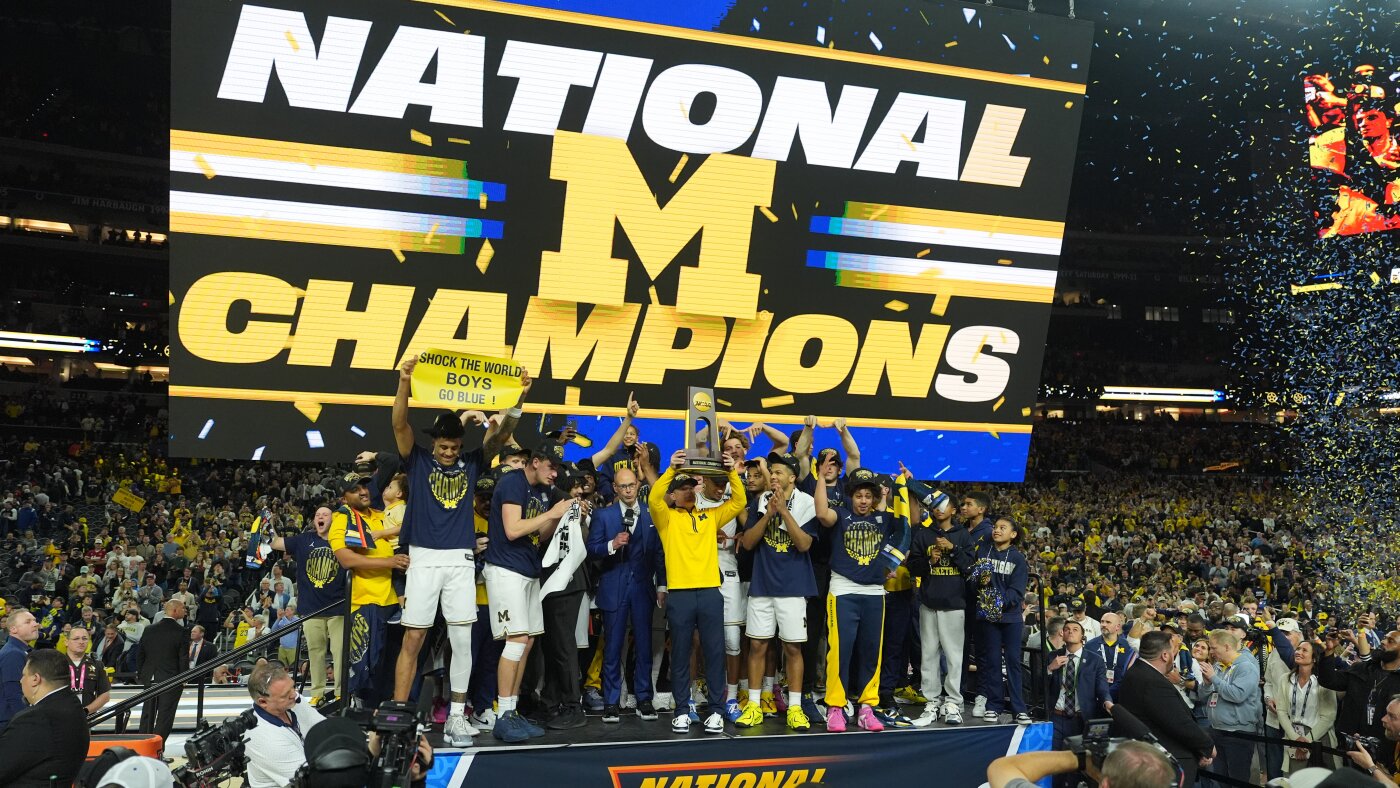
The Michigan Wolverines are finally national champions once more in men’s basketball, taking down the UConn Huskies, 69-63, to finish a thrilling NCAA Tournament in style at Lucas Oil Stadium on Monday night.
This is the first time Michigan has won since 1989, and just the second time in program history they’ve called themselves champions.
Meanwhile, the Huskies were looking to win their third title in the last four tournaments, but their shooting failed them in the end.
Elliot Cadeau celebrates during the first half of the 2026 NCAA men’s basketball national championship game against UConn at Lucas Oil Stadium in Indianapolis, Indiana, on April 6, 2026. (Michael Reaves/Getty Images)
While both teams’ offenses came into this game working like a machine, it was a low-scoring affair to kick off this game. Michigan only owned a 33-29 first-half lead by the buzzer, but it wasn’t Yaxel Lendeborg leading the way in the points department for the Wolverines.
The Michigan star, who is playing on a sprained left MCL and left ankle, which came during the win over Arizona in the Final Four, was just 1-of-5 shooting for four points in the first half. It was Morez Johnson Jr. (10 points) and Elliot Cadeau (seven points) finding some rhythm for the Wolverines.
UCONN’S DAN HURLEY HEARS BOOS AFTER FINAL FOUR WIN OVER ILLINOIS
But it didn’t help that Michigan was scoreless from beyond the arc and shooting just 37% from the field. Meanwhile, UConn wasn’t doing themselves any favors either.
The Huskies shot just 33% in the first half, with Alex Karaban hitting two of his five three-point attempts. Solo Ball, who was spotted in a walking boot entering the game with “some type of foot sprain,” according to head coach Dan Hurley, had eight points on 3-of-4 from the field.
While they were down, UConn was certainly playing the type of game they wanted against Michigan – a rugged battle, especially on the glass. Michigan has shown its prowess of taking momentum and sprinting with it offensively, dominating opponents all year long, including this NCAA Tournament.
Yaxel Lendeborg of the Michigan Wolverines dribbles during the first half against the UConn Huskies in the National Championship of the 2026 NCAA men’s basketball tournament at Lucas Oil Stadium in Indianapolis, Indiana, on April 6, 2026. (Michael Reaves/Getty Images)
However, the Huskies know their scratching and clawing abilities for 40 minutes allow them to never let an opponent feel comfortable. Just ask the Duke Blue Devils what happened in the Final Four.
The Huskies had that same demeanor in the second half, though it didn’t help they took a page out of the Wolverines’ first-half playbook – they couldn’t find the stroke from range. UConn was desperate to hit a three-pointer, but despite open looks, they couldn’t get one to fall as the Michigan lead eventually got to 11 points after Cadeau finally broke the seal for his squad on the opposite end, burying a three-pointer to get to a double-digit lead.
But Hurley was firing up the crowd as the Huskies never quit, cutting the lead to five with less than nine minutes to play in the game. Lendeborg, though, after shaking his head on the bench as he wasn’t having the game he hoped for in the national championship, stepped up when he checked back in.
Lendeborg saw a sweet pass from Cadeau in transition and got the lead back to 11 with a tough layup, making it 56-45 with less than six minutes to play. He would also come in the clutch with another two points following a Braylon Mullins three-pointer.
Once again, the Huskies wouldn’t quit, as Mullins finally found his shot beyond the arc, knocking that Michigan lead back to single digits with a follow-up three-pointer again to Lendeborg’s layups. But, just as gritty as the Huskies played, the Wolverines seemed to always have the answer in this hard-fought contest.
Head coach Dan Hurley of the UConn Huskies reacts during the first half of the NCAA men’s basketball national championship game against the Michigan Wolverines at Lucas Oil Stadium in Indianapolis, Indiana, on April 6, 2026. (Michael Reaves/Getty Images)
A key example of that was, after Karaban buried a three-pointer to cut the Michigan lead to six, Trey McKenney stepped back and drilled a 26-footer with 1:49 left in the game to get the lead back to nine points. The Wolverines faithful in the crowd went ballistic, knowing how much that basket meant considering what UConn has been able to do in this tournament.
With 37 seconds left in the game, Ball got some help from the backboard, making a three-pointer to cut the lead to 67-63 for the Wolverines. Roddy Gayle Jr. made things more interesting in this game, as he couldn’t knock down his two free throw attempts for Michigan. But Karaban didn’t have another clutch three-pointer in him, coming up short with 13 seconds left.
That was it for UConn’s desperation attempt, and Michigan celebrated their win.
In the box score, Cadeau led all scorers with 19 points on 5-of-11 shooting and 8-of-9 from the free throw line. Lendeborg was just 4-of-13, though he still had 13 points. Johnson had a double-double with 12 points and 10 rebounds for the Wolverines as well.
Cadeau was named the Most Outstanding Player of the Final Four.
CLICK HERE TO DOWNLOAD THE FOX NEWS APP
Michigan was just 2-of-15 from the three-point line, and head coach Dusty May even noted after the game getting dominated on the glass, as they were out-rebounded by UConn, 46-39.
The Huskies, though, couldn’t find it offensively. Karaban finished with 17 points and 11 rebounds, but shot just 4-of-14 and 3-of-10 from three-point territory. Tarris Reed Jr. had a double-double as well with 13 points and 14 rebounds, while Mullins, the hero against Duke with his half-court shot, was only 4-of-17 for 11 points.
Follow Fox News Digital’s sports coverage on X and subscribe to the Fox News Sports Huddle newsletter.

AUGUSTA, Ga. — Tiger Woods is everywhere and nowhere at Augusta National this week.
In the wake of last month’s rollover car accident and DUI charge, the five-time Masters winner has stepped away from golf indefinitely and reportedly could be receiving treatment in Switzerland for an addiction to painkillers.
“He’s not immune to it just because he can hit a golf ball really well,” fellow competitor Jason Day said. “He’s had 25 to 30-something surgeries, and when you’re going through that many procedures, it’s painful coming out of those procedures. I’ve had procedures done and I typically try and stay away from all that stuff because I just know that — painkillers, there can potentially be a downfall to it.”
Harris English, playing in his seventh Masters, said he took an interest in golf after watching Woods at Augusta in 1997.
“I know he’s going to get through this,” English said. “He has a big fight ahead of him. He’s a fighter. That’s what he does. He’s going to get through it and come out a better man and a better person. We hope to see him soon.”
This marks the first time since 1994 that neither Woods nor Phil Mickelson is playing in the Masters. Mickelson announced last week that he was pulling out of the tournament because of a “personal health matter” in his family.
In one sense, it’s the end of a storied era. But it might be more on the minds of the patrons than the other competitors in the field.
“With great respect to those two players, I hadn’t thought about it,” said Justin Rose, who lost to Rory McIlroy in a Masters playoff last year. “Yeah, they’ve both been obviously titans of the game for the last three decades. Clearly in a tournament like this, if you’re a past champion, you get an opportunity to come back — whether they’re 1,000 in the world or 500 in the world or whatever current rankings may be, their stature is way more elevated than that in the game of golf and always will be.
“Yeah, it’s always a loss to not have either of them in a field anywhere. To your point, I hadn’t noticed it yet. Therefore, we’re all kind of in our own lane, so to speak.”
Phil Mickelson tees off during the U.S. Open in June 2025.
(Carolyn Kaster / Associated Press)
Two-time Masters winner Bubba Watson said in the case of Woods, golf isn’t — and shouldn’t be — part of the discussion.
“I [couldn’t] care less about Tiger’s golf,” Watson said. “I’ve always been in his ear. I told him that I wanted to be here for his next major. I was here in ’19. We were in the champions locker and I made a lot of the champions come down to congratulate him. That was very emotional.
“I told him from Day 1 that we started hanging out back in ‘06, ‘07, somewhere in there, that I’m pulling for him as a human being — forget his golf.”
Woods, 50, was arrested March 27 on Jupiter Island, Fla., following a two-car rollover crash. Deputies said they found two hydrocodone pills in his pocket and noticed he was lethargic and sweating profusely. He recently underwent his seventh back surgery.
“When I look at that, I look at it and go, he’s just a human being like everyone else and we have struggles,” Day said. “It’s unfortunate. The only thing that I don’t understand is that it’s a little bit selfish of him to drive and put other people in harm’s way as well. But when you’re the player that he was and how strong-willed he is, he thinks he can do almost anything, and that’s probably why he’s probably driving a little under the influence.”
Day said it’s most important for Woods to know he has so many people pulling for him.
“It must be tough to be isolated the way he is normally,” he said. “He stays at home pretty much most of the time, doesn’t really get out too much just because of how popular he is as a person. And then when you’re at home, it’s just difficult. Sometimes you don’t have people around — loving people around enough — to be able to steer you in the direction that you need to.
“Golf misses him. We miss him here this week. It’s always better when he’s playing golf tournaments because we love having him around. So it’s a little bit sad to not have him here this week.”

NEWYou can now listen to Fox News articles!
The Masters Tournament is all about tradition, and that includes everything down to what the golfers wear during the four days at Augusta National Golf Club.
That was on display last year when Australian star Jason Day was asked to keep his Malbon Golf outfits a bit more reserved. But it seems that he’s already starting to push the boundary before teeing off for his first round on Thursday.
Day, a former world No. 1 golfer, was spotted on Monday for his practice round in Malbon’s “Birds of Georgia” collection, wearing a top that featured a bunch of different birds, from orioles to cardinals to woodpeckers and more. The outfit was supposed to have matching pants, but it was reported by Sports Illustrated that Day was told by Augusta National to wear normal, solid-colored pants instead.
Jason Day of Australia plays a shot from the 12th hole tee box during a practice round before the 2026 Masters Tournament at Augusta National Golf Club in Augusta, Ga., on April 6, 2026. (Maddie Meyer/Getty Images)
This came after Malbon dropped Day’s fits for the week on social media.
“If you are on the course and you are tuned in with nature and know the sounds of birds, you’ll make more birdies,” Malbon Golf founder Stephen Malbon told the outlet about Day’s lineup for the week. “It’s inspired by Native American beliefs. Each one of these birds has a different meaning. I’ve been sending the noises of the birds to Jason for the last six months. Hopefully, he’s trying to stay in touch with nature.”
Throughout the week, Day’s birdwatcher-themed outfits will even feature a vest, set for Wednesday’s practice round.
TIGER WOODS STEPPING BACK INTO COMPETITIVE GOLF AS MASTERS LOOM
Day isn’t the only Malbon athlete in the field either. Sungjae Im will be rocking Malbon’s bird-themed clothing.
In 2024, Day made national headlines with his first Masters collaboration with Malbon. He was spotted wearing a vest that had “No. 313. Malbon Golf Championship” written across it in bold lettering with accompanying blue, baggy pants.
Jason Day of Australia wears a detailed vest during a practice round before the 2026 Masters Tournament at Augusta National Golf Club in Augusta, Ga., on April 6, 2026. (Andrew Redington/Getty Images)
But, when Day showed up to the course for his next round, which came on the same day due to a rainout on Thursday, the vest was no longer being worn.
Day revealed that Augusta National told him to remove the sweater, and as he didn’t want to ruffle any feathers during the first major of the year, he did what he was told.
“My agent got a call from high above and said, ‘Hey, we need Jason to take that vest off.’”
Day said last year’s original Masters plans were “a lot crazier” than the 2024 lineup, and the Masters requested an early look at what he was expected to wear. Plans had to be changed.
Jason Day of Australia practices at the tournament practice area before the 2026 Masters Tournament at Augusta National Golf Club in Augusta, Ga., on April 6, 2026. (Andrew Redington/Getty Images)
CLICK HERE TO DOWNLOAD THE FOX NEWS APP
But, while Day admitted he was “not here to step on anyone’s toes because I know that when we play at the Masters, it’s all about the Masters,” his outfits this week already seem to be pushing the limit.
This will be Day’s 15th Masters Tournament appearance at Augusta National, with his best finish coming in 2011 when he finished tied for second.
Fox News’ Paulina Dedaj contributed to this report.

1973 Indians Home Opener Holds Special Memory for NE Ohio Couple – Cleveland Today

UT Austin College of Pharmacy Leads Texas in New U.S. News Rankings

Alabama Football Spring Practice Report before A-Day Scrimmage

Opinion: Alaska needs to curb crypto-kiosk scams
Kroger, Albertsons sued by Arizona, seven other states seeking antitrust lawsuit expense reimbursement

Florida High School Football Rankings: Top 25 teams – Oct. 21

How old is Bo Nix? What to know about Oregon quarterback ahead of 2024 NFL Draft

Cleary's 21 help Le Moyne down Central Connecticut State 69-64 in OT

99th annual Pony Swim held in Virginia

Indiana Members Credit Union announced as new anchor tenant at Bottleworks District

Ilhan Omar calls Trump an ‘unhinged lunatic,’ urges booting him out of office
Between Budapest and Brussels: Péter Magyar’s political tightrope
Michigan muscles its way to program’s 2nd NCAA basketball title, beating UConn

Map: Minor Earthquake Strikes Near San Diego

Trump claims he’d win as the president of Venezuela — just needs to ‘quickly’ learn Spanish
-

 Atlanta, GA2 days ago
1 teenage girl killed, another injured in shooting at Piedmont Park, police say
-

 South-Carolina1 week ago
South Carolina vs TCU predictions for Elite Eight game in March Madness
-

 Movie Reviews5 days ago
Vaazha 2 first half review: Hashir anchors a lively, chaos-filled teen tale
-

 Vermont1 week ago
Skier dies after fall at Sugarbush Resort
-

 Politics1 week ago
Trump’s Ballroom Design Has Barely Been Scrutinized
-

 Politics1 week ago
JD Vance says he was ‘obsessed’ with UFOs, believes aliens are actually ‘demons’
-

 Politics1 week ago
Jeffries declines to break with indicted Democrat after ethics panel’s guilty verdict
-
 Entertainment5 days ago
Inside Ye’s first comeback show at SoFi Stadium