Sports
The Australian Open’s animated tennis players: A YouTube sensation and the future of sports media


MELBOURNE, Australia — One moment, they are playing tennis. The next, they disappear from the court, or melt into a puddle, or do a backflip mid-point. Their rackets flail independently from their hands and sometimes disappear completely. Their heads are oversized. They are the best tennis players in the world; they are the undisputed stars of the 2025 Australian Open.
They are also cartoons.
There’s Daniil Medvedev, last year’s finalist, whaling his racket into the net.
There’s Madison Keys, this year’s semifinalist, running down a ball before backflipping into the air and disappearing, causing Elena-Gabriela Ruse to miss a volley.
And there’s Jack Draper, feeling the effects of five three-set matches in a row and dissolving into the court.
These clips are courtesy of AO Animated, a YouTube livestream produced by the Australian Open that delivers video-game-style broadcasts of the matches played on Melbourne Park’s three show courts: Rod Laver Arena, Margaret Court Arena and John Cain Arena. It uses tracking data from the Hawk-Eye system used for electronic line calling (ELC) to map the movement of the players and the trajectory of the ball, before overlaying the skins — facial features, kits, the racket — that turns that data into a cartoon player.
This means that for all the fun of the glitches, the feed is a faithful reproduction of the live tennis, just on a short delay. There’s real commentary, crowd noise and chair umpire calls, alongside bobble-headed figures who bear only a passing resemblance to the players they’re representing. In a throwback to old computer games, the protagonists occasionally have minds of their own.
The tournament trialed a primitive version in 2023, with no players and just a ball being tracked back and forth. In 2024, there was animation for just one court, but this year, there are three and the viral moments have captured the tennis world’s imagination. Viewership has increased from 246,542 in the first six days of last year’s event to 1,796,338 in the same timeframe this year.
The cartoon players, prone to glitching limbs, lost rackets and sometimes swapping places on the court, have won acclaim from their real-world counterparts.
“It’s funny,” Carlos Alcaraz said in a news conference last Wednesday. Leylah Fernandez, the world No. 30, was scouting an opponent on YouTube and clicked onto one of the streams thinking it would be useful before getting a pleasant but strange surprise.
Then Daria Kasatkina, the Russian world No. 10 who runs a vlog through YouTube, cut to the heart of why this seemingly quirky bit of fun is also a harbinger for the future of tennis media, as well as the growth of the sport. There is no subscription to pay, no ticket and travel to buy, and no need to search a litany of television rights and providers to figure out which broadcaster is hosting the tournament in the place that a budding tennis fan might call home.
“It’s for free,” Kasatkina said in a news conference.
The economics of Grand Slam media rights — determining which channels show the four biggest tennis events in the world — are relatively straightforward. The Australian Open, the French Open, Wimbledon and the U.S. Open sell their media rights to broadcasters; historically, television networks that built their portfolios on the strength of cable television. Some of them (including ESPN, Warner Bros Discovery and, most recently, Tennis Channel) also have direct-to-consumer streaming.
ESPN will pay $2.04billion (more than £1.5bn) to air the U.S. Open through 2037, while Wimbledon’s broadcast deal with ABC and ESPN networks comes in at $52.5million per year, according to SP Global. Warner Bros Discovery has a 10-year deal worth $650m in place to broadcast the French Open in the United States beginning in 2025.
Grand Slam tournaments also have to protect the value of their in-person experience. If fans can watch a major with relative ease from anywhere, there is less value in having a real ticket. As a result, those broadcast deals come with aggressive restrictions on sharing, editing, and uploading clips on sites such as YouTube, TikTok, X and Instagram — the places where the most people would have the most opportunity to discover tennis.
These restrictions extend to the Grand Slams themselves, which give up a degree of control over how they can promote themselves on social media. Since AO Animated is created by the ELC tracking data and not the broadcast feed from television cameras, it can stream live alongside the real match, creating a free-to-air tennis broadcast just two minutes behind the real action. Rather than bristling at AO Animated potentially taking eyeballs away from their live footage, Eurosport and beIN Sports are hosting it on their online platforms.
GO DEEPER
Why tennis disruptors are waiting for the sport to disrupt itself
“We knew we were sitting on this asset, ELC, and it started with that,” Machar Reid, Tennis Australia’s director of innovation said in an interview at Melbourne Park this week.
“We’re using it for the skeletal data, with 29 points on the skeleton. That’s being tracked 50 times a second by the 12 cameras. That allows you to create a 3D mesh and then you put the skin over the top. There’s almost an infinite number of avatars you can have.
“There’s something in it, around building a community to allow people to chat about what’s happened and connect with the sport differently.”
The community chat is a staple of YouTube, Twitch, TikTok and other streaming platforms, which tennis has been institutionally slow to embrace. The NBA, NFL and NHL have used this gamified version of sports broadcasting: in December, Disney+ broadcast the NFL game between the Dallas Cowboys and Cincinnati Bengals as The Simpsons on Monday Night Football. It complements the Formula One drivers who stream on Twitch, the world-famous footballers who love esports, and the athletes who use TikTok.
Taken together, these platforms and free avenues into tennis widen how fans can discover the sport. They might go from being a fan of Coco Gauff the TikToker to Coco Gauff the tennis player to tennis the sport. Or they might see a funny clip of a cartoon version of an elite athlete dissolving into the floor and wonder what on earth is going on.
These characters are drawn by Tennis Australia’s Mark Riedy, who works on the Australian Open’s gaming content.
Riedy works in a bunker, surrounded by computer screens and feeds of all the matches being converted into animation. Riedy designed the graphics, the players and the stadiums; he regularly pops into the YouTube chat to engage viewers with questions and answer some of their queries. He likes to keep it lighthearted, embracing the glitches that have captured the imagination.

Mark Riedy in the animation room at Melbourne Park. (Tennis Australia)
Sitting in the bunker during Emma Raducanu’s third-round match against Iga Swiatek, he tells The Athletic that the idea first came to him because he thought a gamified version of tennis would attract fans with no viable route to the broadcast footage. The tournament has the rights to the pre- and post-match action, so when the warm-up ends and a player takes to the service line to start the match, the footage dissolves into the cartoon world. It’s like a reverse Wizard of Oz and its mid-film switch from black and white to glorious technicolour.
This also means there is no way of checking everything’s working until the very first point, which creates another layer of jeopardy. That includes the main characters, with their big heads, oversized tennis balls and volatile rackets.
But part of the success of AO Animated is that its creators are not too precious about it. They want it to be fun and engaging first and foremost, like the look of the players — which, with their big heads, are hardly realistic.
“It’s definitely intentional,” says Xavier Muhlebach, the tournament’s head of original content.
“We wanted something that was cutesy and kid-friendly, but not exclusively for them. I can sit back and enjoy and have a laugh and watch that and not feel like I’m stuck in a loop watching Blue’s Clues or something.”
Riedy adds: “It’s fun to have a bit of a cartoony look to it. There’s the real version if you want accuracy.
“We might get a scenario where we have proper models for every single player, but at the moment, it’s like a character editor in a video game. You just pop it up and you can change the shape of the head, eyes and everything. It was about creating a character that was editable and changeable and, at the moment, there are enough different hairpieces and caps and things.”
The following day, he sends over an AO Animated version of this reporter, suffering against Alcaraz.
There are other challenges that make the stream tend towards the surreal. The ELC cameras are mainly behind the players, so when they hunch over, the racket — a challenge to track because of the speed at which it moves — can disappear. There is no finger animation (on Riedy’s wishlist for next year) and the cameras stop tracking the players at around six metres behind the baseline, or if they bend down. This explains Draper’s apparent melting into the court against Alcaraz.
Riedy gets on the front foot in the comments by poking fun at any misfortune. “That’s a big drawcard. Just putting this up without the chat, I don’t know if that would have had the same response,” he says.
“It would be different and be very passive, whereas this is more community driven and they’re actually talking about the tennis but also the tech,” Muhlebach adds.
The race to future-proof tennis from an ongoing decline in cable television revenue, which will eventually start to affect the value of broadcast rights, has also created something of a media arms race between the majors. The French Open introduced umpire head cams last year, which were intended to check line calls but instead became famous for making the players look like whinging toddlers.
Tennis Australia has set up its first venture capital fund, the A$30million (£15.2m; $18.6m) AO Ventures, which it says will “provide early backing to high-growth technology-led startups that are innovating in the worlds of sport, entertainment, media and health.”
Further developing AO Animated is another aim, with a desire to add “emotion tracking” so that players can celebrate and despair. There are plans to animate the entire complex, as well as adding commentators that include color not to the real tennis being animated, but to the quirks of the animation itself.
As much as the most important figures in this initiative are the tournament and the fans, as with the sport of tennis, it’s the players who create the value and draw the crowds. The animated tennis is only as good as the tennis being played. World No. 1 Aryna Sabalenka was jokingly unimpressed by her character, sharing a clip on Instagram.
“We’re with them and asking for feedback,” Muhlebach said. “Others might be a bit more standoffish because they’ve been working on their own video game.” Sponsorship changes may also have an impact in the future, with players not infrequently signing new deals or, less often, changing their racket or clothing sponsor.
It’s unlikely that every major, let alone every tournament, will be populated with animated versions of Alcaraz and Swiatek bobbling around the court between points and occasionally backflipping into the stands all that soon. AO Animated is nevertheless one of the clearest signs yet that tennis understands how sports media is changing and that getting left behind could quickly become a death sentence.
One day, these animated tennis bobbleheads might rule the world. Until then, there’s always Daniil Medvedev and his disappearing racket.
(Illustration: Dan Goldfarb for The Athletic)



NEWYou can now listen to Fox News articles!
Toronto Maple Leafs No. 1 draft pick Gavin McKenna has already been on the ice with the team as it held its development camp this week, but the highly-touted rookie is going to have to make a big change for this fall.
His number.
When he was playing for the Western Hockey League’s Medicine Hat Tigers and then again at Penn State this past season, McKenna wore the No. 72.
THE TALLEST PLAYER EVER SELECTED IN THE NHL BLEW MINDS IN HIS DEBUT WITH THE SAN JOSE SHARKS
Toronto Maple Leafs top pick Gavin McKenna has revealed that he’ll be opting for a new number for his rookie campaign. (Photo by Brian Babineau/NHLI via Getty Images)
The expectation was that McKenna would wear No. 72 with the Maple Leafs, and he did so this week at development camp. Plenty of fans have also already ordered No. 72 jerseys with his name on the back.
On most rosters, No. 72 is unique enough that he wouldn’t run into any issues wearing it. However, on July 1, the Leafs signed two-time Stanley Cup champion goaltender Sergei Bobrovsky, who has worn No. 72 for most of his career, except during his first two seasons with the Philadelphia Flyers, when he wore No. 35.
So, some were wondering how this would work out. Would the Leafs want their new franchise player to get his pick of the number litter, or would they defer to a two-time Vezina winner?
FLYERS MAKE STUNNING OFFER SHEET FOR DUCKS STAR LEO CARLSSON IN BLOCKBUSTER NHL MOVE
Gavin McKenna wore No. 72 in juniors, as well as last season at Penn State. (Photo by Richard T Gagnon/Getty Images)
Well, it turns out that McKenna will be the one swapping numbers, and he’ll be switching to No. 92 this season.
McKenna had to get creative here because the obvious number changes were a no-go in Toronto. Adding 7 and 2 would be 9, but that was retired in honor of Charlie Conacher and Ted Kennedy.
Another option would’ve been to flip the digits and go with No. 27, but that was retired in honor of Frank Mahovlich and Darryl Sittler.
ALEX OVECHKIN SIGNS A ONE-YEAR DEAL TO RETURN FOR ANOTHER NHL SEASON WITH THE CAPITALS
So, 92 it is.
However, McKenna reached out to one of the three previous players to wear the number, Jeff O’Neill, to ask whether he was comfortable with him using it.
It’s fair to say he was down with the idea.
CLICK HERE TO DOWNLOAD THE FOX NEWS APP
McKenna will be a key piece of a Maple Leafs team that is looking to bounce back after a nightmare 2025-26 campaign that saw them finish last in the Atlantic Division.
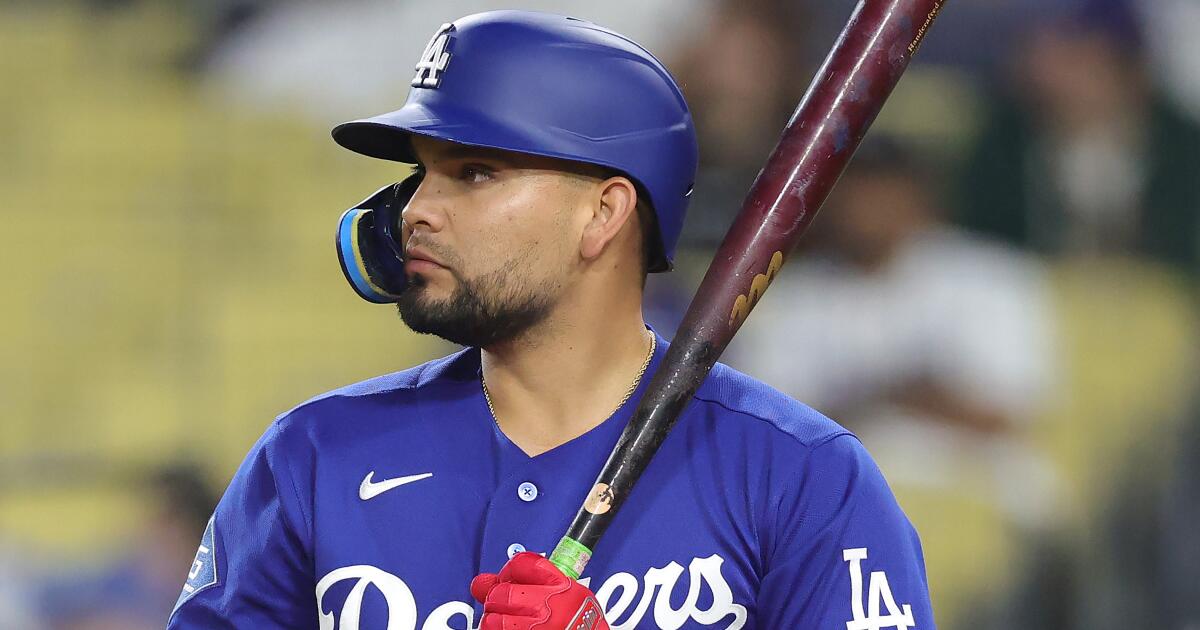
It’ll be the culmination of nine minor-league seasons. But Eliezer Alfonzo‘s major-league debut on Sunday won’t include his family watching from Dodger Stadium.
Alfonzo’s younger sister, Eliana, and stepmother, Patricia, have been missing since last month when earthquakes caused widespread devastation in his home country of Venezuela.
“I’ve been trying to support my dad a lot, every day talking to him, trying to be with him,” Alfonzo said of the elder Eliezer Alfonzo, a retired major-league catcher. “It’s a little tough from here because I would like to be there with him, supporting him every day.”
His father, of course, would love to be in attendance for his son’s debut. He told him as much when he heard the Dodgers were calling him up.
The Dodgers switched their backup catchers Saturday, optioning Chuckie Robinson. They saw an opportunity to give Alfonzo some runway behind Dalton Rushing, with starting catcher Will Smith’s stay on the injured list expected to extend through the All-Star break.
The elder Eliezer Alfonzo, however, is doing whatever he can to locate his wife and daughter. Their dog was found alive, which gave the younger Eliezer Alfonzo hope.
“We’ve just gotta stay together as a family, as a country,” Alfonzo said. “Because I feel like we’re a beautiful country, we’re a really beautiful people over there. It’s not just about my family, it’s all families that have lost people already. But we’ve got hope. We just pray, we ask God to give them back to us alive.”
Alfonzo’s locker in the clubhouse is next to countryman Miguel Rojas’ stall. Rojas’ wife, Mariana, and their two children were in Venezuela, planning to renew Mariana’s passport and seek Venezuelan citizenship for their children, when the earthquakes hit. They managed to stay safe and have returned to the U.S.
“I just want to be here for him,” Rojas said. “At the end of the day, that’s the best thing I can do for him, is being a good teammate and being a friend for him. Because I know there’s going to be ups and downs. He’s going to have a lot of time to be caught [up] in baseball, and that’s going to probably take his mind away from stuff. But sometimes he’s probably going to feel weak, and he’s going to start thinking about his family. So I’m going to be here, I’m right next to him. And that’s what I told him.”
Rojas, who played against the elder Eliezer Alfonzo for years in Venezuela, reached out Saturday morning and promised him he’d save the ball from his son’s first major-league hit.
Sports
Kylian Mbappé’s seventh goal of the World Cup lifts France past Paraguay in physical Round of 16 match

NEWYou can now listen to Fox News articles!
The United States may not have been in action on Independence Day, but France — who fittingly played an important role in the Revolutionary War — was on the pitch in Philadelphia against Paraguay in a massive Round of 16 clash for a trip to the quarterfinals.
It was a hot day in the birthplace of our nation, and that made things difficult for both teams in more ways than one.
While Paraguay is a great squad, they were significant underdogs against a heavily favored French team led by superstar Kylian Mbappé, who has been lighting it up this tournament.
THIS ‘AMERICA THE BEAUTIFUL’ RENDITION BEFORE THE FRANCE VS PARAGUAY MATCH WILL GIVE YOU GOOSEBUMPS
French and Paraguayan players get into a shoving match during their Round of 16 match on Saturday in Philadelphia. (Kyle Ross-Imagn Images)
Obviously, the heat itself is a factor, but it also made for a slower pitch, something that was believed to play into the hands of Paraguay.
However, most of the action in the first half was played on their end as France put the pressure on through the first half hour of the match.
It was intense, and that intensity boiled over in the 35th minute with some pushing and shoving after Mbappé and Paraguay’s Andrés Cubas started a wild shoving match.
VAR DENIES CROATIA’S GAME-TYING GOAL AS CRISTIANO RONALDO LEADS PORTUGAL TO ROUND OF 16
But while the intensity ramped up — and stayed high for pretty much the entire game — Paraguay weathered the storm and had every reason to feel good about reaching halftime with the game scoreless.
France got some more scoring opportunities in the early part of the second half, including a near-breakaway for Mbappé.
France’s Kylian Mbappe scored the go-ahead and ultimately game-winning goal against Paraguay on a penalty kick. (James Lang-Imagn Images)
In the 67th minute, France was awarded a penalty kick for a foul against Desire Doue that had to go to VAR for review, and it was Mbappé who took it.
MESSI, ARGENTINA AVOID A SHOCKING UPSET IN WILD KNOCKOUT STAGE MATCH AGAINST CAPE VERDE
Mbappé has tended to do most of his damage in the second half, and that trend continued here with him drilling the penalty past Paraguay goaltender Orlando Gill.
That was his 19th career World Cup goal, and his seventh of this tournament alone, tying him with Argentina’s Lionel Messi for the tournament lead.
Paraguay seemed to fade after the Mbappé goal, but turned it on again late, forcing Mike Maignan to make his first save of the day about 89 and a half minutes into the match.
CLICK HERE TO DOWNLOAD THE FOX NEWS APP
It seemed like Paraguay’s plan was to try and get a rise out of the French, and they succeeded in drawing three yellow cards. In fact, they even tried to keep that going after the match with players meeting near midfield for some more pushing and shoving.
But France is moving on, and they will take on Morocco in a quarterfinal match on Thursday in Boston.
-

 Health5 minutes ago
July 4 heat delays America 250 celebration as State Fair guests share love of USA
-

 Sports8 minutes ago
Toronto Maple Leafs top pick Gavin McKenna reveals that he’s changing his jersey number
-

 Technology13 minutes ago
China’s robot-run hotel opens to public in 2027
-
 Business20 minutes ago
China-backed AI tool behind fake Brad Pitt fight making Hollywood inroads
-
 Entertainment23 minutes ago
Don Was produced the Rolling Stones, Bob Dylan and Ozzy. At 73, he found his voice in Detroit — and the Dead
-
 Politics35 minutes ago
Commentary: Happy Birthday, America! You’ve weathered another rough year
-
Sports43 minutes ago
Dodgers’ Eliezer Alfonzo praying his sister and stepmother will be found in Venezuela
-

 World53 minutes ago
Reform UK’s Farage failed to disclose funds from convicted criminal: Report

