Sports
Shohei Ohtani's three-run blast caps memorable All-Star week for Dodgers

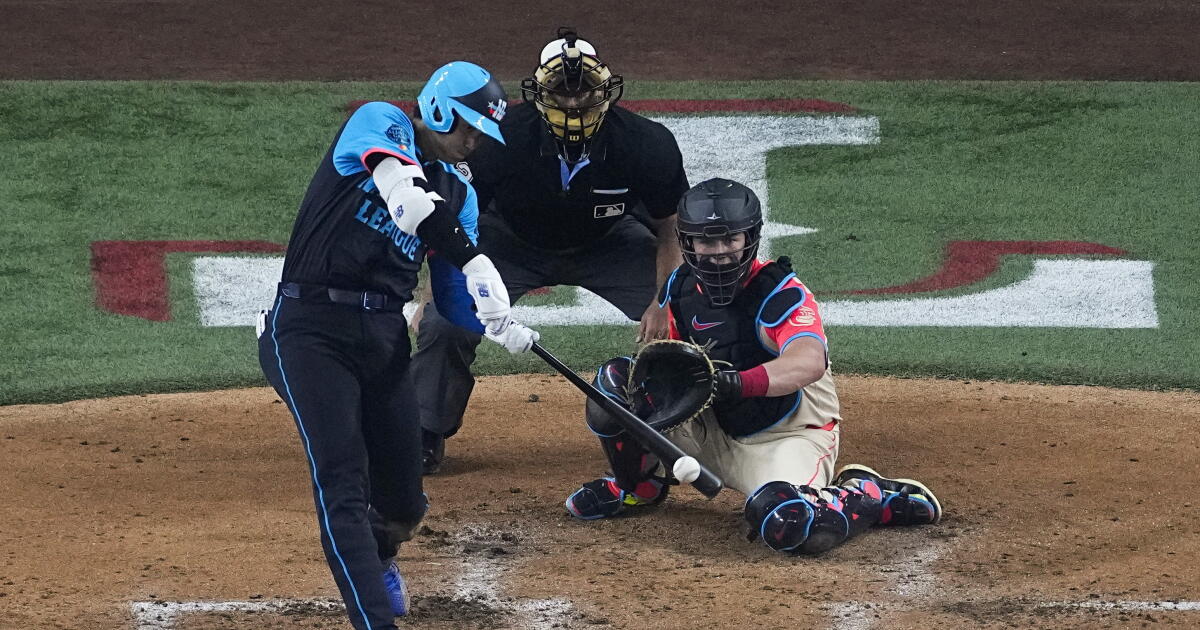
Shohei Ohtani wasn’t able to participate in this week’s Home Run Derby. But the Dodgers slugger didn’t leave All-Star week in Texas without a memorable big fly.
In the third inning of Major League Baseball’s 94th All-Star Game on Tuesday night at Globe Life Field, Ohtani wowed the 39,343-person crowd the best way he knows how: smoking a no-doubt, 400-foot home run halfway up the right-field stands in the American League’s eventual 5-3 win over the National League.
“At this point, it’s normal for him,” teammate Teoscar Hernández said. “It’s Shohei being Shohei.”
The blast was Ohtani’s first home run in the Midsummer Classic, where he is now two for six with three walks in four appearances (he also has a win as a pitcher, making him the only player in MLB history with both a home run and win in the event).
It was the first All-Star Game homer by a Dodgers player since Mike Piazza in 1996, and only the second by a Japanese-born player after Ichiro Suzuki’s inside-the-park home run in the 2007 game.
However, it was also the only scoring for the NL on Tuesday, denying Ohtani potential most valuable player honors that instead went to the Boston Red Sox’s Jarren Durran, a former Long Beach State and Cypress High standout, who broke a 3-3 tie in the fifth inning with a two-run homer.
“In general, I haven’t really hit well during the All-Star Game, so I’m just relieved that I put a good ball in play,” Ohtani, who also had a first-inning walk, said through interpreter Will Ireton. “I was really just focused on having a regular at-bat, as if I was in the regular season.”
Ohtani’s blast opened the scoring Tuesday night, coming on a 2-and-0 splitter from Boston Red Sox right-hander Tanner Houck. Like everyone else in the ballpark, Ohtani began to admire the drive as soon as he hit it, leaning back in the batter’s box with a long gaze before flipping his bat and rounding the bases.
From the dugout, Dodgers teammate Freddie Freeman flung his arms in celebration, while Dodgers pitcher Tyler Glasnow’s jaw dropped.
As Ohtani came around third, he also put his arms in the air — doing the same hip-shaking, Dragon Ball Z-inspired long ball celebration that accompanied the NL-leading 29 homers he hit for the Dodgers during the first half of the season.
“It felt inevitable he was going to do it,” Freeman said. “He steps in the box, and you kind of figure he would come through. Pretty awesome.”
The Dodgers had three other players in Tuesday’s All-Star Game. A night after winning the Home Run Derby, Hernández started in center field but went 0 for 2. Catcher Will Smith entered the game in the sixth inning and recorded a single. But, in the next at-bat, Freeman came off the bench and grounded into a double play, stepping on the foot of Cleveland Guardians first baseman Josh Naylor for an awkward out that required a video review.
Glasnow, a first-time All-Star, watched the game from the dugout, unable to take the mound because of a back injury that landed him on the injured list. Glasnow has been throwing this week, and expects to return from the IL when eligible next week.
But as usual, no one topped Ohtani’s exploits Tuesday night.
Houck said he was trying to throw a low splitter to Ohtani, but left too much of it over the heart of the plate.
“Just a good swing,” he said. “The boys were going out there swinging today.”
Oakland Athletics closer Mason Miller, a flame-throwing 25-year-old rookie right-hander, had better luck against Ohtani in his last at-bat in the fifth inning, striking him out with a couple of 100-mph fastballs and a swing-and-miss slider below the zone.
“I wasn’t giving him one up,” Miller told the Fox broadcast. “That’s for sure.”
When Ohtani met with reporters during the eighth inning, he was asked if he was rooting particularly hard for an NL comeback given his MVP candidacy (a player from the losing team hasn’t won All-Star Game MVP since Carl Yastrzemski in 1970).
“In an ideal world, yes,” he said with a chuckle.
Still, “it’s an honor just being here,” he added.
Indeed, even without any award-winning hardware, Ohtani managed to once again be a main attraction on baseball’s biggest night of stars.
Missing glove
As Freeman dug through his locker in the NL’s visiting clubhouse a few hours before the game, he realized something was missing.
“Where’s my glove?” he asked out loud, with a laugh. “I seriously don’t have a glove.”
Turns out, as he was packing up his stuff at the end of the Dodgers’ series in Detroit on Sunday, Freeman’s first baseman’s glove was accidentally packed in the bag he sent back to Los Angeles.
A Little League-esque sequence ensued.
First, Freeman sought out NL starting first baseman Bryce Harper, knowing he and the Philadelphia Phillies star share Rawlings as an equipment sponsor.
Before first pitch, however, Freeman learned that New York Mets slugger Pete Alonso had an extra mitt with him in Texas.
“He was like, ‘Hey, I don’t a have a glove,’” Alonso chuckled. “I was like, ‘Well, that’s a problem. I have an extra one. Would you like to use one of mine?’”
Old friends from their days playing against each other in the NL East when Freeman played for Atlanta, Alonso joked he didn’t charge Freeman anything for the rental, either.
“Nah,” he said. “Just friendship dues. That’s it.”
Dad duty
When Hernández became the first Dodgers player to win the Home Run Derby on Monday night, there were a few current Dodgers who were missing from the celebration.
While Glasnow stuck around to the end of Hernández’s dramatic win, the club’s three other All-Star hitters were all gone by the end of the three-hour slugfest.
The reason, for Smith and Freeman at least?
They were on Dad duty, having brought their young children with them to Texas this week.
“I had to leave early,” joked Smith, whose daughter Charlotte is almost 2. “My daughter was not having it.”
The same went for Freeman, who was in town with his three sons, Charlie, Maximus, and Brandon.
Hernández said he didn’t give his lineup-mates a hard time, joking he hardly even noticed until seeing social media users wondering about their absences Tuesday.
“At the end of the day, it was a good day,” he said. “I won. So that’s all that matters.”
During batting practice before Monday’s Derby, Freeman’s oldest son, 7-year-old Charlie, received big ovations from the crowd as he raced after fly balls.
In the visiting clubhouse after Tuesday’s All-Star Game, all three boys were climbing over their eight-time All-Star of a dad.
“This is what makes it fun for me now,” Freeman said. “Obviously it’s still fun to play in All-Star Games. But when you have the joy of him coming and shagging balls and stuff like that. To see their faces, that’s what makes it fun.”





Sports
NBA player calls for Hawks to cancel their ‘Magic City’ strip club promotional night out of respect for women

NEWYou can now listen to Fox News articles!
An NBA player has taken exception to an Atlanta Hawks promotional night, which is a nod to a famed strip club in the city.
The Hawks have “Magic City Night” scheduled for March 16 against the Orlando Magic, but a player for neither team isn’t too fond of paying tribute to a strip club, which has been famed for its late-night stories involving athletes, celebrities and more.
While the Hawks call it an ode to a “cultural institution,” San Antonio Spurs center Luke Kornet shared his displeasure in a letter posted on Medium.
Luke Kornet of the San Antonio Spurs reaches for the ball during the third quarter against the Brooklyn Nets at Barclays Center on Feb. 26, 2026 in the Brooklyn borough of New York City. (Ishika Samant/Getty Images)
Kornet, a nine-year veteran and 2024 NBA champion with the Boston Celtics, called for the Hawks’ promotional night to be canceled later this month, saying that it is disrespectful to women to honor the strip club.
“In its press release, the Hawks failed to acknowledge that this place is, as the business itself boasts, “Atlanta’s premier strip club.” Given this fact, I would like to respectfully ask that the Atlanta Hawks cancel this promotional night with Magic City,” Kornet wrote in his post.
“The NBA should desire to protect and esteem women, many of whom work diligently every day to make this the best basketball league in the world. We should promote an atmosphere that is protective and respectful of the daughters, wives, sisters, mothers, and partners that we know and love.”
The Hawks boasted about the theme night in its press release, including a live performance by famous Atlanta rapper T.I., a co-branded, limited-edition hoodie and even the establishment’s “World Famous” lemon-pepper chicken wings in the arena.
A general view of signage with the State Farm Arena logo on Nov. 14, 2025, outside State Farm Arena, in Atlanta, GA. (Erica Denhoff/Icon Sportswire)
“This collaboration and theme night is very meaningful to me after all the work that we did to put together ’Magic City: An American Fantasy’,” said Hawks principal owner, filmmaker and actor, Jami Gertz, said in a press release. “The iconic Atlanta institution has made such an incredible impact on our city and its unique culture.”
Kornet wrote that allowing the night to continue “without protest would reflect poorly on us as an NBA community, “specifically in being complicit in the potential objectification and mistreatment of women in our society.”
Kornet wrote that “others throughout the league” were surprised by the Hawks’ decision to have this promotional night.
“We desire to provide an environment where fans of all ages can safely come and enjoy the game of basketball and where we can celebrate the history and culture of communities in good conscience. The celebration of a strip club is not conduct aligned with that vision,” he wrote.
Luke Kornet of the San Antonio Spurs defends against the Charlotte Hornets during their game at Spectrum Center on Jan. 31, 2026 in Charlotte, North Carolina. (Jacob Kupferman/Getty Images)
The Hawks have seen good reception for the promotional night, as Tick Pick reported a get-in price was initially $10 for the game and has since skyrocketed to $94.
Kornet is in his first season with the Spurs, his sixth NBA team, where he has played mainly in a bench role. He averages 7.1 points and 6.5 rebounds per game across 50 contests.
Follow Fox News Digital’s sports coverage on X and subscribe to the Fox News Sports Huddle newsletter.
Related Article


SCOTTSDALE, Ariz. — How do you improve on the perfect ending?
Clayton Kershaw stood in the desert heat Monday, wearing a far darker shade of blue than the Dodgers do. He does not need a medal, or a chance to fail. His election to the Hall of Fame will be a formality.
In his farewell year, the Dodgers won the World Series, becoming baseball’s first back-to-back champions in 25 years. He secured a critical out. He bathed in adoration at the championship rally, and he told the fans he would be one of them this year.
“I’m going to watch,” he hollered that day, “just like all of you.”
Four months later, he was back in uniform.
He wore a dark blue jersey with red-and-white piping. As Team USA ran through its first World Baseball Classic workout, Kershaw participated in pitchers’ fielding practice and shagged fly balls during batting practice. He could have been home with his five kids, and instead he was rushing off the mound to take a throw at first base.
That November night in Toronto, as it turned out, was not the last time we would see him in uniform.
“Feels good,” he said Monday. “I wouldn’t put on a uniform for anything else. This is a special thing.”
He put the World Baseball Classic into red, white and blue perspective.
“It’s a bucket list thing for me,” he said.
He is either self-deprecating or painfully honest about his capabilities right now, or perhaps a little of both.
The last World Baseball Classic came down to Shohei Ohtani pitching to Mike Trout. This one could come down to Kershaw pitching to Ohtani.
“I think, for our country’s sake, it’s probably better if I don’t,” Kershaw said.
Former Dodgers pitcher Clayton Kershaw fields a ground ball during a workout at Papago Park Sports Complex on Monday.
(Chris Coduto / Getty Images)
Never say never. Team USA planned to run a tremendous rotation of Tarik Skubal, Paul Skenes, Joe Ryan and Logan Webb, but now Skubal says he will pitch just once in the tournament. Skenes says he’ll pitch twice. Ryan says he won’t pitch in the first round, at least.
Kershaw might be needed beyond the role he was promised: save the team from using the current major league pitchers in blowouts or extra innings.
In 11 career at-bats against Kershaw, Ohtani has no hits. Kershaw won’t duck the assignment if gets it, but he considers it so unlikely he is happy to share his game plan publicly.
“It’s throw it, pitch away, play away, hope he flies out to left,” Kershaw said. “Don’t throw it in his barrel.
“I can’t imagine, if it comes down to USA versus Japan, with the arms that we have, that I’ll be needed. But I’ll be ready.”
Kershaw’s average fastball velocity dropped to 89 mph last season, but he led the majors in winning percentage. He could eat innings for some team — maybe even the Dodgers, with Blake Snell and Gavin Stone all but certain to be unavailable on opening day.
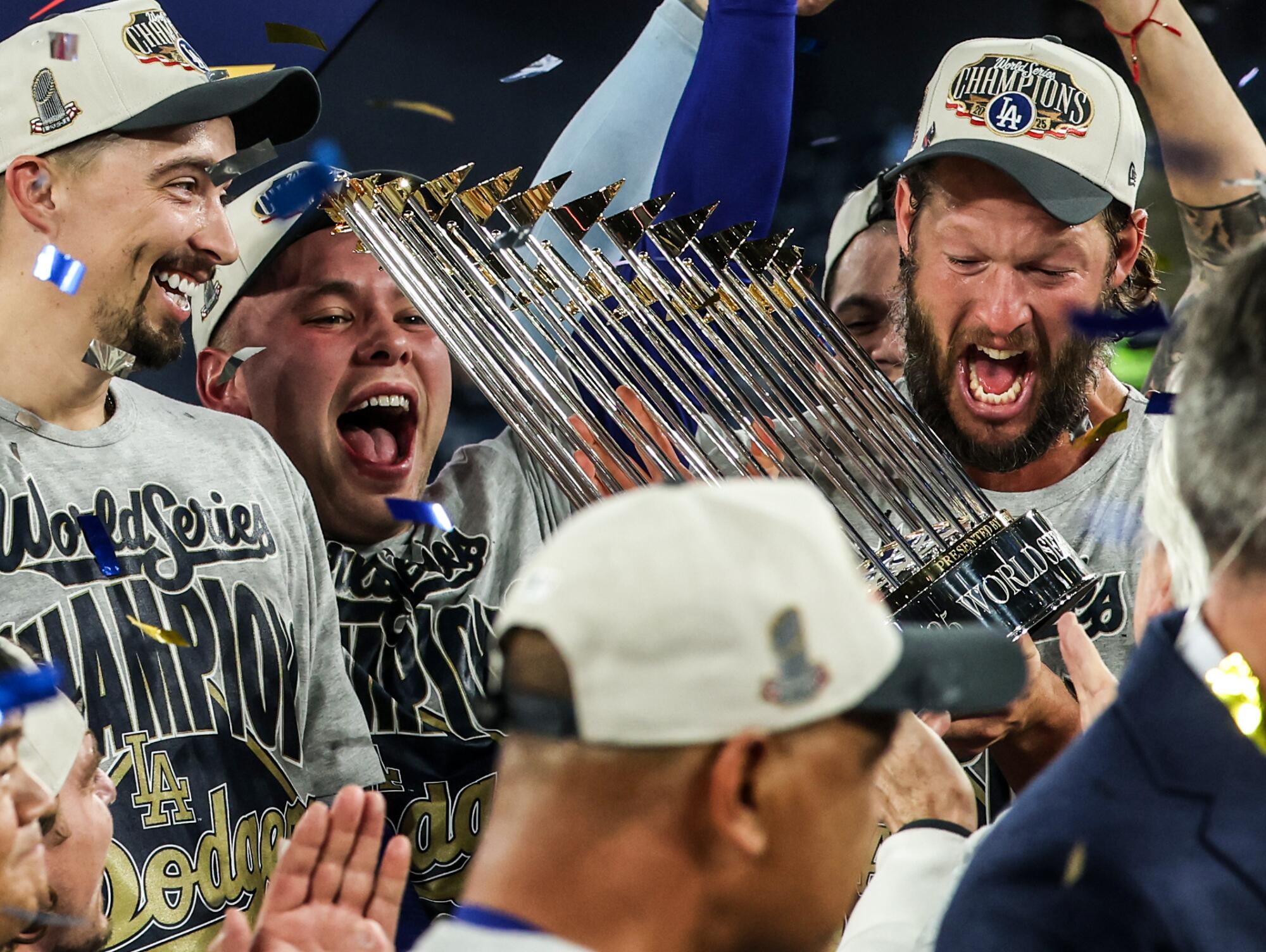
Dodgers pitcher Clayton Kershaw, right, celebrates with teammates after the Dodgers defeated the Toronto Blue Jays for the 2025 World Series title.
(Robert Gauthier / Los Angeles Times)
But, even with his success last year and even with the joy of wearing a uniform once again, he insists he isn’t interested in pitching beyond the WBC.
“I don’t want to,” he said. “You can’t end it better than I did last year. I had a great time last year. It was an absolute blast and honor to be on that team. I think that was the perfect way to end it. Honestly, I don’t know if I would have enough in the tank to pitch for a full season again. I’m really at peace with that decision.
“This is kind of a weird one-off thing, but you can’t really turn down this opportunity. It wasn’t easy to get ready for this, with no motivation for a season, but I actually am in a pretty good spot with my arm. I’ll be fine. If they need me, I’ll be ready.”
Kershaw said he has kept in touch with his old Dodgers teammates, with some connecting on video calls from the weight room or clubhouse at Camelback Ranch. He arrived in the Phoenix area two days before the workout, but he skipped a trip to Camelback Ranch.
“I’ve thought about it,” he said. “I miss the guys. I think it’s probably just better, at least for this first year, for me mentally to just stay away, just for spring training.”
Kershaw said he would be at Dodger Stadium for the championship ring ceremony March 27.
He is content with what he calls “Dad life.” He and his wife, Ellen, just welcomed their fifth child, and Dad life includes lots of shuttles to baseball and basketball practice.
“I run an Uber service,” Kershaw said.
This wouldn’t be a Dodgers story these days without some reference to the team’s big spending so, for what it’s worth, Kershaw spent some time Tuesday chatting with Skubal, who will be the grand prize on the free-agent market next winter, or whenever the likely lockout might end.
That’s a rational explanation, Kershaw says, for Skubal pitching just once in the WBC.
“Everybody knows the situation he is in, contract-wise,” Kershaw said. “Any innings we can get out of him is a huge bonus to this team. He’s great. Super competitive. We’re honored to have him.”
Should we assume Skubal will be pitching for the Dodgers next season? Kershaw laughed.
“No comment,” he said, then walked away to get ready for the first game of his post-retirement life.

NEWYou can now listen to Fox News articles!
Basketball Hall of Famer Charles Barkley sounded off on the frenzied reactions to the U.S. men’s hockey team getting invited to the White House by President Donald Trump.
Trump talked to the Olympic gold medal-winning team immediately after they defeated Canada in overtime last weekend. He said they would be invited to his State of the Union address and added that he needed to invite the women’s team as well or he would be “impeached.”
Charles Barkley sits courtside against the Minnesota Timberwolves during an NBA Cup game at Mortgage Matchup Center on Nov. 21, 2025. (Mark J. Rebilas/Imagn Images)
Trump critics took the joke as a shot at the women’s team, which sparked questions from NHL and Professional Women’s Hockey League reporters as the players returned to their respective club teams.
“I’m proud of the United States men. I’m proud of the United States women. You should have invited both of them to the White House, but it shouldn’t have been disrespect, misogyny,” Barkley said on the “Steam Room” podcast. “Like, yo, man, why do y’all have to mess everything up? Everything isn’t Democrat, Republican, conservative, liberal. That’s why we got this divided, screwed up country. Stop it man. Because, you know, the public, they’re idiots. They’re fools. They can’t think for themselves. I know y’all say stuff to trigger them. Y’all say stuff and y’all know they’re going to be fools.”
Barkley lamented that the average person would get riled up over the supposed controversy.
The U.S. team poses for a group photo after defeating Canada in the men’s ice hockey gold medal game at the 2026 Winter Olympics. Milan, Italy, on Feb. 22, 2026. (Luca Bruno/AP Photo)
“We don’t have to fall for stupidity. But we do – that’s my point. These people out here are stupid. They need something to trigger them. Just because they want us to be stupid. We don’t have to be stupid. He should have invited both teams to the White House. Simple as that. Guys who didn’t want to go shouldn’t have to explain why they didn’t go.”
The former Philadelphia 76ers, Houston Rockets and Phoenix Suns star made clear he would go to the White House regardless of whether Trump was in office.
“I’ve said this before, I’m not a Trump guy. But if I got invited to the White House, I would go. I’m not a Trump guy – I want to make that clear. But I respect the office,” Barkley said. “He’s the president of the United States. But if guys don’t want to go, I understand that too. It doesn’t have to be a talking point. It doesn’t have to be un-American.
Megan Keller (5) celebrates with a flag alongside Cayla Barnes (3) of Team United States after scoring the game-winning goal in overtime during the women’s gold medal match against Canada on Day 13 of the Milan Cortina 2026 Winter Olympic Games at Milan Santagiulia Ice Hockey Arena in Milan, Italy, on Feb. 19, 2026. (Sarah Stier/Getty Images)
CLICK HERE TO DOWNLOAD THE FOX NEWS APP
“I just wish y’all would stop falling for the stupidity.”
Follow Fox News Digital’s sports coverage on X and subscribe to the Fox News Sports Huddle newsletter.
Related Article

Is Iran expanding attacks to target energy and civilian sites in the Gulf?

Trump claims US stockpiles mean wars can be fought ‘forever’; Kristi Noem testifies before Congress – US politics live

Ohio courtroom devolves into chaos after sentencing in death of teen

Travis County DA faces renewed ‘soft on crime’ criticism after career criminal charged with murder

Alleged criminal history of missing mom found after 24 years catches up with her

Florida High School Football Rankings: Top 25 teams – Oct. 21

Cleary's 21 help Le Moyne down Central Connecticut State 69-64 in OT

How old is Bo Nix? What to know about Oregon quarterback ahead of 2024 NFL Draft

99th annual Pony Swim held in Virginia

Indiana Members Credit Union announced as new anchor tenant at Bottleworks District
Is Iran expanding attacks to target energy and civilian sites in the Gulf?
Trump claims US stockpiles mean wars can be fought ‘forever’; Kristi Noem testifies before Congress – US politics live

War in the Middle East: Iran’s broad retaliation in the Gulf • FRANCE 24 English

Trump sends official notification to Congress on strikes against Iran

Unexpected birth brings hope to near-extinct Amazon tribe
-

 World5 days ago
Exclusive: DeepSeek withholds latest AI model from US chipmakers including Nvidia, sources say
-

 Massachusetts6 days ago
Mother and daughter injured in Taunton house explosion
-

 Denver, CO6 days ago
10 acres charred, 5 injured in Thornton grass fire, evacuation orders lifted
-

 Louisiana1 week ago
Wildfire near Gum Swamp Road in Livingston Parish now under control; more than 200 acres burned
-

 Oregon4 days ago
2026 OSAA Oregon Wrestling State Championship Results And Brackets – FloWrestling
-

 Technology1 week ago
Arturia’s FX Collection 6 adds two new effects and a $99 intro version
-

 News1 week ago
Video: How Lunar New Year Traditions Take Root Across America
-

 Florida2 days ago
Florida man rescued after being stuck in shoulder-deep mud for days