Sports
Novak Djokovic beats Carlos Alcaraz at Australian Open in display of physical and tactical fortitude


Relive how Novak Djokovic won the Australian Open quarterfinal
MELBOURNE, Australia — Novak Djokovic beat Carlos Alcaraz 4-6, 6-4, 6-3, 6-4 in the Australian Open quarterfinals at Melbourne Park on Tuesday night.
The No. 7 seed prevailed over the No. 3 seed in a fever-dream of an encounter, defined by a Djokovic injury, his tactical shift as it healed, and Alcaraz’s endless and ultimately fruitless search for a spark.
After three hours and 37 minutes, Djokovic moves on to the semifinals, where he will play No. 2 seed Alexander Zverev.
The Athletic’s tennis writers, Charlie Eccleshare and Matt Futterman, analyze the match against Alcaraz and what it means for the tournament, and for tennis.
A ninth game of Alcaraz genius and Djokovic injury
Alcaraz had started the match looking nervous, and struggling to find his range. He was making errors on the first shot after both his first and second serves, and when Djokovic held serve for 4-3, it felt like he just needed to raise his intensity to steal the first set.
Instead, Alcaraz held for 4-4 before Djokovic suffered a triple whammy in the ninth game. Having chased down a drop shot to go up 15-0, he appeared to hurt himself, wincing and moving gingerly afterwards. Then the thing happened that every Alcaraz opponent dreads: he hit a highlight-reel shot. After an outrageous forehand pass up the line, the Spaniard cupped his hand to his ear and suddenly looked visibly lighter. The third blow felt inevitable for Djokovic, and sure enough a wide forehand conceded the break of serve that was coming and gave Alcaraz the chance to serve out the set.
Novak Djokovic injured his left leg in the first set of the match, in the same game that Carlos Alcaraz seized the decisive break. (Clive Brunskill / Getty Images)
Djokovic was forced to leave the court for a medical timeout; a couple of minutes after returning, he was a set down. In what felt like the blink of an eye, he was suddenly having to play catchup against a player who had only lost one Grand Slam match from a set up. And that was at the Australian Open four years ago, in what was his first-ever major.

GO DEEPER
Inside Novak Djokovic’s recovery – accepting outsiders, hyperbaric chambers, Jelena’s worries
Matt Futterman, Charlie Eccleshare, James Hansen
Djokovic plays Alcaraz tennis, against Alcaraz
There wasn’t any chance that Djokovic was going to go away after picking up that injury. He came out for the second set a completely different player than the one who started the match.
In the first set, he was all about conservatism, turning points into physical contests and allowing Alcaraz to make errors, as he did in the first 12 games of both sets in their gold medal match at the Paris Olympics back in August.
That was no longer a possibility once he was playing with an injury. So Djokovic morphed into a first-strike player, just as he did in the tiebreaks of that Olympic final. He went hunting for every serve, ripping from the baseline at his first chance, even serving and sneaking into the net whenever he could to finish the point quickly. Points soon started ending after three or four shots.

Djokovic turned Alcaraz’s own style against him to win the second set. (Martin Keep / AFP via Getty Images)
Facing his own gifts being turned against him, Alcaraz was caught off-guard and lost his serve in the second game of the second set, as Djokovic whaled away on two forehand returns to get a break point, then won the game on the next one. After that, it became a test of whether this strategy could keep Djokovic in the match long enough to draw even, which would give him time for some combination of adrenaline and medication to kick in. Playing a hyper-aggressive brand of tennis for three sets would be nigh impossible, especially against the master of the art.
It worked even better than he could have hoped. Not only did he steal the set he usually loses while buying time, but when the pain in his leg began to ease, he was able to catch Alcaraz off-guard and keep him guessing about which Djokovic he was going to be facing from one point to the next.
GO DEEPER
Carlos Alcaraz and Jannik Sinner are redrawing the tennis court
Matt Futterman
How two players used to playing with house money dealt with being the gambler
At the 2024 Laver Cup in Berlin, The Athletic watched a match with eight-time Grand Slam champion Andre Agassi. When analyzing the encounter unfolding in front of him, Agassi kept returning to the idea that tennis players are always seeking to keep the odds of winning in their favor. The best players become like the house at a casino, and turn their opponents into gamblers who start with things stacked against them.
Throughout his career, Djokovic has been the ultimate in applying this logic, the epitome of ‘the house always wins’. His opponents might hit the flashier shots, but ultimately they end up losing the match, because whatever they are doing proves unsustainable.
Against Alcaraz, at this tournament and previously in last year’s Wimbledon final, it’s been a surreal experience to see Djokovic thrust into the gambler role, desperately hoping his number might come up. Injuries have played a part in this on both occasions, but it’s also a reality of his now being 37 years old: not everything can be played on your terms.

Alcaraz struggled to play on his terms after the fourth set. (Icon Sportswire / Getty Images)
What made the dynamic more interesting was that Alcaraz too was having to alter the way he normally becomes the house. His instinct is to be the protagonist and get on the front foot, even though he is also a great defender. He trusts that his brilliance will be enough to ultimately overwhelm his opponent, because it almost always is.
Djokovic’s approach Tuesday took him out of his comfort zone, and in the second set he appeared unsure as to what his best route to victory was. He was celebrating hanging in points and drawing errors, rather than whipping up the crowd after hitting a winner that had got them off their feet.
His head looked scrambled and, having been dicing with danger in several service games, Alcaraz was broken to love and Djokovic levelled the match.
By the start of the third set, Djokovic was moving more freely, which gave him the option to play both sides of the equation: house and gambler. He could drag Alcaraz into rallies and bait him into coughing up a spinny shorter ball, or blast off early. This noticeably flummoxed Alcaraz, who seemed confused about his route to victory. He never entered full highlight-reel mode; his serve, with a new, more fluid motion, couldn’t get him cheap points as it did earlier in the tournament.
By allaying his instincts and playing more conservatively, he became the gambler, as so many of Djokovic’s opponents have fooled themselves into doing in the past. This was different — Alcaraz was, at times, playing three different versions of Djokovic at once — but he couldn’t reverse the trend.
GO DEEPER
How to watch tennis with Andre Agassi – Poker analogies, meat, potatoes and intimacy
Charlie Eccleshare
Alcaraz’s search for a spark
All night long, it seemed like Alcaraz was a spark away from finding himself. Especially in the third set, when he was behind from the start and digging to come back. He went a break down, but got back on serve in the seventh game.
This was it… wasn’t it?
It was more like the opposite of that.
Alcaraz then committed three successive errors, on a volley, a forehand and a backhand. Djokovic, sensing his opponent had zero shot tolerance, went to work. He sucked Alcaraz into a 22-shot rally, then finished it with a looping forehand winner into the Spaniard’s backhand corner, not dissimilar to the one Alexei Popyrin hit against Djokovic at the U.S. Open last summer to send the crowd on Arthur Ashe into raptures and put the Serbian on notice that he was going home.

Alcaraz was frequently frustrated by tiny margins of error that accumulated throughout. (Hannah Peters / Getty Images)
After nearly two hours of deadening the stadium to keep the vibes low and Alcaraz disengaged, he put his hand to his ear and revved up the noise.
Then Djokovic fell 0-30 down as he served for the set. Could this be the Alcaraz spark? Nope. Two more errors from him drew Djokovic even. Time to test the shot tolerance again. A 17-shot rally this time, ending with Alcaraz whacking a running forehand into the net.
Rattled, and a point away from going down two sets to one, Alcaraz let Djokovic twist him this way and that and even baulked on an easy overhead before missing a backhand volley that he shouldn’t have had to hit.
Two games, 10 points, about eight minutes of play.
Script flipped.
Matt Futterman, Charlie Eccleshare, James Hansen
The 33-shot footnote in tennis history
In what was a weird match in so many ways, there was at least an exciting finale.
Alcaraz seemed to belatedly realize his only route back into this quarterfinal was to get the atmosphere going. He had searched for that spark all night, and finally got the chance in the fourth set.
When he won a 33-shot rally to save a break point that would have left him 5-2 down and out of the match, the Rod Laver Arena finally fizzed with energy. Djokovic raged, well aware of how significant the moment could be, with both players bent double at the side of the court. Alcaraz was smiling and laughing. Djokovic was fuming.
It felt like the turning point that Alcaraz has shown the tennis world so many times in his career, when he creates a highlight and then rolls downhill. Suddenly he was grinning again, sprinting around the court, almost enjoying himself.
When he held two break points in the next game, the comeback very briefly felt like it might be on.
But back came Djokovic, fending them both off before holding serve. Two games later, he served out the match to render that 33-shot rally ultimately irrelevant.
Charlie Eccleshare
What did Djokovic say after the match?
“I just wish that this match was the final,” Djokovic said in his on-court interview. “One of the most epic matches I’ve played on this court — on any court.”
“When the medications start to release, I’ll see what the reality is tomorrow morning. Right now. I’ll just try to be in the moment and enjoy this victory,” he said of his injury.
What did Alcaraz say after the match?
“We push each other to the limit,” he said. “I think we’ve played great points, great rallies. It was really tight in the third, the fourth set.
“I’m just lucky to live this experience. I’m 21 years old. From these matches, I’m getting so much experience about how to deal with everything. I’m not going to hide.
“I’ve done great things in tennis already, but playing against one of the best in the history of our sport, these kind of matches help me a lot in the future to be better.”
Recommended reading
(Top photo: Fred Lee / Getty Images)



Sports
Golf star records lowest round in LPGA major history with astounding performance at Evian Championship

NEWYou can now listen to Fox News articles!
There are good days on the golf course, and then there is what Haeran Ryu just did on Saturday.
Ryu, 25, recorded the lowest round in LPGA major history on Saturday with an 11-under 60 at the Evian Championship. With the South Korean golfer’s historic round, she holds a three-stroke lead.
Ryu’s round comes just two weeks after winning her first major at the Women’s PGA Championship. On the 18th hole, Ryu left a 30-foot eagle putt a few inches short, and instead settled for a birdie.
CLICK HERE FOR MORE SPORTS COVERAGE ON FOXNEWS.COM
Haeran Ryu of South Korea reacts on the 18th green after the third round of The Amundi Evian Championship at Evian Resort Golf Club in Evian-les-Bains, France, on July 11, 2026. (Stuart Franklin/Getty Images)
She said after the round that she had no idea what she had done until she counted up her scorecard.
“But after the putt and I counted my score with my caddie,” she said. “Oh my God, it’s 11-under par today. It was so amazing. My caddie says, ‘Yep.’ I’m so happy right now.”
If Ryu had made the eagle putt on the 18th hole, she would have been just the second player to shoot a 59 in LPGA history.
ZERO BS. JUST DAKICH. TAKE THE DON’T @ ME PODCAST ON THE ROAD. DOWNLOAD NOW!
Haeran Ryu of South Korea celebrates a birdie on the 15th green during the third round of The Amundi Evian Championship at Evian Resort Golf Club on July 11, 2026, in Evian-les-Bains, France. (Stuart Franklin/Getty Images)
Her 60 broke the record for the lowest round in an LPGA major by one shot. Leona Maguire and Jeungeun Lee6 in 2021, and Hyo Joo Kim in 2014, each shot 61 at the Evian Championship, which was designated as an LPGA major in 2013.
The lowest round in a men’s major is 62, which is shared by four players — Branden Grace at Royal Birkdale in the 2017 British Open, Xander Schauffele and Rickie Fowler in the 2023 U.S. Open at Los Angeles Country Club, and Schauffele and Shane Lowry in the 2024 PGA Championship at Valhalla.
CLICK HERE TO DOWNLOAD THE FOX NEWS APP
Haeran Ryu of South Korea and Lottie Woad of England interact after their round on the 18th green during the third round of the Amundi Evian Championship at Evian Resort Golf Club in Evian-les-Bains, France, on July 11, 2026. (Stuart Franklin/Getty Images)
Ryu hopes her historic third round can help propel her to a second major win in three weeks.
“That is amazing, amazing dream,” Ryu said. “So I just want that one to come true, but we have one more day.”
The Associated Press contributed to this report.
Follow Fox News Digital’s sports coverage on X, and subscribe to the Fox News Sports Huddle newsletter.
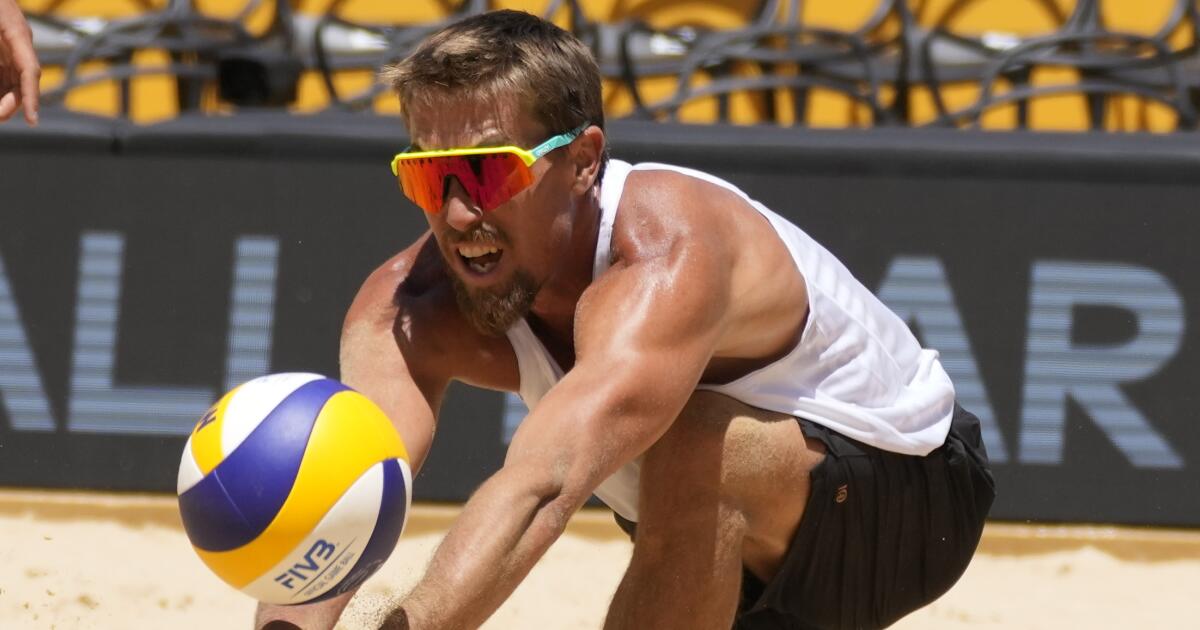
Taylor Crabb is no stranger to South California beaches. The Long Beach State alum returns home this weekend to compete in AVP League matches.
It marks the first time AVP will compete in Long Beach since 2020 and allows players to compete at the 2028 Olympics beach volleyball venue.
Crabb, 34, made his AVP debut in 2013 with his brother, Trevor, and advanced from the qualifier in Manhattan Beach before finishing 25th in his first tournament.
After years of competing with various different partners, Taylor Crabb and Andy Benesh have delivered the top performances this AVP season.
The following interview with Crabb has been edited for clarity and length.
Are you excited to compete in this weekend’s event at Long Beach?
Crabb: Very excited. A lot of my college teammates and part of the school have reached out, saying that they’re gonna come. So I’m excited to get a chance to play in front of them again.
When was the last time you were in Long Beach?
Crabb: I always try to go down there for alumni events or any big games they have. I went to UCLA against Long Beach last year, when it was No. 1 versus No. 2, so I always try to get down there and support them.
You missed out on the chance to compete in the 2020 Olympics because of COVID-19 restrictions and chose not to pursue a spot at the 2024 Olympics. Are you fired up to try to compete in the 2028 Olympics, knowing that Long Beach will host the competition?
Crabb: Yeah, it’s definitely an exciting time having the Olympics in Long Beach, and we kind of get to break it in this weekend. As you said, Tokyo didn’t go the way I wanted, but I’m going full force now. I have a great partner in Andy Benesh, who obviously went to the Paris Olympics, and if it weren’t for the Olympics being in Long Beach, and me getting a partner like Andy, I’m not even sure I’d be going for it, but because of those two things, I want to make the most of it.
You mentioned that if it wasn’t for a partner like Andy, you wouldn’t be going for it. What do you mean by that?
Crabb: I didn’t feel motivated by playing in all the international events, but now, I think, sitting out kind of lit the fire under me, and I’m really motivated now.
You’ve had different partners throughout your time. What other motivation does Andy give you?
Crabb: He’s been, in my mind, the top blocker for the U.S. the last four or five years. Seeing the professionalism he brings every day to practice, on and off the court, while traveling and when showing up to tournaments, it rubs off on you and that’s really motivating to see. And I just want to make him proud.
Why do you love volleyball?
Crabb: A lot of reasons, but it’s just a feeling I have when I’m out there on the court. It feels natural. It feels like home. I was born into a volleyball family. I had a volleyball in my hands my entire life, so I’ve always just enjoyed it.

NEWYou can now listen to Fox News articles!
CM Punk appeared on “Friday Night SmackDown” ready to take on any challenger that was ready to step to him after winning the Undisputed WWE Championship against Sami Zayn.
Punk entered the ring in Oklahoma City and called back to the “Monday Night Raw” after WrestleMania 42 when he told Cody Rhodes he’d be ready to deliver if a championship opportunity fell “out of the sky.”
COMPLETE PRO WRESTLING COVERAGE ON FOX NEWS DIGITAL
Cody Rhodes and CM Punk face off during SmackDown at Paycom Center in Oklahoma City, Okla. (Craig Ambrosio/WWE via Getty Images)
“When championship opportunities fall out of the sky, CM Punk catches them,” he said.
Punk named potential SmackDown superstars he’d think might come for the title, including Gunther, Finn Balor, Royce Keys, Damian Priest and Trick Williams. He even said that Zayn could come back around and get his rematch if he wanted. He didn’t mention Rhodes’ name, but the “American Nightmare” came out uncalled and marched his way down to the ring.
“I don’t think you and I can run away from each other anymore,” Punk told Rhodes.
Cody Rhodes looks on during SmackDown at Paycom Center in Oklahoma City, Okla., on July 10, 2026. (Craig Ambrosio/WWE via Getty Images)
Rhodes agreed and mentioned that Punk would want a match with him, just “say when.” It was a quick retort from Punk, who said, “when.” SmackDown general manager Nick Aldis, who was in the ring for the segment, booked the match for SummerSlam.
Punk will defend the Undisputed WWE Championship at SummerSlam, which takes place Aug. 1 and 2 at U.S. Bank Stadium in Minneapolis.
First, however, Punk and Rhodes will be involved in a tag team match at Saturday Night’s Main Event in New York City next week. Aldis made the match after Gunther demanded that Aldis put him in a match against Punk. Gunther was hoping it would be for the championship. Instead, Gunther will tag with Zayn.
Gunther didn’t take too kindly to that and attacked Aldis. Rhodes came back out to break up the calamity. He wanted to take on Gunther after the show went off air but Gunther walked away.
Gunther makes his entrance during SmackDown at Paycom Center in Oklahoma City, Okla., on July 10, 2026. (Rich Wade/WWE via Getty Images)
CLICK HERE TO DOWNLOAD THE FOX NEWS APP
Punk definitely has his hands full as he moves to SmackDown to become a fighting champion.
-

 New Hampshire41 seconds ago
Gilmanton Iron Works Man Accused Of Possessing Guns, Hundreds Of Grams Of Fentanyl In Hooksett, Manchester
-

 New Jersey13 minutes ago
Ex-NJ GOP aide accused of staging slashing attack shows off horrific scars — and mystery man — in new snap
-

 New Mexico16 minutes ago
New Mexico AG Wants to Know Where Epstein Records Are
-
North Carolina16 minutes ago
UNC shortstop selected in first round of MLB Draft by Red Sox; list of NC players drafted
-
North Dakota28 minutes ago
The Crookston Masonic Lodge and Order of the Eastern Star present a donation check to Honor Flight of North Dakota and Minnesota
-

 Ohio30 minutes ago
Ohio’s first mountain coaster coming to Hocking Hills
-

 Oklahoma36 minutes ago
Housing affordability act becomes law, Oklahoma lawmakers react
-

 Oregon43 minutes ago
East Evans Creek Road wildfire swells to about 2,000 acres; homes threatened


