Sports
NFL execs unfiltered on free agency: What’s the Giants’ QB plan? Thoughts on all NFC teams


It’s time to check in with NFL executives for thoughts on the biggest and most interesting moves NFC teams made — or have not yet made — in free agency.
The once-sleepy Chicago Bears might have won the offseason, drawing positive reviews. The Minnesota Vikings remain the most intriguing team as ownership tries to downplay uncertainty over the general manager’s future. The San Francisco 49ers cleared the decks for a possible Brock Purdy contract, while the Washington Commanders loaded up in the absence of an expensive QB. The New York Giants tipped their hand in the draft, while the Seattle Seahawks did something winning teams almost never do.
Execs discuss these subjects and much more as we run through the full NFC. For each team, we’ve listed the average per-year salary (APY) added and lost via free agency, along with the differential and league-wide rankings in each category, according to Spotrac.com.
If you missed Wednesday’s story on the AFC, you can find it here.
Arizona Cardinals
Added: $50.9M (10th) | Lost: $10.2M (30th) | Differential: $40.7M (4th)
The Cardinals improved from 32nd in defensive EPA per play in 2023 to 23rd last season. They’ll be looking to make another jump after signing pass rusher Josh Sweat from Philadelphia ($19.1 million APY), run-stuffer Dalvin Tomlinson ($14.5 million APY) from Cleveland and old friend Calais Campbell ($5.5 million APY) from Miami.
“Sweat has been a really good, solid, steady player, but they will have to manage his knee,” an exec said. “Is he going to practice every day? There is so much risk involved already. Why compound it?”
The Cardinals needed help on their defensive front; free agency offers no perfect players, and Sweat was familiar to Cardinals coach Jonathan Gannon and defensive coordinator Nick Rallis from their days in Philadelphia. Adding the 38-year-old Campbell, who played for the Cardinals from 2008 to ’16 and is now on his fourth team in four seasons, gives Arizona another veteran mentor.
Milton Williams, another Philly pass rusher, chose New England over Arizona and Carolina when the Patriots offered $26 million per year. The Cardinals pivoted to Sweat.
“Having that familiarity will help,” another exec said of the Sweat signing, “but do I think Sweat is a great player? No. He helps them but doesn’t move the needle a great deal.”
Atlanta Falcons
Added: $25.3M (24th) | Lost: $35.5M (16th) | Differential: -$10.2M (21st)
The Falcons parted with mainstay defensive tackle Grady Jarrett, who turns 32 in April. They added pass rusher Leonard Floyd, who turns 33 in September. They extended left tackle Jake Matthews, added linebacker Divine Deablo from the Raiders for $7 million per year and let center Drew Dalman leave in free agency after Ryan Neuzil developed into a cost-effective replacement.
“I don’t know that they got any better,” one exec said. “It boils down to Michael Penix and whether he is the guy.”
Another exec called the Falcons’ moves “swapping average for average” with one benefit: Floyd’s familiarity with Falcons coach Raheem Morris from their time together on the Rams. Floyd, now on his fourth team in four seasons, has at least 8.5 sacks in each of the past five seasons. Myles Garrett is the only other player riding a streak that long.
Next up: whether the Falcons trade Kirk Cousins after the draft.
Would owner Arthur Blank be willing to pay most of Cousins’ $27.5 million salary for 2025, in exchange for a minimal return? Cousins, burned last offseason when the Falcons unexpectedly drafted Penix only weeks after his own signing in free agency, has a no-trade clause, meaning he can be selective. However that turns out, the Falcons won’t be getting better at the position.
Carolina Panthers
Added: $53.4M (8th) | Lost: $14.9M (29th) | Differential: $38.5M (5th)
With quarterback Bryce Young making strides in 2024 while the Panthers’ defense plummeted 10 spots to No. 32 in EPA per play, Carolina signed four defensive free agents from other teams to deals worth at least $7 million per year. That tied New England for the most by any team in free agency this offseason (Buffalo was third with three).
“They got a little better, but they are still working from a deficit,” an exec said. “They were a three-year reset from last year, so this is just year two for them.”
Carolina, like Arizona, lost out on Eagles defensive lineman Williams when New England outbid everyone, signing him to a deal worth $26 million per year. The Panthers presumably wanted to stay below the $24 million average for their own defensive lineman, Derrick Brown, and the $25 million figure for Jaycee Horn, the cornerback Carolina recently extended.
The Panthers instead bolstered their defensive front with Tershawn Wharton ($15 million APY) and Bobby Brown ($7 million APY), whose combined APY was $22 million.
“It was easier for New England to do that with Milton Williams than it would have been for Carolina,” another exec said. “Wharton is smaller than Williams but had similar production.”
Chicago Bears
Added: $50.9M (11th) | Lost: $24.2M (22nd) | Differential: $26.7M (8th)
The Bears got high marks after addressing their offensive line by acquiring guards Joe Thuney and Jonah Jackson and adding center Drew Dalman from Atlanta in free agency.
“I like what Chicago has done,” one exec said. “They have gotten better. I do not know how much we will see it in their record. If they win eight games, is that progress?”
The Bears’ Vegas win total stands at 8.5 after the team finished 5-12 last season.
“I applaud them for doing it the way they are doing it,” another exec said. “You get two proven commodities at guard, and the head coach (Ben Johnson) knows Jonah Jackson from Detroit. It’s an overpay for the center, but they have a chance to address left tackle in the draft and come away with a pretty formidable group.”
Dalman differs in style from Frank Ragnow, the center Johnson had in Detroit. One exec thought it signaled a coming commitment to wide-zone running.
“Detroit did a lot of that, but with the keeper element that Caleb Williams enables, your cutback is going to be there,” this exec said. “Time will tell if their guard play enables the gap-scheme element as a complement. I do think the integrity of the pocket, with that center, will be compromised in dropback situations. I’d imagine they are planning on staying out of those situations as much as they can.”
Chicago’s two big additions to its defensive line, Dayo Odeyingbo and Grady Jarrett, came from one team needing pass rush help (Indianapolis) and another desperate for it (Atlanta).
“The guy they signed from Indy (Odeyingbo) has the upside to get 8-10 sacks as an interior rusher,” an exec said. “He was hurt coming out of college and never fit in with what the Indy was doing. That is a good signing. Jarrett is just a run defender at this point.”
Dallas Cowboys
Added: $21.1M (29th) | Lost: $42.7M (11th) | Differential: -$21.6M (26th)
The word “selectively” seems to be doing most of the work six weeks after Cowboys co-owner Stephen Jones said Dallas would be “selectively aggressive” in free agency.
“They are a well-run team, but what they want to do and what their fans want them to do are two different things right now,” an exec said. “They are more serious about staying relevant and keeping that brand up high than they are about winning.”
There has been no big offseason push to catch Philadelphia in the NFC East, from the decision to replace coach Mike McCarthy from within to signing Dante Fowler Jr. to replace DeMarcus Lawrence on defense.
“They are buying low on former highly drafted picks like Solomon Thomas and Kaiir Elam, but how often do those guys really pan out?” another exec said. “Jeff Okudah (signed by Minnesota) is Exhibit A. Third overall pick, now on his fourth team in four years.”
Re-signing defensive tackle Osa Odighizuwa ($20 million APY) was critical for new defensive coordinator Matt Eberflus, who struggled to find the right three-technique for his defenses in Chicago. But there’s still no deal for pass rusher Micah Parsons, whose price tag likely climbed after Cleveland signed Myles Garrett for $40 million per year.
Parsons, who is scheduled to play on his fifth-year option in 2025, has 52.5 sacks over his first four seasons.
An outspoken voice on social media and through his podcast, Parsons took harsh criticism recently from his former teammate Lawrence, who said this of Parsons upon signing with Seattle: “Maybe if you spent less time tweeting and more time winning, I wouldn’t have left.”
Much ado about nothing?
“If you wait out Jerry (Jones), he will pay,” an exec said. “But there are people who think Parsons is ‘out there’ a little bit and might not be worth paying at the highest level, so it will be interesting to see where Dallas falls on that.”
Jones’ claim that he didn’t even know the name of Parsons’ agent, David Mulugheta, and Parsons’ response added to the intrigue.
Detroit Lions
Added: $26.4M (22nd) | Lost: $32.6M (19th) | Differential: -$6.2M (17th)
Replacing cornerback Carlton Davis with D.J. Reed while re-signing linebacker Derrick Barnes, receiver Tim Patrick and defensive tackle Levi Onwuzurike made sense without addressing the two biggest issues facing Detroit: the pass rush and losing both coordinators to head-coaching jobs.
“Reed isn’t necessarily better than Davis, but if you go with the culture narrative, Reed fits into that more than Carlton Davis did,” an exec said. “They got somebody who plays the way they want to play, attitude-wise.”
Coaching free agency is where most of the conversations headed after the Lions replaced offensive coordinator Ben Johnson with John Morton and defensive coordinator Aaron Glenn with Kelvin Sheppard.
“There would be a lot about Detroit that scares me, but it’s not the players,” another exec said.
Morton owns one season of NFL play-calling experience, with the 2017 New York Jets. Sheppard owns none. The uncertainty is palpable.
“Ben Johnson took total advantage of the four-down game-management approach because he’s a really, really good play caller, an evil genius, really,” another exec said. “Losing him would almost be like the Rams losing Sean McVay.”
How the staff utilizes players could become more important as Detroit funnels resources into new contracts for core players in the coming years.
“I will be curious with role players if there is a dropoff because you have to have a vision for how to deploy these guys,” an exec said. “Glenn was really good at that, getting the best out of a Derrick Barnes and those guys.”
Green Bay Packers
Added: $32.8M (19th) | Lost: $19M (26th) | Differential: $13.8M (11th)
Toughness was the theme execs saw in the Packers’ moves to sign guard Aaron Banks from the 49ers ($19.3 million APY) and cornerback Nate Hobbs from the Raiders ($12 million APY).
“Jordan Love got hurt last year, so with Banks coming from the same offense, that allows them to add protection in a guy who is young and knows the system,” one exec said. “I do not know if Banks is the right guy, but I see the thinking behind what they are doing.”
An exec more familiar with Banks liked the signing, which will bump Elgton Jenkins from left guard to center.
“Banks is a good player and a physical, tough dude,” this exec said. “I think the 49ers wanted to keep him, but they weren’t paying anyone.”
Toughness was part of the appeal with Hobbs amid expectations that Jaire Alexander might not be in the Packers’ future.
“Hobbs will help them,” another exec said. “He is not going to be a prima donna like Jaire Alexander. He is going to come in and play hard, and that is going to be big for them. The mentality is good. He is also a versatile nickel guy — a tough, physical piece who the defensive coordinator can move around and use in different ways.”
Los Angeles Rams
Added: $38.3M (14th) | Lost: $43M (10th) | Differential: -$4.7M (16th)
How many playoff teams let their Super Bowl-winning quarterback explore trade opportunities before welcoming him back and proceeding as normal? The Rams did it with Matthew Stafford and lived to tell about it.
“I would love to know how the conversation with Stafford went and whether he felt jilted or appreciated by it,” an exec said. “They were able to give him the opportunity to see if the grass was greener without ever losing him. They could stand on that, and that is a really powerful thing for a team, especially if they felt good about their offer.”
Another exec saw it as a wink-nod situation, where both sides probably knew Stafford would be returning.
“I think secretly they have faith in Jimmy Garoppolo,” a third exec said. “You don’t mess around with your starting quarterback unless you are confident in the other guy.”
The decision to add Davante Adams after releasing Cooper Kupp was interesting because Adams does not fit the typical mold of a Rams receiver. He’s a traditional X, not known for his blocking. Adams also likely sees himself as a true No. 1 receiver, but Puka Nacua is the workhorse for the Rams.
“Davante is a little better separator (than Kupp), but there has been a dropoff in his ability to get consistently open,” another exec said.
Some also wondered how Adams would fit in McVay’s scheme, which often puts receivers in condensed sets and features them as blockers. Could Adams evolve the way Larry Fitzgerald did later in his career? One exec found that unlikely.
“Larry was willing to get rugged, block, do some dirty work over the middle,” this exec said.
Minnesota Vikings
Added: $76.9M (2nd) | Lost: $96.5M (2nd) | Differential: -$19.6M (25th)
The top three free agents Minnesota signed — guard Will Fries ($17.5 million APY, turns 27 on Friday), defensive tackle Jonathan Allen ($17 million APY, age 30) and defensive tackle Javon Hargrave ($15 million APY, age 32) — combined to miss 35 of 51 games last season. That caught execs’ attention at a time when general manager Kwesi Adofo-Mensah has an unresolved contract. Some are questioning who is making the decisions for Minnesota.
“It’s like the 2015 Colts all over again, signing older guys who have been hurt, who are on third or fourth contracts,” one exec said, referencing an Indianapolis team that added 30-something former stars Trent Cole, Frank Gore, Kendall Langford and Andre Johnson in free agency.
Indy’s then-general manager, Ryan Grigson, is now the Vikings’ senior vice president of player personnel. Although Minnesota has struggled in the draft recently, the team has fared well at finding veteran pieces for defensive coordinator Brian Flores. Will Allen and Hargrave be next?
“There is no more fascinating team than Minnesota because they have 13- and 14-win seasons over the past three years but no playoff win to show for it and only one division title,” another exec said. “The head coach seems like a difference maker, a multiplier. If Kwesi does not get a new deal, would they just promote Grigson? It’s fascinating.”
Vikings co-owner Mark Wilf sought to quash such speculation at the league meetings, noting that the organization has had “very, very positive conversations” with Adofo-Mensah regarding a new contract. He also indicated there would be no shift in the power dynamic between head coach and GM. But until a new deal is in place, people will wonder.
The team’s handling of its quarterback situation also invited speculation, with execs suggesting Minnesota’s interest in Aaron Rodgers reflected uncertainty regarding J.J. McCarthy’s readiness to lead the team. Rodgers, who turns 42 in December, now stands as a potential fallback option later in the offseason, amid expectations he’ll sign with Pittsburgh instead.
“You cannot build a team with old players, especially old players who have been cut because they were hurt,” the first exec said.
Signing cut players instead of true unrestricted free agents does have one key advantage: Adding them does not threaten compensatory picks. The Vikings have a third-round comp pick this year for losing Kirk Cousins last spring. They are in line to add a 2026 third for Sam Darnold and a 2026 fifth for Cam Robinson, per Over the Cap.
New Orleans Saints
Added: $25.2M (25th) | Lost: $32.2M (20th) | Differential: -$7M (18th)
Another year, another round of execs suggesting the Saints should be starting over instead of coming back year after year with a modified version of the previous team.
“It is easy to say from afar, but of all the teams, New Orleans, you can go get Arch Manning!” one exec said. “Tear the thing down! You are not really competitive, you have no answer at QB, you are bloated, you have cap issues and in a year, the prodigal son could return home. What am I missing?”
In other news, the Saints re-signed Chase Young ($17 million APY) and Juwan Johnson ($10.3 million APY), while bolstering their secondary with former Chiefs safety Justin Reid ($10.5 million APY).
“If the Saints said they were blowing it up, their fans would all get it,” the exec added. “This is a year you probably could have traded Derek Carr.”
Did we mention Reid should upgrade the secondary?
“That is one of the guys Kansas City is going to miss on defense,” another exec said. “He’s low key a really good player that nobody gives the credit he deserves, primarily because he doesn’t force turnovers. He is an enforcer, a good tackler, physical and consistent.”
New York Giants
Added: $75.4M (3rd) | Lost: $8.2M (32nd) | Differential: $67.2M (2nd)
Russell Wilson plus Jameis Winston equals what for the Giants, after owner John Mara put his coach and GM on notice?
“They went to Cam Ward’s pro day, came back from that and signed Russell Wilson,” one exec observed. “To me, that says that the owner said, ‘You cannot trade up for a quarterback. If one falls to you, great, draft him, but you are not trading up for one.’”
When Mara said he was “running out of patience” but still trusts coach Brian Daboll and GM Joe Schoen, some took it to mean the owner was staying the course only reluctantly. Restricting the availability of future assets could be seen as a lack of faith.
“There is a big push by the owners to stop firing people and eating all this dead money with coaches,” another exec said. “Some owners are paying credence to that.”
The Giants were 3-14 last season. Their Vegas win total for 2025 is 5.5.
“If you have the most stable ownership, you come out and say, ‘I believe in these guys, it’s been a weird set of circumstances, but they are the right people,’” another exec said. “There is no way you can run a franchise going from three wins to playoffs as a mandate.”
Signing cornerback Paulson Adebo from New Orleans ($18 million APY) and safety Jevon Holland from Miami ($15.1 million APY) could help the secondary, at least.
“If you don’t let Xavier McKinney go to market last year, you don’t need Holland this year,” an exec said. “You are being reactive. Adebo is decent when healthy but coming off injury. Holland had a downtick last year with Miami, but he is still young, and if you are going to sign someone, sign someone young.”
Philadelphia Eagles
Added: $13.9M (30th) | Lost: $77.7M (5th) | Differential: -$63.8M (31st)
The Super Bowl champs lost much more than they gained with Milton Williams, Josh Sweat, Mekhi Becton, Darius Slay and C.J. Gardner-Johnson leaving the roster, but they kept All-Pro linebacker Zack Baun, which didn’t seem assured, and they gave running back Saquon Barkley a good-faith salary bump.
The departures put Philadelphia in position to land 2026 compensatory picks in the third, fourth and fifth rounds — additional opportunities to supplement a roster that is highly talented and also highly leveraged.
“They have so much money guaranteed in the future, their margin for error is small from an injury standpoint,” one exec said. “They won that bet last year. What are the odds of them winning that bet again next year?”
The Eagles’ 11.5 Vegas win total for 2025 is tied for first in the league, a reflection of faith in their ability to maximize resources, even with a long list of former players counting against future caps.
Jason Kelce, Sweat, Fletcher Cox, Gardner-Johnson and Becton are counting $51 million against the 2025 cap, despite none remaining on the roster. Slay and James Bradberry, two other former Eagles, will count $20.9 million in 2026. As long as the Eagles’ roster remains strong, and as long as the team drafts well, these future burdens will not impede success.
“They are just forging ahead, and they have the draft capital to do it, and obviously the skins on the wall,” another exec said.
Philly made some interesting low-cost bets this offseason, adding Josh Uche and Azeez Ojulari to their pass rush, Kenyon Green to their offensive line and A.J. Dillon to their offensive backfield. They struck gold last offseason when they signed Baun to a cheap one-year deal. Is one of these guys next?
“It could be Uche because he will be the replacement for Sweat,” an exec said. “Those guys get $17-20 million even if they are just OK. For Uche, it’s all about fit. If they just let him rush the passer, that is what he does best.”
San Francisco 49ers
Added: $24.1M (26th) | Lost: $128.5M (1st) | Differential: -$104.4M (32nd)
The 49ers, 6-11 last season after three consecutive appearances in the NFC Championship Game (with one Super Bowl), are attempting what the Rams pulled off after the 2022 season. They are betting on a short list of core players and future draft choices (11 in 2025 alone) to fuel their next run — without a long list of departing players whose cost likely outweighed their expected future contributions.
“It’s easy to spend the way they have spent when you are in NFC Championships,” one exec said. “It’s not easy when you are 6-11, and the roster is getting older and now you have to pay Brock Purdy. You aren’t just tacking on $50-60 million to that roster. But they haven’t gone after their core.”
Eight players left the 49ers for deals worth at least $10 million per year, twice the number of any other team. That doesn’t count receiver Deebo Samuel, who was traded to Washington. They still have Purdy, Christian McCaffrey, George Kittle, Trent Williams, Nick Bosa and Fred Warner. Linebacker Dre Greenlaw was the one 49ers departure they badly wanted to retain, but concerns over his durability stopped them from making an offer Greenlaw could not refuse, opening the door for Denver.
“They are putting a lot of trust in their ability to draft, but also not surprisingly, they are like, ‘Well, we can get Malik Mustapha and Ji’Ayir Brown, turn them into starters, so why keep paying for all these other guys coming off a six-win season?’” another exec said. “They are keeping the true difference makers and letting go of those they feel were overpaid now, or resting on their laurels.”
As for that Purdy extension? Unlike the Cowboys, who forfeited their ability to use the franchise tag with Dak Prescott, the 49ers possess all available negotiating mechanisms.
“People forget with Purdy, the guy has made nothing,” another exec said. “If you are Brock Purdy, you are staring two years of franchise tags in the face and $5 million (in 2025 salary). His best-case scenario (without an extension) is $100 million over three years. I am not saying they would pound him, but I have never understood how people think he gets to $60 million (per year on an extension).”
Seattle Seahawks
Added: $73.8M (4th) | Lost: $23M (24th) | Differential: $50.8M (3rd)
Most teams coming off a winning season do not trade their starting quarterback and starting receiver.
The Seahawks did just that, sending Geno Smith to Las Vegas before replacing him with Sam Darnold at quarterback, and trading DK Metcalf to Pittsburgh.
“They kind of landed on their feet, in a way, by getting Darnold lined up, so that was savvy,” an exec said.
Seattle added a second-round pick for Metcalf, a third-rounder for Smith and used some of the financial savings to sign Kupp. Some questioned how Kupp would fit as a slot receiver on a team already featuring Jaxon Smith-Njigba, who flourishes from that spot.
“If you are Seattle, would you rather have Cooper Kupp, Sam Darnold, a second-round pick, a third-round pick and $10 million, or would you rather have Geno Smith and DK Metcalf?” another exec asked. “Does anybody think you are that different with Darnold, Kupp, the picks and $10 million? People probably think you are better now.”
A significant shift in offensive scheme under new coordinator Klint Kubiak will cloud the evaluation of personnel changes.
Meanwhile, the Seahawks have done relatively little to address their offensive line, a trouble spot for years. That could change in the draft. The scheme also figures to take pressure off the line after Seattle leaned heavily into five-man protections and dropback passing last season.
“The scheme will definitely help an inferior group up front,” another exec said.
Tampa Bay Buccaneers
Added: $21.3M (28th) | Lost: $18.4M (27th) | Differential: $2.9M (13th)
The Buccaneers won a weak NFC South for a fourth consecutive season and maintained continuity by re-signing Chris Godwin, Lavonte David and Ben Bredeson, among others. They let center Robert Hainsey leave after Graham Barton replaced him in the starting lineup in 2024. And they picked up pass rusher Haason Reddick.
“In a bad division, that is not a bad plan,” one exec said. “New Orleans isn’t getting better. Atlanta is starting a second-year QB. Carolina is frisky, but not there yet. Where is the impetus for change?”
The Bucs defeated Philadelphia and Detroit during the 2024 regular season, then lost at home in the wild-card round to Washington in an upset. They could make the case that they were close.
“People question the Reddick move, but it looks like a great scheme fit for Todd Bowles,” another exec said. “They do a good job identifying rushers, with Calijah Kancey as an example. Keeping Godwin and everyone else, and adding the rusher, was huge for them.”
Washington Commanders
Added: $33M (18th) | Lost: $51.5M (7th) | Differential: -$18.5M (24th)
The Commanders signed or re-signed 23 free agents to one-year contracts, by far the highest number for any team this offseason. They traded picks for 30-year-old left tackle Laremy Tunsil and 29-year-old receiver Deebo Samuel. They surprisingly signed Javon Kinlaw to a three-year, $45 million deal after releasing Jonathan Allen.
“They are going for it,” an exec said. “(Coach) Dan Quinn is like, ‘Let’s go.’ I do respect that. It’s a boldness that is not afraid to fail. Kind of like Howie Roseman in Philly pouncing on Saquon Barkley.”
What is there to fear after Jayden Daniels’ breakout rookie season?
“I’m afraid that is the team that is going to have the quarterback hit the sophomore slump, and now you have invested in all these older guys and you are not really building a team anymore, you are just adding pieces,” another exec said, noting that C.J. Stroud’s production fell off after a breakout rookie season. “At some point, you get diminishing returns with all those old guys.”
It’s notable that one team with a quarterback on a rookie deal (Houston) traded its starting left tackle to another team with a quarterback on a rookie deal (Washington).
“If you are Houston, ‘Hey, we had Tunsil, and our offensive line was no good. He wants a new deal, and we can get value,’” an exec said. “If you are Washington, ‘Hey, Tunsil makes us better.’ Both things can be right. Houston probably does not want to give him a new deal and knows he will not be happy without one.”
(Illustration: Will Tullos / The Athletic; Photos: Joe Sargent, Brace Hemmelgarn, Cooper Neill / Getty Images)



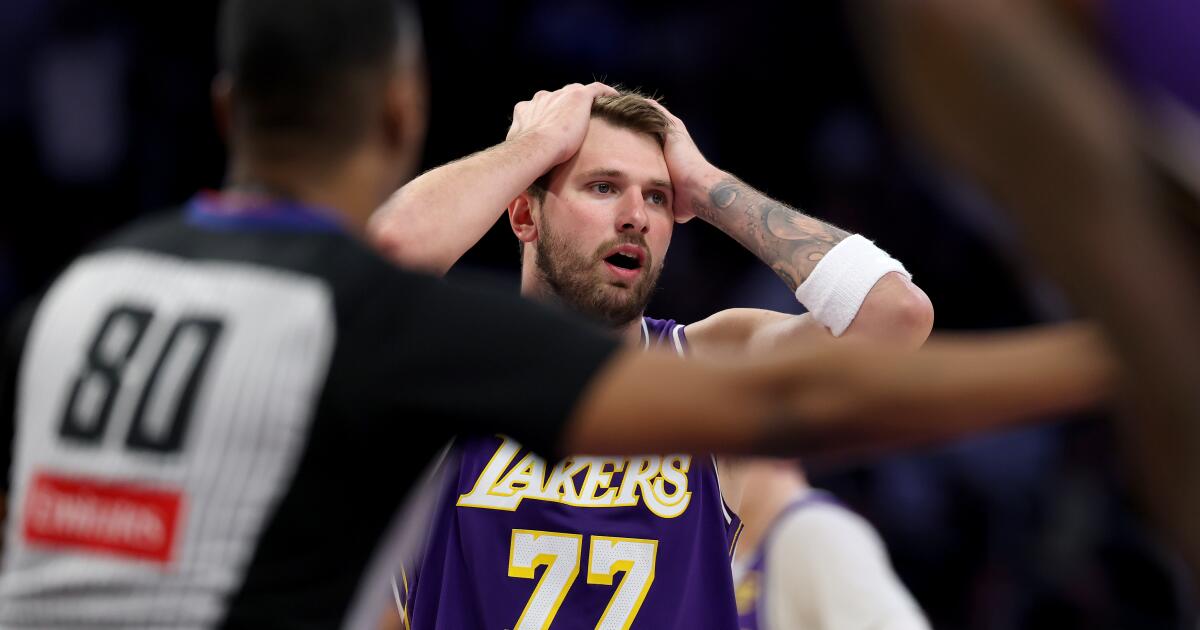
For the second time in less than a week, Luka Doncic faces a one-game suspension because of technical foul accumulation.
Only a week after Doncic’s 16th technical foul was rescinded by the NBA, the Lakers superstar picked up another one in a 116-99 win over the Brooklyn Nets on Friday and is in line to miss the Lakers’ next game against the Washington Wizards on Monday.
In the third quarter with the Lakers trailing by one against the lowly Nets (17-57), Doncic was called for an offensive foul against Nic Claxton as the Lakers (48-26) were trying to inbound the ball after a dunk by Ziaire Williams. After the Lakers turnover, Williams and Doncic appeared to exchange words with Doncic pushing Williams aside with one hand. Williams then flailed his arms behind him and slapped Doncic in the throat.
“He was yelling in my face three times,” said Doncic, who finished with 41 points, eight rebounds and three assists in the win. “I just wanted to get out of there. … I didn’t even talk. I just wanted to get out of there. And they said I pushed. My push was exaggerated, which was obviously not [the case].”
Both were assessed technical fouls with 5:12 remaining in the third quarter, and Williams’ hit was reviewed for a possible flagrant, although it was not upgraded.
The NBA requires players to sit out for one game without pay after their 16th technical foul of the season. But Doncic avoided that fate after the NBA rescinded the foul that would have forced him to the bench for a critical road game last week. Lakers coach JJ Redick said the Lakers will try to appeal Doncic’s latest foul but he did not see what happened on the play.
Last week, Doncic avoided a suspension after the NBA rescinded the foul that would have forced him to the bench for a critical road game against the Eastern Conference-leading Detroit Pistons. Doncic is slated to miss Monday’s game against the Wizards, who have lost 17 of their last 18 games and have the third-worst record in the Eastern Conference (17-56).
Lakers star Luka Doncic reacts to a referee’s call during the second half Friday against the Brooklyn Nets at Crypto.com Arena.
(Allen J. Schaben / Los Angeles Times)
Doncic picked up his first 16th technical foul last week against the Orlando Magic after getting into an argument with Orlando forward Goga Bitadze. Doncic claimed Bitadze directed a vulgar comment about Doncic’s family in Serbian toward the Lakers star guard. Bitadze refuted the story, saying it was actually Doncic who said the curse word out loud first and that he was only repeating what he heard.
The NBA rescinded both fouls upon review the following day.
Doncic, the NBA’s leading scorer, has scored 30 points or more in 12 consecutive games, the longest such streak in his career. He has 43 30-point games this season, tying Elgin Baylor and Jerry West for sixth-most in a season by a Lakers player. He has scored 40 points or more in the last 12 games.
Against the Nets, Austin Reaves finished with 26 points, eight rebounds and five assists and LeBron James had 14 points, eight assists and six rebounds.
Before the game, Redick said the Nets game would be like playing on the road since the Lakers had spent almost two weeks away from Crypto.com Arena and had returned home in the wee hours of Thursday morning from Indianapolis.

Lakers guard Austin Reaves celebrates after shooting a three-pointer against the Nets in the second half Friday.
(Allen J. Schaben / Los Angeles Times)
The challenge was to find the energy to play, which wasn’t a problem for Doncic, who had 24 points in the first half. Doncic was nine for 15 from the field in the first half and four for six from three-point range in 20 minutes. He finished shooting 15 for 25 from the field as the Lakers shot 54% from the floor. They shot 44% (11 for 25) from three-point range.
That the Lakers were facing a Nets team with the second-worst record in the NBA didn’t matter.
That the Lakers were facing a Nets team had lost nine of its last 10 games didn’t matter.
That the Lakers were facing a Nets team that’s last in the league in scoring (106.3 points per game) didn’t matter.
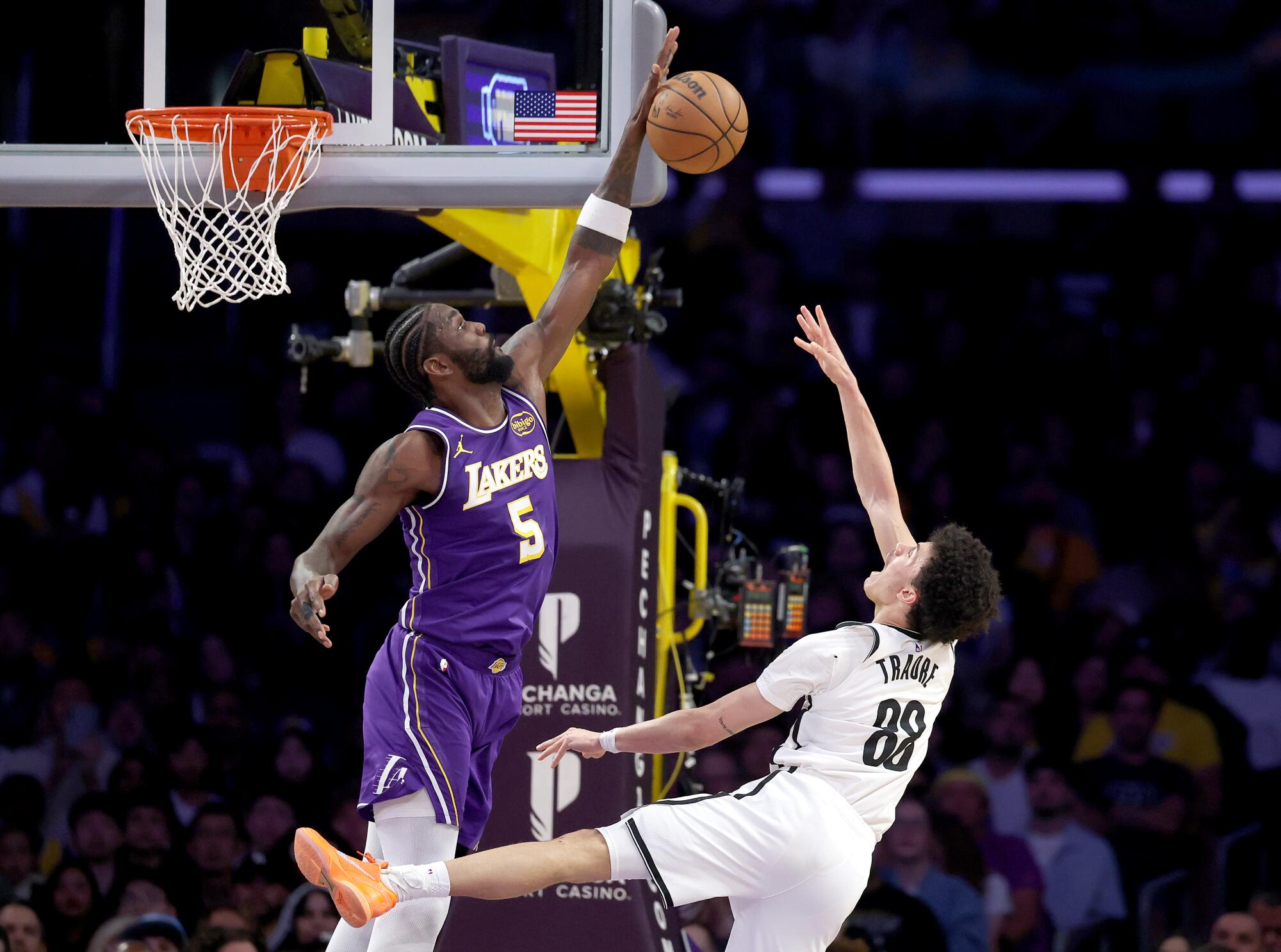
Lakers center Deandre Ayton, left, blocks a shot by Brooklyn Nets guard Nolan Traore in the first half Friday.
(Allen J. Schaben / Los Angeles Times)
What mattered to the Lakers was finding a way to win as the regular season winds down.
“I felt like we were a step slow,” Redick said. “And I told the guys at halftime, ‘This is our seventh game of the road trip. Anytime you come back, there’s a day in between, that’s just you’re in another city until you can get adjusted to the time zone and you get a couple days break.’ So the next two [off] days will be good for us.”
Notes: Lakers broadcast analyst Stu Lantz missed Friday night’s game against the Nets because of health issues. Derek Fisher, who won five NBA titles with the Lakers, took over Lantz’s role for the game. Public address announcer Lawrence Tanter also missed the game because of a health matter. Jason Barquero filled in for Lantz. “The entire Lakers organization is wishing Lawrence all the best in his recovery, and we look forward to welcoming him back soon,” the team said in a statement.


NEWYou can now listen to Fox News articles!
Tiger Woods was involved in a car crash on Jupiter Island in Florida on Friday, according to multiple reports.
The Martin County Sheriff’s Office told ESPN that the crash happened on Jupiter Island. Woods’ condition was not immediately known.
Woods competed in the TGL championship earlier this week with his girlfriend, Vanessa Trump, and her daughter, Kai, in the stands. It was his return to competitive golf after rupturing his Achilles last year, just ahead of the Masters.
Tiger Woods of Jupiter Links Golf Club looks on before the match against the Los Angeles Golf Club at SoFi Center on March 23, 2026, in Palm Beach Gardens, Florida. (Adam Glanzman/TGL/TGL Golf via Getty Images)
The 15-time major winner, five of which have come at Augusta, was noncommittal about playing at this year’s Masters. President Donald Trump said on “The Five” on Thursday that he would be at Augusta but not play.
Woods has had trouble behind the wheel in the past. In 2021, he got into a wreck that resulted in serious leg injuries that kept him off the golf course for months.
This is a breaking story. Check back for more updates.

A look at the top 20 high school softball teams in the Southland; as ranked by CalHiSports.com for The Times.
Rk. School; Record; Last ranking
1. Murrieta Mesa; 16-0; 1
2. Fullerton; 11-1; 4
3. Norco; 9-2; 3
4. JSerra 14-2; 2
5. La Mirada 12-2; 6
6. Oaks Christian; 12-1; 5
7. Orange Lutheran 5-3; 7
8. Etiwanda; 14-1; 11
9. Riverside King; 10-2; 20
10. Chino Hills; 13-4; NR
11. Chaminade; 10-1; NR
12. Sherman Oaks Notre Dame; 11-3; 8
13. El Modena; 7-4; 19
14. La Habra; 12-3; 18
15. Temescal Canyon; 8-4; 12
16. Long Beach Poly; 5-0; 16
17. Los Altos; 7-5; NR
18. Garden Grove Pacifica; 10-5; 9
19. Westlake; 10-2; NR
20. Anaheim Canyon; 8-4,10
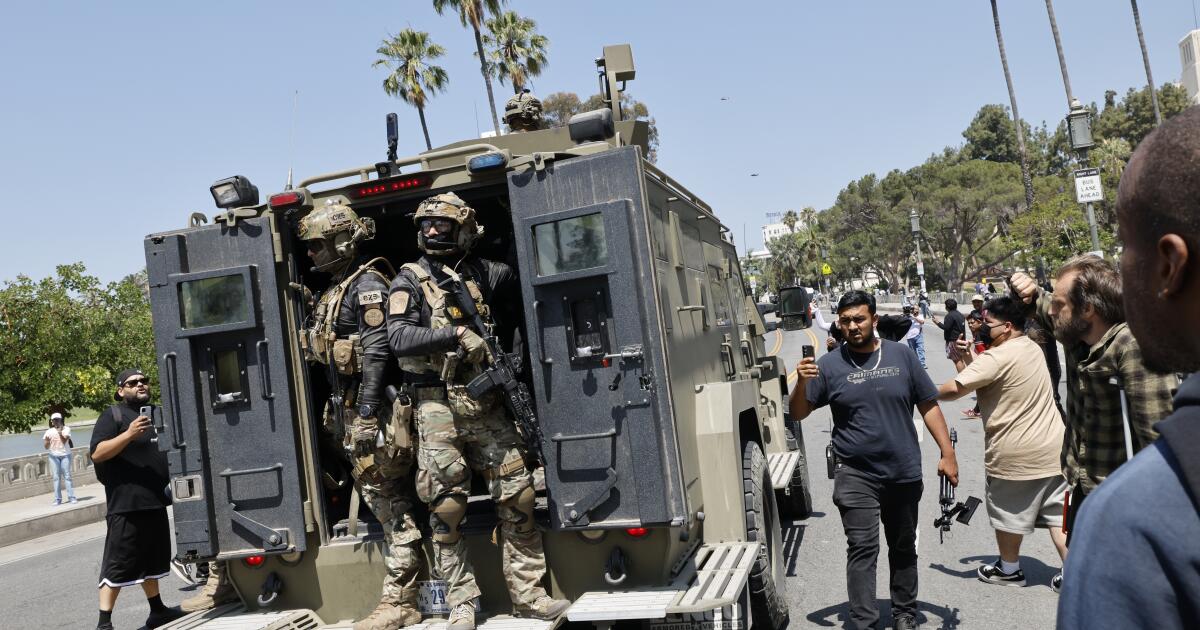
DHS attorney said agents in Los Angeles should have ‘started hitting’ protesters, emails show
Lakers beat Nets, but Luka Doncic is facing suspension again after 16th technical

EU Parliament unblocks key political hurdle in digital euro talks

Man arrested in plot to firebomb Palestinian activist’s home after undercover op

Video: We Analyzed the Deadly Crash at LaGuardia

Florida High School Football Rankings: Top 25 teams – Oct. 21

How old is Bo Nix? What to know about Oregon quarterback ahead of 2024 NFL Draft

Cleary's 21 help Le Moyne down Central Connecticut State 69-64 in OT

99th annual Pony Swim held in Virginia

Indiana Members Credit Union announced as new anchor tenant at Bottleworks District
EU Parliament unblocks key political hurdle in digital euro talks
Man arrested in plot to firebomb Palestinian activist’s home after undercover op

WATCH: Senate hearing goes silent after Angel Father confronts top Dem over daughter’s death

US diplomat Marco Rubio denounces settler violence, tolls in Hormuz strait

Iran-linked hackers have breached FBI Director Kash Patel’s personal emails | CNN Politics
-

 Detroit, MI1 week ago
Drummer Brian Pastoria, longtime Detroit music advocate, dies at 68
-

 Movie Reviews1 week ago
‘Youth’ Twitter review: Ken Karunaas impresses audiences; Suraj Venjaramoodu adds charm; music wins praise | – The Times of India
-

 Sports7 days ago
IOC addresses execution of 19-year-old Iranian wrestler Saleh Mohammadi
-

 New Mexico5 days ago
Clovis shooting leaves one dead, four injured
-
 Business1 week ago
Disney’s new CEO says his focus is on storytelling and creativity
-

 Technology6 days ago
YouTube job scam text: How to spot it fast
-

 Tennessee4 days ago
Tennessee Police Investigating Alleged Assault Involving ‘Reacher’ Star Alan Ritchson
-

 Texas1 week ago
How to buy Houston vs. Texas A&M 2026 March Madness tickets