Sports
Joao Fonseca: Brazilian tennis starlet who plays beyond his years but still gets homesick


What’s the right moment to hitch your hopes to an up-and-coming tennis player?
People were having visions of Carlos Alcaraz’s future when he was 10, the age at which Babolat and the other big racket companies sometimes start handing out equipment and swag. At France’s Les Petit As, the premier tournament for juniors 14-and-under, any prospects racking up games, sets and matches will already have an agent in their parents’ ear, if not a signed contract.
By those measures, having faith in Joao Fonseca, the easy-going Brazilian teenager with the wavy light hair who can already hit serves at 140mph (225kmh), seems like a pretty conservative bet.
Some more numbers. At 18, he’s the youngest player to make the field for the ATP Next Gen Finals in Jeddah, Saudi Arabia, a competition for the top-ranked men’s players who are 20 or younger. And at 6-foot-1 (185cm), Fonseca is in the Goldilocks zone — not too tall, not too short — of players who have won most of the Grand Slams the past decade.
Fonseca grew up worshipping Roger Federer, which is part of the reason his lead sponsor is On, the Swiss sports manufacturer that Federer has a significant stake in. On signed Fonseca, who hails from Rio de Janeiro, two years ago when he was just 16.
“They said it was going to be me, Iga (Swiatek) and Ben Shelton,” Fonseca recalled during an interview last month. “Of course I said yes.”
Perhaps Fonseca’s business acumen is as precocious as his tennis talent. On’s stock price was $17.36 two years ago. It’s around $55 now. His contract lets him travel with a physiotherapist full time; it’s also gotten him onto the practice court with Shelton, 22, when they have landed at the same tournaments.
The first time they met, at the 2023 Mallorca Championships, Shelton figured out Fonseca was the new guy in the On team and suggested they practice the next day.
“I was like, ‘I am nothing and you want to practice with me?’,” Fonseca said.
GO DEEPER
Ben Shelton: ‘I didn’t want to be one of 50 Nike guys’
He wasn’t nothing then and he certainly isn’t now. He won the U.S. Open junior title in September 2023, the season he became the first player from Brazil to top the junior rankings. In February, he smashed Arthur Fils in the first round of the Rio Open, 6-0, 6-4. At the time, the loss appeared to be a major setback for Fils, who is now ranked top 20 in the world and is the favorite for the Next Gen tournament, which begins today. They played each other in the last match of the first day. Fonseca beat Fils again, in five best-of-four game sets, breaking on a sudden-death deuce in the final set before serving out like a veteran.
That first loss in Brazil has become more palatable for Fils ever since it happened. Fonseca started the year ranked world No. 727. He’s up to No. 145 now and he came within a couple of games of his first Grand Slam main draw in New York this August, losing to Eliot Spizzirri — four years his senior — in three sets in the last round of qualifying.

Joao Fonseca in full flight in Rio de Janeiro. (Wang Tiancong / Xinhua via Getty Images)
The obvious comparison to a top player is world No. 1 Jannik Sinner, given Fonseca’s big serve, easy baseline power and shy demeanor on the court and off it. Fonseca hums along like a flywheel, ready to whip his opponent off their axis when he leans into a forehand, or perhaps a two-handed backhand down the line. He can also change gear.
At the Madrid Open, Fonseca went a set down to Alex Michelsen, an American who is another rival in the 20-and-under bracket. Outplayed in cross-court forehand rallies, Fonseca started marmalizing balls straight down the middle and asking Michelsen to generate angles, pinging anything short to the corners. Michelsen couldn’t pass the exam: Fonseca served him a 6-0 bagel to level the match and prevailed in the third set.
“He is a player who can play his best under big pressure, and he has the ability to adapt fast to different situations,” his coach Guilherme Teixeira wrote over email. Teixeira has been working with his charge since he was 11; Fonseca’s mother, Roberta, has watched him play for much longer than that.
Roberta, who also answered questions over email, said she has never seen her son get nervous before a tennis match. She remembers him losing when he was eight or nine because he kept volleying balls that were heading out back into play. He was seriously upset leaving the court, but as soon as he saw his mother he started begging her to sign him up for another tournament.
None of this, including qualifying for the Next Gen Finals, guarantees anything. Alcaraz and Sinner both won it on their climb up the tennis mountain, but the tournament has also featured younger versions of Alexander Zverev, Stefanos Tsitsipas, Daniil Medvedev, Taylor Fritz, and Casper Ruud — all of them Grand Slam finalists but just one of them, to date, a winner. Medvedev won the U.S. Open in 2021. Many of the fabled eight at the end of each season have never gotten close.

GO DEEPER
Daniil Medvedev is the fly-swatting enigma of men’s tennis – and he’s taking a moment
Fonseca is in this year’s lineup alongside Fils and Luca Van Assche of France; Michelsen, Learner Tien and Nishesh Basavareddy of the U.S.; Jakub Mensik of the Czech Republic and Shang Juncheng of China, who also goes by his Americanized name, Jerry Shang.
It’s hard to say whether there are any Grand Slam finalists in that group, especially in tennis. The kids with the swag and the spots at Les Petits As may be alright, but wariness in the face of teenage hype is the far safer posture. Brazil hasn’t produced a top men’s tennis player since Gustavo ‘Guga’ Kuerten, the three-time French Open champion and former world No. 1 who helped revolutionize tennis with his early adoption of polyester strings.
For decades, players from the country and the rest of South America have had to overcome their rearing almost exclusively on red clay. It’s a far greater challenge for them than for players from other red clay hubs like Spain because of the distance that South Americans have to travel to find different playing surfaces and opponents. There is no wonder that young people tend to gravitate to the far more accessible game of soccer instead, before getting to talk about the influence of World Cup trophies, Ronaldo Nazario and Neymar. To play tennis in Brazil, you mostly have to be a member of a private club.

Joao Fonseca has already represented Brazil at the Davis Cup. (Emmanuele Ciancaglini / Getty Images for ITF)
Fonseca remembers traveling to Europe to compete for the first time when he was about 13. He played on a public court in Germany with a picturesque view. Tennis balls appeared free and unlimited.
“In Europe, you have so much more help,” he said.
He was lucky enough to be born into a family of means with sports-mad parents. His mother flirted with professional volleyball. She and her husband, who competed in junior tennis in Brazil as a teenager, have run half-marathons and competed in road and mountain cycling and adventure races.
“Sport runs through our veins,” Roberta said.
Joao played just about anything they offered to him, including soccer, volleyball, swimming, judo, skateboarding, surfing, and skiing, plus tennis. His mother said he excelled at all of them.
At six, he would score all the goals at soccer tournaments for his academy while also chasing back on defense. He could swim all four strokes from an early age, and his swim club bumped him to the competitive team. He achieved his purple belt in judo at 10.
Teixeira spotted his tennis potential when he first saw him at 11. The quality of his shots, his pure contact with the ball, was far ahead of other kids his age and older, but there was something else he noticed. Wins didn’t excite him all that much and losses didn’t make him all that sad.
“On tour, you need to compete and practice week after week and be able to manage your emotions,” Teixeira said. “He just resets his mind and starts again.”
In the last year, Fonseca’s first as a full-fledged professional, Teixeira has seen him dial up that dedication. He is treating tennis as his career for the first time, engaging in practices and gym sessions with what Teixeira describes as a new level of seriousness.
This is a typical training day schedule for him, which begins with tests on his muscles to determine how hard he can go that day:
- 8:30 a.m.: Tests
- 9 a.m.: Physiotherapy and warm-up
- 10 a.m.: Gym
- 11 a.m.: Practice on court
- 1 p.m.: Lunch and rest
- 3 p.m.: On court
- 4:30 p.m.: Gym
- 5:30pm: Physiotherapy, if needed
Teixeira said Fonseca is also paying more attention to his rest and what he eats. He is diligent with breathing exercises that can help him stay calm during matches. Improving his footwork is high on the agenda for 2025.
Fonseca is still a teenager, though. He can only manage a month or so away from home before fatigue and homesickness set in. This season, he tried to play tournaments for four or five weeks, before returning home for a couple weeks of training and seeing his friends and family.

Joao Fonseca reacts to winning the U.S. Open boys’ singles title in 2023. (Sarah Stier / Getty Images)
He’s still a teenage tennis player too. His biggest challenge is consistency: figuring out how to win when he isn’t playing his best. In junior tennis, the better player — the one with the best technique and the best shots — usually wins the tournament. That’s not how it shakes out during the serious stuff.
“In the pro tour, there’s a lot of players that can find the solutions, and the ones that find more solutions during the tournaments, during the weeks, they have better results,” Fonseca said. He went 7-7 in ATP matches this year; not bad for an 18-year-old. Sinner was 11-10 in 2019, the year he turned 18.
Fonseca has time, but for some things he is impatient, especially shaking that assumed allegiance to red clay and slow courts. Instead, he wants grass to be his best surface one day
“I love Wimbledon,” he said. “I want to be like Sinner or (Novak) Djokovic. Those guys that play good on any surface.”
(Top photo: On)



Sports
Golf star records lowest round in LPGA major history with astounding performance at Evian Championship

NEWYou can now listen to Fox News articles!
There are good days on the golf course, and then there is what Haeran Ryu just did on Saturday.
Ryu, 25, recorded the lowest round in LPGA major history on Saturday with an 11-under 60 at the Evian Championship. With the South Korean golfer’s historic round, she holds a three-stroke lead.
Ryu’s round comes just two weeks after winning her first major at the Women’s PGA Championship. On the 18th hole, Ryu left a 30-foot eagle putt a few inches short, and instead settled for a birdie.
CLICK HERE FOR MORE SPORTS COVERAGE ON FOXNEWS.COM
Haeran Ryu of South Korea reacts on the 18th green after the third round of The Amundi Evian Championship at Evian Resort Golf Club in Evian-les-Bains, France, on July 11, 2026. (Stuart Franklin/Getty Images)
She said after the round that she had no idea what she had done until she counted up her scorecard.
“But after the putt and I counted my score with my caddie,” she said. “Oh my God, it’s 11-under par today. It was so amazing. My caddie says, ‘Yep.’ I’m so happy right now.”
If Ryu had made the eagle putt on the 18th hole, she would have been just the second player to shoot a 59 in LPGA history.
ZERO BS. JUST DAKICH. TAKE THE DON’T @ ME PODCAST ON THE ROAD. DOWNLOAD NOW!
Haeran Ryu of South Korea celebrates a birdie on the 15th green during the third round of The Amundi Evian Championship at Evian Resort Golf Club on July 11, 2026, in Evian-les-Bains, France. (Stuart Franklin/Getty Images)
Her 60 broke the record for the lowest round in an LPGA major by one shot. Leona Maguire and Jeungeun Lee6 in 2021, and Hyo Joo Kim in 2014, each shot 61 at the Evian Championship, which was designated as an LPGA major in 2013.
The lowest round in a men’s major is 62, which is shared by four players — Branden Grace at Royal Birkdale in the 2017 British Open, Xander Schauffele and Rickie Fowler in the 2023 U.S. Open at Los Angeles Country Club, and Schauffele and Shane Lowry in the 2024 PGA Championship at Valhalla.
CLICK HERE TO DOWNLOAD THE FOX NEWS APP
Haeran Ryu of South Korea and Lottie Woad of England interact after their round on the 18th green during the third round of the Amundi Evian Championship at Evian Resort Golf Club in Evian-les-Bains, France, on July 11, 2026. (Stuart Franklin/Getty Images)
Ryu hopes her historic third round can help propel her to a second major win in three weeks.
“That is amazing, amazing dream,” Ryu said. “So I just want that one to come true, but we have one more day.”
The Associated Press contributed to this report.
Follow Fox News Digital’s sports coverage on X, and subscribe to the Fox News Sports Huddle newsletter.
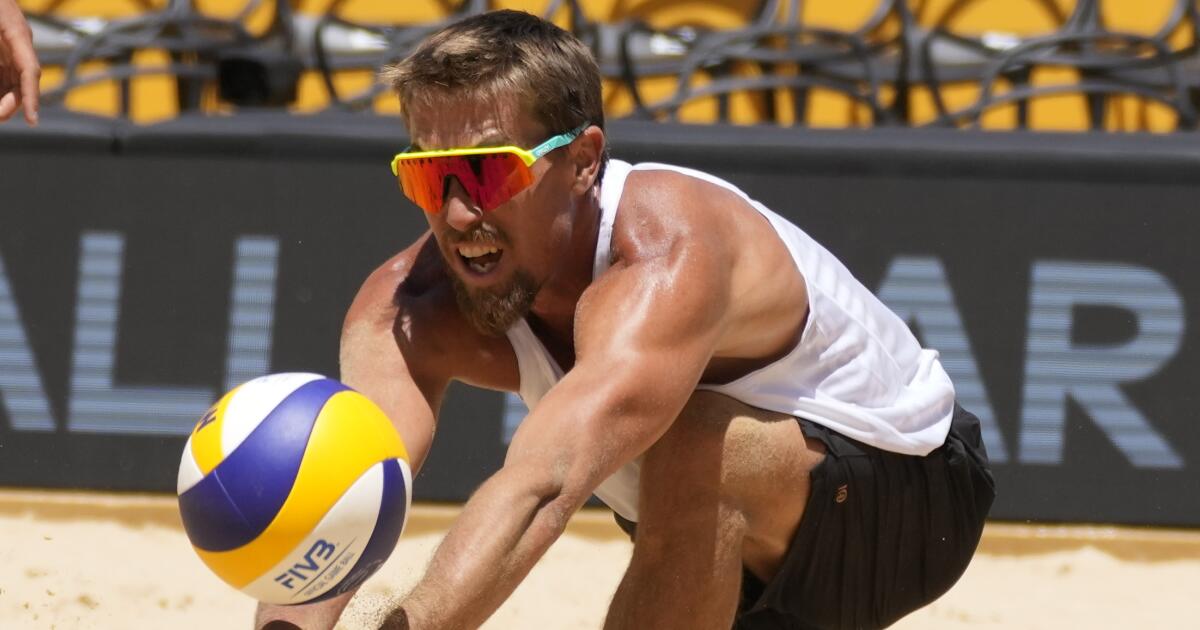
Taylor Crabb is no stranger to South California beaches. The Long Beach State alum returns home this weekend to compete in AVP League matches.
It marks the first time AVP will compete in Long Beach since 2020 and allows players to compete at the 2028 Olympics beach volleyball venue.
Crabb, 34, made his AVP debut in 2013 with his brother, Trevor, and advanced from the qualifier in Manhattan Beach before finishing 25th in his first tournament.
After years of competing with various different partners, Taylor Crabb and Andy Benesh have delivered the top performances this AVP season.
The following interview with Crabb has been edited for clarity and length.
Are you excited to compete in this weekend’s event at Long Beach?
Crabb: Very excited. A lot of my college teammates and part of the school have reached out, saying that they’re gonna come. So I’m excited to get a chance to play in front of them again.
When was the last time you were in Long Beach?
Crabb: I always try to go down there for alumni events or any big games they have. I went to UCLA against Long Beach last year, when it was No. 1 versus No. 2, so I always try to get down there and support them.
You missed out on the chance to compete in the 2020 Olympics because of COVID-19 restrictions and chose not to pursue a spot at the 2024 Olympics. Are you fired up to try to compete in the 2028 Olympics, knowing that Long Beach will host the competition?
Crabb: Yeah, it’s definitely an exciting time having the Olympics in Long Beach, and we kind of get to break it in this weekend. As you said, Tokyo didn’t go the way I wanted, but I’m going full force now. I have a great partner in Andy Benesh, who obviously went to the Paris Olympics, and if it weren’t for the Olympics being in Long Beach, and me getting a partner like Andy, I’m not even sure I’d be going for it, but because of those two things, I want to make the most of it.
You mentioned that if it wasn’t for a partner like Andy, you wouldn’t be going for it. What do you mean by that?
Crabb: I didn’t feel motivated by playing in all the international events, but now, I think, sitting out kind of lit the fire under me, and I’m really motivated now.
You’ve had different partners throughout your time. What other motivation does Andy give you?
Crabb: He’s been, in my mind, the top blocker for the U.S. the last four or five years. Seeing the professionalism he brings every day to practice, on and off the court, while traveling and when showing up to tournaments, it rubs off on you and that’s really motivating to see. And I just want to make him proud.
Why do you love volleyball?
Crabb: A lot of reasons, but it’s just a feeling I have when I’m out there on the court. It feels natural. It feels like home. I was born into a volleyball family. I had a volleyball in my hands my entire life, so I’ve always just enjoyed it.

NEWYou can now listen to Fox News articles!
CM Punk appeared on “Friday Night SmackDown” ready to take on any challenger that was ready to step to him after winning the Undisputed WWE Championship against Sami Zayn.
Punk entered the ring in Oklahoma City and called back to the “Monday Night Raw” after WrestleMania 42 when he told Cody Rhodes he’d be ready to deliver if a championship opportunity fell “out of the sky.”
COMPLETE PRO WRESTLING COVERAGE ON FOX NEWS DIGITAL
Cody Rhodes and CM Punk face off during SmackDown at Paycom Center in Oklahoma City, Okla. (Craig Ambrosio/WWE via Getty Images)
“When championship opportunities fall out of the sky, CM Punk catches them,” he said.
Punk named potential SmackDown superstars he’d think might come for the title, including Gunther, Finn Balor, Royce Keys, Damian Priest and Trick Williams. He even said that Zayn could come back around and get his rematch if he wanted. He didn’t mention Rhodes’ name, but the “American Nightmare” came out uncalled and marched his way down to the ring.
“I don’t think you and I can run away from each other anymore,” Punk told Rhodes.
Cody Rhodes looks on during SmackDown at Paycom Center in Oklahoma City, Okla., on July 10, 2026. (Craig Ambrosio/WWE via Getty Images)
Rhodes agreed and mentioned that Punk would want a match with him, just “say when.” It was a quick retort from Punk, who said, “when.” SmackDown general manager Nick Aldis, who was in the ring for the segment, booked the match for SummerSlam.
Punk will defend the Undisputed WWE Championship at SummerSlam, which takes place Aug. 1 and 2 at U.S. Bank Stadium in Minneapolis.
First, however, Punk and Rhodes will be involved in a tag team match at Saturday Night’s Main Event in New York City next week. Aldis made the match after Gunther demanded that Aldis put him in a match against Punk. Gunther was hoping it would be for the championship. Instead, Gunther will tag with Zayn.
Gunther didn’t take too kindly to that and attacked Aldis. Rhodes came back out to break up the calamity. He wanted to take on Gunther after the show went off air but Gunther walked away.
Gunther makes his entrance during SmackDown at Paycom Center in Oklahoma City, Okla., on July 10, 2026. (Rich Wade/WWE via Getty Images)
CLICK HERE TO DOWNLOAD THE FOX NEWS APP
Punk definitely has his hands full as he moves to SmackDown to become a fighting champion.
-

 Austin, TX5 minutes ago
Man shot and killed by police after pointing gun at people in Austin, Texas
-

 Alabama12 minutes ago
Alabama has Talent returns with local connection
-

 Alaska15 minutes ago
Alaska Sports Scoreboard: July 11, 2026
-

 Arizona20 minutes ago
Cardinals Mailbag: Latest on Jacoby Brissett, Carson Beck, and Arizona’s QB Future
-

 Arkansas27 minutes ago
Arkansas tips its hat to blues pioneer Larry “Totsie” Davis in England dedication
-

 California30 minutes ago
‘Explosive diarrhea’ parasite surfaces in California as health officials fear statewide surge
-

 Colorado35 minutes ago
This Quiet Colorado Town Is An Underrated Gem For Nature Lovers
-

 Connecticut42 minutes ago
Car catches fire in Trumbull

