Sports
Is Novak Djokovic’s first tennis season without a Grand Slam title in seven years a sign?


Follow live coverage of Day 7 at the 2024 US Open
NEW YORK — It was the best of times, it was the worst of times.
Twenty-six days after Novak Djokovic won Olympic gold in Paris, he finished off his second-least profitable Grand Slam season since 2009 with a stunning third-round defeat to Alexei Popyrin at the U.S. Open. With a few months remaining on the 2024 tennis calendar, he could end the year without a Tour-level title for the first time since 2005, while simultaneously securing what he describes as the “greatest achievement of his career”.
When has it ever been a case of either/or for Djokovic? The 24-time major winner is generally only satisfied when he is winning everything. Settling for anything less has generally been anathema to the man who has dominated tennis, with a blip or two, since the start of 2011.
As it so often goes in this sport, father time is undefeated. At 37 , perhaps the moment that was always coming has finally arrived. Not in a steep decline, nor an end to his relevance at Grand Slam tournaments. Just his becoming a player that can still hit the heights on occasion, but not all the time and not all season long.
Players who have beaten him include Alejandro Tabilo, Tomas Machac, Luca Nardi, and now Popyrin. His defeats at the majors to his two biggest rivals, Jannik Sinner in Australia and Carlos Alcaraz at Wimbledon, were both desperately one-sided. That Djokovic reached that Wimbledon final just six weeks after surgery on the medial meniscus of his right knee is testament to the fact that he can still be a force at Grand Slams. That Alcaraz cut him down so easily in that final is testament to the feeling that his defeats now, after so long, have the capacity to become ugly very quickly.
Novak Djokovic left New York without a Grand Slam title to his name this year. (Angela Weiss / AFP via Getty Images)
It happened against Popyrin, in front of 24,000 on Arthur Ashe. Djokovic has been in recovery for months, slowly upping his physical exertion, and in that time, his game has necessarily suffered. His ball-striking and tactical nous are still there, and he has even added a turbo boost when he needs it, most memorably ripping two forehands past Alcaraz in the second-set tiebreak at the Olympics.
His thoughts after his defeat to Popyrin didn’t account for any of that.
“I have played some of the worst tennis I have ever played, honestly, serving by far the worst ever,” Djokovic told reporters in a short post-match press conference as Friday night ticked into Saturday morning.
Ever since he returned from surgery, his service motion has been ungainly, particulary on the follow-through. He has looked unsteady as he lands, often stumbling into the court. But the ball has still gone in the box. Not so across this tournament, where he made 52 percent of his first serves, against a career average in the mid-60s. He hit 32 double faults in 38 service games across three rounds.
He also acknowledged that it had been difficult coming here so soon after the high of the Olympics, and that he wasn’t really in the right state to compete. “I spent a lot of energy winning the gold, and I did arrive to New York just not feeling fresh mentally and physically,” he said.

GO DEEPER
Novak Djokovic knew he would win Olympic gold – he just didn’t know when
“But because it’s the U.S. Open, I gave it a shot and I tried my best.”
All of this is totally understandable — it’s just, this is Djokovic. Aside from the 2016 to 2018 comedown after he completed the career Grand Slam, what’s been so remarkable about him is his ability to always go again, even as he’s ticked monumental achievement after monumental achievement off his list.
That wasn’t the case against Popyrin. He looked lifeless, struggling to rouse himself in the way he normally does, and he was strikingly quiet — barely making a sound as he struck the ball — even in moments of high exertion and stress. The crowd play was half-hearted. The tight games invariably went against him, rather than for him. The familiar first-set rope-a-dope that turns into a dominant four-set win never came.
In the third set and the early part of the fourth, when Popyrin was collapsing into serves, missing and lambasting himself, it looked as if the inevitable was coming. But it wasn’t the inevitable of the last 20 years that arrived. It was the inevitable of the last eight months.

Alexei Popyrin overcame a wobble midway through the match to seize control in the fourth set. (Sarah Stier / Getty Images)
As his Grand Slam season ends, the phenomenal achievement of winning Olympic gold increasingly looks like a shiny distraction, in analytical terms. Nothing can diminish the scale of doing that at 37, not least Djokovic’s reaction as he collapsed to the clay and shook with tears, but it has still been a pretty disappointing year for him. There are mitigating circumstances — not just Djokovic’s knee, but being struck on the head by a metal water bottle in Rome — that have made achieving his usual heights even more challenging.
He will be back for the Australian Open, desperate to wrestle the title he has won 10 times back from Jannik Sinner, but what happened on Friday wasn’t a blip. It was not an earth-shattering result, like when he lost to Sam Querrey at Wimbledon in 2016, which turned the tennis world upside down. Losing to Popyrin, who ran him close at this year’s Australian Open and at Wimbledon too, was in keeping with many of his defeats this year.
Winning in Paris was the outlier, and while a Grand Slam final; semifinal; and quarterfinal is a year that the vast, vast majority of players would retire on at any age, that isn’t how Djokovic thinks. Until 2024, he had won a major title every year since 2010, but for 2017.
“Sitting from a larger perspective, of course I have to be content,” Djokovic said when asked to take a longer-term view himself. Seeing whether Djokovic has the ability to reset his goals in the next year or so, and whether he is happy to do so, will be one of the defining stories in tennis in 2025.
(Top photo: Sarah Stier / Getty Images)



Sports
Golf star records lowest round in LPGA major history with astounding performance at Evian Championship

NEWYou can now listen to Fox News articles!
There are good days on the golf course, and then there is what Haeran Ryu just did on Saturday.
Ryu, 25, recorded the lowest round in LPGA major history on Saturday with an 11-under 60 at the Evian Championship. With the South Korean golfer’s historic round, she holds a three-stroke lead.
Ryu’s round comes just two weeks after winning her first major at the Women’s PGA Championship. On the 18th hole, Ryu left a 30-foot eagle putt a few inches short, and instead settled for a birdie.
CLICK HERE FOR MORE SPORTS COVERAGE ON FOXNEWS.COM
Haeran Ryu of South Korea reacts on the 18th green after the third round of The Amundi Evian Championship at Evian Resort Golf Club in Evian-les-Bains, France, on July 11, 2026. (Stuart Franklin/Getty Images)
She said after the round that she had no idea what she had done until she counted up her scorecard.
“But after the putt and I counted my score with my caddie,” she said. “Oh my God, it’s 11-under par today. It was so amazing. My caddie says, ‘Yep.’ I’m so happy right now.”
If Ryu had made the eagle putt on the 18th hole, she would have been just the second player to shoot a 59 in LPGA history.
ZERO BS. JUST DAKICH. TAKE THE DON’T @ ME PODCAST ON THE ROAD. DOWNLOAD NOW!
Haeran Ryu of South Korea celebrates a birdie on the 15th green during the third round of The Amundi Evian Championship at Evian Resort Golf Club on July 11, 2026, in Evian-les-Bains, France. (Stuart Franklin/Getty Images)
Her 60 broke the record for the lowest round in an LPGA major by one shot. Leona Maguire and Jeungeun Lee6 in 2021, and Hyo Joo Kim in 2014, each shot 61 at the Evian Championship, which was designated as an LPGA major in 2013.
The lowest round in a men’s major is 62, which is shared by four players — Branden Grace at Royal Birkdale in the 2017 British Open, Xander Schauffele and Rickie Fowler in the 2023 U.S. Open at Los Angeles Country Club, and Schauffele and Shane Lowry in the 2024 PGA Championship at Valhalla.
CLICK HERE TO DOWNLOAD THE FOX NEWS APP
Haeran Ryu of South Korea and Lottie Woad of England interact after their round on the 18th green during the third round of the Amundi Evian Championship at Evian Resort Golf Club in Evian-les-Bains, France, on July 11, 2026. (Stuart Franklin/Getty Images)
Ryu hopes her historic third round can help propel her to a second major win in three weeks.
“That is amazing, amazing dream,” Ryu said. “So I just want that one to come true, but we have one more day.”
The Associated Press contributed to this report.
Follow Fox News Digital’s sports coverage on X, and subscribe to the Fox News Sports Huddle newsletter.
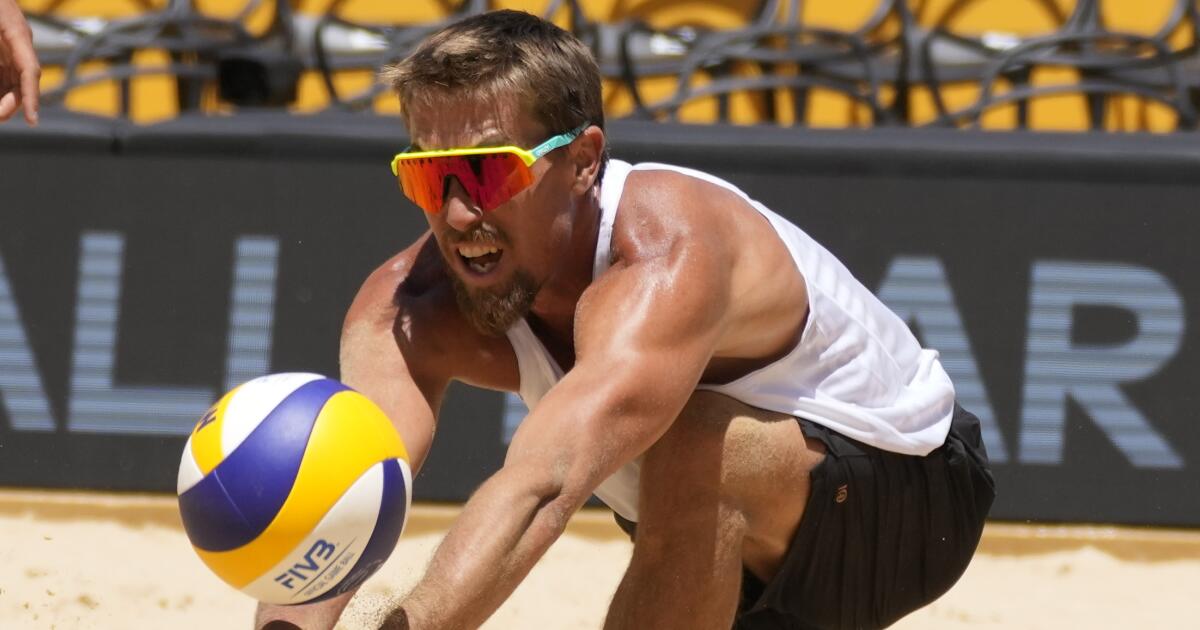
Taylor Crabb is no stranger to South California beaches. The Long Beach State alum returns home this weekend to compete in AVP League matches.
It marks the first time AVP will compete in Long Beach since 2020 and allows players to compete at the 2028 Olympics beach volleyball venue.
Crabb, 34, made his AVP debut in 2013 with his brother, Trevor, and advanced from the qualifier in Manhattan Beach before finishing 25th in his first tournament.
After years of competing with various different partners, Taylor Crabb and Andy Benesh have delivered the top performances this AVP season.
The following interview with Crabb has been edited for clarity and length.
Are you excited to compete in this weekend’s event at Long Beach?
Crabb: Very excited. A lot of my college teammates and part of the school have reached out, saying that they’re gonna come. So I’m excited to get a chance to play in front of them again.
When was the last time you were in Long Beach?
Crabb: I always try to go down there for alumni events or any big games they have. I went to UCLA against Long Beach last year, when it was No. 1 versus No. 2, so I always try to get down there and support them.
You missed out on the chance to compete in the 2020 Olympics because of COVID-19 restrictions and chose not to pursue a spot at the 2024 Olympics. Are you fired up to try to compete in the 2028 Olympics, knowing that Long Beach will host the competition?
Crabb: Yeah, it’s definitely an exciting time having the Olympics in Long Beach, and we kind of get to break it in this weekend. As you said, Tokyo didn’t go the way I wanted, but I’m going full force now. I have a great partner in Andy Benesh, who obviously went to the Paris Olympics, and if it weren’t for the Olympics being in Long Beach, and me getting a partner like Andy, I’m not even sure I’d be going for it, but because of those two things, I want to make the most of it.
You mentioned that if it wasn’t for a partner like Andy, you wouldn’t be going for it. What do you mean by that?
Crabb: I didn’t feel motivated by playing in all the international events, but now, I think, sitting out kind of lit the fire under me, and I’m really motivated now.
You’ve had different partners throughout your time. What other motivation does Andy give you?
Crabb: He’s been, in my mind, the top blocker for the U.S. the last four or five years. Seeing the professionalism he brings every day to practice, on and off the court, while traveling and when showing up to tournaments, it rubs off on you and that’s really motivating to see. And I just want to make him proud.
Why do you love volleyball?
Crabb: A lot of reasons, but it’s just a feeling I have when I’m out there on the court. It feels natural. It feels like home. I was born into a volleyball family. I had a volleyball in my hands my entire life, so I’ve always just enjoyed it.

NEWYou can now listen to Fox News articles!
CM Punk appeared on “Friday Night SmackDown” ready to take on any challenger that was ready to step to him after winning the Undisputed WWE Championship against Sami Zayn.
Punk entered the ring in Oklahoma City and called back to the “Monday Night Raw” after WrestleMania 42 when he told Cody Rhodes he’d be ready to deliver if a championship opportunity fell “out of the sky.”
COMPLETE PRO WRESTLING COVERAGE ON FOX NEWS DIGITAL
Cody Rhodes and CM Punk face off during SmackDown at Paycom Center in Oklahoma City, Okla. (Craig Ambrosio/WWE via Getty Images)
“When championship opportunities fall out of the sky, CM Punk catches them,” he said.
Punk named potential SmackDown superstars he’d think might come for the title, including Gunther, Finn Balor, Royce Keys, Damian Priest and Trick Williams. He even said that Zayn could come back around and get his rematch if he wanted. He didn’t mention Rhodes’ name, but the “American Nightmare” came out uncalled and marched his way down to the ring.
“I don’t think you and I can run away from each other anymore,” Punk told Rhodes.
Cody Rhodes looks on during SmackDown at Paycom Center in Oklahoma City, Okla., on July 10, 2026. (Craig Ambrosio/WWE via Getty Images)
Rhodes agreed and mentioned that Punk would want a match with him, just “say when.” It was a quick retort from Punk, who said, “when.” SmackDown general manager Nick Aldis, who was in the ring for the segment, booked the match for SummerSlam.
Punk will defend the Undisputed WWE Championship at SummerSlam, which takes place Aug. 1 and 2 at U.S. Bank Stadium in Minneapolis.
First, however, Punk and Rhodes will be involved in a tag team match at Saturday Night’s Main Event in New York City next week. Aldis made the match after Gunther demanded that Aldis put him in a match against Punk. Gunther was hoping it would be for the championship. Instead, Gunther will tag with Zayn.
Gunther didn’t take too kindly to that and attacked Aldis. Rhodes came back out to break up the calamity. He wanted to take on Gunther after the show went off air but Gunther walked away.
Gunther makes his entrance during SmackDown at Paycom Center in Oklahoma City, Okla., on July 10, 2026. (Rich Wade/WWE via Getty Images)
CLICK HERE TO DOWNLOAD THE FOX NEWS APP
Punk definitely has his hands full as he moves to SmackDown to become a fighting champion.
-

 Austin, TX5 minutes ago
Man shot and killed by police after pointing gun at people in Austin, Texas
-

 Alabama12 minutes ago
Alabama has Talent returns with local connection
-

 Alaska15 minutes ago
Alaska Sports Scoreboard: July 11, 2026
-

 Arizona20 minutes ago
Cardinals Mailbag: Latest on Jacoby Brissett, Carson Beck, and Arizona’s QB Future
-

 Arkansas27 minutes ago
Arkansas tips its hat to blues pioneer Larry “Totsie” Davis in England dedication
-

 California30 minutes ago
‘Explosive diarrhea’ parasite surfaces in California as health officials fear statewide surge
-

 Colorado35 minutes ago
This Quiet Colorado Town Is An Underrated Gem For Nature Lovers
-

 Connecticut42 minutes ago
Car catches fire in Trumbull

