Sports
How the PWHL’s youngest player is adjusting to a new league — and a new language


OTTAWA — Nearly 6,000 miles away from her hometown in Hokkaido, Japan, Akane Shiga was being asked about the weather.
Mike Hirshfeld, general manager of Ottawa’s PWHL team, was sitting with Shiga and coach Carla MacLeod in the team office at TD Place Arena, speaking to the 22-year-old forward and Japanese national team member through her interpreter.
“She’s looking at me like, ‘What is he talking about?’” Hirshfeld said about the playful preamble to an important bit of news ahead of the PWHL’s final roster deadline.
Because what Hirshfeld really wanted to know was how Shiga felt about spending the winter in Ottawa, as a member of the newest pro team in Canada’s capital.
When he told Shiga that she’d made the team, “her face just lit up,” Hirshfeld said.
“I feel very honored to be given this opportunity,” Shiga told The Athletic through her interpreter, Madoka Suzuki.
GO DEEPER
Six teams, one draft and a lot of Ikea furniture: How the PWHL was made in six months
The moment was the culmination of a hockey journey that saw Shiga travel across the world for her chance to play professional hockey in North America. Despite her credentials — an Olympian and four-time member of Japan’s World Championship team — she was not selected in the 15-round PWHL Draft in September. Unswayed, Shiga flew to Ottawa alone in November, with no guarantee of a contract, to try out for the team.
Her skating ability, quick release and hockey IQ impressed Ottawa’s braintrust and earned Shiga a one-year contract.
Now, she is a historic player in a historic league embarking on a singular path: Shiga is the youngest player in the PWHL and the only Japanese-born player.
This season Shiga is adjusting to her first year as a professional hockey player, and simultaneously adapting to life in a new country and learning a new language.
“To know the courage it took for her to fly over here on her own and walk into an environment where she didn’t speak the language and she didn’t know anyone,” MacLeod said. “To know at that moment that she had gambled on herself and she earned her opportunity — that’s what sport is all about.”
Where Shiga grew up in Hokkaido — the northernmost and second-largest island in Japan — hockey is, at the very least, an option. Some might call it Japan’s hockey hotbed, with most of the national team players coming from the northern region.
“If you want to play hockey, it’s accessible,” Shiga said through her interpreter. “But it’s not a sport that everyone picks to play like it is in Canada.”
In Tokyo, on the other hand, where Suzuki — who was hired to serve as Shiga’s interpreter in November and plays hockey at Carleton University in Ottawa — is from, “you’re kind of a weirdo if you’re playing hockey,” he said with a laugh.
According to the IIHF, there are only 1,281 registered female hockey players in Japan, with a national population of about 124 million. There are more indoor rinks in Canada (2,860) and registered female players in the state of Florida (1,517).

Shiga is the star of the Japanese women’s national team, and in 2021 she became the first Japanese player to score against Team USA. (Dennis Pajot / Getty Images)
Shiga, though, found hockey skating on an outdoor rink with her sister, Aoi, when she was six years old and she “never looked back.” When she was 13, in 2014, Shiga watched a Japanese women’s hockey team play at the Olympics for the first time in her life — and for the first time since Japan was the host nation in 1998. “It had a big impact on my career,” she said.
MacLeod, now Shiga’s coach in Ottawa, was an assistant coach for Japan at the time.
“I know what ’98 meant to me as a young Canadian kid when I saw those women on TV and I knew that that dream could then be mine,” said MacLeod, who went on to win two Olympic gold medals with Team Canada. “To know that a piece of that moment is within her and helping her to inspire that next group and helping her to achieve her dreams is pretty special.”
Shiga’s dream was realized only one year later when she made the Japanese under-18 team for the 2015-16 Division 1 world championships. She was one of the youngest players at the tournament and scored two goals and four points to lead Japan to a gold medal, and promotion to the top tier U18 world championships in 2016-17.
“I didn’t think I was ready to make the jump that soon,” Shiga said. “But I was very excited to get the news.”
She’s been a member of the Japanese national program ever since, playing on four under-18 teams, four senior world championships and qualifying for the 2022 Olympics. In 2019, Shiga made the switch from defense to forward because her coach, Yuji Iizuka thought she could help provide more offense for the team.
And he was right.
In 2021, Shiga was one of the breakout stars of the women’s world championships in Calgary, Alta. She scored the opening goal against Hungary in a critical 4-1 win for Japan to make it to the quarterfinals. She became the first Japanese player ever to score against Team USA — and she did it twice. Then, she scored the game-winning goal against Czechia to secure Japan’s best finish (sixth) at women’s worlds. Her four goals tied for fifth among North American stars like Natalie Spooner and Hilary Knight. It was one more than Canada’s Captain Marie-Philip Poulin had in the tournament.
“She’s a very important part of the team’s success,” Iizuka told IIHF.com “Our teams have always had trouble scoring, so to find someone who can put the puck in the net is very important.”
After years of adding to her reputation as one of the most talented players outside North America — including a trip to the 2022 Beijing Olympics — it was only natural that Shiga’s name popped up when the PWHL Ottawa front office decided to prioritize bringing in international talent.
“Obviously there’s a natural tether for me to the international game, and I’ve been lucky to see how talented these players are around the world. So for us it was an easy decision to say, Let’s bring in some international players and see how they do,” MacLeod said. “If they can make it, great. And if they don’t, at least we know that too. But we didn’t want to leave that uncertainty.”
According to Shiga, Ottawa was the only team to call when PWHL free agency opened in September.
At training camp, Shiga quickly impressed.
“I would say two days in, we knew we had something,” Hirshfeld said. “Her skating is off the charts. So is her hockey IQ. I remember Claude Julien (the former NHL coach) was here one day and he was like, ‘Who is that?’”
“Her skill with the puck catches everyone’s attention because she can maneuver things in a small space that a lot of people can’t,” MacLeod explained. “The puck comes off her stick faster than you anticipate and with a velocity that you’re not sure where that’s all coming from because she’s such a petite player. And she can do it in a phone booth.”
There was chatter amongst the Ottawa players ahead of camp about a player from Japan trying out for the team. Some national team players would have been familiar with Shiga’s game from world championships or the Olympics. But others, like defender Zoe Boyd, were being introduced to her for the first time.
She recalls a moment early into training camp where Shiga danced around in the offensive zone and sent a slapshot zinging past her face, bardown and in.
“Holy crap, this girl is legit,” Boyd thought at the time. “She’s the real deal.”
“Surprised isn’t the right word to describe it,” she explained. “We’re just amazed by Akane, her play, and what an amazing person she is — in spite of not being able to fluently speak English.”
When Madoka Suzuki answered the phone on a Thursday afternoon, he was in the car taking Shiga home from one of their errands.
“Had to do some banking,” he said. “Applying for credit cards and stuff.”
Bringing Shiga to Ottawa introduced the issue of the language barrier. The PWHL has 14 players from overseas — hailing from countries such as France, Hungary, and Czechia — but most of those players speak at least some English. Shiga did not, so Ottawa knew they’d need an interpreter to make her feel more comfortable and confident at tryouts.
The team started with a call to the Japanese Embassy, who provided a list of names, but those interpreters would cost around $300 per hour. “No one can afford that,” Hirshfeld said, laughing.
The team tried calling the universities in the city and connected with Stacey Colarossi, the coach of Carleton’s women’s hockey team, who referred Hirshfeld to Suzuki, a 24-year-old from Japan and a forward on the men’s hockey team.

Madoka Suzuki, left, with his sister, Chihiro, and Akane Shiga. Suzuki is employed by the PWHL’s Ottawa team as Shiga’s interpreter, though he has also been helping her adjust to life in Canada. (Photo courtesy of Madoka Suzuki)
As it turned out, Suzuki’s sister, Chihiro, played on the national team with Shiga last year and had already alerted her brother that Shiga had made the move to Ottawa and might need a friend in town. So, when Hirshfeld made the call with a job offer, Suzuki quickly accepted.
The day Shiga arrived in Ottawa, Suzuki was at the airport to pick her up and bring her to the team hotel. When the team skates, Suzuki is on the ice translating instructions for drills, or messages from the coaching staff. He attends team meetings and games, too, as his schedule allows. If Suzuki has class — he’s a psychology major at Carleton — or is on the road with his hockey team, he will join meetings or interviews over the phone.
“He understands the teachings from the coaching side and obviously as he’s translating, is giving her information that’s helping her grow and fit within the team side of things,” MacLeod said. “He’s really invaluable when it comes to Akane and Akane feeling included.”
“We love having Madoka around,” said defender Jincy Roese (née Dunne). “I feel like he’s just one of the girls — as much part of this team as any one of us.”
Suzuki’s work with Shiga goes beyond the rink. After Shiga made the Ottawa team, she had to fly to Hungary to play in the 4 Nations tournament for Team Japan. While she was there, Suzuki found a realtor to start looking for apartments for Shiga and got all the paperwork done so that when she returned they could find her a place to live as quickly as possible. He’ll take her to the bank to get an account or credit card set up, or to Ikea to buy furniture, or to get food at a restaurant or grocery store.
“A lot of the ‘work’ I’m doing is more as a friend than anything,” he said. “She’s made it super easy on me too. She’s very enjoyable to work with.”
Suzuki moved to Canada from Japan with his mom and sister in 2014, when he was 14 years old. He spoke English and had family with him, but he still remembers the difficult adjustment to a new place and new culture.

Akane Shiga and Madoka Suzuki, pictured with Suzuki’s former billet family. (Photo courtesy of Madoka Suzuki)
“I’m glad I could help her out this way, because otherwise it’s quite the journey to get your feet going up here,” he said.
Shiga has been using the Duolingo app to learn English. Her teammates have been helping her learn, too. Suzuki will sometimes step back and just let Shiga try to talk without needing the translation. If he’s not around, teammates will use Google Translate if Shiga needs help.
“She’s really quiet right now, but that’s to be expected,” said Roese. “But you see it there, she’ll speak a little more, she’ll get a little more involved in conversation. You can tell she’s starting to follow along more.”
Roese has learned some Japanese to help break the language barrier where she can. And MacLeod still knows a few words from her time as an assistant coach with Team Japan.
“I know the word ‘koko’ (which means here in Japanese), or I know the word hurry or no hesitation,” she said. “There’s certainly something small, small nuggets that obviously I was fortunate enough to pick up when I worked with them for two years. Not enough to actually be smart, but enough to maybe help in moments.”
Shiga’s teammates “love her,” Hirshfeld said. And several have taken her under their wing to make her feel comfortable and included on the team.
Boyd and her roommate Kristin Della Rovere will drive Shiga home from the rink, or take her to a teammate’s house if there’s a get-together. They’ve gone for bubble tea and have promised to have Shiga over once she’s settled in so she can see Boyd’s cat, Sam.
Shiga loves cats and has two back home in Japan named Pickle and Churro. “I miss the cats more than anyone,” she said with a laugh.
“I can’t imagine what it must be like to come to a country where nobody speaks your language,” Boyd said. “So naturally I just wanted to make sure that she understands things — like everybody did.
“But Akane is hilarious. Even though she can’t speak English very well, she still makes the funniest jokes and gets her point across. It’s been a pleasure to hang out with her and be a teammate with her.”
On the ice, Shiga is still adjusting to her first professional season. Through six games, Shiga hasn’t registered a point yet, but nobody in Ottawa is looking at the scoresheet.
“We’re not even worrying about that,” said Hirshfeld. “She’s getting used to the speed and physicality of this league, but I know she’s got the hockey IQ to work through it. She’s a great skater, which I think is a great advantage in this league. We’re very optimistic.”
Shiga has impressed in games with her skating and hands in tight with the puck. MacLeod says she works hard in practice and has already seen Shiga’s game grow in Ottawa. It seems like only a matter of time before she scores her first PWHL goal.
“I’ve never seen somebody that can rip the puck like she can,” Roese said. “Just bardown from anywhere.”
Shiga is also one of the most popular players in Ottawa. “I think she got the second loudest cheer after (Brianne) Jenner,” MacLeod said about the home-opener intros.
The Ambassador of Japan to Canada attended Ottawa’s home opener. There have been several Shiga signs spotted in the stands, and plenty of fan mail sent to her home — something Shiga says started after she played in the Olympics.
“She’s 22 years old,” MacLeod said. “Think of all the variables: youngest in the league, playing in a country, in a league that’s not native tongue to her, and she just keeps rising. What an incredible human being.”
Shiga hopes her sister, a 24-year-old defender playing in Switzerland, can join the league next season. The two were signed to play together with the Buffalo Beauts in the PHF before the league folded last season. More than anything, she hopes more players from Japan can follow in her footsteps.
“To be able to pave the path for younger players and give them someone to look up to — to say, you can be from Japan and play hockey — is a huge honor,” she said. “And I’m just very excited for what the future holds.”
(Illustration: John Bradford / The Athletic; Photos: Courtesy of Madoka Suzuki; Minas Panagiotakis / Getty Images)



Lawmakers face off in congressional baseball game
Fox News correspondent Chad Pergram previews the annual Congressional Baseball Game, where Republican lawmakers aim to extend their five-year winning streak against Democrats. The report highlights the competitive spirit, challenges faced by both teams during early morning practices, and the game’s significant fundraising efforts for DC nonprofits.
NEWYou can now listen to Fox News articles!
I mentioned how humbling baseball can be in yesterday’s article. I was certainly humbled last night. Humbled might not even be the right word – instead, it probably should be incredibly frustrated. I had under 10.5 in the Royals and Padres game, and through nine innings, there were exactly six runs scored. Unfortunately, three were on each side, so it went to a 10th inning. In the top of the 10th, three runs crossed the plate. That pushed the total to 9, but I was still alive. In the bottom of the inning, the Royals scored four runs. A seven-run 10th inning, and the game goes over. About as brutal as it gets. Luckily, I won on the Reds, but that… was something. Let’s try to dodge that luck as the Rays take on the Red Sox.
Tampa Bay is one of the best teams in baseball, which isn’t all that shocking when you consider their franchise as a whole. They are 56-40 for the season with sole possession of first place in the division. The Rays have been hot all year, but I’d challenge almost any casual fan to name more than three players on the team. Junior Caminero is probably the most well-known, partially because he is an All-Star, and partially because he was almost injured in the All-Star Game.
Tampa Bay Rays’ Junior Caminero celebrates his solo home run off Cincinnati Reds pitcher Brandon Williamson during the third inning of a baseball game in St. Petersburg, Fla., on April 22, 2026. (Chris O’Meara/AP)
You might be familiar with some of the starting pitchers for the staff, but I wouldn’t be surprised if you weren’t. The Rays are a bit unconventional at times with their rotation and arms. Today, they are sending out Ian Seymour to start the game, or maybe we should consider calling it opening the game? Seymour has 33 appearances and just six starts. It is normal for a guy to get stretched out and move from the bullpen to the rotation, but some are better left in the bullpen, and it seems like that might be the case for him. As a starter, he has allowed teams to hit .242 against him compared to just .197 as a reliever. The encouraging sign for the Rays is that in 18 at-bats against him, the Red Sox have not recorded a hit and struck out seven times.
RED SOX HAD A NIGHTMARE TRAVEL DAY FOR THE AGES, YET STILL FOUND A WAY TO BEAT THE METS IN NEW YORK
The Boston Red Sox looked like they were dead in the water just about a month ago. They were in last place in the division and looked like they were probably going to be sellers at the trade deadline. Perhaps it was just a very bad start. Maybe this team is better than we expected. Or, it is possible this was just a hot stretch, and they will end up falling back down the standings. A lot is still to be determined, but the club is finally clicking, and I know they are looking to ride that success as long as possible.
CHICAGO, ILLINOIS – JULY 7: Ceddanne Rafaela #3 of the Boston Red Sox celebrates hitting a two-run home run during the second inning against the Chicago White Sox at Rate Field on July 7, 2026 in Chicago, Illinois. (Photo by Geoff Stellfox/Getty Images) (Getty Images)
The Red Sox will send Patrick Sandoval to the hill today. This is just his second start of the season for the Red Sox, and he has no record with a 2.08 ERA and a 1.38 WHIP. He has just 4.1 innings under his belt, so I’d be very surprised if I see him go deep into this game. It is possible, since yesterday was a doubleheader, that they need Sandoval to eat innings even if he pitches poorly. Rays hitters have faced him 28 times, but 17 of those have come from Yandy Diaz, who is just 3-for-17 against him. The other three players that have seen Sandoval before are a combined 2-for-11.
SIGN UP TO GET THE LATEST SPORTS NEWS
I think this might be a game where you see some runs from both teams. Neither starter is going to strike fear into their opponent, exactly. However, I will at least give them credit for showing success against their opponent in the limited exposure. I do lean to the over at 9.5 for this game, but I think there is a better play.
Tampa Bay Rays’ Yandy Diaz, center, is congratulated on his two-run home run against the Atlanta Braves during the fourth inning of a baseball game, Sunday, July 9, 2023, in St. Petersburg, Fla. (AP Photo/Mike Carlson)
CLICK HERE TO DOWNLOAD THE FOX NEWS APP
The Red Sox have won 11 straight games, but I don’t see them getting to 12. Boston should be very happy they’ve gotten all the way back to .500, but Tampa Bay is a very good team, and I actually think Seymour is more reliable than Sandoval in just his second start. Combine that with the Red Sox winning both games yesterday, and I think the Rays take this one. Give me Tampa Bay on the moneyline.
CLICK HERE FOR MORE SPORTS COVERAGE ON FOXNEWS.COM
For more sports betting information and plays, follow David on X/Twitter: @futureprez2024
Sports
Commentary: LAFC star Son Heung-Min proves life after the World Cup can offer hope and redemption
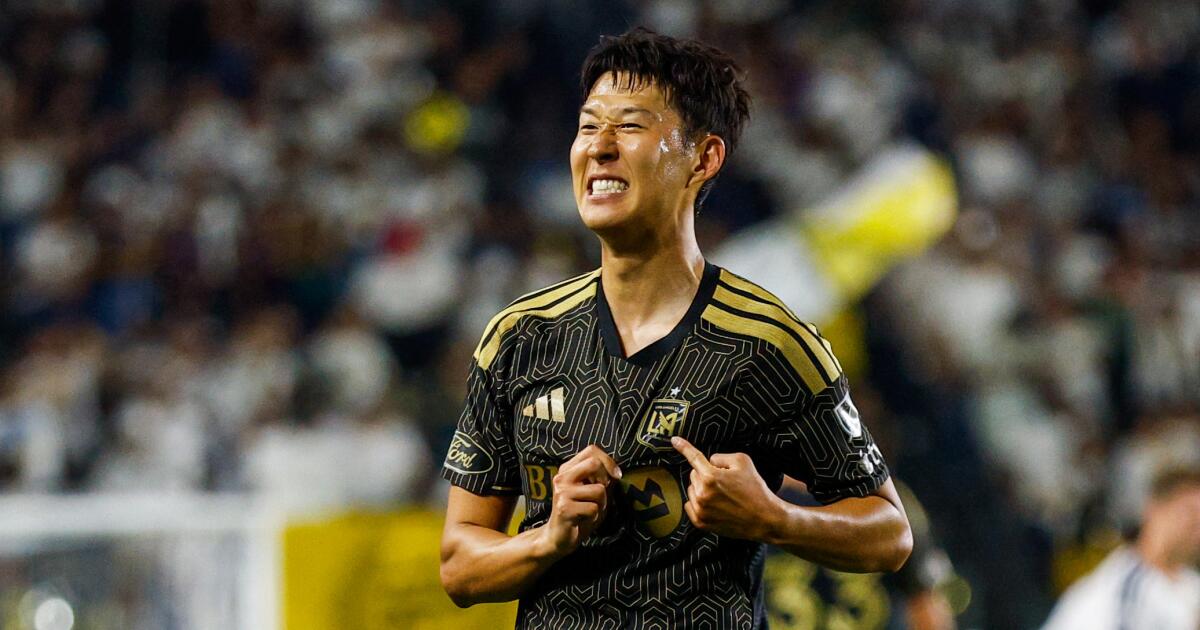
The Son, as they say, will come out tomorrow.
Bet your bottom dollar that Son Heung-min, LAFC’s $26 million man — the record MLS fee for an incoming player — would peel himself off the mat and clear away the cobwebs and sorrows of the past few weeks and months.
He did it with a sizzling, right-footed goal in the 57th minute of LAFC’s 3-0 victory Friday over the Galaxy in the 27th rendition of El Tráfico and the first this year. Also, the first crosstown showdown of Son’s so-far, so-so tenure in L.A.
His arrival last August from Tottenham Hotspur in England’s Premier League was met with uncommon fanfare. Here came another global soccer icon to Major League Soccer — and to L.A., where the South Korean sensation was welcomed enthusiastically by a Korean diaspora that’s about 250,000 strong.
LAFC forward Son Heung-Min celebrates after scoring a goal against the Galaxy at Dignity Health Sports Park in Carson on Friday.
(Ronaldo Bolanos/Los Angeles Times)
The first Asian player to win the Premier League Golden Boot, Mayor Karen Bass spoke at Son’s introductory news conference. The Dodgers invited him to throw out the first pitch on Shohei Ohtani’s bobblehead night (and turned around this season and produced a bobblehead of Son throwing that pitch).
His first LAFC goal — a free kick over the wall in a 1-1 draw with FC Dallas — was named the MLS’s goal of the year. After notching 173 goals across all competitions with Tottenham Hotspur, he finished with nine goals in his first 10 regular-season appearances for LAFC.

Then the scoring stopped. As if someone turned off the spigot.
Before Friday, Son recorded nine assists but no goals over 13 unlucky matches this season. He went 44 shots without striking a goal. And 237 days between goals, according to The Chosun Daily’s tally.
Yeah, just a bit of what his LAFC teammate Mark Delgado described as “a drought.”
Most painfully, Son also was shut out in South Korea’s disastrously short World Cup stay.
South Korea entered the tournament with the expectation that its “golden generation” – led by Son – would reach the knockout stage. But after it opened Group A with a 2-1 win over Czechia, the Koreans lost 1-0 to Mexico and 1-0 to South Africa and failed to qualify for the round of 32 as one of the eight best third-placed teams.
The uproar in South Korea that followed included the country’s president demanding an investigation.

Mexico’s Julián Quiñones and South Korea’s Son Heung-min vie for the ball during a World Cup match on June 18 in Guadalajara, Mexico.
(Ricardo Mazalan / Ap Photo/ricardo Mazalan)
For his part, a heartbroken Son shared a statement on Instagram: “I don’t dare to convey the disappointment and hurt of the fans with a single word ‘sorry.’ So even saying those words feels insufficient.”
It was impossible not to wonder: What the heck?
Where was the version of Son that everyone was celebrating a year ago?
How did the 34-year-old’s game decline so suddenly?
Was this a classic case of overpromising and underdelivering?
It still might be. LAFC — now 8-5-3 and third in MLS’s Western Conference — is going to face tougher competition in the days ahead than the work-in-progress Galaxy.
But on Friday, the center-forward was aggressive and in control. He took two shots in the first seven minutes, both blocked by defenders. He toyed with the Galaxy just before halftime, lining up to take a penalty before turning it over to Denis Bouanga, who scored to make it 2-0.
Then he and Delgado exchanged passes in the second half to set up Son’s first goal in darn near forever.
LAFC coach Marc Dos Santos gave Son 10 days off after the World Cup, but Son said he was eager to return to L.A., because he so enjoys the camaraderie of this club.
Those good vibes were on display when Son’s shot whizzed between two defenders and the outstretched arms of Galaxy goalkeeper Novak Micovic.
Son put his finger to his lips in the universal “shhh” sign and then did his patented camera celebration — click! — miming a snapshot. Because every goal is precious, and let’s be real, you never know when another will come.

LAFC’s Son Heung-Min celebrates after scoring what could be a breakthough goal against the rival Galaxy at Dignity Health Sports Park in Carson on Friday.
(Ronaldo Bolanos/Los Angeles Times)
Around him, the crowd and his colleagues went wild.
Dos Santos did some vein-popping flexing on the sideline. Mathieu Choinière pumped his fists as though he were operating a handcrank. Jacob Shaffelburg and Ryan Hollingshead flanked him on either side as though posing for a family photo. Son’s hair got tousled and nobody wearing black and gold could stop smiling.
“He deserves it, coming back from an emotional World Cup, and joining us right away,” Dos Santos said.
“He’s a great guy,” Delgado said. “He’s been in a bit of a goal drought, and, you know, we all want him to score. We all, he’s always smiling, and in training, he’s always scoring.
“And we’re like, ‘yeah, we need that, we need that!’ Trying to give him confidence,” Delgado continued. “And in games, he finally is getting that confidence back. So to see him score and put the ball in the net and just see his face light up with a smile is awesome. We all want to see him succeed here. We all want him to lead this club like we know he can.”
Now the goal is to keep the goals coming.
“Scoring the first goal of this season, I think it [will] help me,” Son said. “I think, definitely, going forward through the second part of the season. So, let’s keep going, and hope Wednesday [against Salt Lake] I can score another goal.”
Sports
Raising Cane’s owner Todd Graves on how viral Tom Brady-Rob Gronkowski dunk tank came to be at Fanatics Fest

Tom Brady, LeBron, Jeter UNITE at Fanatics Fest
FOX Business’ Madison Alworth reports live from Fanatics Fest in New York City, detailing the immense gathering of sports fans and athletes. CEO Lance Fensterman reveals that mega-stars such as Serena Williams and David Beckham are attending. The festival anticipates 200,000 attendees over its four-day run, showcasing its significant growth since 2022.
NEWYou can now listen to Fox News articles!
Fanatics Fest is a viral moment waiting to happen considering the plethora of superstars under one Manhattan roof, and perhaps the first one came on Thursday’s opening day at the Javits Center in the Raising Cane’s activation.
It was a legendary combination of Tom Brady, Rob Gronkowski and 500 gallons of Raising Cane’s famous sauce filled in a dunk tank. Brady, whose accuracy with a football is still unmatched, didn’t miss his target.
Gronkowski went splashing into the sauce, as Brady and Raising Cane’s owner Todd Graves joined the masses in celebrating one of the coolest moments to kick off Fanatics Fest.
Todd Graves, Rob Gronkowski and Tom Brady attend Fanatics Fest NYC 2026 at Jacob Javits Center in New York City on July 16, 2026. (Dave Kotinsky/Getty Images for Fanatics)
Before Brady’s toss pulled the seat out from under his favorite tight end when they were both in the NFL, Fox News Digital caught up with Graves to find out how a dunk tank filled with his brand’s famous sauce came to be.
“I never thought of a Cane’s Sauce dunk tank, but partnering with Fanatics and Fanatics Fest, which is great,” Graves explained. “They’re amazing partners. One, Michael Rubin and I have been friends, and talk about business, help each other out in many different ways. A rising tide lifts all boats. Before we started partnering with Fanatics, I loved what he was doing, I loved the fanfare, I loved having sports and entertainment figure heads – everybody from Tom Brady to Kevin Hart , right? All that together, I was like, ‘Man, let’s partner. Let’s do this deal.’
TOM BRADY DRAWS INSPIRATION AFTER MEETING WITH MAKE-A-WISH TEAN HEART TRANSPLANT RECIPIENT AT FANATICS FEST
“With Fanatics Fest, partnering with them wasn’t just like, ‘Here, come, do whatever you think of.’ No, it was, ‘Let’s put our minds together and do what we can.’ So, they came up with the idea. Actually [CEO of OBB Media] Michael Ratner was like, ‘Let’s do a Cane’s Sauce dunk tank.’ I was like, ‘Yes!’ And he was like, ‘Let’s do Brady dunking Gronk.’ Oh my God, I couldn’t think of two better people doing it.”
Graves believed the moment was going to be “legendary” and “going to be something in Cane’s lore” forever. And when the brand opened its first doors in Baton Rouge, Louisiana on Aug. 28, 1996, Graves wasn’t thinking 30 years down the road two of the most recognizable athletes in the country would be making this happen.
“The crews are already so excited about it. The fans will love it. What better guy like Gronk, and to have Brady hit the target. It’s ideal,” Graves added.
Tom Brady throws football during Raising Cane’s dunk tank event, where Rob Gronkowski fell into 500 gallons of Cane’s Sauce. (Raising Cane’s)
Brady and Gronkowski got the crowd going with a little chicken Hail Mary moment, with the quarterback tossing some Cane’s chicken fingers into a cup of sauce the tight end was holding. But then, the moment of truth.
In classic Gronkowski fashion, he was chirping Brady from his seat, but the FOX Sports NFL colleagues knew what the end result was going to be with that. Brady toyed with Gronkowski at first, hitting a Cane’s logo just above the target on purpose, and did so again with a different one.
Then, on his third throw, Brady struck true, and all of the 6-foot-6, 265-pound Gronkowski caused a Cane’s Sauce explosion when he fell in. There was a splash zone if you were close enough, and it was a moment fans, media and everyone else who witnessed it couldn’t stop talking about.
As Gronkowski wiped the sauce from his eyes, and Brady calmed down from all the laughter he caused, Graves was right there to thank them both for the epic moment he’ll never forget.
Todd Graves, Rob Gronkowski and Tom Brady attend the Cane’s Sauce Dunk Tank Showdown hosted by Graves at Fanatics Fest at the Javits Center in New York City on July 16, 2026. (Phillip Faraone/Getty Images for Raising Cane’s)
CLICK HERE TO DOWNLOAD THE FOX NEWS APP
“Through growth, I have 100,000 crew members now, and we have 1,000 locations and we’re about to turn 30. For me to walk in here and see our logos up here and see people that want to come and be a part of Cane’s, it’s a dream come true. To do a dunk tank, and Tom Brady and Gronk want to do that, I built a brand that’s special to my crew and customers. So, an absolute dream. I always have to pinch myself and part of my job is doing things like this, which is great,” Graves said.
“We love what we do. I love my company, I love my crew and customers. This is just something I think we can do some fun for them, because I know how much I’m going to enjoy it.”
Follow Fox News Digital’s sports coverage on X and subscribe to the Fox News Sports Huddle newsletter.
-

 Virginia6 minutes ago
Washington DC, Maryland, Virginia storm warnings: Saturday July 18
-

 Washington12 minutes ago
House Budget Committee advances Reconciliation 3.0 amid GOP divisions
-

 Wisconsin18 minutes ago
David Crowley reenters battleground Wisconsin’s Democratic governor primary with Gov. Evers’ backing
-

 West Virginia24 minutes ago
Brooke County man sentenced to 1 to 15 years for meth distribution
-

 Wyoming30 minutes ago
Douglas Photographer Captures Historic Black Rancher’s Homestead Under Milky Way
-

 Crypto36 minutes ago
Kaspersky uncovers OkoBot framework targeting crypto wallet users
-

 Finance42 minutes ago
Personal Finance: New housing affordability law has promising provisions | Chattanooga Times Free Press
-

 Fitness48 minutes ago
30-30-30 rule popularizes healthy morning routine – WTOP News

