Sports
Emma Navarro keeps her eye on the ball at the Australian Open as tennis limelight shines brighter


MELBOURNE, Australia — A seriously cold December afternoon in midtown Manhattan, in the lobby of a hotel off Central Park.
A 23-year-old woman looks up from a club chair near an elevator. She’s wearing a baseball cap, diddling around a bit on her phone.
“Hey,” she says.
Take another look. Oh, right, that’s Emma Navarro: U.S. Open semifinalist and a top-10 women’s player after just one full season of top-tier tournaments. She’s chilling ahead of a packed evening of photo ops, press gaggles, and an appearance at the New York Knicks NBA basketball game with a few other tennis players you might have heard of — Carlos Alcaraz, Ben Shelton and Jessica Pegula.
It might be fun. Then again, hanging out in this comfy chair, anonymously watching the bustle of her native city pass by is pretty cool too. There are many reasons why Navarro, who plays Ons Jabeur in the third round of the Australian Open Saturday, pursued tennis. Being a famous person was not one of them.
“The exact opposite,” she said the other day, after a second-round win in Melbourne over Wang Xiyu of China, her second consecutive three-set battle with the outcome up in the air until the final point.
She was at it once again Saturday, when she opened a packed Margaret Court Arena against Ons Jabeur, a three-time Grand Slam finalist and darling of the sport on the way back from a torrid few months with injury. After winning 20 of the first 24 points and surging to a 5-0 lead in the first set, she had to scramble in the third to prevail, saving three break points when serving at 1-2.
When it was over, she credited her parents for taking her and her siblings on six-hour bike rides when they were kids for her third-set prowess. Then she scribbled “me heart 3 sets” on the television camera. She should. She went 19-6 in matches that went the distance last season. On her way off the court, she was straight into signing autographs for fans hanging over the stands. The match was played in the light and shadow of lunchtime in Melbourne and Navarro is not yet fully adjusted to being center stage, day after day after day.
“It’s something that I work really hard at managing and feeling comfortable with being in the spotlight. It’s the opposite of my nature. It feels unnatural,” she said.
This happens in tennis sometimes. Not everything develops in sync. Not everyone who can fire forehands and backhand on a wire seemingly all afternoon is an alpha-dog extrovert, letting their life unfold in a series of Instagram posts and TikTok videos.
And so it is with Navarro, whose tennis life had been an exploration in incrementalism up until the summer of last year. At 18, after a terrific junior career — including a singles final and doubles title at the French Open — she still wasn’t sure she wanted to be a professional tennis player. So she went to the University of Virginia for two years, where she won the NCAA nationwide college-level women’s singles championship.
When she did turn pro, she opted not to pursue wild-card entries that might have been easily attainable, given that her father, Ben, is active in the tennis business and owns the ATP and WTA 1000-level Cincinnati Open. She was fine climbing her way through second-tier tournaments on the ITF and WTA 125 circuits.
GO DEEPER
Win or lose, Emma Navarro wants to hit one more ball
Navarro was outside the top 100 as recently as April 2023. She finished that year as world No. 32, the magic number for a Grand Slam seeding, and won her first WTA Tour tournament in Hobart, Tasmania, the day before the start of the 2024 Australian Open.
Then she played her way into the spotlight. She notched consecutive wins over Coco Gauff, first at Wimbledon and then the U.S. Open, where Gauff, now a friend, was the defending champion. She rose into the top 10 for the first time. And that’s when things started to get a little busy.

Emma Navarro is figuring out how to live in the tennis limelight. (Daniel Pockett / Getty Images)
A flood of interview and appearance requests. A commercial portfolio that now includes deals with Fila, Yonex, Red Bull, Dove, Fanatics, De Bethune and, as of Friday, Mejuri, the high-end jewellery brand that put her in a bespoke photo shoot in Charleston, S.C., in December. Navarro is the company’s first athlete ambassador.
For Serena Williams and Maria Sharapova, Naomi Osaka and Gauff, Iga Swiatek and Zheng Qinwen, something like that is just another day ending with a “Y”. For Navarro, it is, in her own words, “an adjustment”.
The adjustment has a tennis guise too, which might go some distance toward explaining Navarro’s first two matches here this month. Both ended up being tennis escape rooms, first on Rod Laver Arena and then on the site’s second stadium, Margaret Court Arena.
She was down a break of serve in the third set in both matches. Peyton Stearns, another former NCAA champion, had a match point against her in a second-set tiebreak that she couldn’t take. Stearns then served for the match in the third, but couldn’t get over the line.
In both cases, Navarro was in the first match of the day, putting her in the prime-time slot back in the States on ESPN — a slot that Gauff often plays in. Like the fame and exposure that winning and marketing deals carry, big court assignments and prime-time hours bring a not-so-subtle message of expectation.
In both matches, the usually steady Navarro sprayed balls from the middle of the baseline that she had roped back for much of last year, wearing down opponent after opponent. Then she found a way, stringing together her best shots of the afternoon in the handful of deciding points that made the difference twice over.
Against Jabeur, she raced through the first set to 5-0 before Jabeur started playing with the finesse that carried her to the brink of the biggest prizes in the sport. She got back to 5-4. Navarro still took the set.
For nearly her entire tennis life, Navarro had been the girl and then the woman who was thrilled when she showed up at a tournament and learned she was playing on Court 35 in the back of the facility.
“Like, put me in the forest,” she said.
That’s not happening anymore.
“You spend whatever 20 years working at something, mainly behind closed doors, and then all of a sudden you’re a form of entertainment for people,” she said. “People pay to come watch you do what you do. It’s definitely an adjustment.”
Navarro’s coach, Peter Ayers, has been working with her the past eight years. He said his way of getting Navarro used to being a new version of herself during the off-season was to stick with the formula that got her here.
“It’s always been a very methodical approach,” Ayers said during an interview in Melbourne. “We want her to get better without neglecting her bread and butter. It’s always a balance.”
For Navarro, who will never be one of the WTA tour’s giants, that means trying to play bigger and more aggressively within the parameters of her strengths. She is not about to start firing lasers, like some of her peers can do point in, point out.
“I’m very leery of just chasing velocity,” said Ayers.
There are other ways.
Ayers is a baseball guy. One of his favorite pitchers was Greg Maddux, the Atlanta Braves ace of the 1990s. Maddux was far from the hardest thrower, but no one could place balls on the edge of the strike zone as well as he could. “There’s a lot she can do with being more precise,” Ayers said.
Same with her strokes.
Navarro doesn’t have to try to out-hit players such as Aryna Sabalenka or out-spin Swiatek. But she can do a lot of damage if her feet are a step or two closer to the baseline more often, or even inside it.
Ayers, like Navarro, knows that life is different when there is a single digit next to your name on the rankings ladder. It’s been a while since Navarro sneaked up on anyone, as she did on Gauff at dusk in southwest London six months ago. People aren’t afraid of losing to her anymore, Ayers said; when that fear goes away, opponents can play free without worrying about the consequences.
“You’re getting everyone’s best shot,” he said. “The idea is that makes you better.”

Emma Navarro has found herself on her heels in her two Australian Open matches to date. (Daniel Pockett / Getty Images)
Navarro has always been something of problem-solver, whether it’s figuring out an opponent, how she wants to spend her time and who she wants to be as a tennis player. In a sense, what she’s doing now, is figuring out another problem — how to exist as this new version of herself, the version that has been better than all but a handful of players in the women’s game for the past six months.
“The single-digit gets me a little bit,” she said. “It’s just so far outside my realm of expectations for myself.”
There’s been some revelations lately, though, that will hopefully begin to pay some dividends soon. There’s a way to play a certain kind of tennis and still be that woman sitting on a club chair in a hotel lobby, anonymously watching the world go by.
“My tennis can be alpha and I’ll let that do its job and I can just be me,” she said. “If I’m not feeling like myself, I’m probably not going to be playing my best tennis.”
(Top photo: Ng Han Guan / Associated Press)



Sports
Golf star records lowest round in LPGA major history with astounding performance at Evian Championship

NEWYou can now listen to Fox News articles!
There are good days on the golf course, and then there is what Haeran Ryu just did on Saturday.
Ryu, 25, recorded the lowest round in LPGA major history on Saturday with an 11-under 60 at the Evian Championship. With the South Korean golfer’s historic round, she holds a three-stroke lead.
Ryu’s round comes just two weeks after winning her first major at the Women’s PGA Championship. On the 18th hole, Ryu left a 30-foot eagle putt a few inches short, and instead settled for a birdie.
CLICK HERE FOR MORE SPORTS COVERAGE ON FOXNEWS.COM
Haeran Ryu of South Korea reacts on the 18th green after the third round of The Amundi Evian Championship at Evian Resort Golf Club in Evian-les-Bains, France, on July 11, 2026. (Stuart Franklin/Getty Images)
She said after the round that she had no idea what she had done until she counted up her scorecard.
“But after the putt and I counted my score with my caddie,” she said. “Oh my God, it’s 11-under par today. It was so amazing. My caddie says, ‘Yep.’ I’m so happy right now.”
If Ryu had made the eagle putt on the 18th hole, she would have been just the second player to shoot a 59 in LPGA history.
ZERO BS. JUST DAKICH. TAKE THE DON’T @ ME PODCAST ON THE ROAD. DOWNLOAD NOW!
Haeran Ryu of South Korea celebrates a birdie on the 15th green during the third round of The Amundi Evian Championship at Evian Resort Golf Club on July 11, 2026, in Evian-les-Bains, France. (Stuart Franklin/Getty Images)
Her 60 broke the record for the lowest round in an LPGA major by one shot. Leona Maguire and Jeungeun Lee6 in 2021, and Hyo Joo Kim in 2014, each shot 61 at the Evian Championship, which was designated as an LPGA major in 2013.
The lowest round in a men’s major is 62, which is shared by four players — Branden Grace at Royal Birkdale in the 2017 British Open, Xander Schauffele and Rickie Fowler in the 2023 U.S. Open at Los Angeles Country Club, and Schauffele and Shane Lowry in the 2024 PGA Championship at Valhalla.
CLICK HERE TO DOWNLOAD THE FOX NEWS APP
Haeran Ryu of South Korea and Lottie Woad of England interact after their round on the 18th green during the third round of the Amundi Evian Championship at Evian Resort Golf Club in Evian-les-Bains, France, on July 11, 2026. (Stuart Franklin/Getty Images)
Ryu hopes her historic third round can help propel her to a second major win in three weeks.
“That is amazing, amazing dream,” Ryu said. “So I just want that one to come true, but we have one more day.”
The Associated Press contributed to this report.
Follow Fox News Digital’s sports coverage on X, and subscribe to the Fox News Sports Huddle newsletter.
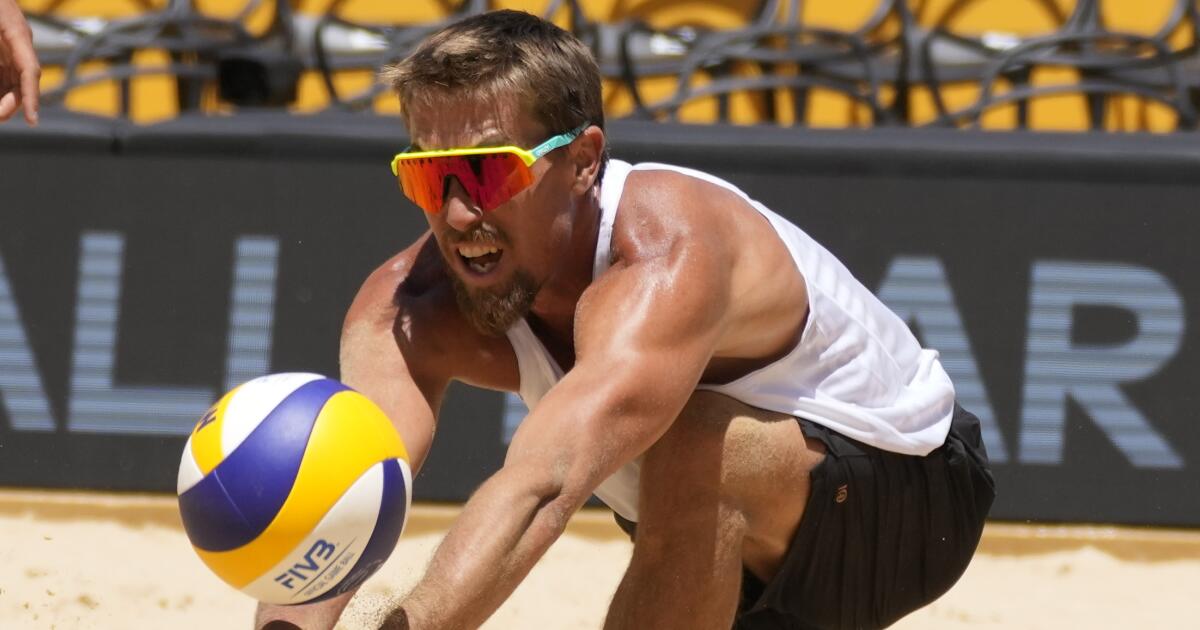
Taylor Crabb is no stranger to South California beaches. The Long Beach State alum returns home this weekend to compete in AVP League matches.
It marks the first time AVP will compete in Long Beach since 2020 and allows players to compete at the 2028 Olympics beach volleyball venue.
Crabb, 34, made his AVP debut in 2013 with his brother, Trevor, and advanced from the qualifier in Manhattan Beach before finishing 25th in his first tournament.
After years of competing with various different partners, Taylor Crabb and Andy Benesh have delivered the top performances this AVP season.
The following interview with Crabb has been edited for clarity and length.
Are you excited to compete in this weekend’s event at Long Beach?
Crabb: Very excited. A lot of my college teammates and part of the school have reached out, saying that they’re gonna come. So I’m excited to get a chance to play in front of them again.
When was the last time you were in Long Beach?
Crabb: I always try to go down there for alumni events or any big games they have. I went to UCLA against Long Beach last year, when it was No. 1 versus No. 2, so I always try to get down there and support them.
You missed out on the chance to compete in the 2020 Olympics because of COVID-19 restrictions and chose not to pursue a spot at the 2024 Olympics. Are you fired up to try to compete in the 2028 Olympics, knowing that Long Beach will host the competition?
Crabb: Yeah, it’s definitely an exciting time having the Olympics in Long Beach, and we kind of get to break it in this weekend. As you said, Tokyo didn’t go the way I wanted, but I’m going full force now. I have a great partner in Andy Benesh, who obviously went to the Paris Olympics, and if it weren’t for the Olympics being in Long Beach, and me getting a partner like Andy, I’m not even sure I’d be going for it, but because of those two things, I want to make the most of it.
You mentioned that if it wasn’t for a partner like Andy, you wouldn’t be going for it. What do you mean by that?
Crabb: I didn’t feel motivated by playing in all the international events, but now, I think, sitting out kind of lit the fire under me, and I’m really motivated now.
You’ve had different partners throughout your time. What other motivation does Andy give you?
Crabb: He’s been, in my mind, the top blocker for the U.S. the last four or five years. Seeing the professionalism he brings every day to practice, on and off the court, while traveling and when showing up to tournaments, it rubs off on you and that’s really motivating to see. And I just want to make him proud.
Why do you love volleyball?
Crabb: A lot of reasons, but it’s just a feeling I have when I’m out there on the court. It feels natural. It feels like home. I was born into a volleyball family. I had a volleyball in my hands my entire life, so I’ve always just enjoyed it.

NEWYou can now listen to Fox News articles!
CM Punk appeared on “Friday Night SmackDown” ready to take on any challenger that was ready to step to him after winning the Undisputed WWE Championship against Sami Zayn.
Punk entered the ring in Oklahoma City and called back to the “Monday Night Raw” after WrestleMania 42 when he told Cody Rhodes he’d be ready to deliver if a championship opportunity fell “out of the sky.”
COMPLETE PRO WRESTLING COVERAGE ON FOX NEWS DIGITAL
Cody Rhodes and CM Punk face off during SmackDown at Paycom Center in Oklahoma City, Okla. (Craig Ambrosio/WWE via Getty Images)
“When championship opportunities fall out of the sky, CM Punk catches them,” he said.
Punk named potential SmackDown superstars he’d think might come for the title, including Gunther, Finn Balor, Royce Keys, Damian Priest and Trick Williams. He even said that Zayn could come back around and get his rematch if he wanted. He didn’t mention Rhodes’ name, but the “American Nightmare” came out uncalled and marched his way down to the ring.
“I don’t think you and I can run away from each other anymore,” Punk told Rhodes.
Cody Rhodes looks on during SmackDown at Paycom Center in Oklahoma City, Okla., on July 10, 2026. (Craig Ambrosio/WWE via Getty Images)
Rhodes agreed and mentioned that Punk would want a match with him, just “say when.” It was a quick retort from Punk, who said, “when.” SmackDown general manager Nick Aldis, who was in the ring for the segment, booked the match for SummerSlam.
Punk will defend the Undisputed WWE Championship at SummerSlam, which takes place Aug. 1 and 2 at U.S. Bank Stadium in Minneapolis.
First, however, Punk and Rhodes will be involved in a tag team match at Saturday Night’s Main Event in New York City next week. Aldis made the match after Gunther demanded that Aldis put him in a match against Punk. Gunther was hoping it would be for the championship. Instead, Gunther will tag with Zayn.
Gunther didn’t take too kindly to that and attacked Aldis. Rhodes came back out to break up the calamity. He wanted to take on Gunther after the show went off air but Gunther walked away.
Gunther makes his entrance during SmackDown at Paycom Center in Oklahoma City, Okla., on July 10, 2026. (Rich Wade/WWE via Getty Images)
CLICK HERE TO DOWNLOAD THE FOX NEWS APP
Punk definitely has his hands full as he moves to SmackDown to become a fighting champion.
-

 New Jersey10 minutes ago
Ex-NJ GOP aide accused of staging slashing attack shows off horrific scars — and mystery man — in new snap
-

 New Mexico13 minutes ago
New Mexico AG Wants to Know Where Epstein Records Are
-
North Carolina13 minutes ago
UNC shortstop selected in first round of MLB Draft by Red Sox; list of NC players drafted
-
North Dakota25 minutes ago
The Crookston Masonic Lodge and Order of the Eastern Star present a donation check to Honor Flight of North Dakota and Minnesota
-

 Ohio28 minutes ago
Ohio’s first mountain coaster coming to Hocking Hills
-

 Oklahoma33 minutes ago
Housing affordability act becomes law, Oklahoma lawmakers react
-

 Oregon40 minutes ago
East Evans Creek Road wildfire swells to about 2,000 acres; homes threatened
-

 Pennsylvania43 minutes ago
Indicators 2026: How walkable is Northeast Pennsylvania?


