Sports
‘Double Vision’: How an NHL goalie inspired Foreigner’s arena-rock megahit


The lyrics to both verses were finished, and the first line of the chorus — Fill my eyes — was in place. Lou Gramm and Mick Jones, the driving forces behind Foreigner, one of the best-selling rock bands in history, had worked through the melody enough to know they had another hit on their hands.
It was the fall of 1977, and the band was in a New York City studio working through songs for the follow-up album to the self-titled “Foreigner,” which launched them to fame a year earlier. The new record didn’t have a title, and the song they were most excited about had everything, as Gramm put it, “except a hook and a name.”
“It was quite frustrating,” Gramm told The Athletic. “I could not find the words or a phrase that would culminate what I was singing about in the verses. I wasn’t even wrestling with words, really. I was just drawing a blank.”
Artists and athletes have always mingled, and the 1970s and ’80s were particularly wild times in New York City, where Studio 54 became the celebrity haven. Gramm and Jones became friends with several actors and pro athletes, Gramm said, but they got along best with members of the New York Rangers, including goaltender John Davidson.
There’s no way Gramm could have expected his passion for hockey, and his friendship with Davidson, to pay such dividends as he waited for inspiration to strike so he could complete his favorite track. Then, one evening at the Atlantic Recording Studios in New York City, approximately 1 1/2 miles north of Madison Square Garden, it struck in the form of vulcanized rubber.
“I was inside my vocal booth, this little two-by-three cubby hole,” said Gramm, now 74. “They put you in a soundproof booth so that the music of the band doesn’t leak into your vocal tracks. I had a little eight-inch TV taped to the upper left-hand corner of this little booth, and I would turn it on ever-so-quietly so I could watch the Rangers between my takes.
“John Davidson came out of the net to play a puck and one of the other (opposing) guys conked him. He went down hard. There was a fight, and a couple of the (Rangers) stood around (Davidson) to protect him while he was down. I remember the trainers came out to help him to the bench so he could get checked out.”
In today’s NHL, Davidson would almost certainly have been removed from the game. Back then, it was largely the player’s decision. “I got dinged and stayed in,” Davidson said. “That’s what we did in those days.”
On the Rangers’ TV broadcast, it was announced — likely by then play-by-play voice Jim Gordon or commentator Bill Chadwick — that Davidson had complained of “double vision” on the bench before he re-entered the game.
Gramm, hearing that, immediately reached for his pen and paper.
“I’ve told John this a number of times,” Gramm said. “When he got hit, as frightening as it was, as terrible as it was, it triggered something in my imagination that set off the chorus.
“I knew we had something with that song already. I just knew it, but this was the final piece. I’m in the vocal booth, where I’m supposed to be singing, but instead I’m writing these lyrics as fast as I can. The words started flowing like water. It came out of me quick, faster than I could write, which is how it’d go sometimes.
“I finished, stepped out of the booth, and said, ‘Guys, guys, guys. I’ve got this. I’ve got the chorus.’ And when we finally put it all together, it was unbelievable.”
Fill my eyes with that double vision,
No disguise for that double vision,
Ooh, when it gets through to me,
It’s always new to me,
My double vision gets the best of me
The album was released in June 1978, peaked at No. 3 on the Billboard charts, and sold over 7 million copies, making it the band’s best-selling record. The song “Double Vision” was released three months later, in September, and peaked at No. 2 on the charts, then the highest-charting single for Foreigner.
Pretty wild, considering it almost didn’t get finished in time to make the album.
“It’s a great combination of words,” Jones, now 80, wrote in an email exchange with The Athletic. “It came together pretty quickly. It was such a great song and such a great title that it spurred us on to record the song and name the album after it.
“There are times where the lyrics come first, then the music. Sometimes it’s the music, then the words.”
But this time was different. Call it divine intervention by the hockey gods.
J.D. … a storied career
Davidson has had an almost unrivaled 50-year career in pro hockey as a player (St. Louis Blues and Rangers), a Hall of Fame broadcaster both with the Rangers, “Hockey Night In Canada” and other national outlets, and as an executive who has served as club president for three franchises: the Blues, Rangers and Columbus Blue Jackets.
Last summer, when the Blue Jackets hired president and GM Don Waddell, Davidson stepped down to become senior advisor, and he’s filled in this season when Blue Jackets TV analyst Jody Shelley is on the road broadcasting games for Amazon Prime Video. Davidson’s next game is Monday, when the Jackets play the Islanders in New York.
It’s no surprise, given his broadcasting chops, that Davidson is a master storyteller. It helps, of course, when you have some incredible stories to tell.
Davidson and the Rangers were still weeks away from training camp when “Double Vision” was released. The song was impossible to miss in the U.S., but also in Canada, where it reached No. 3 on the charts. Davidson, a Canadian, remembered hearing and liking the song when he heard it almost hourly on the radio.
But he had no idea he had a role in it until he arrived back in New York before the season.
“All I knew is that it was a great rock and roll song,” Davidson said. “I had somebody with the Rangers come up to me and say, ‘You have to see this.’ It was a review of the song or the record — somebody had written about it — and it mentioned the whole deal about me getting hit and hurt and how Lou took that and used it.
“Pretty incredible. After that, Lou and I talked about it quite a bit. He was around a lot, and we became pretty friendly. He’d play in some charity games, sing the national anthem before Rangers games. We goofed around a little bit. Really good guy.”
The season after “Double Vision” came out, Davidson helped carry the Rangers to the Stanley Cup Final, where they lost to the Montreal Canadiens in five games. They became the toast of the town that spring, and Davidson could be called the toastmaster. He loved music, and musicians loved him.
To his knowledge, Davidson joked, “Double Vision” is the only song that he inspired. But the stories are staggering.
“We went out after games all the time to see musicians playing,” Davidson said. “I went with Diana (his wife) to a place called the Lone Star Cafe to see a group called The Byrds. They were great, and the venue was so small it was like they were playing in your living room.
“After they played a bunch of songs, they called out for somebody to join them, and the guy sitting next to us gets up and goes down to join the band. It was Jerry Garcia.”
Davidson became especially close with Glenn Frey of the Eagles, with whom he shared an agent (Irving Azoff). They’d frequently end up back at Azoff’s house, but one night something special happened.
“Irving has a cassette in his hands — that’s how long ago this was, right, a cassette! — and he wants to play us this song he’d recorded earlier in the day that he thinks is going to be huge,” Davidson said. “He puts it in, presses play, and it was Jimmy Buffett’s ‘Cheeseburger in Paradise.’ Nobody had heard it yet. How wild is that?”
Davidson once got a 6 a.m. wake-up call during a Rangers road trip in Vancouver. It was from Frey, who was partying with Buffett and others in Aspen, Colo., and lost track of time.
Davidson was so close with Frey that in the summer of 1978, when the Eagles were touring to promote “Hotel California,” they allowed Davidson and his crew to sit on the stage one summer night in Calgary, just out of view of the crowd in old McMahon Stadium, which sat roughly 30,000.
“We were 20 feet from the band,” Davidson said. “I’d played in front of crowds before, but that many people so into that band … the wave of energy that comes up to the stage feels like a wind.”
And there was another memorable night that was quite a bit calmer.
“I got a call from (New York author) Larry ‘Ratso’ Sloman. It was around Christmas,” Davidson said. “He said ‘Come into the city with Diana, we’re going to go over to Joni Mitchell’s condo and we’re going to have dinner at her place.’ So we did.
“She, truly, was one of the nicest ladies we’d ever met. Just wonderful. Just like you’d expect, right? We spent half the night making homemade decorations for her Christmas tree.”
Davidson’s fame extended way beyond the rink. He did Miller Lite ads in Canada just after his career ended. He was the voice of EA Sports’ NHL ’97. He was the announcer in the 1999 movie “Mystery, Alaska,” and even appeared a few years earlier in an episode of the sitcom, “The Nanny.”
Where does “Double Vision” rank? Hard to say, Davidson said. But the song, nearly 50 years after it was released, is still played on classic rock radio stations. It’s been streamed nearly 40 million times on Spotify, which says Foreigner averages 17.9 million monthly listeners. The “Double Vision” video has been watched more than 5 million times on YouTube.
“My relatives — the cousins, nieces and nephews especially — they think it’s pretty cool,” Davidson said. “They probably don’t believe me at first. I tell them I’m famous because I got hit in the head with the puck.”
Faded memories
It’s been almost 50 years since “Double Vision” was written and recorded. Davidson was part of the story, sure, but he wasn’t present when Gramm got his burst of creativity and finished the song. Gramm remembers the moment he heard the words “double vision,” but the rest of the details are foggy.
Gramm has said repeatedly that the Rangers were playing the Philadelphia Flyers, which makes sense, because that was the heyday of the Broad Street Bullies. Those Flyers, who loved to fight and intimidate, would run an opposing goalie just out of sheer boredom. He’s also been certain that Davidson left the game for the second-string goalie.
But Davidson played only three of the Rangers’ six games against the Flyers during the 1977-78 season: a 3-3 tie on Dec. 7 and a 2-2 tie on March 15, both in the Garden, and a 3-0 loss at The Spectrum on April 6. But Davidson started and finished all three of those games for the Rangers, meaning he couldn’t have left the game with an injury.
The April 6 game in Philadelphia is the type of game that would make sense. At 15:38 of the second period, all hell broke loose between the Flyers and Rangers, resulting in 88 penalty minutes. Davidson and his Flyers counterpart, Bernie Parent, were each penalized for “goalie leaving the crease” and Davidson got an extra two minutes for roughing.
But Davidson never left that game, either. Plus, “Double Vision” — the album and the song — had already been recorded at a studio in Los Angeles, ready for release just two months later.
Jones has heard Gramm’s account, but he remembers it differently. “I recall that Lou and I were at a Rangers playoff game,” he said. That would jibe with the New York Rangers’ account.
The Rangers played the Buffalo Sabres in a qualifying series, but Davidson played only in Game 2 of that series — the Sabres won in three games — and he never left the ice.
Others have suggested it occurred in a game vs. Montreal. Davidson tells the story that he was struck in the mask by a puck (which matches the Rangers’ account) but Gramm insists it was an elbow or a collision when Davidson came out to play the puck.
The NHL, at the request of The Athletic, found 22 games in which Davidson started a game but didn’t finish. In only one of those, according to Stuart McComish, the league’s senior manager of statistics and research, did Davidson return to finish the game. That occurred on April 3, 1976 — two years earlier — against the New York Islanders.
At this point, the mystery only adds to the story.
“There were two or three games in my career where I got clunked in the head, when you get rattled a bit,” Davidson said. “It was probably one of those, right?
“To be honest, though, I’m not sure it really matters. It’s a hell of a song and a hell of a story.”
Foreigner, which sold 80 million records worldwide, was inducted into the Rock & Roll Hall of Fame in Cleveland last October. Gramm and Kelly Clarkson made a duet out of the band’s biggest hit, “I Want to Know What Love Is,” but Jones was not able to attend because of declining health.
Davidson said he watched the induction ceremony. When a medley of Foreigner’s hits were played, he smiled at one song in particular. That’s how it goes every time he hears “Double Vision” on the radio, in a hockey rink, a shopping mall, etc.
Gramm and Davidson spend their winters in Florida. Gramm is in Sarasota, Davidson is in Naples, approximately 115 miles apart. They’re hoping to meet up for lunch someday.
“It’d be awesome to see my old friend again, wouldn’t it? Tell him I’ll buy lunch,” Gramm said with a chuckle. “That’s the least I can do.”
(Illustration: Demetrius Robinson / The Athletic; Photos: Manny Millan / Sports Illustrated via Getty Images, Rick Diamond / Getty Images)



NEWYou can now listen to Fox News articles!
In just his second season at the helm, Curt Cignetti led Indiana to its first national championship.
During the Hoosiers’ title run, Cignetti became known for his demanding coaching style. Indiana opened spring practice Thursday, and incoming transfer wide receiver Nick Marsh got a crash course in what it means to play for Cignetti.
Marsh, who transferred from Michigan State, arrived at practice in gold cleats. After noting Marsh’s productive two-year stint in East Lansing, Cignetti pivoted to the wideout’s footwear.
Nick Marsh (6) of the Michigan State Spartans runs the ball up the field during the first quarter of a game against the Maryland Terrapins at Ford Field Nov. 29, 2025, in Detroit. (Mike Mulholland/Getty Images)
“I didn’t love those gold shoes he came out in today,” Cignetti said. “He learned what getting your a– ripped is all about. I don’t know if that happened to him very often at Michigan State. That was before practice started.”
INDIANA’S CURT CIGNETTI SHUTS DOWN NFL COACHING SPECULATION: ‘I’VE ALWAYS BEEN MORE OF A COLLEGE FOOTBALL GUY’
Marsh totaled 1,311 receiving yards and nine touchdowns at Michigan State. TCU quarterback Josh Hoover also headlines Indiana’s transfer additions.
An Indiana Hoosiers helmet during a game against the Ball State Cardinals at Lucas Oil Stadium Aug. 31, 2019, in Indianapolis. (Michael Hickey/Getty Images)
Cignetti added that the coaching staff has “more work to do with this group than the first two teams,” noting the group is still learning more about players the team will likely rely on next season.
Indiana Hoosiers head coach Curt Cignetti during the second quarter against the Miami Hurricanes in the 2026 College Football Playoff national championship at Hard Rock Stadium Jan. 19, 2026, in Miami Gardens, Fla. (Alex Slitz/Getty Images)
Indiana went 16-0 en route to a thrilling win over Miami in the College Football Playoff national championship in January.
Cignetti framed his callout of Marsh’s cleats as an early message about expectations.
“That was a wake-up call,” Cignetti said of the receiver’s pre-practice cleats. “But he’s really worked hard, done a great job for us.”
Follow Fox News Digital’s sports coverage on X, and subscribe to the Fox News Sports Huddle newsletter.
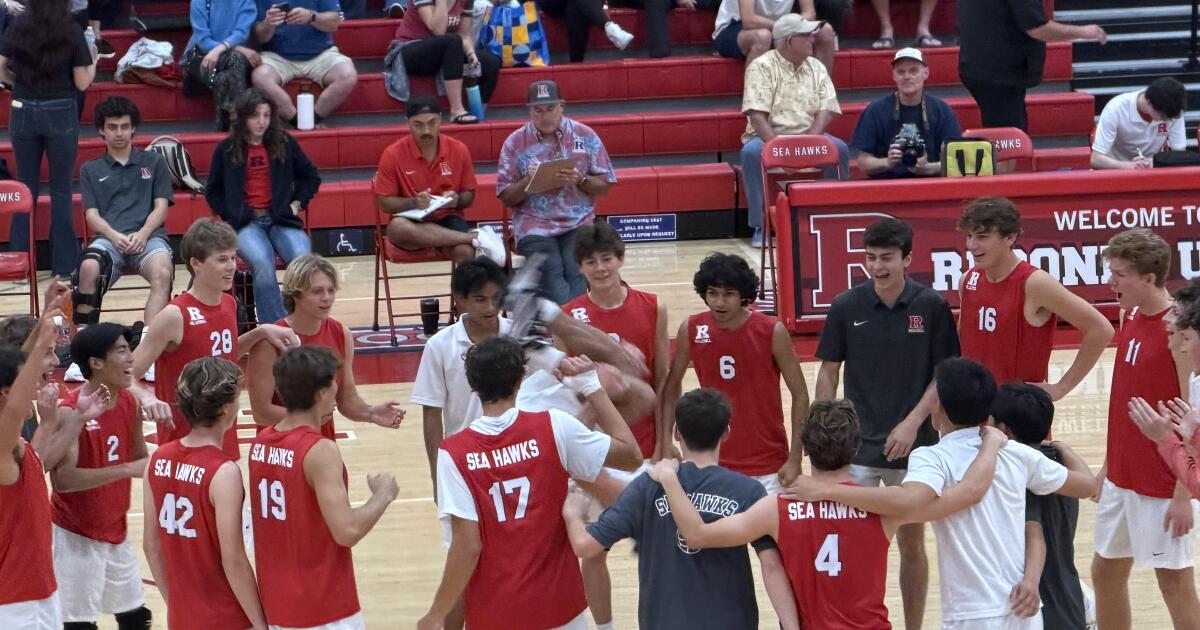
Redondo Union didn’t care that Mira Costa’s volleyball team was ranked No. 1 in California. This was their South Bay rival coming to their gym Thursday night, and anything can happen when a team digs deep and doesn’t fear losing.
The Sea Hawks (14-2) were aggressive from the outset and came away with a 27-25, 21-25, 25-22, 21-25, 15-13 victory.
“Chemistry,” setter Tommy Spalding said about the Sea Hawks’ triumph. He’s one of three players headed to MIT, and all three had big matches.
At one point on back-to-back plays, Carter Mirabal had a block and Vaughan Flaherty followed with a kill off an assist from Spalding. Chemistry.
JR Boice, a Long Beach State commit, was delivering kills, and Cash Essert’s serving and all-around play kept Mira Costa’s Mateo Fuerbringer looking frustrated. The Sea Hawks’ focus was on Fuerbringer, who came alive in the fifth set with six kills, but Redondo was able to come back from an 11-9 deficit.
It was only Mira Costa’s second loss in 25 matches. Redondo Union took over first place in the Bay League.
Baseball
Orange Lutheran 3, Jacksonville (Fla.) Trinity Christian 2: The Lancers advanced to the semifinals of the National High School Invitational in Cary, N.C., behind a walk-off single in the eighth inning by Andrew Felizzari. Brady Murrietta had tied the score with a squeeze bunt in the bottom of the seventh. CJ Weinstein had two doubles for the Lancers.
Venice (Fla.) 12, Harvard-Westlake 0: The Wolverines were limited to three hits at the National High School Invitational in Cary, N.C.
Casteel (Queen Creek, Ariz.) 3, St. John Bosco 2: The Braves suffered their first defeat in North Carolina. Jack Champlin threw five innings and also had two RBIs.
Chatsworth 6, Taft 3: Tony Del Rio Nava threw six innings and had two RBIs in the West Valley League win.
Granada Hills 4, El Camino Real 3: A two-run single by Nicholas Penaranda in the seventh inning keyed a three-run inning for the Highlanders in their West Valley League upset. JJ Saffie had three hits for ECR.
Cleveland 4, Birmingham 3: The Cavaliers pushed across a run in the top of the 10th inning to break a 3-3 tie in the West Valley League win. Joshua Pearlstein finished with three hits, including a home run.
Sun Valley Poly 4, San Fernando 2: Fabian Bravo gave up four hits in 6 2/3 innings for the Parrots, who are tied with Sylmar for first place in the Valley Mission League. Ray Pelayo struck out eight for San Fernando.
Verdugo Hills 15, Kennedy 1: Cutlor Fannon had two doubles and four RBIs in the five-inning win. Anthony Velasquez added two singles and four RBIs.
Westlake 9, Agoura 4: Jaxson Neckien hit a three-run home run to power the Warriors.
Thousand Oaks 7, Calabasas 5: Gavin Berigan, Jeff Adams and Cru Hopkins each had two hits for the Lancers.
Oaks Christian 11, Newbury Park 2: Dane Disney contributed three hits in the Marmonte League win. Carson Sheffer had two doubles and three RBIs.
Santa Monica 12, Simi Valley 4: Ryan Breslo and Johnny Recendez had two RBIs and a triple for Santa Monica. Ravi Chernack had three RBIs.
Dana Hills 7, Corona Santiago 0: Gavin Giese finished with eight strikeouts over six innings and gave up one hit for Dana Hills.
Softball
Sherman Oaks Notre Dame 10, Sierra Canyon 0: Kelsey Luderer contributed three hits and two RBIs while freshman Ainsley Jenkins threw five scoreless innings.
Chaminade 15, Louisville 2: Norah Pettersen had two hits and four RBIs.
Carson 10, San Pedro 0: Atiana Rodriguez finished with three hits, including a double and triple, and three RBIs.
Huntington Beach 6, El Modena 2: Willow Kellen had three hits for the Oilers.
Murrieta Mesa 15, Chaparral 0: It’s a 16-0 start for the Rams. Tatum Wolff hit two home runs.

NEWYou can now listen to Fox News articles!
The fiancée of Buffalo Sabres star Rasmus Dahlin received a roaring welcome home in her first appearance of the season Wednesday night, months after undergoing a lifesaving transplant after she suffered heart failure during a vacation in France.
Carolina Matovac, 25, was shown on the jumbotron during Wednesday’s game against the Boston Bruins. Fans cheered as she waved, and Dahlin, who was also shown on the screen in a split, cracked a smile at the crowd’s reaction.
Carolina Matovac and Rasmus Dahlin of the Buffalo Sabres pose on the red carpet at the Metro Toronto Convention Centre in Toronto, Ontario, Canada, Feb. 1, 2024. (Nicole Osborne/NHLI via Getty Images)
“Welcome home to Carolina Matovac, the fiancée of our captain Rasmus Dahlin,” the arena announcer said. “She is back with us, attending her first game of the season. The Sabrehood loves you, Carolina.”
In an open letter to fans in September, Dahlin shared that Matovac had been feeling ill for several days during their trip, which led to her experiencing “major heart failure.”
“Fortunately, she received CPR on multiple occasions, and up to a couple of hours at a time to keep her alive, which ultimately saved her life. Without her receiving lifesaving CPR, the result would have been unimaginable. It is hard to even think about the worst-case scenario,” he wrote at the time.
Rasmus Dahlin (of the Buffalo Sabres prepares for a faceoff during a game against the New York Rangers at KeyBank Center in Buffalo, N.Y., Oct. 9, 2025. (Bill Wippert/NHLI via Getty Images)
Matovac remained on life support for weeks before receiving the transplant in France.
JACOB WINTERTON, FORMER OHL PLAYER AND BROTHER OF NHL’S RYAN WINTERTON, DEAD AT 25 AFTER CANCER BATTLE
In January, Matovac revealed she was pregnant when her heart failed, adding that her unborn child was the reason she went to the hospital initially.
“You will always hold a special place in our hearts as our first baby, even though we never had the chance to meet. Our love for you is endless,” she wrote in a post on Instagram on what was supposed to be her due date.
“Though you didn’t get to experience this world, you played a vital role in ensuring that I could continue to be a part of it.”
Buffalo Sabres defenseman Rasmus Dahlin follows the puck in the first period against the Ottawa Senators at the Canadian Tire Centre in Ottawa, Ontario, Canada, on April 1, 2025. (Marc DesRosiers/Imagn Images)
CLICK HERE TO DOWNLOAD THE FOX NEWS APP
Despite taking some time to be with Matovac as she recovered in their native Sweden, Dahlin is second on the team with 65 points, and the Sabres are on the cusp of ending an NHL-record 14-season playoff drought.
The Associated Press contributed to this report.
Follow Fox News Digital’s sports coverage on X, and subscribe to the Fox News Sports Huddle newsletter.

Ski Maine, Where Skiing’s Main Street Ends

Showers and falling temperatures across Maryland Friday

Woman struck, fatally injured, while walking on the Lodge Freeway, state police say

Think you’re middle class in Massachusetts? Here’s the income range

Over 840,000 Minnesotans Assist Aging Loved Ones, Shaping Their Daily Lives

Florida High School Football Rankings: Top 25 teams – Oct. 21

How old is Bo Nix? What to know about Oregon quarterback ahead of 2024 NFL Draft

Cleary's 21 help Le Moyne down Central Connecticut State 69-64 in OT

99th annual Pony Swim held in Virginia

Indiana Members Credit Union announced as new anchor tenant at Bottleworks District

Video: Will ICE Change Under Its New Leader?

DHS shutdown breakthrough comes at cost for Republicans as funding fights nears end

Rubio joins crucial G7 talks as Iran war set to dominate second day

A surprise resignation could open the door for an independent to win a Montana Senate seat

Video: Savannah Guthrie Says She Believes Her Mother Was Taken for Ransom
-

 Detroit, MI1 week ago
Drummer Brian Pastoria, longtime Detroit music advocate, dies at 68
-

 Science1 week ago
How a Melting Glacier in Antarctica Could Affect Tens of Millions Around the Globe
-

 Movie Reviews1 week ago
‘Youth’ Twitter review: Ken Karunaas impresses audiences; Suraj Venjaramoodu adds charm; music wins praise | – The Times of India
-
 Science1 week ago
I had to man up and get a mammogram
-

 Sports6 days ago
IOC addresses execution of 19-year-old Iranian wrestler Saleh Mohammadi
-

 New Mexico5 days ago
Clovis shooting leaves one dead, four injured
-
 Business1 week ago
Disney’s new CEO says his focus is on storytelling and creativity
-

 Texas1 week ago
How to buy Houston vs. Texas A&M 2026 March Madness tickets