Sports
Carlos Alcaraz and Jannik Sinner play tennis. Their Australian Open rivals see a different sport


MELBOURNE, Australia — Just as it did 12 months ago, the tennis gods gave the Australian Open the men’s singles draw it craved. On the steps of Margaret Court Arena, Jannik Sinner and Carlos Alcaraz emerged in opposite halves, setting up the possibility of a first Grand Slam final duel for the matchup that defines tennis on the ATP Tour.
The 23-year-old Italian and the 21-year-old Spaniard split the four majors 2-2 in 2024. They hit the ball as hard as anyone and cover every inch of the court, laterally and vertically, inside the lines and out.
For their opponents, their tennis feels like a different sport to the one they signed up to at the start of their journey to the professional circuit.
They also do not lack for confidence.
“I’m an ambitious guy,” Alcaraz said during a visit to New York in December for an exhibition at Madison Square Garden. “I’m sure sooner or later I’m going to be the Australian Open champion.”
Sinner said his goal last year was to gain a better understanding of what he might be able to achieve in his career. With two Grand Slams triumphs and the No. 1 ranking he got some hints, though ticking those boxes was not a specific goal.
“It’s going to be the same next year,” he said after winning the ATP Tour Finals in Turin and finishing the season 73-6. “Whatever we can catch, we take, and the rest we learn.”
Sinner and Alcaraz have intermittently played tennis like it’s a fantastical computer game since their 2022 U.S. Open quarterfinal and its five hours and 15 minutes of spellbinding shotmaking. In 2024, they fully reconfigured the sport, overtaking the baseline call and response honed by Rafael Nadal and Novak Djokovic and the reactive development of players like Alexander Zverev and Daniil Medvedev, who arrived armed with huge serves and counterpunching groundstrokes.
Sinner and Alcaraz have reconfigured tennis into a hyper-aggressive game of chicken. To hit a neutral ball is to be on defense and to be on defense is to lose (against each other) or to steal the point (against pretty much everybody else). Their ATP Tour rivals, from Zverev and Medvedev to Taylor Fritz, Casper Ruud and all the way down, are at a loss. The tennis they knew has vanished before their eyes.
GO DEEPER
Tennis mailbag part one: Challenging Sinner and Alcaraz, baseline boredom, coaching change
Great players win lots of matches and championships. The greatest ever players change how their sport is played, redrawing the tennis court to create new shots and angles that few thought were possible before. Think of the way the basketball stars Steph Curry and Caitlin Clark normalized three-pointers from way beyond the stripe, extending defenses, creating offensive space where it wasn’t supposed to exist, and redesigning the toolkit that top-level basketball required.
Sinner and Alcaraz are having a similar impact on their sport. Tennis courts are still 78 feet long and 27 feet wide. They have not grown. These two just make it seem like they have.
In most tennis rallies, the player that forces their opponent into or outside the tramlines — where the width of the singles court expires — is likely to win the point. Either the ball won’t come back because the angle is too sharp, or it will come back soft and floating, ready to be dispatched into space.
There is a massive difference in what happens when Sinner and Alcaraz are outside the tramlines. This supposed zone of no return is where they can show off. It’s where Alcaraz can display his blazing speed and rocketing forehands blasted on a full sprint over or around the net post. It’s where Sinner embodies the junior skiing champion he once was, bending low as he swings his racket then pushing back into the court like he has just come around a slalom gate on icy slope.

Jannik Sinner and Carlos Alcaraz have pushed each other to extremes since their 2022 U.S. Open quarterfinal (Julian Finney / Getty Images)
Far more often than the rest of the tour, Sinner and Alcaraz are winning points or getting on the attack from places where they are supposed to lose. It has created a paradox, most visibly with Alcaraz, in which stressing and pressing them is a bad idea. They win one impossible point, and then another, lifting the crowd and pointing to their ears, and the avalanche starts to rumble down the mountain.
Zverev, who knows he is world No. 2 in rank but not in spirit, knows what this feels like. He rarely gets tired during tennis matches, even the longest five-set duels at Grand Slams. The 2024 French Open final against Alcaraz was different. By the fifth set, his legs were gone, his body wilting from the relentlessness of the challenge that he expects will shape tennis for many years.
“Everybody talks about how great they are defensively,” Zverev said after defeating Alcaraz at the ATP Tour Finals in Turin. He doesn’t buy it.
“Tennis is not about defense anymore,” he added.
“It used to be a few years back, but I think those guys, 90 percent of the time they’re only playing offense. It’s about making sure that you can keep up offensively with them, being able to keep up with their speeds of groundstrokes as well. That’s the No. 1 thing. Not backing off, going for your shots in the most important moments. That’s maybe where I struggled, as well, in my career, trusting my shots and going for them when I need to.”
He and just about everyone else. This is where Sinner and Alcaraz are taking tennis. Movement, specifically in and out of the corners, has become as important as the serve and the return. Ben Shelton has realized his 150mph serve and lashing forehand will only take him so far, hiring Gabriel Echevarria, a movement specialist, early last year. Naomi Osaka hired a ballerina to help her gain more surety and speed in the corners. Nearly every player wants to master an open-stance backhand, to save a split second on the pivot back to the center of the court.
Fritz, who has long known that he struggles outside the singles line, spent much of the off-season working on moving out to the farthest reaches of a tennis court to chase down balls. His coach, Michael Russell, has seen a version of this movie before. At 46, he’s three years older than Roger Federer, eight years older than Nadal and nine years older than Djokovic. He watched those three players change the sport’s equation, just as Sinner and Alcaraz are doing now.
“There’s no room for uncharacteristic errors,” he said during an interview in Italy in November. “Literally, they’re not giving you an inch.”

Carlos Alcaraz thrives on winning points from seemingly impossible positions (Julian Finney / Getty Images)
When Russell uses the word “error,” he’s not talking about a ball that flies long or dumps into the net, unforced or not. He’s talking about any ball that doesn’t have enough speed, depth, or width to stop Sinner and Alcaraz from exploiting it. For decades, a first principle of tennis has been resetting a point, changing its state from attack to neutral, or defense to neutral. Sinner and Alcaraz don’t allow for this. There’s a reason Fritz and Zverev, the two players closest to Sinner and Alcaraz in the rankings, have spent so much time the past months learning how to dictate the terms of engagement.
“Even if it’s only one or two points a match, that can be the differential. Applying that psychological pressure that the guy can’t just float the ball back and reset,” Russell said.
This is what Alcaraz and Sinner do so well and so much better than their ATP Tour contemporaries.
That flip of a point from defense to attack has been codified by data specialists TennisViz and Tennis Data Innovations as a “steal score,” measuring how often a player wins a point from defense. Alcaraz is top. Sinner is not far behind.
Across the ATP Tour, players are hitting shots outside the singles sidelines around 17 percent of the time, but Sinner and Alcaraz win around 45 percent of the points they play from there. Their opponents win around 30.
From outside the doubles lines, Alcaraz wins 43 percent of points and Sinner 42. Alcaraz’s opponents win around 22 percent; Sinner’s around 29.
Casper Ruud, who like Zverev and Fritz spent most of 2024 with his head spinning, doesn’t recognize the tennis that took him to three Grand Slam finals in 12 months in 2022 and 2023. After spending years perfecting his balance between patience and a lethal forehand, he could feel Sinner and Alcaraz making tennis pass him by. Those deep, looping shots he has long used to hang in points simply don’t work against them. He needs to change, or perish as a force at the top of the game.
“They can turn around the point with one shot on the run, even from the forehand or backhand,” he said in an interview Italy in November. “I feel like that is something definitely missing in my game on the faster hard court.
“That’s something in the next weeks and months I’ll try to keep working on. But I’m not going to change my game in one day or one week. It’s going to take time.”

Jannik Sinner and Carlos Alcaraz’s meetings inevitably descend into games of tennis chicken (Clive Brunskill / Getty Images)
Ruud is 26. Fritz and Zverev are 27. They and the rest of their contemporaries, who have spent most of their tennis lives banging on the Big Three ceiling, are now having to make a mid-career adjustment based on how two youngsters who have achieved their dreams before them play the sport.
Younger players, even juniors, may be at an advantage. Just as so many of them are trying to master Alcaraz’s drop-shot-lob combinations, they are growing up knowing what they have to be able to do to reach the top of tennis. For the rest of the ATP Tour, it can feel like climbing a mountain that dissolves just before the apex, then re-forms with new terrain and a higher summit.
Sinner and Alcaraz are remaking tennis for everybody else, but what happens when the unstoppable force goes up against the immovable object? What would the Australian Open final that everybody wants to see look like?
“You have more tension. You have more eyes on us because this is a match most people want to see,” Sinner said Friday in a Melbourne news conference.
“First, you have to arrive to this stage where you play against Carlos, which is a very difficult part to go through. When this happens, the feeling — I think he also feels the same way — it’s a bit different. We usually play a high-quality match because when two players face each other and you bring out your best, the quality of the match usually is very high.”
Sinner spent most of the year as the world No. 1, even though Alcaraz holds a 6-4 edge in their rivalry. Alcaraz won all three of their meetings last year, most recently in the final of the China Open in Beijing, edging Sinner 6-7(6), 6-4, 7-6(3) from 3-0 down in the deciding tiebreak with seven points from another galaxy.
Alcaraz said in New York in December that he and his friends think it’s pretty funny that Sinner is No. 1 without beating him last year. Sinner is besting him on serve right now; Alcaraz is the better player in the forecourt, with the vertical movement to go with the lateral magic tricks they share.

GO DEEPER
Carlos Alcaraz and Jannik Sinner go head to head in their own tennis galaxy
That might have a little bit to do with the edge he holds in the nether reaches of the tennis court. They are about even in their performance on points when they move each other beyond the singles line, with Alcaraz winning 36 percent of those points and Sinner 38 percent.
Outside the doubles lines, Alcaraz has a clear advantage, winning 36 percent of the points against 30 percent for Sinner. In general, their pushing each other to greater heights also forces them to lose a few points that they would win against anybody else.
Once they get in attack, they are the two best players on the ATP Tour at closing out the point. Sinner wins 74 percent of the time; Alcaraz 73.
Against each other though, when they are pulling off their acrobatics on points that send the opponent off the court, those rates drop. However, Alcaraz’s doesn’t drop as much. He converts 66 percent of the time against Sinner, while Sinner converts 62 percent of the time from his end of the court.
That still leaves a sizable number of those highlight reel points, when they both put on a version of tennis as escape art. It’s their ability to do the extraordinary against the only other player in their orbit — though don’t count Djokovic and his 24 Grand slam titles out just yet.
“Insane,” Fritz said in Turin.
He’s the one who has to try and beat them.
(Top photos: Getty Images; design:Will Tullos)



Sports
Golf star records lowest round in LPGA major history with astounding performance at Evian Championship

NEWYou can now listen to Fox News articles!
There are good days on the golf course, and then there is what Haeran Ryu just did on Saturday.
Ryu, 25, recorded the lowest round in LPGA major history on Saturday with an 11-under 60 at the Evian Championship. With the South Korean golfer’s historic round, she holds a three-stroke lead.
Ryu’s round comes just two weeks after winning her first major at the Women’s PGA Championship. On the 18th hole, Ryu left a 30-foot eagle putt a few inches short, and instead settled for a birdie.
CLICK HERE FOR MORE SPORTS COVERAGE ON FOXNEWS.COM
Haeran Ryu of South Korea reacts on the 18th green after the third round of The Amundi Evian Championship at Evian Resort Golf Club in Evian-les-Bains, France, on July 11, 2026. (Stuart Franklin/Getty Images)
She said after the round that she had no idea what she had done until she counted up her scorecard.
“But after the putt and I counted my score with my caddie,” she said. “Oh my God, it’s 11-under par today. It was so amazing. My caddie says, ‘Yep.’ I’m so happy right now.”
If Ryu had made the eagle putt on the 18th hole, she would have been just the second player to shoot a 59 in LPGA history.
ZERO BS. JUST DAKICH. TAKE THE DON’T @ ME PODCAST ON THE ROAD. DOWNLOAD NOW!
Haeran Ryu of South Korea celebrates a birdie on the 15th green during the third round of The Amundi Evian Championship at Evian Resort Golf Club on July 11, 2026, in Evian-les-Bains, France. (Stuart Franklin/Getty Images)
Her 60 broke the record for the lowest round in an LPGA major by one shot. Leona Maguire and Jeungeun Lee6 in 2021, and Hyo Joo Kim in 2014, each shot 61 at the Evian Championship, which was designated as an LPGA major in 2013.
The lowest round in a men’s major is 62, which is shared by four players — Branden Grace at Royal Birkdale in the 2017 British Open, Xander Schauffele and Rickie Fowler in the 2023 U.S. Open at Los Angeles Country Club, and Schauffele and Shane Lowry in the 2024 PGA Championship at Valhalla.
CLICK HERE TO DOWNLOAD THE FOX NEWS APP
Haeran Ryu of South Korea and Lottie Woad of England interact after their round on the 18th green during the third round of the Amundi Evian Championship at Evian Resort Golf Club in Evian-les-Bains, France, on July 11, 2026. (Stuart Franklin/Getty Images)
Ryu hopes her historic third round can help propel her to a second major win in three weeks.
“That is amazing, amazing dream,” Ryu said. “So I just want that one to come true, but we have one more day.”
The Associated Press contributed to this report.
Follow Fox News Digital’s sports coverage on X, and subscribe to the Fox News Sports Huddle newsletter.
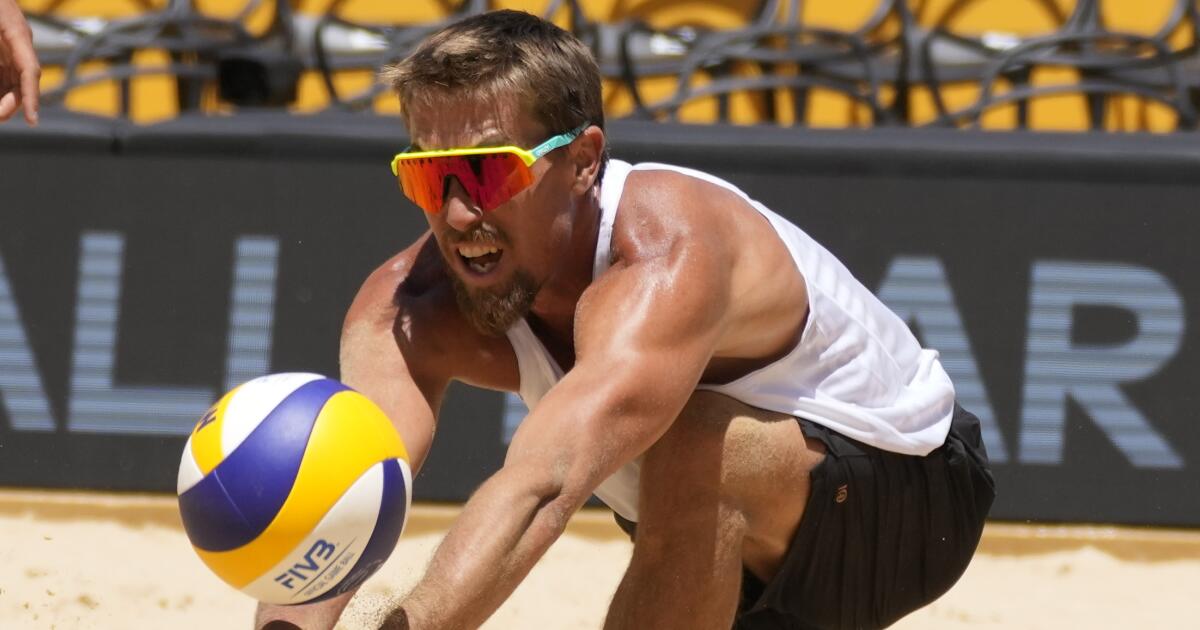
Taylor Crabb is no stranger to South California beaches. The Long Beach State alum returns home this weekend to compete in AVP League matches.
It marks the first time AVP will compete in Long Beach since 2020 and allows players to compete at the 2028 Olympics beach volleyball venue.
Crabb, 34, made his AVP debut in 2013 with his brother, Trevor, and advanced from the qualifier in Manhattan Beach before finishing 25th in his first tournament.
After years of competing with various different partners, Taylor Crabb and Andy Benesh have delivered the top performances this AVP season.
The following interview with Crabb has been edited for clarity and length.
Are you excited to compete in this weekend’s event at Long Beach?
Crabb: Very excited. A lot of my college teammates and part of the school have reached out, saying that they’re gonna come. So I’m excited to get a chance to play in front of them again.
When was the last time you were in Long Beach?
Crabb: I always try to go down there for alumni events or any big games they have. I went to UCLA against Long Beach last year, when it was No. 1 versus No. 2, so I always try to get down there and support them.
You missed out on the chance to compete in the 2020 Olympics because of COVID-19 restrictions and chose not to pursue a spot at the 2024 Olympics. Are you fired up to try to compete in the 2028 Olympics, knowing that Long Beach will host the competition?
Crabb: Yeah, it’s definitely an exciting time having the Olympics in Long Beach, and we kind of get to break it in this weekend. As you said, Tokyo didn’t go the way I wanted, but I’m going full force now. I have a great partner in Andy Benesh, who obviously went to the Paris Olympics, and if it weren’t for the Olympics being in Long Beach, and me getting a partner like Andy, I’m not even sure I’d be going for it, but because of those two things, I want to make the most of it.
You mentioned that if it wasn’t for a partner like Andy, you wouldn’t be going for it. What do you mean by that?
Crabb: I didn’t feel motivated by playing in all the international events, but now, I think, sitting out kind of lit the fire under me, and I’m really motivated now.
You’ve had different partners throughout your time. What other motivation does Andy give you?
Crabb: He’s been, in my mind, the top blocker for the U.S. the last four or five years. Seeing the professionalism he brings every day to practice, on and off the court, while traveling and when showing up to tournaments, it rubs off on you and that’s really motivating to see. And I just want to make him proud.
Why do you love volleyball?
Crabb: A lot of reasons, but it’s just a feeling I have when I’m out there on the court. It feels natural. It feels like home. I was born into a volleyball family. I had a volleyball in my hands my entire life, so I’ve always just enjoyed it.

NEWYou can now listen to Fox News articles!
CM Punk appeared on “Friday Night SmackDown” ready to take on any challenger that was ready to step to him after winning the Undisputed WWE Championship against Sami Zayn.
Punk entered the ring in Oklahoma City and called back to the “Monday Night Raw” after WrestleMania 42 when he told Cody Rhodes he’d be ready to deliver if a championship opportunity fell “out of the sky.”
COMPLETE PRO WRESTLING COVERAGE ON FOX NEWS DIGITAL
Cody Rhodes and CM Punk face off during SmackDown at Paycom Center in Oklahoma City, Okla. (Craig Ambrosio/WWE via Getty Images)
“When championship opportunities fall out of the sky, CM Punk catches them,” he said.
Punk named potential SmackDown superstars he’d think might come for the title, including Gunther, Finn Balor, Royce Keys, Damian Priest and Trick Williams. He even said that Zayn could come back around and get his rematch if he wanted. He didn’t mention Rhodes’ name, but the “American Nightmare” came out uncalled and marched his way down to the ring.
“I don’t think you and I can run away from each other anymore,” Punk told Rhodes.
Cody Rhodes looks on during SmackDown at Paycom Center in Oklahoma City, Okla., on July 10, 2026. (Craig Ambrosio/WWE via Getty Images)
Rhodes agreed and mentioned that Punk would want a match with him, just “say when.” It was a quick retort from Punk, who said, “when.” SmackDown general manager Nick Aldis, who was in the ring for the segment, booked the match for SummerSlam.
Punk will defend the Undisputed WWE Championship at SummerSlam, which takes place Aug. 1 and 2 at U.S. Bank Stadium in Minneapolis.
First, however, Punk and Rhodes will be involved in a tag team match at Saturday Night’s Main Event in New York City next week. Aldis made the match after Gunther demanded that Aldis put him in a match against Punk. Gunther was hoping it would be for the championship. Instead, Gunther will tag with Zayn.
Gunther didn’t take too kindly to that and attacked Aldis. Rhodes came back out to break up the calamity. He wanted to take on Gunther after the show went off air but Gunther walked away.
Gunther makes his entrance during SmackDown at Paycom Center in Oklahoma City, Okla., on July 10, 2026. (Rich Wade/WWE via Getty Images)
CLICK HERE TO DOWNLOAD THE FOX NEWS APP
Punk definitely has his hands full as he moves to SmackDown to become a fighting champion.
-

 New Hampshire15 seconds ago
Gilmanton Iron Works Man Accused Of Possessing Guns, Hundreds Of Grams Of Fentanyl In Hooksett, Manchester
-

 New Jersey12 minutes ago
Ex-NJ GOP aide accused of staging slashing attack shows off horrific scars — and mystery man — in new snap
-

 New Mexico15 minutes ago
New Mexico AG Wants to Know Where Epstein Records Are
-
North Carolina15 minutes ago
UNC shortstop selected in first round of MLB Draft by Red Sox; list of NC players drafted
-
North Dakota27 minutes ago
The Crookston Masonic Lodge and Order of the Eastern Star present a donation check to Honor Flight of North Dakota and Minnesota
-

 Ohio30 minutes ago
Ohio’s first mountain coaster coming to Hocking Hills
-

 Oklahoma35 minutes ago
Housing affordability act becomes law, Oklahoma lawmakers react
-

 Oregon42 minutes ago
East Evans Creek Road wildfire swells to about 2,000 acres; homes threatened


