Sports
Australian Open storylines: Carlos Alcaraz’s serve motion and late finishes in Melbourne


If you would like to follow The Athletic’s Australian Open coverage, click here and follow our tennis page.
Are 5g of lead and a few bends of the knees going to win Carlos Alcaraz a career Grand Slam?
Is Iga Swiatek going to make a move on Melbourne?
Will the clock tick past midnight (and 1 a.m., and 2 a.m., and 3 a.m….) in Australia once again?
The 2025 Australian Open promises to be a cracker. Here, The Athletic’s tennis writers, Matt Futterman and Charlie Eccleshare, chart some of the key storylines to follow over the next fortnight.
GO DEEPER
Australian Open draw 2025: Djokovic’s luck runs out, Gauff leads U.S. vs U.S. ties
Will Alcaraz serve up a career Grand Slam?
Alcaraz doesn’t have many weaknesses. He does have something that he does less well than everything else.
Serve.
It’s better than average, but not elite. It’s the one place that his nearest rival, Jannik Sinner, has a big advantage over him. But it’s also the reason that smart people think Alcaraz could dominate tennis for a long time. He’s won four Grand Slams with an average serve, the thinking goes. Imagine how good he will be with a great one.
Whether he has done that with a slightly tweaked service motion will go a long way toward determining whether he can complete the career Grand Slam at just 21 by winning the Australian Open.
He said in a news conference Saturday that the serve didn’t feel natural yet. He still had to thinking about it, remind himself what to do and what not to do.
“There are some times that I think or I feel like it is a problem,” he said. “Sometimes in the match that I’ve played or during the practice, there are some games that I’m not doing the right thing.”
He has no doubt that he and his Babolat Pure Aero racket, newly weighted with 5g of lead in the neck, will get there eventually.
The change has to do with how and when he coils his body during the service motion. He used to do it later in the motion and more quickly. Now he’s easing his way into it, adding more fluidity to the most important of tennis shots.
What does he want from it? “Good rhythm,” he said, and more precision. At a little over six feet tall, he will likely never have a dominating bullet serve. But at Wimbledon he was serving at 130mph and hitting the lines on command, blowing Novak Djokovic off the court in the final and leading the seven-time SW19 champion to remark that he had never seen Alcaraz serve better.
Anytime a player makes even a slight change in a stroke, it can be dramatic: tennis takes a clear head and Alcaraz thinking about how to serve could make things cloudy if a match gets tight.

GO DEEPER
‘Joy in the suffering’: How Carlos Alcaraz won the French Open
Matt Futterman
Is this Swiatek’s Australian opportunity?
After not going beyond the quarters of a major outside of Roland Garros for the past two seasons, Swiatek has a big opportunity in Melbourne. She’s in an inviting quarter and if she can get through that would be a big favorite in the semifinal against her slated opponent there Jasmine Paolini.
With new coach Wim Fissette in tow, and potentially a feeling of liberation after playing under the cloud of a doping ban during the last couple of months of the 2024 season, she looks well-placed for a deep run. Her performance at the United Cup, where she won three matches against top-10 players and was a break up in both sets against Coco Gauff before losing 6-4, 6-4, made her look ready.

Iga Swiatek has never been past the fourth round in Melbourne. (Phil Walter / Getty Images)
After losing the No. 1 ranking to Aryna Sabalenka while serving 22 days of that one-month ban in September and October, Swiatek wants it back as soon as possible. She also wants to disabuse the persistent notion that she can only achieve success on clay courts, despite her remarkable collection of wins and titles off the surface. It is only in majors where she has had more difficulty; even then, she is a U.S. Open champion.
The way the ranking system works means that Swiatek could reclaim the world No. 1 ranking without an especially deep run if Sabalenka, the defending champion and Gauff, a semifinalist last year, go out early. But only by taking advantage of her presentable draw and reaching the latter stages will Swiatek properly reestablish herself after a difficult few months.
Charlie Eccleshare
Can Tiafoe and Shelton take their next steps?
Frances Tiafoe kind of got caught telling the truth last year when he said the only tournaments he cared about were Wimbledon, his hometown Citi Open in Washington, D.C., and the U.S. Open.
Perhaps that explains his near upset of Alcaraz on Centre Court at Wimbledon, his second run to the U.S. Open semifinals, and the reasonably mediocre results everywhere else. He tried to walk back that comment Friday at Melbourne Park, but a few moments later landed back on the theme of needing to be more motivated throughout the season.
“Ideally I would like to play less and do better,” Tiafoe said. “I’m 27 next week. I’ve been around and I’m super excited, super motivated, to be present and try to get my best stuff week in, week out.”
In the summer, he said, he’s willing to die to win every match. The rest of the year, he sees opponents who are more willing than he is. He knows that has to change.
GO DEEPER
‘Better tennis is ahead of me’: Is Frances Tiafoe coming alive again?
There is no better place to start than at the Australian Open, which is a kind of carbon copy of the U.S. Open. Fast hard courts and rowdy crowds that absolutely love Tiafoe. What can he do with that?
Same goes for Ben Shelton, a quarterfinalist here two years ago, and a U.S. Open semifinalist later in his first full season but now No. 21 in the world. Sophomore year didn’t go as he thought it might, especially at the Grand Slams, where he made the second week just once and bowed out in the fourth round of Wimbledon.
Shelton is still fairly early in his tennis life compared with the competition. He didn’t start playing in earnest until he was 12. But on the hard courts here where he is very comfortable, he will harbor ambitions of challenging Taylor Fritz as the American most likely to break that two-decade-plus streak without a men’s Grand Slam.
GO DEEPER
Ben Shelton: ‘I didn’t want to be one of 50 Nike guys’
Matt Futterman
Will the late finish’s coolness wear off?
It might be the U.S. Open that introduced a late-finishing match policy in 2024, and the French Open that saw Djokovic and Lorenzo Musetti playing until 3:06 a.m., but nowhere does late-night tennis like the Australian Open. Daniil Medvedev and Emil Ruusuvuori hit 3:40 a.m. in 2024. Andy Murray and Thanasi Kokkinakis went until 4:05 a.m. in 2023. And Lleyton Hewitt and Marcos Baghdatis went later than all of them in 2008, playing until 4:34 a.m.

Daniil Medvedev signing interviews after a 3:40 a.m. finish at last year’s tournament. He beat Emil Ruusuvuori in five sets. (Anthony Wallace / AFP via Getty Images)
In New York, the late-night-tennis transition from quirky exclusive club to all-too-regular grind formally went through, as players complained about the cascade down from long day session matches into a long day’s journey into night, which can enfeeble performances in the next round. This year’s tournament is sure to bring some furtive glances at the clock and roars of adoring fans into the small hours. Whether they remain an idiosyncratic one-off or a constant will determine how much they define the tournament.
James Hansen
How will Rybakina handle her coaching situation?
Elena Rybakina figured to be starting her Grand Slam season fresh with her new coach Goran Ivanisevic, until she wasn’t.
The Kazakh world No. 6 is locked in a stalemate with the WTA over her former coach and current member of her team — an unnamed role — Stefano Vukov. The WTA is investigating allegations that Vukov behaved abusively toward Rybakina, and has provisionally suspended him from accessing WTA coaching credentials. He is ineligible for an Australian Open credential too, so is in Melbourne without being allowed inside the tournament.
He has denied the allegations, and Rybakina Saturday doubled down on her assertion that Vukov has “never mistreated” her.
“As I said before, I have never made any complaints or any of these things,” Rybakina said in a news conference. “I always said that he never mistreated me.
“I’m not happy with the whole situation,” she said. “The people who are not so close to the tennis world, they just see the comments and then they’re picking it up.”
The WTA has confirmed the investigation and provisionally suspended Vukov pending its outcome. Sources briefed on the investigation last week told The Athletic that the WTA’s report would be complete in days. It is yet to release any findings.
In a vacuum, Rybakina should be among the favorites for the tournament. The fast hard courts are ideal for her game. Her serve slides away from opponents. The bounces are true, allowing her the rock her groundstrokes. In addition to her coaching issues, she can struggle with insomnia, which weakens her immune system.
She said she just wants to focus on her matches. Is that possible?
Matt Futterman
Can a British player follow in Murray’s footsteps?
Andy Murray’s presence on Djokovic’s team serves as a reminder of how reliant British tennis has been on him in Melbourne. Since Murray’s fifth Australian Open final nine years ago, Kyle Edmund in 2018 is the only British player to have reached a quarterfinal or better.
Could that change this year? The standout chances look like No. 15 seed Jack Draper or No. 22 seed Katie Boulter, with Emma Raducanu in her usual position of being a big threat — if she’s healthy.
“I’m feeling great about Katie Boulter, given how she played against Swiatek at the United Cup,” said Laura Robson, British former junior Wimbledon champion who reached the fourth round of both Wimbledon and the U.S. Open as a teenager, of a three-hour epic that Swiatek ultimately won 6-7(4) 6-1, 6-4.
“After the first set it was one of those situations where in the past you might have worried that she was going to fade away. For her to still be in it two hours later, it was really a positive sign.”
Unlike Boulter, Draper has experience of going deep at a Grand Slam after his run to the semifinals at the U.S. Open. He’s been nursing a niggle with his hip, but said in a news conference on Saturday that he’s feeling good and wouldn’t be here if he wasn’t feeling 100 percent.
Raducanu has been managing a physical issue too after suffering a back spasm in training, but if she can get a bit of momentum, no one will want to face her.
GO DEEPER
Raducanu left insect bites untreated over fear of positive doping test
Charlie Eccleshare
Will Andreeva repeat her Melbourne success with a friend and rival in tow?
Although the WTA Tour is synonymous with prodigies, there are only four players in the women’s top 50 who are 20 or younger. One of those is Gauff, who feels so much older given it’ll be six years in July since her breakout tournament at Wimbledon. Of the other three, there’s Linda Noskova (20) and a pair of very exciting young Russians: Mirra Andreeva and Diana Shnaider.
Andreeva, 17, has thus far generated more of a buzz than her 20-year-old compatriot Shnaider, after a fairytale run to the fourth round in Melbourne last year. But Shnaider is currently ranked higher (13 vs. 15) and she won four tournaments in 2024 on three different surfaces, the only woman to do so. Her decision to go pro was partly spurred by running Maria Sakkari close at the 2023 tournament.

Mirra Andreeva (left) and Diana Shnaider have formed a familiar doubles pairing during their respective rises on the singles circuit. (Bradley Kanaris / Getty Images)
She and Andreeva are the standout youngsters on the WTA Tour right now; they are also friends and doubles partners, winning a silver medal at the 2024 Paris Olympics and the Brisbane title in the run-up to the first Grand Slam of the year.
Robson, who is covering this year’s Australian Open for broadcaster Eurosport, has them down as her two players to watch at this Australian Open.
“She (Shnaider) is a really tricky lefty player, with a bit nice flair to a game and a style that slightly different from everyone else,” she said.
“She’s been my one to watch for 2025 for the last few months and I’m sticking with that.”
Then there’s Andreeva. “I think she’s going to have a great season,” said Robson.
“I saw her in practice on Rod Laver Arena and she was absolutely smacking the ball. She always feels like she’s got a bit more experience than she actually does, and I think she’ll do well on any surface.”
GO DEEPER
Mirra Andreeva manages one teenage tennis miracle after another
Charlie Eccleshare
Tell us what you’re looking out for at the Australian Open this year in the comments.
(Top photo: Anthony Wallace / AFP via Getty Images)



Sports
Golf star records lowest round in LPGA major history with astounding performance at Evian Championship

NEWYou can now listen to Fox News articles!
There are good days on the golf course, and then there is what Haeran Ryu just did on Saturday.
Ryu, 25, recorded the lowest round in LPGA major history on Saturday with an 11-under 60 at the Evian Championship. With the South Korean golfer’s historic round, she holds a three-stroke lead.
Ryu’s round comes just two weeks after winning her first major at the Women’s PGA Championship. On the 18th hole, Ryu left a 30-foot eagle putt a few inches short, and instead settled for a birdie.
CLICK HERE FOR MORE SPORTS COVERAGE ON FOXNEWS.COM
Haeran Ryu of South Korea reacts on the 18th green after the third round of The Amundi Evian Championship at Evian Resort Golf Club in Evian-les-Bains, France, on July 11, 2026. (Stuart Franklin/Getty Images)
She said after the round that she had no idea what she had done until she counted up her scorecard.
“But after the putt and I counted my score with my caddie,” she said. “Oh my God, it’s 11-under par today. It was so amazing. My caddie says, ‘Yep.’ I’m so happy right now.”
If Ryu had made the eagle putt on the 18th hole, she would have been just the second player to shoot a 59 in LPGA history.
ZERO BS. JUST DAKICH. TAKE THE DON’T @ ME PODCAST ON THE ROAD. DOWNLOAD NOW!
Haeran Ryu of South Korea celebrates a birdie on the 15th green during the third round of The Amundi Evian Championship at Evian Resort Golf Club on July 11, 2026, in Evian-les-Bains, France. (Stuart Franklin/Getty Images)
Her 60 broke the record for the lowest round in an LPGA major by one shot. Leona Maguire and Jeungeun Lee6 in 2021, and Hyo Joo Kim in 2014, each shot 61 at the Evian Championship, which was designated as an LPGA major in 2013.
The lowest round in a men’s major is 62, which is shared by four players — Branden Grace at Royal Birkdale in the 2017 British Open, Xander Schauffele and Rickie Fowler in the 2023 U.S. Open at Los Angeles Country Club, and Schauffele and Shane Lowry in the 2024 PGA Championship at Valhalla.
CLICK HERE TO DOWNLOAD THE FOX NEWS APP
Haeran Ryu of South Korea and Lottie Woad of England interact after their round on the 18th green during the third round of the Amundi Evian Championship at Evian Resort Golf Club in Evian-les-Bains, France, on July 11, 2026. (Stuart Franklin/Getty Images)
Ryu hopes her historic third round can help propel her to a second major win in three weeks.
“That is amazing, amazing dream,” Ryu said. “So I just want that one to come true, but we have one more day.”
The Associated Press contributed to this report.
Follow Fox News Digital’s sports coverage on X, and subscribe to the Fox News Sports Huddle newsletter.
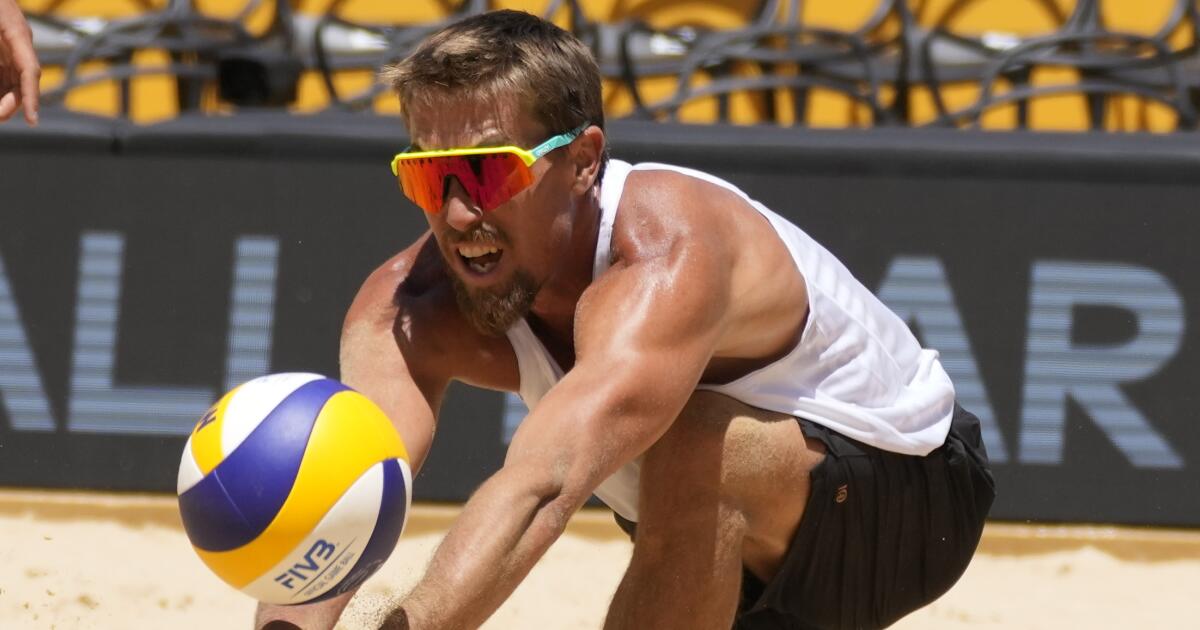
Taylor Crabb is no stranger to South California beaches. The Long Beach State alum returns home this weekend to compete in AVP League matches.
It marks the first time AVP will compete in Long Beach since 2020 and allows players to compete at the 2028 Olympics beach volleyball venue.
Crabb, 34, made his AVP debut in 2013 with his brother, Trevor, and advanced from the qualifier in Manhattan Beach before finishing 25th in his first tournament.
After years of competing with various different partners, Taylor Crabb and Andy Benesh have delivered the top performances this AVP season.
The following interview with Crabb has been edited for clarity and length.
Are you excited to compete in this weekend’s event at Long Beach?
Crabb: Very excited. A lot of my college teammates and part of the school have reached out, saying that they’re gonna come. So I’m excited to get a chance to play in front of them again.
When was the last time you were in Long Beach?
Crabb: I always try to go down there for alumni events or any big games they have. I went to UCLA against Long Beach last year, when it was No. 1 versus No. 2, so I always try to get down there and support them.
You missed out on the chance to compete in the 2020 Olympics because of COVID-19 restrictions and chose not to pursue a spot at the 2024 Olympics. Are you fired up to try to compete in the 2028 Olympics, knowing that Long Beach will host the competition?
Crabb: Yeah, it’s definitely an exciting time having the Olympics in Long Beach, and we kind of get to break it in this weekend. As you said, Tokyo didn’t go the way I wanted, but I’m going full force now. I have a great partner in Andy Benesh, who obviously went to the Paris Olympics, and if it weren’t for the Olympics being in Long Beach, and me getting a partner like Andy, I’m not even sure I’d be going for it, but because of those two things, I want to make the most of it.
You mentioned that if it wasn’t for a partner like Andy, you wouldn’t be going for it. What do you mean by that?
Crabb: I didn’t feel motivated by playing in all the international events, but now, I think, sitting out kind of lit the fire under me, and I’m really motivated now.
You’ve had different partners throughout your time. What other motivation does Andy give you?
Crabb: He’s been, in my mind, the top blocker for the U.S. the last four or five years. Seeing the professionalism he brings every day to practice, on and off the court, while traveling and when showing up to tournaments, it rubs off on you and that’s really motivating to see. And I just want to make him proud.
Why do you love volleyball?
Crabb: A lot of reasons, but it’s just a feeling I have when I’m out there on the court. It feels natural. It feels like home. I was born into a volleyball family. I had a volleyball in my hands my entire life, so I’ve always just enjoyed it.

NEWYou can now listen to Fox News articles!
CM Punk appeared on “Friday Night SmackDown” ready to take on any challenger that was ready to step to him after winning the Undisputed WWE Championship against Sami Zayn.
Punk entered the ring in Oklahoma City and called back to the “Monday Night Raw” after WrestleMania 42 when he told Cody Rhodes he’d be ready to deliver if a championship opportunity fell “out of the sky.”
COMPLETE PRO WRESTLING COVERAGE ON FOX NEWS DIGITAL
Cody Rhodes and CM Punk face off during SmackDown at Paycom Center in Oklahoma City, Okla. (Craig Ambrosio/WWE via Getty Images)
“When championship opportunities fall out of the sky, CM Punk catches them,” he said.
Punk named potential SmackDown superstars he’d think might come for the title, including Gunther, Finn Balor, Royce Keys, Damian Priest and Trick Williams. He even said that Zayn could come back around and get his rematch if he wanted. He didn’t mention Rhodes’ name, but the “American Nightmare” came out uncalled and marched his way down to the ring.
“I don’t think you and I can run away from each other anymore,” Punk told Rhodes.
Cody Rhodes looks on during SmackDown at Paycom Center in Oklahoma City, Okla., on July 10, 2026. (Craig Ambrosio/WWE via Getty Images)
Rhodes agreed and mentioned that Punk would want a match with him, just “say when.” It was a quick retort from Punk, who said, “when.” SmackDown general manager Nick Aldis, who was in the ring for the segment, booked the match for SummerSlam.
Punk will defend the Undisputed WWE Championship at SummerSlam, which takes place Aug. 1 and 2 at U.S. Bank Stadium in Minneapolis.
First, however, Punk and Rhodes will be involved in a tag team match at Saturday Night’s Main Event in New York City next week. Aldis made the match after Gunther demanded that Aldis put him in a match against Punk. Gunther was hoping it would be for the championship. Instead, Gunther will tag with Zayn.
Gunther didn’t take too kindly to that and attacked Aldis. Rhodes came back out to break up the calamity. He wanted to take on Gunther after the show went off air but Gunther walked away.
Gunther makes his entrance during SmackDown at Paycom Center in Oklahoma City, Okla., on July 10, 2026. (Rich Wade/WWE via Getty Images)
CLICK HERE TO DOWNLOAD THE FOX NEWS APP
Punk definitely has his hands full as he moves to SmackDown to become a fighting champion.
-

 New Hampshire19 seconds ago
Gilmanton Iron Works Man Accused Of Possessing Guns, Hundreds Of Grams Of Fentanyl In Hooksett, Manchester
-

 New Jersey12 minutes ago
Ex-NJ GOP aide accused of staging slashing attack shows off horrific scars — and mystery man — in new snap
-

 New Mexico15 minutes ago
New Mexico AG Wants to Know Where Epstein Records Are
-
North Carolina15 minutes ago
UNC shortstop selected in first round of MLB Draft by Red Sox; list of NC players drafted
-
North Dakota27 minutes ago
The Crookston Masonic Lodge and Order of the Eastern Star present a donation check to Honor Flight of North Dakota and Minnesota
-

 Ohio30 minutes ago
Ohio’s first mountain coaster coming to Hocking Hills
-

 Oklahoma35 minutes ago
Housing affordability act becomes law, Oklahoma lawmakers react
-

 Oregon42 minutes ago
East Evans Creek Road wildfire swells to about 2,000 acres; homes threatened


