Sports
Aaron Donald used his strength, mind and humor to power a bigger-than-football persona


The Rams’ 2023 season had ended.
An emotional defeat in an NFC wild-card game at Detroit closed a successful run for star defensive lineman Aaron Donald and his mostly younger teammates.
Disappointment coursed through the visiting locker room at Ford Field, but players said they were proud of what they accomplished, and looked forward to next season.
After speaking with Donald and his teammates, reporters made their way toward the exit.
Suddenly, from behind, Hulk-sized hands landed on my shoulders. Forearms that felt like iron cannons pressed down on my back.
Soon it registered.
Aaron Donald had me in his grip.
Now that Donald, a certain first-ballot Hall of Famer, has announced his retirement after a 10-year career with the Rams, I reflect on that moment.
For eight years, since the Rams moved back to Los Angeles from St. Louis, I watched quarterbacks helplessly find themselves wrapped up in Donald’s clutches. The three-time NFL defensive player of the year routinely — and violently — smashed them to the turf.
During training camp and portions of in-season practice sessions, I got a close-up view as the muscle-bound and cat-quick Donald perfected his craft.
One drill in particular always spurred intrigue. Donald shuffled through a line of tackling dummies, wickedly slapping them at head height along the way. How could opposing players absorb such blows?
Aaron Donald takes part in a drill at practice.
Several years ago, my fascination led to a what-were-you-thinking? situation.
Donald was scheduled to speak with reporters in the locker room. But first, longtime teammate and wingman Michael Brockers fielded questions at his locker next to Donald’s.
Much like he often did on the field, Donald sensed an opening. A gap. So he made a lightning-quick move to skip out of the room.
Instinctively, albeit foolishly, I leaped into his path.
A colleague audibly gasped. At 6 feet 1 and 285 pounds, Donald might have initially been regarded as undersized for an NFL defensive tackle. But not when face to face with a reporter 30 years his senior.
Donald took a step to his right, then another to his left.
Like an undrafted free-agent running back trying to make the roster, I held my ground. Comically, I might have even raised my hands to block him.
“C’mon, Aaron,” I said, laughing nervously.
Donald chuckled, shook his head and returned to his locker to answer questions.
Not that he always appreciated them, especially when pressed after offering vague first or second answers about his contract situation or other uncomfortable topics. Ultimately, though, he never refused to articulate his thoughts. And he usually did so with a grin.
In 2019, a trip to Donald’s hometown of Pittsburgh provided a window into his personality and how he became one of the greatest players in NFL history.
For a visitor, descending the steps to the dark and musty basement of his boyhood home on Churchland Street was unforgettable.
Rams defensive tackle Aaron Donald was still using his old weight-lifting and exercise equipment in the basement of his childhood home well into his NFL career whenever he visited home. He calls the space “The Dungeon.”
(Gary Klein / Los Angeles Times)
“Welcome to the Dungeon,” said his father, Reggie Donald Jr., a former powerlifter who molded his son into a workout colossus on the spartan basement equipment.
Another comment that resonated came from Donald’s older sister, Akita.
Sometimes when her then-chubby brother got angry as a youngster, she noted, he threatened to run away. He packed a book bag full of snacks and left the house.
“Ten to 15 minutes later,” she said, “guess who’s back with no shoes on, eating all the snacks?”
That image never left my mind. Especially when Donald, muscles rippling, proudly appeared shirtless for news conferences during training camp. Or when he projected a shirtless image of himself in a bodybuilder pose as the background during Zoom calls with reporters.
During his zoom conference call with reporters, Rams defensive tackle Aaron Donald used a photo of himself flexing as his background.
(Gary Klein / Los Angeles Times)
Donald used that strength and his smarts to make one-of-a-kind plays, none bigger than when he pressured Cincinnati Bengals quarterback Joe Burrow to clinch Super Bowl LVI at SoFi Stadium.
Afterward, Donald ran elatedly across the field pointing to his left index finger, as if he was screaming to the world, “Ring Me!”
I had heard Donald at full volume in the aftermath of another significant win.
In 2017 at Tennessee, in the locker room after the Rams clinched the NFC West for the first time since 2003, a joyful Donald yelled so loudly that it almost knocked me over.
He loved to win — and hated to lose.
Tears rolled down his cheeks as he stood on the sideline during a divisional-round playoff defeat at Green Bay that ended the 2020 season. He came back the next season and helped lead the Rams to their Super Bowl victory.
After that win, Donald answered questions while seated at a podium, then rode with his kids on the back of a cart to the locker room. He looked at peace.
Rams defensive end Aaron Donald celebrates after sacking Cincinnati Bengals quarterback Joe Burrow to clinch the Rams’ victory in Super Bowl LVI on Feb. 13, 2022.
(Allen J. Schaben / Los Angeles Times)
Two years later, there we were in a locker room in Detroit.
After Donald answered a few questions, another reporter noted the joy and energy the Rams young defense exhibited during their run to the playoffs, and asked Donald if he was eager to carry it forward.
“For sure,” he said.
I followed with another question.
“So, in terms of continuing to play,” I began, “you’re going to continue to play?”
Donald chuckled.
“We going to see,” he said. “I’m proud of this team. I’m proud of this group, you know, we got a lot more football left.”
I followed again.
“So you are?” I asked, “Or we’re going to see?”
Aaron Donald celebrates with his children while riding on the back of a golf cart at SoFi Stadium following the Rams’ victory over the Cincinnati Bengals in Super Bowl LVI on Feb. 13, 2022.
(Gary Klein / Los Angeles Times)
Donald laughed and asked why I asked that question.
The session was over.
A few moments later, I was engulfed from behind, a loud voice in my ear.
“Gary!” Donald said with a hearty laugh as he squeezed me, ”Man, how can you ask me that question when we just lost the game and got off the field?”
He kept walking and exited the room.
One day, I hope we meet up again.
I’ll congratulate him on a great career and thank him for his professionalism, cooperation and his humor.
I’ll probably shake his hand.
Or perhaps I’ll pull him in.
And wrap him up.


NEWYou can now listen to Fox News articles!
A lot of history has a chance to be made when it comes to the MLB MVP awards this season.
Let’s check out the odds for the AL and NL MVP race at FanDuel Sportsbook as of July 16.
This page may contain affiliate links to legal sports betting partners. If you sign up or place a wager, FOX Sports may be compensated. Read more about Sports Betting on FOX Sports.
American League MVP
Yordan Alvarez: -165 (bet $10 to win $16.06 total)
Junior Caminero: +450 (bet $10 to win $55 total)
Bobby Witt Jr.: +500 (bet $10 to win $60 total)
Ben Rice: +1400 (bet $10 to win $150 total)
Nick Kurtz: +2000 (bet $10 to win $210 total)
Julio Rodriguez: +4500 (bet $10 to win $460 total)
Shea Langeliers: +5500 (bet $10 to win $560 total)
What to know: We’re going to have a new AL MVP. Two-time defending AL MVP Aaron Judge has not played since May due to injury. His three MVP awards are tied with a host of MLB legends for the third-most all-time, including Yankee icons Mickey Mantle, Joe DiMaggio and Yogi Berra. However, he’ll have to wait to get his fourth, according to the current odds. The name atop the board is Houston’s Yordan Alvarez, who is leading the AL in home runs (31), hits (111), RBIs (70), on-base percentage (.426), slugging percentage (.633) and OPS (1.059). He is also second in the league in batting average (.318).
National League MVP
Shohei Ohtani: -1500 (bet $10 to win $10.67 total)
Pete Crow-Armstrong: +750 (bet $10 to win $85 total)
Kyle Schwarber: +3000 (bet $10 to win $310 total)
James Wood: +4000 (bet $10 to win $410 total)
Juan Soto: +4000 (bet $10 to win $410 total)
Corbin Carroll: +6500 (bet $10 to win $660 total)
Otto Lopez: +6500 (bet $10 to win $660 total)
What to know: It appears Ohtani is gonna do this thing again, mostly because of his combination of pitching and hitting. At the plate, he’s third in the NL in OBP (.403), third in OPS (.952), fifth in home runs (22) and fifth in slugging (.549). And on the mound, he’s 8-2 in 14 starts with a 1.79 ERA, 0.95 WHIP and 95 strikeouts. Yeesh. Last season, Ohtani won back-to-back NL MVP awards for the first time since Albert Pujols did it in 2008 and 2009. He also won the AL MVP in 2023, making him the first player in MLB history to win MVP back-to-back in each league. This year, if Ohtani is to win NL MVP, he will make a dent in Barry Bonds’ record of four straight MVP wins (2001-2004). All four of Ohtani’s MVP wins have been unanimous, with him receiving all 30 first-place votes. He has the second-most MVPs in history, trailing only Bonds’ seven.
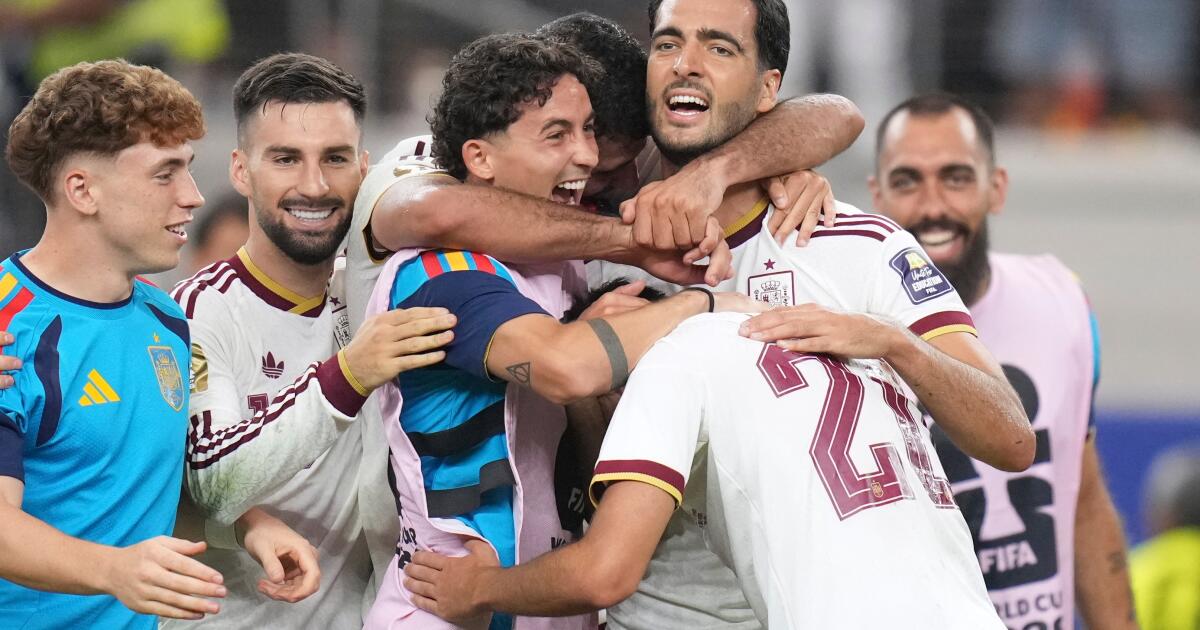
EAST RUTHERFORD, N.J. — If something happened once, it can happen again. That’s kind of what Yogi Berra was getting at when he said “it’s like deja vu all over again.”
Berra, the late Yankee catcher and once New Jersey’s unofficial poet laureate, spent most of his life within walking distance of East Rutherford, N.J., where history could repeat itself all over again in Sunday’s World Cup final between Spain and Argentina. And that makes his words newly relevant.
Argentina and Lionel Messi, the reigning champions, will be seeking to become the first to repeat in 64 years while Spain will be playing in the title game for just the second time ever. And the similarities to its first trip, in 2010, are uncanny.
Sixteen years ago Spain became just the second reigning European champion to win a World Cup. It will enter Sunday’s game as the reigning European champion.
In the run-up to the 2010 World Cup, Spain ran off a 35-game unbeaten streak, which matched the longest in history at the time. La Roja will enter Sunday’s game with a 37-game unbeaten streak, which matches the current longest streak in history.
And that 2010 team was known for an absence of ego and a depth of character, a blue-collar collection of quiet superstars built around a core of Andrés Iniesta, Xavi Hernández and Carles Puyol, players who emphasized humility, unity and selflessness.
This team? It’s the same.
“We’re one big family,” center back Pau Cubarsí said in Spanish.
A family that has already achieved its goal, according to coach Luis de la Fuente. So while Argentina may be feeling the pressure of chasing World Cup history, De la Fuente said his team is playing with house money
“I don’t believe in the idea that finals are there to be won. They’re there to be enjoyed,” he said. “What’s to come could be the icing on the cake.”
Of course a cake is nothing without the icing. But then Spain hasn’t had to separate joy from success in this World Cup, enjoying an unbeaten run to the final whose only blemish has been a tournament-opening draw with Cape Verde.
That was the first of six clean sheets for Spanish keeper Unai Simón, though it’s really been a group effort with Simón facing an average of just two shots on goal a game.
“This team never ceases to amaze me,” De la Fuente said. “The scope for improvement is endless. It was a labor of love, a process. It was about reaching the crucial moment in the best possible shape.”
De la Fuente, 65, whose only senior international appearance as a player came in the 1988 Olympics, coached Spain’s U-23 team to a silver medal in the Tokyo Games in 2021 then took over the national team a year later, after it crashed out of a second straight World Cup in the round of 16.
De la Fuente spent nearly two decades coaching at the youth level, including nine years with Spain’s U19 and U21 national teams. But seven months after taking over the senior team, he led later Spain to its first UEFA Nations League title and a year after that it won its first Champions League title in more than a decade. La Roja has lost just twice in 48 games under De la Fuente, who has the highest winning percentage of any man who has managed more than nine games for Spain.
Given his background, De la Fuente trusts young players — with an average age of 26.7, Spain has the sixth-youngest roster in the World Cup — and his starting lineup includes two teenagers in Cubarsí and forward Lamine Yamal. The core of the team — Simón, Mikel Merino, Dani Olmo, Rodri, Mikel Oyarzabal, Fabián Ruiz — are players he coached to European youth-level championships and ones he has known for half their lives.
That has given the team a level of familiarity and trust that goes both ways.
“This team never ceases to amaze me,” the coach said. “The scope for improvement is endless. It was a labor of love, a process. It was about reaching the crucial moment in the best possible shape.”
And they’ve gotten there, said right back Pedro Porro, another product of De la Fuente’s youth teams, by all pulling in the same direction.
“From the very first day we got here — not just me, but the whole team — we’ve been working toward a common goal,” Porro said. “That’s part of the process. There are no excuses.”
That, too, is something De la Fuente brought to the job, though it’s not an original concept for Spain. It’s more like deja vu all over again.
“We are ordinary, generous people,” the coach said. “We’ve recaptured the spirit of 2010.”

NEWYou can now listen to Fox News articles!
The ESPYS brought some of the biggest names in sports and entertainment to New York City on Wednesday night, a day that typically ranks among the slowest on the sports calendar.
But this year’s ceremony was preceded by a World Cup semifinal match in Atlanta that was already being described as an instant classic. Lionel Messi and Argentina punched their ticket to a second straight World Cup final with a win over England. The defending champions will meet Spain on Saturday in nearby New Jersey, just a short trip across the Hudson River from where comedian Marcello Hernández opened the ESPYS.
The “Saturday Night Live” star wasted little time taking a few jabs at Jake Paul, Tiger Woods and other sports figures.
ESPN’S JOHN BUCCIGROSS NAMES HIS MOUNT RUSHMORE OF ALL-TIME SPORTSCENTER ANCHORS
Marcello Hernández speaks onstage during the 2026 ESPY Awards at David H. Koch Theater at Lincoln Center in New York City. (Mike Coppola/Getty Images)
“Mike Tyson ripped my watch off. Welcome to the ESPYS!” Hernández joked after making a boxing-style entrance in a robe with Tyson as part of his entourage.
“I must say, it’s an honor to be here among so many great athletes, and Jake Paul,” Hernández began in his roughly 10-minute monologue.
Paul appeared to take the joke in stride, laughing and applauding as cameras cut to him in the crowd. Hernández then stayed on the YouTube star-turned-boxer, needling him over his history of fighting older opponents.
“Jake, that’s just a joke. Don’t fight me,” Hernández continued. “My dad and my stepdad are both here. They’re over 50, and I know that’s how you like them. So, fight them instead.”
Paul kept laughing as Hernández’s bit played out, eventually closing with the comedian shifting attention to his father and stepfather, who were shown in the audience.
Atmosphere at the 2026 ESPYS at the David H. Koch Theater at Lincoln Square on July 15, 2026, in New York, New York. (Gilbert Flores/Variety via Getty Images)
Hernández later used Caleb Williams’ “Madden 27” cover as a lead into Woods.
CLICK HERE FOR MORE SPORTS COVERAGE ON FOXNEWS.COM
“I want to congratulate Caleb Williams, the quarterback for the Chicago Bears, who will be on the cover of the new Madden video game. Congratulations to Caleb,” Hernández said, before adding, “And Tiger Woods will be on the cover of Grand Theft Auto.”
Woods was arrested in Florida in March on charges of DUI after a car crash. The arrest report said a deputy found pain pills in his pocket and observed signs of impairment at the scene. Woods later announced he would take time away from golf to seek treatment.
Hernández also worked North Carolina football coach Bill Belichick into the monologue, using the 74-year-old’s relationship with Jordon Hudson as part of a joke about the New York Knicks’ title drought.
“The Knicks won their first championship since 1973. And to put into perceptive how long ago that was, in 1973 hockey players didn’t wear helmets, basketball had no three point line. And in 1973, Bill Belichick was the age his girlfriend is now.”
The Knicks later took home the ESPY for Best Team.
Jalen Brunson, Karl-Anthony Towns, OG Anunoby and other members of the 2025-26 Knicks championship team took the stage to accept the award, but Josh Hart was noticeably absent. Brunson drew laughs when he joked, “I want to say thank you to the ESPYS for pulling Josh Hart’s invite.”
Earlier in the night Brunson also received the “Best Championship Performance” award.
Jalen Brunson accepts the Best Championship Performance award onstage during the 2026 ESPY Awards at David H. Koch Theater at Lincoln Center in New York City on July 15, 2026. (Kevin Mazur/Getty Images for W+P)
Former NBA player Jason Collins, who died in May at age 47 following a battle with Stage 4 glioblastoma, posthumously received the Arthur Ashe Award for Courage. Former MLB pitcher Jim Abbott received the Jimmy V Award for Perseverance, while Scott Ruskan was honored with the Pat Tillman Award for Service.
CLICK HERE TO DOWNLOAD THE FOX NEWS APP
The ESPYS are held every summer, bringing together top athletes and other stars to celebrate the best moments from the past year in sports while honoring figures recognized for courage, service and impact. In past years, the ceremony has been held in Los Angeles, but shifted to New York this year.
Follow Fox News Digital’s sports coverage on X, and subscribe to the Fox News Sports Huddle newsletter.
-
 News11 seconds ago
Flood sirens blare in South Central Texas as rivers reach perilous heights
-

 Los Angeles, Ca2 hours ago
Arrest made in deadly shooting at 4th of July gathering in Compton; search for 2nd suspect continues
-

 Detroit, MI2 hours ago
Detroit crime hits decades-low as Michigan governor candidates debate how to keep progress going
-

 San Francisco, CA2 hours ago
Operator of boat that capsized near Alcatraz mourns brother as search continues
-

 Dallas, TX2 hours ago
Mavericks vs Thunder Game Preview and Injury Update
-

 Miami, FL2 hours ago
Miami Dolphins Fans Vs. The Media
-

 Boston, MA3 hours ago
Man who allegedly shot at Boston Police officers arrested after foot chase in Dorchester
-

 Denver, CO3 hours ago
Swan, dragon and duck boats are back pedaling around City Park

