Sports
13-year-old prodigy Mckenna Whitham aiming to make NWSL before finishing high school

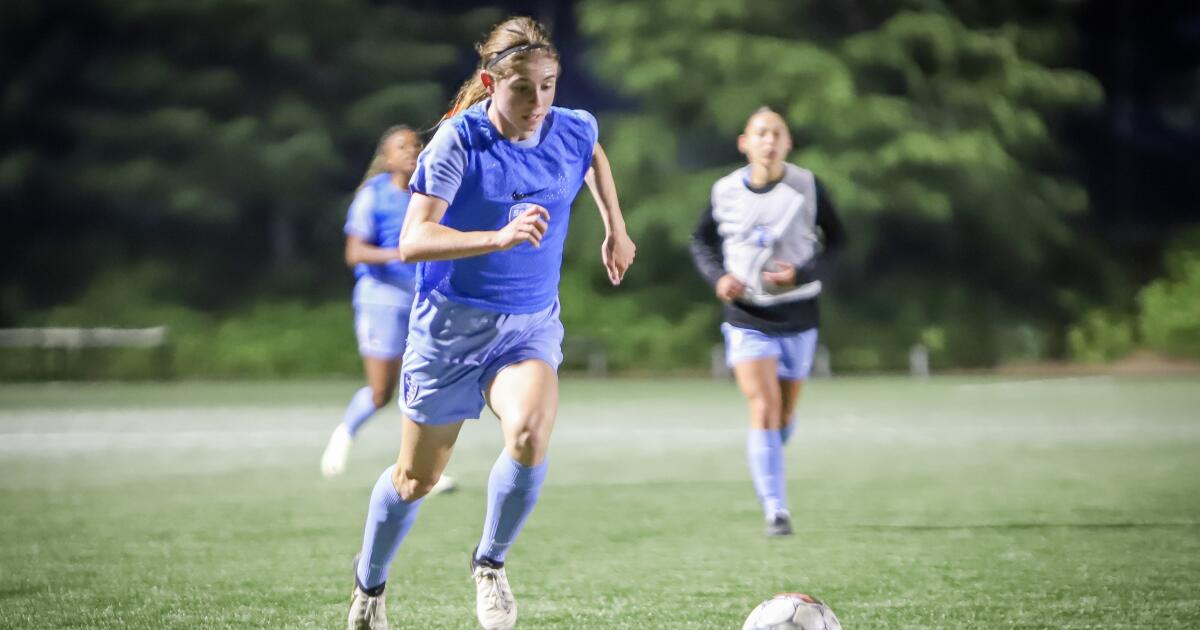
There aren’t many things Mckenna Whitham can’t do on a soccer field.
She’s fast. She can shoot. She can dribble. She can pass.
“She has a skill set that is different,” her father, Josh, says. “She doesn’t have a flaw in her game.”
She’s also just 13.
At an age when most kids are preparing for high school, Mckenna Whitham is preparing to turn pro in the world’s most popular sport. She’s already the youngest person to sign a name, image and likeness contract with Nike and the youngest to play for an NWSL club. In that February preseason game, Whitham, a non-roster invitee with Gotham FC, scored the game’s only goal in stoppage time, making her the youngest player to score for an NWSL team.
For Mckenna high school isn’t a necessity, it’s a detour.
“My thoughts haven’t really been high school or anything. I’ve always wanted to go pro, like right away,” she said. “And I’ve been working really hard to get there.”
Kennedy Fuller is already there and the midfielder, who signed with Angel City three days before her 17th birthday last March, said her advice to Whitham would be to be patient — not always an easy thing for a 13-year-old.
Mckenna Whitham practices with the Santa Clarita Blue Heat at College of the Canyons.
(Courtesy of Luc Caouette)
“It’s super important that she thinks about putting herself in the best environment possible,” said Fuller, who took a red-eye back to Texas for her high school graduation hours after playing the final 28 minutes of her team’s scoreless draw with the San Diego Wave last week. “Whether that’s playing up a couple of years, whether that’s playing with boys, whether that’s playing with professional training, professional teams, whatever that may be.
“Putting herself in the best environment possible is what’s going to eventually help her be the best version of herself.”
Whitham, who goes by Mak, is already doing much of that. By playing with the U.S. U-15 team, she’s playing up a couple of years and she’s been training with LAFC’s boys’ academy team. And on Wednesday she’s expected to make her debut with the Santa Clarita Blue Heat, a highly regarded summer pro-am club whose alumni include World Cup veterans Savannah DeMelo, Alyssa Thompson, Lauren Sesselmann and Ashley Sanchez and reigning NWSL rookie of the year Jenna Nighswonger.
That Whitman can even dream the dream of becoming a professional before finishing high school — a dream Kennedy and a handful of others are already living — is a relatively new development. Until 2021, NWSL required women to be at least 18 to play in the league.
That was news to Olivia Moultrie and her family. At 13, the same age Whitham is now, Moultrie, now 18, signed with the Wasserman Media Group, U.S. soccer’s most powerful agency, then accepted a multiyear endorsement deal with Nike and an offer to train with the NWSL’s Portland Thorns, moving with her parents and two younger sisters to Oregon for what she thought would be the start of a professional career.
When the league told her she’d have to wait five years to play in an official match, she sued and the courts eventually agreed that the NWSL was in violation of antitrust rules. So ahead of the 2022 NWSL season, new commissioner Jessica Berman pushed through a mechanism for signing players under 18, opening the door not just for Moultrie, but for other rising stars such as Chloe Ricketts, Melanie Barcenas and Jaedyn Shaw. Angel City has three teenagers in addition to Fuller: forwards Alyssa Thompson, 19, and Casey Phair, 16 and defender Gisele Thompson, 18.
“It’s incredibly important that we have a domestic pathway for those special players that want to take the next step,” said Jill Ellis, who coached the U.S. women’s team to two World Cup titles before becoming president of the San Diego Wave. “It was a rarity a few years ago to have teenagers in the pro ranks. To see the evolution and opportunities now for our best young talent is exciting.”
Which brings us back to the Whithams, who moved from the San Francisco Bay Area to Southern California last summer because the soccer opportunities, such as the chance to play with the Blue Heat and with Slammers FC, an elite youth program in Orange County, were better for Mak. Her father , a senior vice president for a global staffing firm, can work remotely, freeing him to ferry his daughter to games and practices. Her mother, Joni, homeschools her daughter, which helps keep her schedule flexible.
“My job is to make sure that as long as she’s having fun, and if she wants to do it, that she has the opportunity to do it. Then it’s up to her to prove herself,” Josh Whitham said.
“All I care about is that she’s following her dreams and that she wants to do it. My goal is just to be here to support her.”
Josh Whitham said he doesn’t push his daughter to train. The motivation comes from her.
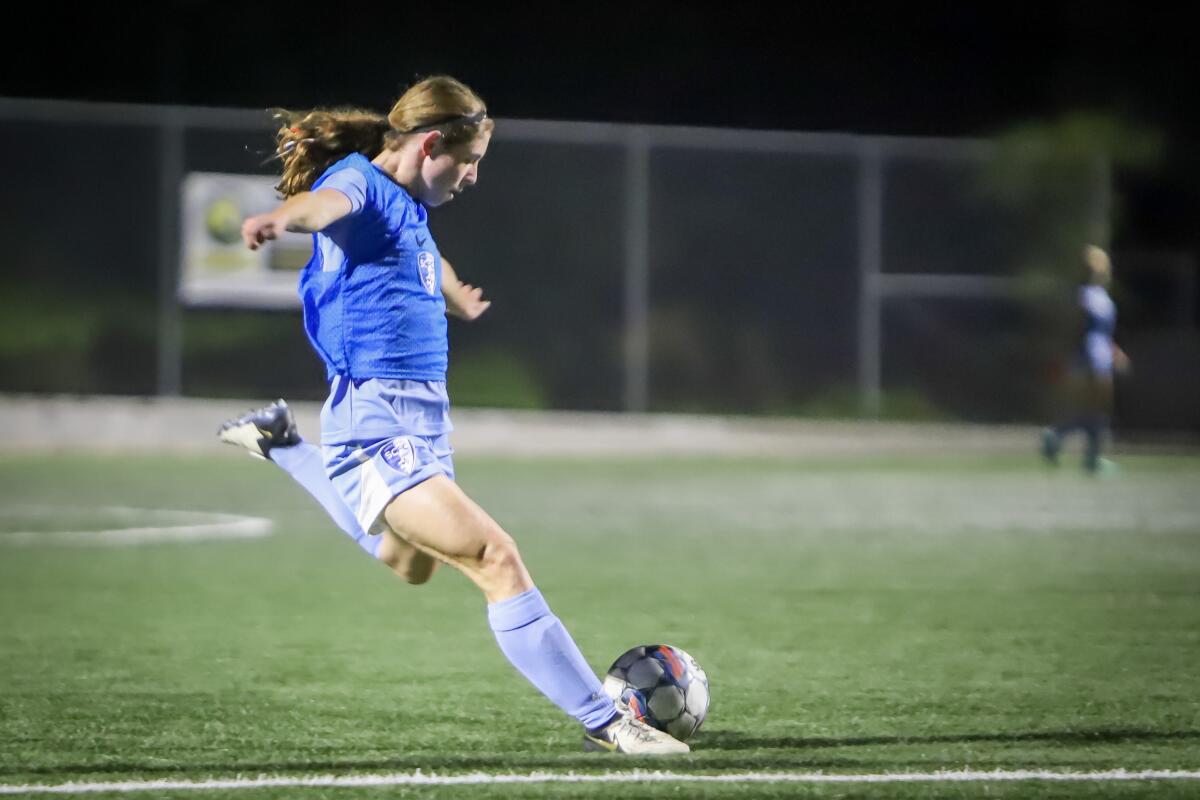
Mckenna Whitham kicks the ball during a Santa Clarita Blue Heat training session at College of the Canyons this month.
(Courtesy of Luc Caouette)
“She runs her entire schedule, including her homeschooling,” he said. “She learned a big organizational thing that most adults struggle with.”
Josh Whitham knows a little bit about the challenges of being a precocious athlete. At 15, he was the youngest member of the U.S. Olympic ski team, ranking as high as 40th in the world and making the roster for the 1998 Nagano Olympics as an alternate before he was out of high school.
“We have those conversations,” he said. “But my job is shifting to more of an advisor and just to make sure I’m here to talk about anything. [The] experiences she’s living right now, you can never replace those no matter what you do. In regular life you cannot replace going to Europe, being with the teams, having the interaction with these players.
“We do worry about those things. All I care is that she’s following her dreams and we’ll be here to support her. And if that [dream] changes, then it changes.”
Right now that dream is to sign a professional contract. Barcenas became the young player in NWSL history when she signed with the Wave last season at 15 years 138 days. Whitham, who has continued to train with Gotham, the reigning NWSL champion, as well as NWSL clubs in Kansas City and Washington, won’t turn 15 for another 14 months.
“As of now, we’ve committed to riding out this the way it is and finishing out the year,” Josh Whitham said. “She wants to sign. It’s just a matter of time and where the best developmental situation is.”
Time, certainly, is on their side.
“This,” Josh Whitham agreed “is a long road.”
⚽ You have read the latest installment of On Soccer with Kevin Baxter. The weekly column takes you behind the scenes and shines a spotlight on unique stories. Listen to Baxter on this week’s episode of the “Corner of the Galaxy” podcast.


Roki Sasaki’s abysmal appearance faded away in the Dodgers’ 12-7 win over the San Diego Padres on Thursday night, but only after the National League West leaders rose from a catatonic first inning.
The Dodgers roared back from a 6-0 deficit as Andy Pages skirted a tying double down the left-field line, and Mookie Betts and Max Muncy each drove in runs to give them the lead for good in a four-run fourth inning. All of which sent the sold-out Dodger Stadium crowd into jubilant celebrations, some jumping, others breaking out World Cup chants.
“Thankfully, it played out the way I didn’t expect,” manager Dave Roberts said of the team’s ability to turn the game around, “or the way it started.”
By the time the game ended, Sasaki’s three-inning start seemed like a murky nightmare the Dodgers awoke from in a sweat. Except the Dodgers weren’t dreaming, and the team hadn’t done much to assuage the concerns with Sasaki.
The problem with Sasaki isn’t his stuff. On his best nights, when the velocity and command combine, Sasaki blows past batters with a triple-digit fastball and cutting off-speed pitches. The problem has been how to tick the radar without making the strike zone look like a Jackson Pollock painting — and recently, it has.
Sasaki’s June swoon, impervious to the calendar change, continued into Thursday’s series opener against the Padres, in which the right-hander gave up three home runs among seven hits before Roberts called it quits going into the fourth inning.
“They were on everything,” Roberts said. “You could see it.”
One possible concern? Tipping pitches. While Roberts and catcher Dalton Rushing said the team would need to do more research into Sasaki’s start, both left the door open to this answer.
“That would be a big explanation as to how they felt like they were on every pitch,” Rushing said.
As San Diego chugged through its lineup, Sasaki struggled to keep up. With his first pitch, he gave up a double to Fernando Tatis Jr., who scored on Manny Machado’s home run that left center fielder Pages staring at the ball’s path as it plopped down on the other side of the blue outfield fence.
The inning was only a preview of the Padres’ power. Each of the nine San Diego batters got his chance against Sasaki in the second, and the team quickly dug the Dodgers into a six-run hole. He surrendered two home runs in the second inning. Jackson Merrill blasted a ball to left-center field leading off, and, two outs later, Jake Cronenworth drove in two runs with a shot to right-center.
Sasaki said through interpreter Kensuke Okubo that he needed to work on his command, but he felt like his fastball was good.
Roki Sasaki has his head down after giving up a solo homer to Jackson Merrill in the second inning.
(Gina Ferazzi / Los Angeles Times)
“I don’t think my stuff was bad today,” Sasaki said. “Overall, it wasn’t great but a lot of things evolved.”
Part of Sasaki’s issue lies with his approach. Roberts said he wants the second-year pitcher to be aggressive, to play the cat-and-mouse game required to beat batters in the box. But when given the opportunity, Sasaki has shrunken in recent outings, struggling with his command and his ability to pitch deep into games.
“We had a great May, so let’s just get back to competing and making pitches,” Roberts said.
When reliever Will Klein walked out to the mound in the fourth to the aggressive, rambunctious clamor of the Dropkick Murphys’ “I’m Shipping Up to Boston” and collected two scoreless, one-hit innings, the relief was immediate: The Dodgers took the lead.
The lineup already was revving, as Rushing homered in the second inning while Sasaki was still in the game, and both Kyle Tucker and Muncy drove in runs off starter Randy Vasquez in the third, cutting the deficit to two. The Dodgers broke through against the Padres’ bullpen to score six runs in the fourth and fifth innings.
“The bullpen was fantastic tonight, and then the offense came up big,” Roberts said.
A late catch by Pages helped close out the game after he gloved a ball despite ramming into the padding of the center field wall. A combined effort by Paul Gervase and Tanner Scott shut down San Diego’s ninth-inning momentum after it pushed across a run.
“Turned back around, was able to find the ball and make a really good catch right there,” Tucker said of Pages. “That was a huge out.”
The Dodgers (57-31) beat their division rivals for the fifth time in seven games to open a 13-game lead over both San Diego and Arizona. The Padres, meanwhile, have lost six straight and given up 66 runs over the last six days, the most in such a span in franchise history.
But San Diego’s flaws don’t negate the Dodgers’ as they burned through six relievers in their win. So, while the Dodgers crawled out of the hole with a season-high 17 hits, the steep cost heightens the pressure on the rest of the rotation the rest of the series.

NEWYou can now listen to Fox News articles!
In previous years, the Round of 16 was the first knockout stage match, but with an expanded field of 48 teams— it is now the second.
Let’s check out the odds at FanDuel Sportsbook as of July 2 for which countries are favored to make the Round of 16 and emerge from it.
This page may contain affiliate links to legal sports betting partners. If you sign up or place a wager, FOX Sports may be compensated. Read more about Sports Betting on FOX Sports.
To Reach Round of 16
Argentina: -2000 (bet $10 to win $10.50 total)
Colombia: -550 (bet $10 to win $11.82 total)
Portugal: -340 (bet $10 to win $12.94 total)
Switzerland: -235 (bet $10 to win $14.26 total)
Egypt: -148 (bet $10 to win $16.76 total)
Australia: +122 (bet $10 to win $22.20 total)
Algeria: +186 (bet $10 to win $28.60 total)
Croatia: +260 (bet $10 to win $36 total)
Ghana: +380 (bet $10 to win $48 total)
Cape Verde: +1160 (bet $10 to win $126 total)
Now let’s check out the odds at FanDuel Sportsbook as of July 2 for the matchups already in place.
SATURDAY, JULY 4
Canada vs. Morocco
To Advance: MAR -300, CAN +225
Moneyline: MAR -130, Draw +240, CAN +420
Paraguay vs. France
To Advance: FRA -1800, PRY +1140
Moneyline: FRA -600, Draw +600, PRY +1800
SUNDAY, JULY 5
Brazil vs. Norway
To Advance: BRA -245, NOR +196
Moneyline: BRA -120, Draw +260, NOR +340
Mexico vs. England
To Advance: ENG -134, MEX +110
Moneyline: ENG +145, Draw +210, MEX +200
MONDAY, JULY 6
USA vs. Belgium
To Advance: USA -110, BEL -110
Moneyline: USA +165, Draw +230, BEL +170
Sports
Thousand Oaks native Claire Liu finally reaches Wimbledon’s third round, will face Coco Gauff

LONDON — Claire Liu packed her bags and checked out of her London hotel room on Wednesday morning before heading to the All England Club.
It was more pragmatism than pessimism — a reality of a qualifier navigating her Wimbledon journey one day at a time.
But as her boyfriend reminded her while organizing her luggage: “Just because you’re packing doesn’t mean you’re leaving,” Liu recalled with a laugh.
He was right.
The Thousand Oaks native went on to win her second-round match against 51st-ranked Zeynep Sonmez of Turkey 7-5, 6-3, advancing to the third round of a Grand Slam for the first time in her professional career. She had tried 29 previous times at majors, including qualifying rounds, since 2015.
“I was just super relieved to get through that,” said Liu, noting she had blown a set and a break lead in the French Open’s second round last month.
For Liu, who turned 26 in May, returning to the manicured lawns of SW19 brings her tennis journey full circle. Nine years ago, she captured the 2017 Wimbledon girls’ singles title — the first American to do so since Chanda Rubin in 1992 — and was the No. 1 junior in the world. She still holds fond memories of that heady achievement, including chatting with her idol, Roger Federer, at the Wimbledon Champions Ball.
Yet, the transition from teenage phenom to professional mainstay has been anything but a linear ascent. When asked if she expected to be in the third round of a major this late in her career given her junior success, Liu was candid.
“Younger me would have believed it more than now,” she said.
That shift in perspective comes after weathering some brutal setbacks.
Liu climbed as high as No. 52 in early 2023 but then endured a wrist injury and took a months-long mental health hiatus in 2024 that eventually saw her ranking plummet outside the top 400 last year.
Currently sitting at No. 146, she’s been rebuilding her standing by playing a mix of WTA 125 events and ITF tournaments before returning to the main WTA Tour, with 2026 stops in far-flung places from Bahrain to Boca Raton and plenty of places in between.
“My goals haven’t changed, but I think the stress of how I got there really took a toll on me,” said Liu.
To navigate the darkness, Liu leaned heavily into both sports psychology and traditional therapy, including EMDR, a technique that helps people process traumatic experiences. She also started a Substack newsletter called “Finding Claire-ity,” where she openly chronicles her life and struggles on the tour.
The Southern California native, who has trained at the USTA facility in Carson since she was 9 years old and resides in Redondo Beach, also split with her longtime coach last season, a difficult decision, and hired Clemens Wagner.
The switch following the U.S. Open last year is clicking.
“I saw in her someone who fought a lot of battles inside herself,” says Austrian-born Wagner, who has a background in tennis analytics.
Together, they have focused on keeping an “aggressive undertone” on the grass, emphasizing coming to the net and squeezing the most out of her game.
Wagner notes that the 5-foot-7 player’s game isn’t the flashiest, but describes her as a “silent killer” who excels at “redirecting pace, standing close to the baseline, constantly putting pressure on her opponents.”
The reboot is starting to pay significant dividends.
Liu put together her best stretch in years this spring, winning a lower-tier title in Trnava, Slovakia, her first professional title since 2024, and then qualifying for the French Open.
Having again successfully navigated three rounds of qualifying to reach the main draw here, Liu has now won five consecutive matches at Wimbledon. Not surprisingly, she currently has no sponsors, just equipment support from Head Sport and Asics Corp., making her Wimbledon run particularly lucrative. By reaching the third round, Liu achieved her highest career payday: around $250,000. A victory Friday would boost that to nearly $400,000.
First, she faces her biggest test yet: a third-round contest against two-time major champion Coco Gauff on No. 1 Court, which perhaps fittingly is the same show court where Liu won the girls’ title almost a decade ago.
Gauff, 22, noted that she and Liu haven’t crossed paths much since Liu is older, but expects a serious battle. Gauff won both of their previous meetings on hard courts.
“I feel like anytime you’re playing a qualifier, it’s always tough because they have three matches already,” the seventh-seeded American said.
Liu, who didn’t even know she was playing Gauff until a reporter told her after her match, is purposefully keeping her focus narrow.
“I will just take today to be happy for winning, and then tomorrow I’ll think about it,” Liu said. “Obviously she’s one of the best players in the world right now, so that’ll be a good experience.”
Veteran Jessica Pegula, 32, the top-ranked American who also toiled away on the sport’s lower tier before becoming a top-10 mainstay, appreciates Liu’s resolve.
“It’s always nice to see girls that are figuring it out slowly but surely,” the No. 4 seed said. “I think I can relate to that.”
Liu’s accommodations? Fortunately, her mother was able to rebook the same hotel after the match, which eased some of the logistical issues for her unexpectedly extended stay in London.
“It definitely makes me stay in the moment, like, day by day,” Liu smiled of her lodging limbo.
On Wednesday morning, Liu packed her bags expecting she might leave Wimbledon. Instead, she emptied them one more time, with the biggest match of her career still waiting.
-
Sports4 minutes ago
Dodgers overcome Roki Sasaki’s poor performance to rout Padres
-

 World14 minutes ago
Watch: Following the money—the EPPO investigation into defunct far-right EU group
-

 News41 minutes ago
Bessent on Trump’s crypto earnings: “I don’t think there’s an appearance problem”
-

 Los Angeles, Ca2 hours ago
Boy, 17, with autism accused in murder of 4-month-old girl at Claremont daycare
-

 Detroit, MI2 hours ago
Brief rally not enough for Tigers vs Rangers as win streak ends at 3
-

 San Francisco, CA3 hours ago
Crash on freeway in Millbrae leaves driver dead after reportedly overturning multiple times, CHP says
-

 Dallas, TX3 hours ago
Paige Bueckers, Azzi Fudd do the usual in Hartford, win. This time with Dallas Wings
-

 Miami, FL3 hours ago
World Cup-inspired art exhibit transforms Miami’s Wynwood with interactive soccer experience

