Southwest
Meet the American who was the first paid professional football player: Pudge Heffelfinger

The name of the first professional football player seems too perfect to be true.
Pudge Heffelfinger sounds like a mythical Midwestern gridiron god more than a living, breathing human being.
Heffelfinger’s fable is actually nonfiction fare. He was as real as the broken ribs he brutally delivered to a poor college kid while scrimmaging for kicks and giggles with the Yale varsity football team — at 49 years old.
This groundbreaking goliath of American sports was “unquestionably the most amazing football player I had ever known,” legendary sportswriter Grantland Rice gushed in the introduction to Heffelfinger’s own book.
MEET THE AMERICAN WHO GAVE THE NATION OUR THANKSGIVING ORIGIN STORY: PILGRIM EDWARD WINSLOW
Heffelfinger was a Paul Bunyan-esque behemoth from Minnesota: tall, strapping, handsome and ferocious.
He starred for Yale from 1888 to 1891 and was the best player on some of the most dominant teams in college football history.
William Walter “Pudge” Heffelfinger was a strapping 6-foot-3, 205-pound lineman for the dominant Yale teams of 1888 to 1891. He became the first professional football player in 1892, when the Allegheny Athletic Association paid him $500 to play against the rival Pittsburgh Athletic Club. (Courtesy Pro Football Hall of Fame)
A year after manhandling overmatched amateur college opponents, Heffelfinger reshaped America’s favorite sport forever.
He was paid $500 to take the field for the Allegheny Athletic Association in an 1892 contest against the rival Pittsburgh Athletic Club.
“Pudge Heffelfinger was unquestionably the most amazing football player I had ever known.” — Grantland Rice
Heffelfinger entered history that day as the first known pro football player.
“Other players may have been paid to play before him — we don’t know for sure,” sports historian Ken Crippen, founder of The Football Learning Academy, told Fox News Digital.
“But Heffelfinger was the first for whom we have proof. After Heffelfinger … you were going to get the best players by throwing money at them.”
Heffelfinger proved to be one of the great ironmen in sports history. He played competitive football well into his 60s, after college as a barnstorming mercenary and in later years as a celebrity figure at charity games.
Grantland Rice, left, and Joe E. Brown, right, at the Santa Anita races. Rice is known for, among other things, crafting legendary phrases such as “The Four Horsemen of Notre Dame.” He called Pudge Heffelfinger “the most amazing football player I had ever known.” (Bettmann Archive/Getty Images)
Some sources put his last game at age 65, helping raise money for World War I veterans in 1932.
This super-human figure coached football, mentored players and championed football in media.
He helped popularize the game by publishing the annual “Heffelfinger’s Football Facts” from 1935 to 1950. It featured news, stats and schedules for both pro and college football.
MEET THE AMERICAN WHO SHAPED MODERN FOOTBALL: WALTER CAMP, PIGSKIN PIONEER
“It has been said by some historians that I will go down as ‘the greatest player of all time,’” Heffelfinger wrote in 1954, the year he died, in a biography called “This Was Football.”
“Deep in my heart I know it’s not true,” he added. “I can honestly claim, however, that I stuck with the game longer than anybody else did. On and off, I was an active football player 50 years.”
Born into new era of sports
William Walter “Pudge” Heffelfinger was born on Dec. 20, 1867, in Minneapolis to Christopher and Mary Ellen (Totton) Heffelfinger.
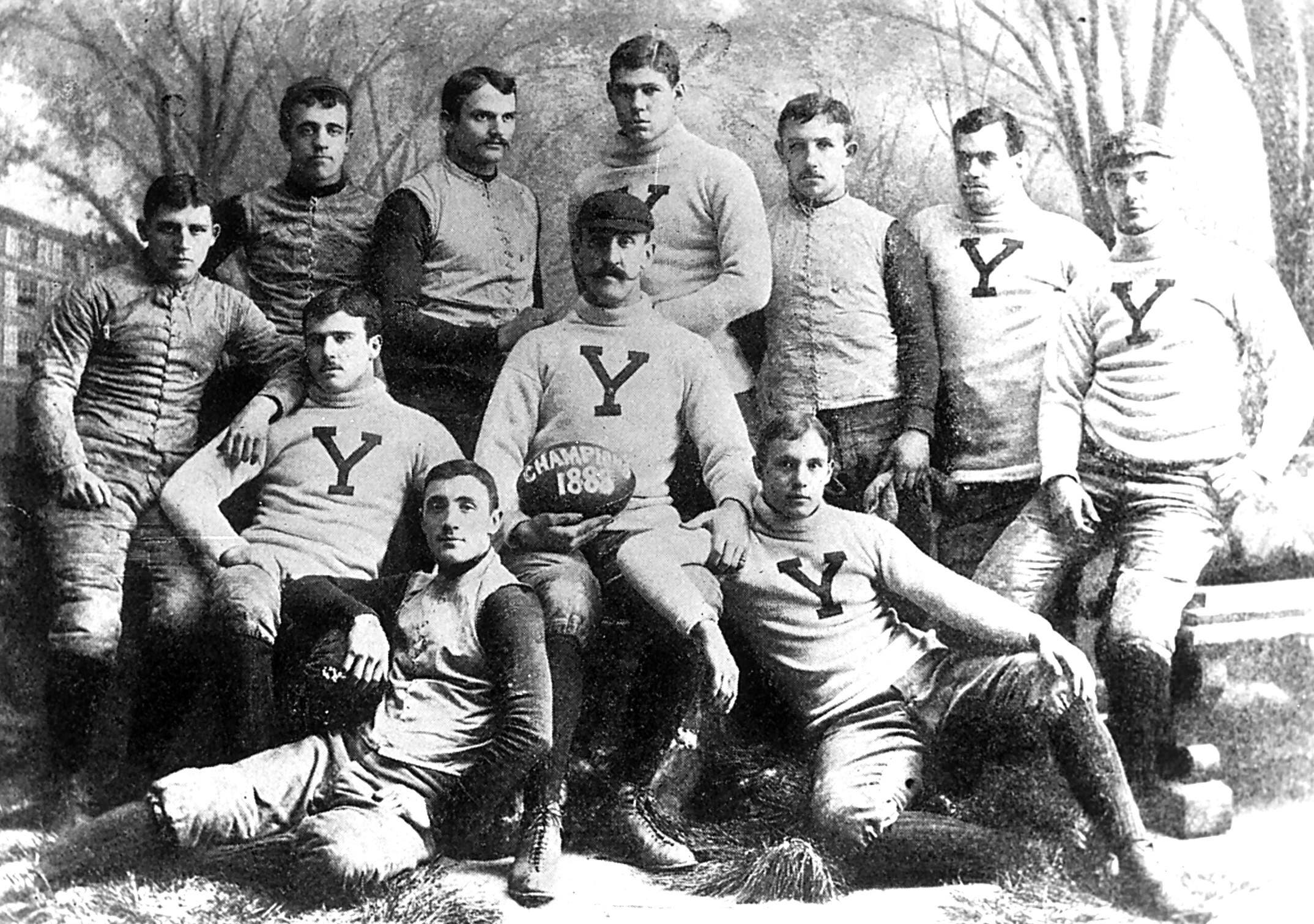
Yale University’s 1888 football team, coached by Walter Camp, went 13-0 and outscored its opposition 694-0. Pudge Heffelfinger (back row, center) towered over his teammates. (ullstein bild via Getty Images)
His father was a Civil War veteran wounded at Gettysburg, who then built a prominent shoemaking business in Minneapolis.
“Pudge wasn’t really pudgy,” Richard Goldstein wrote in “Ivy League Autumns,” published in 1996.
MEET THE AMERICAN WHO INSPIRED THE NATION IN TWO WORLD WARS: CHRISTIAN SOLDIER SGT. ALVIN YORK
“He picked up the nickname while playing sandlot football in Minneapolis at age 15.”
Heffelfinger was born into a nation on the cusp of the sport-as-entertainment explosion that followed the Civil War.
The Cincinnati Red Stockings, the first professional baseball team, played their first game in the spring of 1869. In the autumn of that same year, Rutgers and Princeton battled in the first college football game.
The Red Stocking Baseball Club of Cincinnati, Ohio, poses for a team photo in 1869, which was issued as a trade card. The Red Stocking, the first pro baseball team, and the first college football game, both emerged in 1869 — part of a post-Civil war obsession with sports as entertainment. (Mark Rucker/Transcendental Graphics, Getty Images)
Heffelfinger starred in both baseball and football at Central High School in Minneapolis. It’s the same high school that produced music legend Prince — before closing in 1982.
His athletic exploits gave Heffelfinger the opportunity to play at Yale, the best college program in America, under coach and pigskin pioneer Walter Camp, widely proclaimed as the father of modern football.
“Heffelfinger was extremely quick, powerful, intelligent and fearless,” Goldstein wrote. “He pounced on opponents while playing defense and led the line charge on offense, springing from a semi-erect stance.”
The U.S. Postal Service issued a Walter Camp stamp in 2003 to pay tribute to his unparalleled contributions to American football. Pudge Heffelfinger played for Walter Camp at Yale. (United States Postal Service)
Added Goldstein, “Heffelfinger’s specialty was moving to the right, then turning in to lead interference for a Tennessean named Thomas (Bum) McClung, Yale’s star halfback.”
Yes, Heffelfinger was football’s first pulling guard. It’s still a dramatic feature of the game today.
“Playing left guard, Heffelfinger was extremely quick, powerful, intelligent and fearless.”
Listed at 6 feet, 3 inches and 205 pounds, Heffelfinger was a giant in his day. Towering over his teammates, he helped Yale dominate college football.
He was a three-time All American performer and would have earned the honor four times, notes Goldstein, but for the fact that the award wasn’t introduced until his sophomore season.
Pudge Heffelfinger starred at Yale from 1888 to 1891. Despite his nickname, he was not pudgy. But he towered over other players of the era. (Courtesy Pro Football Hall of Fame)
The 1888 Yale team, his freshman year, went 13-0 and outscored its opponents 694-0. It was the single most dominant team in more than 150 years of college football history.
“‘Pudge’ not only lettered in football, but he also lettered in baseball, rowing and track,” reports the Pro Football Hall of Fame.
He was reportedly the only four-letter athlete in Yale history and left Yale recognized as football’s greatest player.
Pro football’s birth certificate
Pro football of today grew out of community and company football clubs in the “Gridiron Breadbasket” of western Pennsylvania and Ohio.
These still-amateur teams were boosted by the growing popularity of college football.
ON THIS DAY IN HISTORY, NOV. 10, 1928, NOTRE DAME SHOCKS ARMY TO ‘WIN ONE FOR THE GIPPER’ AT YANKEE STADIUM
The Allegheny Athletic Association was founded on the north side of Pittsburgh in 1890, often fielding former college stars and competing against college programs.
Pro football’s “birth certificate”: Dated Nov. 12, 1892, this Allegheny Athletic Club expense accounting sheet lists “game performance bonus to W. Heffelfinger for playing (cash) $500.00.” The ledger notation is the earliest evidence of a player being paid to play football. (Courtesy Pro Football Hall of Fame)
“The new club was a natural rival to the older Pittsburgh Athletic Club but labored under several disadvantages,” writes the Pro Football Researchers Association.
The “Triple A’s” sought to level the playing field the old-fashioned way: with money.
A handwritten ledger from the Allegheny Athletic Club shows an entry on Nov. 12, 1892 for “game performance bonus to W. Heffelfinger for playing (cash) $500.00.”
The Hall of Fame in Canton, Ohio, calls the document “Pro Football’s Birth Certificate.”
Pudge Heffelfinger was a Paul Bunyan-esque figure from Minnesota. He still towered over other men while being honored at an undated football game later in life. He continued to play football until his mid 60s. (Courtesy Pro Football Hall of Fame)
“Apparently, he was well worth it, as the Allegheny Athletic Club defeated the Pittsburgh Athletic Club, 4-0,” writes the Pro Football Hall of Fame.
“Heffelfinger recovered a fumble and returned it [25 yards] for a touchdown for the game’s only score. Touchdowns were worth just four points in 1892.”
The Allegheny Athletic Club netted a tidy $621 profit for the day, despite devoting nearly half the team’s $1,062 in expenses to Heffelfinger. The payout was big money at the time.
“The average annual income of a Pennsylvania family in 1892 was $834,” Pudge’s great-great-nephew, Tom Heffelfinger, told the Minneapolis Star-Tribune in 2018.
MEET THE AMERICAN WHO FIRST COMMANDED THE MARINES: REVOLUTIONARY WAR HERO SAMUEL NICHOLAS
The story of Pudge Heffelfinger, the first professional football player, lived on only through word of mouth and hazy legend for nearly 75 years.
History changed in the 1960s when a mysterious man walked into the office of Pittsburgh Steelers president Dan Rooney.
“After a brief discussion, the man gave Rooney a typed, 49-page manuscript about the early history of pro football,” the Pro Football Researchers Association reported in 1989.
In this Feb. 5, 2017, file photo, New England Patriots’ Tom Brady raises the Vince Lombardi Trophy after defeating the Atlanta Falcons in overtime at the NFL Super Bowl 51 football game in Houston. Pro football today is about a $19 billion-a-year business. (AP Photo/Darron Cummings, File)
“When Rooney read the paper, he realized he had a piece of research of incalculable importance. Unfortunately, by that time, the man had departed.
As best Rooney could recall, the visitor’s name was Nelson Ross. But although Rooney tried to track down Ross, the man never resurfaced.
The Pro Football Hall of Fame dug into the story, and found in its files the ledger entry from the Allegheny Athletic Association showing the details of the day it made Heffelfinger the first pro football player.
The practice of paying players was formalized in 1920 with the creation of the American Professional Football Association. Two years later, it was renamed the National Football League.
‘Forever young’
William Walter Heffelfinger died on April 2, 1954, in Blessing, Texas. He was 86 years old.
The Texas Historical Commission memorialized the football great with a signpost tablet placed outside his burial site at Hawley Cemetery in Blessing.
Wiliam Walter “Pudge” Heffelfinger, who played football into his 60s, chronicled his groundbreaking sports journey in the 1954 book, “This Was Football.” (Kerry J. Byrne/Fox News Digital)
It highlights his many contributions to the game, including his advent of the pulling guard and his induction into the College Football Hall of Fame in 1951.
Heffelinger enjoyed quite a life outside football, as politician, businessman and media mogul.
“Pudge gave forth an aura of shining light, a special, ageless glory … the living symbol of the game, indestructible and forever young.”
“He was a Minnesota delegate to the Republican National Conventions in 1904 and 1908. He served as Hennepin (Minnesota) County Commissioner from 1924-48 and even ran, although unsuccessfully, for Congress in 1930,” writes the Pro Football Hall of Fame.
But it was the moment in 1892, when his $500 exploits paid off in victory for the Allegheny Athletic Association, that heralded a new era in American culture.
Then-Green Bay Packers quarterback Aaron Rodgers, number 12, jogs toward the locker room after the Packers defeated the San Francisco 49ers 30-28 at Levi’s Stadium in Sept. 2021. (Cary Edmondson-USA TODAY Sports)
Professional football today is the great colossus of global sports.
Its popularity in America is rivaled only by college football; its profitability around the world is matched by no other sport.
For instance, the National Football League generated $17.2 billion in revenue in 2021.
Today, it’s roughly a $19 billion-a-year business.
Game-day pay has also grown dramatically in the numerous autumns since Pudge pocketed five bills.
Heffelfinger likely would have marveled at all the changes.
“I’d love to live another 86 years — just to see what’s around the corner!” he enthused in his book, “This Was Football,” published the year he died.
Pudge Heffelfinger at age 82 in Blessing, Texas, around 1950. He died at age 86 in 1954. Heffelfinger was the first athlete paid to play football. He continued to play competitive football until age 64. (Public Domain)
Grantland Rice dug deep into the well of English-language literature to find ways to pay homage to Heffelfinger.
To read more stories in this unique “Meet the American Who…” series from Fox News Digital, click here.
“To borrow a line from old Bill Shakespeare: ‘Cowards die many times before their death. The valiant never taste of death but once,” wrote Rice.
For more Lifestyle articles, visit www.foxnews.com/lifestyle
“Pudge gave forth an aura of shining light, a special, ageless glory. He was the living symbol of the game, indestructible and forever young.”
Read the full article from Here


“Moana” has been called a box office flop, an unnecessary money grab by Walt Disney Studios, but what it hasn’t been called yet is a triumphant win for cultural representation on the big screen.
The live-action adaptation of the beloved 2016 animated movie “Moana” effectively bombed at the box office, making much less money than industry insiders anticipated.
While it failed to live up to the expectations of the box office and critics alike, the film did exceed the expectations of moviegoers of Pacific Island descent, and they’ve taken to social media to express just how much the movie means to them.
Moana is more than the main character’s name. It means ocean across several Pacific Islander languages.
One user explained how this kind of representation is more than entertainment.
“When I watched ‘Moana,’ I couldn’t hold back my tears. I heard the language of my parents, the language of my people. I saw our traditional Samoan clothing, our weaving, our siva, our culture, our values. I saw my people. I saw me.”
Another user said seeing Pacific Islanders on the silver screen influenced her own artistry.
“Representation matters. As a sometimes-Female-Polynesian-filmmaker (depending on the day and my imposter syndrome), seeing our stories on a screen this big makes me dream a little bigger too.”
Even the film’s star, Dwayne “The Rock” Johnson, spoke to the film’s representation in a recent Instagram post.
“I feel that our movie ‘Moana’ will always serve a bigger purpose than just a film – it’s representation. Our Polynesian culture showcased to the world, and embraced by the world – with love, humility, warrior spirit and MANA.”
That representation was taken as a serious responsibility by the actors and creative team behind the scenes of Disney’s latest live-action remake.
“We got chosen for a reason,” Rena Owen, who plays Gramma Tala in the film, explains.
“Every single one of us, whether that’s an actor, whether that’s a creative, whether that’s a crew person. We’re raised that way, we’re raised in villages and we’re raised… on our earth, with our sky father and our moana, that’s what we all have in common. So, we just had to be ourselves.”
Disney once again leaned on members of its Oceanic Cultural Trust, a group formed over a decade ago to ensure cultural accuracy for the first “Moana” movie.
The trust’s lead consultant, Dr. Grant Muāgututiʻa, spoke about the work that went into bringing Moana to life on screen.
“We have a big responsibility to our folks who are gonna be watching the film. We’re elated that the film crew and the filmmakers were really receptive to all of the input that we had and we’re really happy with the way it turned out.”
Dr. Muāgututiʻa is a linguist by trade, serving as Assistant Professor of Linguistics at California State University San Marcos. He told KTLA he was thrilled that people of Samoan descent can hear their language spoken in a major Disney film.
“The mountaintop scene where you can hear both Jon Tui, who plays Chief Tui, and Catherine Laga’aia, who plays Moana speaking Samoan. And then the Siva Tau scene, where Seiuli Dwayne Johnson also speaks Samoan. I think those are special moments that are new, especially for our people to see. They’re able to experience real islanders that are proud of their culture.”
“Moana” Choreographer and Cultural Trust member Tiana Nonosina Liufau agreed.
“Seeing an all-Pasifika cast, and hearing them, there’s a lot of Mana in that, hearing these words come out of their mouth, something audiences can trace back to their genealogy, that’s priceless. All worth it.”

Crews worked overnight on what is expected to be a long-term effort to clean up and repair a broken water main that caused extensive damage in West Hollywood on Thursday.
Yellow tape remained in place Friday morning, blocking streets around Sunset Boulevard and Holloway Drive as crews continued pumping water out of the century-old trunk line.
Asphalt and soil were also being removed so crews could get a better look at the damaged 36-inch trunk line, a major feeder pipe serving the area.
-

Aerial view of flooded streets in West Hollywood following a water main break on July 16, 2026. -
Two men fell into a sinkhole that opened on a sidewalk after a massive water main break in West Hollywood on July 16, 2026. (KTLA) -
Aerial view of flooded Metro buses in West Hollywood following a water main break on July 16, 2026. -
Aerial view of flooded streets in West Hollywood following a water main break on July 16, 2026. -
Aerial view of flooded streets in West Hollywood following a water main break on July 16, 2026. -
A broken water main sent water gushing out of an apartment building and turned streets into rivers in West Hollywood on July 16, 2026. (KTLA) -
A broken water main sent water gushing into a parking garage in West Hollywood on July 16, 2026. (KTLA) -
Floodwaters from a water main break push parked cars into one another in West Hollywood. July 2026. (KTLA) -
Floodwaters from a water main break push parked cars into one another in West Hollywood. July 2026. (KTLA) -
Residents stand at the entrance to an apartment parking garage as floodwaters from a water main break rush past in West Hollywood. July 2026. (KTLA) -
A parking garage is seen flooding following a water main break in West Hollywood on Thursday, July 16, 2026. (KTLA) -
Floodwaters from a water main break push parked cars into one another in West Hollywood. July 2026. (KTLA) -
Floodwaters from a water main break push parked cars into one another in West Hollywood. July 2026. (KTLA) -
Floodwaters from a water main break push parked cars into one another in West Hollywood. July 2026. (KTLA) -
A broken water main sent water gushing into the streets of West Hollywood on July 16, 2026. (KTLA)


“First and foremost is our crews’ safety,” a Los Angeles Department of Water and Power spokesperson said Thursday. “When we excavate, we are going to have to make sure the area is safe before we send crews in to proceed and start the actual repairs on the pipe.”
The water main ruptured around 3 a.m. Thursday, sending thousands of gallons of water rushing through West Hollywood streets, flooding dozens of garages and pushing parked cars into one another.
A Metro bus yard was also flooded, leaving several buses partially submerged.
The force of the water washed away dirt and gravel supporting the roadway, creating a massive sinkhole on Sunset Boulevard and a smaller one near Palm Avenue, where two people fell in.
“I’m astounded by the massive sinkhole that has just opened up before our eyes,” KTLA’s Annie Rose Ramos reported Thursday from Palm Avenue.
The two men appeared to be uninjured.
As for the larger trunk line that burst beneath Sunset Boulevard, KTLA’s Carlos Herrera reported it was scheduled for replacement in 2031.
LADWP officials now hope to establish a repair timeline after getting a closer look at the damage Friday. For now, the intersection is expected to remain closed for anywhere from several days to several weeks.
The cause of the rupture remains under investigation.
Los Angeles, Ca
Arrest made in deadly shooting at 4th of July gathering in Compton; search for 2nd suspect continues

Los Angeles County Sheriff Robert Luna gave an update Thursday on several shootings over the Fourth of July weekend that left three people dead and several others injured.
Police arrested Antoine Jones, a 50-year-old man from the Los Angeles area, who they believe is responsible for the murder of a 19-year-old woman and the attempted murder of two additional surviving female victims who were attending a large community block party in Compton.
On July 4 at approximately 11:40 p.m., deputies from the Compton station responded to an apartment complex on the 700 block of West Laurel Street following reports of multiple people being shot.
Meah Bordenave-Jenkins, a 19-year-old nursing student at the University of Nevada, Las Vegas, was killed when gunfire broke out at the party.
Deputies located Bordenave-Jenkins and the two other women suffering from gunshot wounds outside of the apartment complex.
“While today’s announcement represents an important step towards justice for Meah and her family, our work is very far from being over,” said LASD Sheriff Robert Luna.
The LASD is also seeking the public’s help in identifying those responsible for the murder of Eric Washington, 37, a beloved community activist and former government staffer, and the attempted murder of another surviving man injured that same night at the same party.
Washington was reportedly killed while trying to deescalate a conflict at the party, his family said. Deputies found victim Washington suffering from a gunshot wound inside the complex.
Investigators later learned that another man had also been shot at some point during the incident.
Bordenave-Jenkins and Washington both died from their injuries. The remaining victims, two women and a man, sustained non-life-threatening injuries and have been released from the hospital. They have not been identified by police.
Detectives determined the two shootings happened moments apart at the party but appear to be separate and unrelated.
-
A man and a women were killed and three others were injured, one critically, at a Fourth of July Party in Compton on July 4, 2026. (OnScene.TV) -
A shooting at a Compton Fourth of July block party in the 2100 block of Grandee Avenue in Compton left one man dead and another injured on July 5, 2026. (OnScene.tv) -
A shooting at a Compton Fourth of July block party in the 2100 block of Grandee Avenue in Compton left one man dead and another injured on July 5, 2026. (OnScene.tv) -
A shooting at a Compton Fourth of July block party in the 2100 block of Grandee Avenue in Compton left one man dead and another injured on July 5, 2026. (OnScene.tv) -
A shooting at a Compton Fourth of July block party in the 2100 block of Grandee Avenue in Compton left one man dead and another injured on July 5, 2026. (OnScene.tv) -
A shooting at a Compton Fourth of July block party in the 2100 block of Grandee Avenue in Compton left one man dead and another injured on July 5, 2026. (OnScene.tv) -
A shooting at a Compton Fourth of July block party in the 2100 block of Grandee Avenue in Compton left one man dead and another injured on July 5, 2026. (OnScene.tv) -
A shooting at a Compton Fourth of July block party in the 2100 block of Grandee Avenue in Compton left one man dead and another injured on July 5, 2026. (OnScene.tv) -
A shooting at a Compton Fourth of July block party in the 2100 block of Grandee Avenue in Compton left one man dead and another injured on July 5, 2026. (OnScene.tv) -
A man and a women were killed and three others were injured, one critically, at a Fourth of July Party in Compton on July 4, 2026. (Google) -
A man and a women were killed and three others were injured, one critically, at a Fourth of July Party in Compton on July 4, 2026. (OnScene.TV) -
A man and a women were killed and three others were injured, one critically, at a Fourth of July Party in Compton on July 4, 2026. (OnScene.TV) -
A man and a women were killed and three others were injured, one critically, at a Fourth of July Party in Compton on July 4, 2026. (OnScene.TV) -
A man and a women were killed and three others were injured, one critically, at a Fourth of July Party in Compton on July 4, 2026. (OnScene.TV) -
A man and a women were killed and three others were injured, one critically, at a Fourth of July Party in Compton on July 4, 2026. (OnScene.TV) -
A man and a women were killed and three others were injured, one critically, at a Fourth of July Party in Compton on July 4, 2026. (OnScene.TV)


Detectives identified Jones as the suspect responsible for Bordenave-Jenkins’ death and the attempted murder of the two surviving women. Authorities located Jones on July 14 in Los Angeles and took him into custody.
The LASD is still searching for the suspect or suspects responsible for the murder of Washington and the attempted murder of the surviving male victim.
“Although today’s arrest is significant, this investigation remains extremely active,” Luna said.
“There were hundreds of people at this gathering,” Luna said. “Somebody knows, somebody saw or somebody heard what happened.”
The LASD also announced they’re searching for a suspect in a separate shooting at a different Fourth of July gathering that occurred in the early morning of July 5.
At approximately 12:10 a.m., Compton deputies responded to the 2100 block of North Grandee Avenue, where they located a 30-year-old victim, Thaddeus Clark, and a second victim suffering from gunshot wounds at the gathering.
Clark, a father of three, did not survive his injuries, Luna said.
The LASD is urging anyone with information about Clark’s murder and the attempted murder of the surviving victim to contact the LASD Homicide Bureau.
Although these shooting incidents occurred at gatherings less than an hour apart, investigators found no evidence that the two were connected, Luna said.
Luna also announced three suspects have been arrested in connection with a shooting in East L.A. on July 5. It happened as crowds crossed the intersection near Whittier Boulevard and Leonard Avenue during a World Cup match.
Four people were hit by gunfire, including two men, one woman and a boy. None of the injuries were life-threatening.
The sheriff said the alleged shooter, a 15-year-old known gang member, was arrested. Two female suspects, ages 21 and 38, have been arrested in the Lancaster and Palmdale areas for their alleged roles in luring the primary victim to the location and assisting the shooting suspect in evading arrest.
They’re all facing four counts of attempted murder.
-
 Lifestyle9 minutes ago
Spain could make World Cup history: The first to win men’s and women’s trophies back-to-back
-

 Technology21 minutes ago
Taylor Farms pulls iceberg lettuce from the US market after cyclosporiasis outbreak
-

 World27 minutes ago
Who is Andy Burnham? The Trump critic set to become the UK’s next prime minister
-

 Politics34 minutes ago
Major appeals court declares New Jersey AR-15 ban unconstitutional in landmark Second Amendment ruling
-

 Health40 minutes ago
First death reported in Upper East Side Legionnaires’ disease outbreak as cases rise to 67
-

 Sports45 minutes ago
Raising Cane’s owner Todd Graves on how viral Tom Brady-Rob Gronkowski dunk tank came to be at Fanatics Fest
-

 Technology51 minutes ago
Fox News AI Newsletter: IBM’s AI warning sends ‘shockwave’
-
 Business58 minutes ago
Netflix is the king of streaming. So why is its stock down this year?

