Southwest
Internal review shows aggravating factors in New Mexico officer's deadly shooting

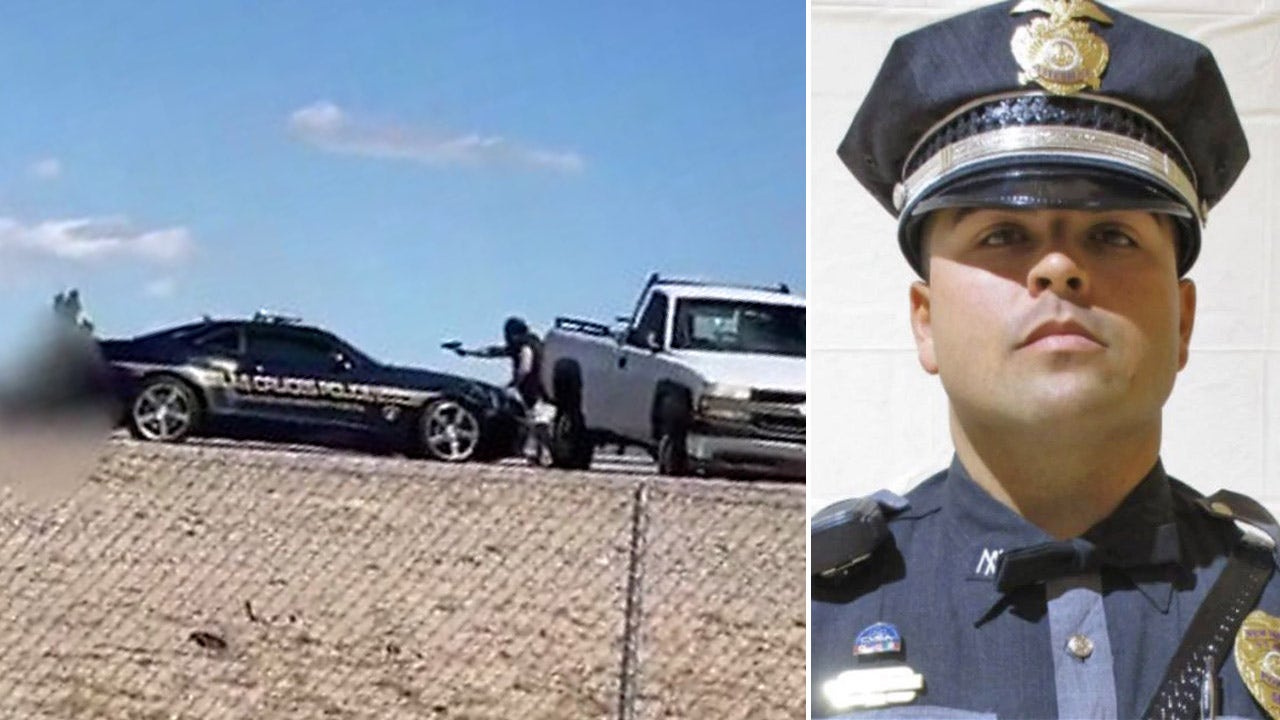
Flawed tactics and poor communications were among the key findings of a New Mexico State Police internal review of the deadly shooting of an officer who unknowingly stopped an armed drug suspect while he was being tracked by federal agents as part of an undercover operation in February 2021.
The report released Wednesday provides excruciating detail — partially drawn from dashboard and body-worn camera footage — of the death of Officer Darian Jarrott. He was killed by a burst of gunfire during a traffic stop on Interstate 10.
The report also describes the killing of drug trafficking suspect Omar Cueva-Felix after a 40-mile vehicle chase and a shootout with authorities in Las Cruces.
TERRORISTS WHO HELD CHILDREN AT NM DESERT COMPOUND SENTENCED TO LIFE, BUT THEY PLAN TO APPEAL
It concludes that two U.S. Homeland Security Investigations agents and a State Police supervisor provided conflicting accounts about whether the supervisor received “full disclosure” about Cueva-Felix’s criminal history and an HSI plan to arrest him along the interstate.
“Omar Cueva-Felix killed Officer Jarrott in cold blood, and unfortunately, we cannot change that,” New Mexico State Police Chief Troy Weisler said in a statement that accompanied the release of the report.
The chief said the review resulted in several internal departmental policy changes and discussions about possible alternative actions and tactics for certain situations.
“The highlighting of mistakes by different individuals involved in the incident and noting areas for improvement is done solely to learn and find ways to operate more safely,” Weisler said.
New Mexico State Police Officer Darian Jarrott, pictured at right, is fatally shot on video by Omar Cueva-Felix following a vehicle chase. (Austin Contreras via Storyful/New Mexico State Police)
Jarrott, 28, was the first New Mexico State Police officer killed in the line of duty in more than 30 year. A father of four, he became a state police officer in 2015 after working as a state transportation inspector.
The incident spawned multiple lawsuits that allege both HSI and Jarrott’s superiors were negligent and did not warn the officer of Cueva-Felix’s dangerousness beforehand. A federal judge in Albuquerque dismissed one of the cases last July with a ruling that the government was immune from liability.
A State Police supervisor had asked Jarrott to pull over Cueva-Felix at the behest of federal agents. The request was made after the suspect sold a large quantity of drugs to an undercover agent, showed off a large rifle and told them he wasn’t going back to prison.
Cueva-Felix, 40, of Deming, had what authorities described as an extensive criminal history in California and was known to carry firearms.
The fatal traffic stop occurred the afternoon of Feb. 4, 2021, on I-10, about 15 miles east of Deming. Within minutes, Jarrott was ambushed and shot multiple times. Cueva-Felix then led authorities on a chase that ended with him being killed in Las Cruces during a shootout that also injured a city police officer.
Eric McLoughlin, acting special agent in charge of Homeland Security Investigations El Paso, said in a statement provided to the Albuquerque Journal that the agency is reviewing the report and the committee’s recommendations regarding joint enforcement actions. He also reiterated the agency’s condolences for Jarrott’s death.
McLoughlin said the New Mexico State Police is among many law enforcement agencies with which his agency works and special agents are often embedded as task force members with other local, state and federal law enforcement agencies.
According to the review, no State Police officers were at an official operation briefing and Jarrott was not included in text messages with federal agents about the plan. It also noted that there was no incident command structure in place, even though two agencies and different HSI elements were working in cities 60 miles (96 kilometers) apart.
The review also found that Jarrott didn’t appear to pick up on “danger cues” after stopping Cueva-Felix and should have “changed his tactics” once he spotted a handgun on the suspect’s hip.
Read the full article from Here

Los Angeles, Ca
Arrest made in deadly shooting at 4th of July gathering in Compton; search for 2nd suspect continues

Los Angeles County Sheriff Robert Luna gave an update Thursday on several shootings over the Fourth of July weekend that left three people dead and several others injured.
Police arrested Antoine Jones, a 50-year-old man from the Los Angeles area, who they believe is responsible for the murder of a 19-year-old woman and the attempted murder of two additional surviving female victims who were attending a large community block party in Compton.
On July 4 at approximately 11:40 p.m., deputies from the Compton station responded to an apartment complex on the 700 block of West Laurel Street following reports of multiple people being shot.
Meah Bordenave-Jenkins, a 19-year-old nursing student at the University of Nevada, Las Vegas, was killed when gunfire broke out at the party.
Deputies located Bordenave-Jenkins and the two other women suffering from gunshot wounds outside of the apartment complex.
“While today’s announcement represents an important step towards justice for Meah and her family, our work is very far from being over,” said LASD Sheriff Robert Luna.
The LASD is also seeking the public’s help in identifying those responsible for the murder of Eric Washington, 37, a beloved community activist and former government staffer, and the attempted murder of another surviving man injured that same night at the same party.
Washington was reportedly killed while trying to deescalate a conflict at the party, his family said. Deputies found victim Washington suffering from a gunshot wound inside the complex.
Investigators later learned that another man had also been shot at some point during the incident.
Bordenave-Jenkins and Washington both died from their injuries. The remaining victims, two women and a man, sustained non-life-threatening injuries and have been released from the hospital. They have not been identified by police.
Detectives determined the two shootings happened moments apart at the party but appear to be separate and unrelated.
-

A man and a women were killed and three others were injured, one critically, at a Fourth of July Party in Compton on July 4, 2026. (OnScene.TV) -
A shooting at a Compton Fourth of July block party in the 2100 block of Grandee Avenue in Compton left one man dead and another injured on July 5, 2026. (OnScene.tv) -
A shooting at a Compton Fourth of July block party in the 2100 block of Grandee Avenue in Compton left one man dead and another injured on July 5, 2026. (OnScene.tv) -
A shooting at a Compton Fourth of July block party in the 2100 block of Grandee Avenue in Compton left one man dead and another injured on July 5, 2026. (OnScene.tv) -
A shooting at a Compton Fourth of July block party in the 2100 block of Grandee Avenue in Compton left one man dead and another injured on July 5, 2026. (OnScene.tv) -
A shooting at a Compton Fourth of July block party in the 2100 block of Grandee Avenue in Compton left one man dead and another injured on July 5, 2026. (OnScene.tv) -
A shooting at a Compton Fourth of July block party in the 2100 block of Grandee Avenue in Compton left one man dead and another injured on July 5, 2026. (OnScene.tv) -
A shooting at a Compton Fourth of July block party in the 2100 block of Grandee Avenue in Compton left one man dead and another injured on July 5, 2026. (OnScene.tv) -
A shooting at a Compton Fourth of July block party in the 2100 block of Grandee Avenue in Compton left one man dead and another injured on July 5, 2026. (OnScene.tv) -
A man and a women were killed and three others were injured, one critically, at a Fourth of July Party in Compton on July 4, 2026. (Google) -
A man and a women were killed and three others were injured, one critically, at a Fourth of July Party in Compton on July 4, 2026. (OnScene.TV) -
A man and a women were killed and three others were injured, one critically, at a Fourth of July Party in Compton on July 4, 2026. (OnScene.TV) -
A man and a women were killed and three others were injured, one critically, at a Fourth of July Party in Compton on July 4, 2026. (OnScene.TV) -
A man and a women were killed and three others were injured, one critically, at a Fourth of July Party in Compton on July 4, 2026. (OnScene.TV) -
A man and a women were killed and three others were injured, one critically, at a Fourth of July Party in Compton on July 4, 2026. (OnScene.TV) -
A man and a women were killed and three others were injured, one critically, at a Fourth of July Party in Compton on July 4, 2026. (OnScene.TV)


Detectives identified Jones as the suspect responsible for Bordenave-Jenkins’ death and the attempted murder of the two surviving women. Authorities located Jones on July 14 in Los Angeles and took him into custody.
The LASD is still searching for the suspect or suspects responsible for the murder of Washington and the attempted murder of the surviving male victim.
“Although today’s arrest is significant, this investigation remains extremely active,” Luna said.
“There were hundreds of people at this gathering,” Luna said. “Somebody knows, somebody saw or somebody heard what happened.”
The LASD also announced they’re searching for a suspect in a separate shooting at a different Fourth of July gathering that occurred in the early morning of July 5.
At approximately 12:10 a.m., Compton deputies responded to the 2100 block of North Grandee Avenue, where they located a 30-year-old victim, Thaddeus Clark, and a second victim suffering from gunshot wounds at the gathering.
Clark, a father of three, did not survive his injuries, Luna said.
The LASD is urging anyone with information about Clark’s murder and the attempted murder of the surviving victim to contact the LASD Homicide Bureau.
Although these shooting incidents occurred at gatherings less than an hour apart, investigators found no evidence that the two were connected, Luna said.
Luna also announced three suspects have been arrested in connection with a shooting in East L.A. on July 5. It happened as crowds crossed the intersection near Whittier Boulevard and Leonard Avenue during a World Cup match.
Four people were hit by gunfire, including two men, one woman and a boy. None of the injuries were life-threatening.
The sheriff said the alleged shooter, a 15-year-old known gang member, was arrested. Two female suspects, ages 21 and 38, have been arrested in the Lancaster and Palmdale areas for their alleged roles in luring the primary victim to the location and assisting the shooting suspect in evading arrest.
They’re all facing four counts of attempted murder.

A broken water main sent water gushing from an apartment building and turned nearby streets into rivers in West Hollywood early Thursday morning. The break was reported around 3 a.m. near Holloway Drive and Sunset Boulevard. “It’s a rupture of one of the significant mains that goes through here. West Hollywood, as it turns out, […]

After more than four decades, the remains of a woman who was found buried in the mountains of Riverside County were identified as a multi-millionaire who went missing in 1981.
The body of Thelma Gaston was discovered by a person gathering firewood in a mountainous area near Sugar Loaf Mountain and the Pinyon Crest community on Nov. 28, 1981.
After experiencing a series of heartbreaking life events, including the death of her husband and her 32-year-old son in the same year in 1957, Gaston continued forging ahead, focusing on her business of buying repossessed properties and selling them.
By 1980, she had amassed a fortune estimated to be over $20 million, SFGATE reported.
On June 28, 1981, a note was left on the front door of her home near Century City, saying she was out searching for her cat. However, she never returned home and her loved ones did not hear from her.
By then, Gaston was 80 years old. As Los Angeles Police Department detectives investigated her disappearance, they discovered a younger man, Lawrence Remsen, then 39, had recently entered her life and was the woman’s romantic companion, SFGATE reported.
At one point, the woman’s friends said Gaston had wondered about Remsen’s motives in being with her.
Police eventually found letters and documents reportedly signed by Gaston that gave Remsen power of attorney. Another letter allegedly written by the woman claimed she had run away “to have some fun in life.” However, her friends said the move was completely out of character.
Detectives later confirmed the letters were certified with a stolen notary stamp and her signatures were believed to be forged.
Remsen had tried selling some of Gaston’s properties and attempted to withdraw more than $100,000 from her bank accounts. Remsen eventually fled the Southern California area.
A few months later, he was arrested by border agents when he tried to enter the U.S. from Mexico. He was charged with Gaston’s murder even though the woman’s body had not been found.
During a trial hearing, Remsen later claimed he found the woman dead of natural causes in her home and, attempting to take her fortune, had disposed of her body in the ocean.
The judge disagreed and later ruled that Remsen had killed the woman “intentionally and with malice.” He was convicted of murder and sentenced to life in prison.
Gaston’s body was later discovered buried in a shallow grave in the mountains. However, due to the poor condition of the remains, investigators were unable to narrow down an identity.
A breakthrough occurred in 2022 when the Riverside County Sheriff’s Coroner’s Bureau received new funding to reexamine long-standing unidentified cases.
“Combined with significant advances in forensic science, this funding opened new avenues for identification,” the sheriff’s office said.
In May 2026, utilizing investigative genetic genealogy and dental records, the remains were positively identified as Gaston’s.
“The Riverside Sheriff’s Coroner’s Bureau extends its sincere appreciation to everyone whose dedication, expertise, and perseverance made this identification possible,” officials said in a statement. “Together, these efforts have ensured that Ms. Gaston has her name—and her story—returned to her.”
Remsen, who is now 83 years old, continues serving his life sentence at the California Institution for Men in Chino.
-
 News8 minutes ago
Flood sirens blare in South Central Texas as rivers reach perilous heights
-

 Los Angeles, Ca2 hours ago
Arrest made in deadly shooting at 4th of July gathering in Compton; search for 2nd suspect continues
-

 Detroit, MI2 hours ago
Detroit crime hits decades-low as Michigan governor candidates debate how to keep progress going
-

 San Francisco, CA2 hours ago
Operator of boat that capsized near Alcatraz mourns brother as search continues
-

 Dallas, TX2 hours ago
Mavericks vs Thunder Game Preview and Injury Update
-

 Miami, FL3 hours ago
Miami Dolphins Fans Vs. The Media
-

 Boston, MA3 hours ago
Man who allegedly shot at Boston Police officers arrested after foot chase in Dorchester
-

 Denver, CO3 hours ago
Swan, dragon and duck boats are back pedaling around City Park

