Washington, D.C
The Ned announces its Washington D.C. opening • Hotel Designs


In 2017, The Ned established itself as a space for the discerning in London before expanding to New York and Doha. Each Ned’s Club location is unique, drawing from the rich histories of their settings yet unified by a common philosophy to share a space where professionals can meet, create, revel and have a good time.

Image credit: Ned’s Club/Rendering
The fourth and newest location— Ned’s Club Washington D.C., is inspired by the glamour of the ‘roaring twenties’ era and neoclassical designs, paying tribute to the Club’s location at the intersection of two historic properties, the 12-story Walker Building and an old bank building. The Club will occupy the upper three floors once home to iconic D.C. institutions such as Riggs Bank and American Security and Trust Company, and honour the Capital’s rich history with vintage vibes of the Art Deco era.
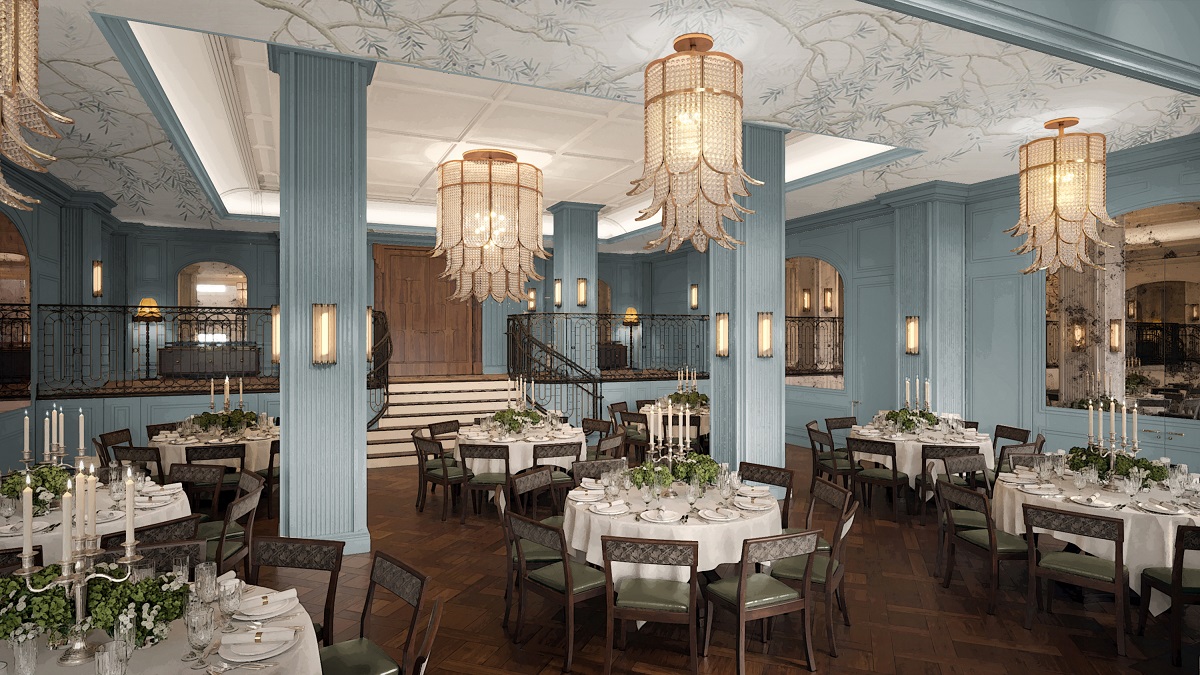
Image credit: Ned’s Club/Rendering
“We are thrilled to unveil Ned’s Club Washington D.C., our modern interpretation of the private member’s club, as the latest in our global collection,” expressed Gareth Banner, Group Managing Director. “It’s an honour to welcome new members to this extraordinary venue, which stands as a testament to the city’s rich history. At Ned’s Club Washington D.C., we’re not just providing physical spaces but an environment that reimagines networking, entertainment, dining and events in an iconic building and location that only D.C. could offer.”

Image credit: Ned’s Club/Rendering
Taking residence within President’s Park, with a panorama of the U.S. Treasury and White House, Ned’s Club Washington D.C. offers a globally-influenced design that complements D.C.’s distinctive character.
The interiors, by Soho House Design and Stonehill Taylor, pull inspiration from the property’s Art Deco historical vestibule. Throughout the member club floors, history and art converge with custom mosaic designs on the floor complemented by a palette of vibrant gold, blue, and green. Here, members are treated to a range of spaces designed to fuse work and leisure. The tenth floor stands as a tribute to former U.S. presidents, each room reflecting the unique styles of their eras.

Image credit: Ned’s Club/Rendering
By day, The Library resonates with calmness—its furnishings echoing the sophisticated elegance reminiscent of past eras, complete with a classic fireplace. At night, it transforms into a vibrant social space with an elegant bar. The Drawing Room extends beyond culinary offers, presenting sweeping views of Washington D.C.’s iconic landmarks. The Dining Room features stained-glass fixtures and rich wooden accents to create an ambiance akin to the sun-drenched dining settings treasured during the Kennedy years.
Within the Conservatory, members are welcomed into an indoor space with greenery and natural aesthetics. Perched at the pinnacle, the Loft Restaurant and Rooftop Terrace are adorned with custom mosaic artworks that pay homage to the historical Walker Building. Here, guests indulge in sweeping views from a vantage point that captures the grandeur of the US capital.

Image credit: Ned’s Club/Rendering
Following the other Ned art collections, which illustrate inclusivity at their core, Ned’s Club Washington D.C. will exhibit two permanent art collections. The first is a pointed look at gender imbalance in the American political landscape. Taking as its starting point the ratio of male presidents in American history to the number of women Presidents, the collection inverts these numbers. Entitled No President and displayed in one space together, a carefully selected collection will present the work of 46 American women artists. The second collection champions local artists, displaying the work of those who are born, based, or trained in Washington, D.C. The local collection will include site-specific commissions and a diverse range of artists, from museum-level names to emerging talent.
In addition to world-class design, members can look forward to a host of tailored events such as CEO-led workshops, rare whisky tastings, panel discussions, live music, and entertainment that capture the spirit of D.C. Ned’s Club members also enjoy access to all members-only spaces at The Ned London, The Ned NoMad New York and The Ned Doha, as well as invitations to special offsite events around the world.
Main image credit: Ned’s Club / Rendering



The U.S. celebrates 250 years since signing the Declaration of Independence July 4. D.C. will be packed with America250 events and celebrations.
This summer many of D.C.’s top museums are showing new exhibits that explore American history. There’s an activity for everyone to enjoy this summer, from a new view of the Lincoln Memorial to new exhibits at the Smithsonian Air and Space Museum.
Most Smithsonian museums are open daily, including on July 4, from 10 a.m. to 5:30 p.m.
Photo by Smithsonian Institution
Air and Space Museum
The Air and Space Museum is nearing the end of the multi-year renovations that began in 2018 just in time for America 250. On July 1 the museum unveils five new exhibits:
If you’re interested in learning more about the history behind space technology and how the U.S. has used air and space tech in the past, you should check out RTX Living in the Space Age Hall and the Jay I. Kislak World War II In The Air exhibits.
If interactive exhibits are more your speed, the TEXTRON How Things Fly exhibit will feature nearly 50 interactive works. The Flight and the Arts Center is a great choice for art and space lovers alike, and the U.S National Science Foundation Discovering Our Universe explores the tools that move what we know on space forward.
Admission is free, but you must get a timed ticket.
Smithsonian Castle: American Aspirations Exhibition
Although “the pursuit of happiness” is among the most well-known cornerstones of the Declaration of Independence, this exhibit at the Smithsonian Castle challenges viewers to consider the other ideals America aspires to, including liberty, new horizons, fairness, democracy and hope. Through a collection of some of America’s most notable objects, from Harriet Tubman’s Hymnal to Thomas Edison’s lightbulb, the exhibit explores how America has sought to live up to its ideals through its history.
This exhibit will be open through Sept. 7 before the castle again closes for renovations. Admission is free.
Lincoln Memorial Undercroft

Images courtesy of the National Park Service
What better way to celebrate America 250 than to explore the hidden foundations of one of its most iconic monuments? The Lincoln Memorial’s undercroft opened June 25, featuring 15,000 sq feet of structural framework and exhibits that trace the history of President Lincoln and the memorial. Viewers can learn about the construction of the building, its place in American history and its impact in the civil rights movement as they walk through the caverns of concrete columns.
It’s free to visit, but every visitor age 2 and up needs a timed-entry ticket. You can reserve tickets in advance on recreation.gov or by calling 877‑444‑6777. Note, there’s a $1 service fee for every reservation. You can also pick up same-day tickets on the National Mall.
The Undercroft exhibit will be closed on July 4, but open the rest of the holiday weekend.
Arts and Industries Building: Voices and Votes
The Arts and Industries Building houses an exhibit based off an exhibition currently on display at the Smithsonian’s National Museum of American History. This new exhibit explores American democracy and asks visitors to engage in deeper questions about what democracy in America means. It includes photos, videos, items and interactive displays. Admission is free.
MLK Library: District Vibes/American Pride: How DC Changed American Culture
If you’re looking for a D.C. twist to America 250, look no further than D.C. Public Libraries! With art, artifacts and programming throughout the summer, the Martin Luther King Jr. Memorial Library will show how D.C. and American history are intertwined. Admission is free.
Other DCPL libraries will offer events on this theme and other America 250 events, too.
D.C. libraries will be closed on July 3 and 4.
Building Museum: THE PLAYGROUND

Daybreaker FUN HOUSE at the National Building Museum (Joy Asico/Asico Photo)
The National Building Museum’s historic Great Hall will see a fun-filled transformation this summer as they collaborate with New York-based design firm, Snarkitecture, for the third time. This collab will transform the Great Hall into an interactive playground. The playground aims to show America’s story through relationships and memories made by community.
“The Playground” brings outdoor activities indoors, giving museumgoers the rare opportunity to be a part of the art. The exhibit will open July 3 and run through Aug. 30. The events schedule includes evening hours for adults to enjoy, and special activities for kids.
To visit The Playground, book museum admission between 10:30 a.m. and 3:30 p.m. Tickets cost $15.95-$18.95 (infants under 2 can visit for free).
National Gallery of Art: Dear America
The National Gallery of Art’s latest exhibit is a love letter to America, exploring what it means to be an American through 100 different works. The multimedia exhibit features drawings, photographs and prints in which artists asked, “What does it mean to be American?” It includes works by Roy Lichtenstein, Carrie Mae Weems and Tonita Peña. Admission is free, and the museum is set to be open on July 4.
National Museum of Women in the Arts: Celebrate Women Artists Throughout America 250
The National Museum of Women in the Arts is celebrating women who shaped American history and art.
Exhibits include “Ms. Americana,” which features 10 paintings from American women artists. They also will feature an exhibit on Pueblo pottery from the North American Southwest called “Burnished: Pueblo Pottery at NMWA” and another on quilts in the Second Great Migration called “Routed West: Twentieth Century African American Quilts in California.”
Tickets are $16 for adults or $13 for D.C. residents and those 65+. People under 21, visitors with disabilities and SNAP/EBY holders can go for free. There are also free community days, including on Sunday, July 5. Make sure to book those tickets in advance.
From These Lands: Sharing Our Natural and Cultural Heritage
This summer, the National Museum of Natural History unveils its new exhibit focused on connections between people, places and the natural world. The exhibit will feature items from all 50 states, D.C. and the five inhabited U.S. territories. This exhibit opens on June 18, but patrons can visit until 2029. Admission is free.
American History Museum: In Pursuit
The National Museum of American History is displaying a new exhibit, highlighting 250 items spanning from the 1700s to the present day that reflect the ideals of the Declaration of Independence. The exhibit is on all three floors of the museum with pieces that aim to highlight how Americans have pursued the promise signed in 1776. The exhibit will last until the end of the year. Admission is free.
Subscribe to The Weekend Scene, our free newsletter about events, experiences and adventures for you and for your family around the DMV.

D.C. released draft plans for the community surrounding a new Washington Commanders stadium at the former site of RFK Stadium.
Renderings included with the draft plan show the idea is to have a community with open spaces, parks, retail and housing. Walkability and access to the Anacostia River were essential for many who weighed in.
“We’ve been working throughout the development of this master plan with WMATA and the District Department of Transportation, and in this project, as all projects, having lots of ways for people to get to one place is really important, whether on foot, on bike, you’re in a vehicle, you’re taking transit, you’re taking Metrorail or the bus – all of those are provided for,” Office of Planning Director Anita Cozart said. “So, the big part of the master plan is making sure that there is space for those.”
The master plan includes space for a grocery store and as many as 6,500 new houses with 30% of those houses dedicated as affordable.
The community will develop around the stadium after it’s built, Cozart said.
The plan includes the visions and desires of thousands of people and agencies who weighed in on it, but it’s not final. The public is invited to inspect the plan and comment until Aug. 14.
“What did we get right about this master plan; what are some things that we might need to tweak,” Cozart said. “The next step after that is the master plan goes to the City Council.”

Club exercises Tamara Bolt’s 2027 option, extends Madison Haugen through end of season
Washington, D.C. (06/30/2026) – The Washington Spirit has made two midseason roster moves ahead of the resumption of the regular season early next month, the club announced today. The club has exercised its 2027 option on forward Tamara Bolt’s contract and extended short-term injury replacement (STR) player Madison Haugen through the end of the 2026 season.
“As we look ahead to kicking off the second half of the season, we’re confident in the group of players we have together and our midseason roster moves reflect that,” said Sporting Director James Hocken. “Our roster is constantly evolving to best serve the club’s aim of bringing trophies home to DC.”
Bolt signed with the Spirit in January 2025 before spending the calendar year on loan with Dallas Trinity FC of the USL Super League. Since returning to DC prior to this season, the Salvador, Brazil native has appeared in five matches for the Spirit. Bolt played three seasons with top-flight Brazilian side SC Internacional before joining the Spirit, appearing in 36 matches and tallying six goals in the process.
Haugen joined the Spirit as a short-term injury replacement player this past preseason, adding depth to the team’s roster in the absence of its players out on maternity leave. The defender has yet to appear in a match for the Spirit this season. Haugen most recently competed for Portugal’s Sporting CP, scoring five goals across 21 appearances.
The Spirit maintains ongoing conversations with all players that will be free agents following the 2026 season. Updates will be provided as they occur.
The Spirit will next take the pitch at Audi Field on Friday, July 3 when the side returns from the NWSL-wide June break to host the Houston Dash. Kicking off the holiday weekend at 8 p.m. EDT, tickets are available at WashingtonSpirit.com/tickets.
About The Washington Spirit
The Washington Spirit is the premier professional women’s soccer team based in Washington, D.C. and plays at Audi Field in Buzzard Point. The Spirit was founded on November 21, 2012 and is an inaugural member of the National Women’s Soccer League (NWSL), the fastest growing sports league in the US. The club is home to some of the best players in the world who have won championships for both club and country. For more information about the Spirit, visit WashingtonSpirit.com and follow the club on Twitter, Instagram and Facebook.
-

 San Diego, CA52 seconds ago
An Apprentice Program for Commercial Fishing
-
Milwaukee, WI6 minutes ago
Connecting Milwaukee teens to summer work
-

 Atlanta, GA13 minutes ago
Conference offers safe space for gay men to unpack the stigmas, challenges of adoption and surrogacy
-

 Minneapolis, MN16 minutes ago
Westbound I-94 reopens in Minneapolis after fatal crash
-

 Indianapolis, IN21 minutes ago
Edwards Checks Out At Indianapolis – SPEED SPORT
-

 Pittsburg, PA22 minutes ago
Analysis: Here’s why the Pittsburgh Symphony’s budget just jumped by $7 million to $42 million
-

 Augusta, GA28 minutes ago
Augusta’s role in the American Revolution: An underdog story 250 years in the making
-

 Washington, D.C31 minutes ago
Looking for indoor July 4 plans in DC? Try these America250 exhibits


