By the sixth inning, DJ Herz had mastered his strikeout strut. He had done it 10 times entering the frame, and with each ensuing punchout, his stalk around the mound became just a bit more pronounced.
Washington, D.C
Rookie DJ Herz delivers historic dominance as the Nats blank Marlins


His last hitter in the Nationals’ 4-0 win over the Miami Marlins on Saturday afternoon at Nationals Park was Tim Anderson, who had fanned twice. Herz got up 0-2, and Anderson asked for time in a bid to disrupt Herz’s timing. Nothing else worked to that point, so maybe a few extra seconds could rattle the 23-year-old rookie.
No chance. Two pitches later, Herz threw a 93-mph fastball by Anderson for his 13th and final strikeout. And when Anderson swung through the pitch, Herz showed off more than a strut. This time, he turned his back to the home dugout, backpedaled and put his hands out before shaking his glove.
“This outing, I wanted to control my body language a little bit more, be a little better at that,” Herz said. “The first five innings, it was perfect. And then I got the last strikeout, and I kind of had a feeling that I was done. And I just let my emotions fly a little bit.”
Before his start, Herz said he had a conversation with Jake Irvin about wanting to be emotionless on the mound. “I just wanted to go out there and be a stone-cold killer.”
Mission accomplished. The only blemish in his six innings was a Jake Burger single that got past Trey Lipscomb to start the fifth inning. The Nationals (34-36) have won seven of eight and will go for a series sweep Sunday.
Manager Dave Martinez pulled Herz after the sixth. The numbers: one hit, 13 strikeouts, 84 pitches, 57 for strikes. And perhaps most important to Herz: no walks.
“He and [catcher Drew] Millas worked really good and very quick,” Martinez said. “And they did get into that rhythm, and he was feeling it.”
In a Nationals season that will be defined by the growth of the team’s young starters, Herz could be the surprise of the bunch. The team knew Josiah Gray, MacKenzie Gore and Jake Irvin would be big league contributors this season, and Mitchell Parker has been a welcome addition. But Herz, a 6-foot-2 left-hander acquired from the Cubs at the trade deadline last season in the Jeimer Candelario deal, delivered one of the best starts in the majors this season.
Per OptaStats, his 68.4 strikeout percentage (13 of the 19 hitters faced) was the second highest by an MLB rookie in the modern era with a minimum of 15 batters faced, trailing only the Cubs’ Kerry Wood in his 20-strikeout game from 1998. His strikeout total was the most by a Nationals pitcher since Max Scherzer fanned 14 in May 2021.
“Everything was working tonight, so we couldn’t really go wrong,” Millas said.
One more fact from the start that has local appeal: Herz became one of two MLB pitchers with a start of at least 13 strikeouts and no walks in one of his first three outings since 1901 — the other being Stephen Strasburg in his debut June 8, 2010. Pretty good company, especially for a guy who didn’t make it out of the fifth inning in each of his first two starts. He was on a pitch limit in his major league debut. And in the second, it took him 87 pitches to get through 4⅓ innings.
Herz couldn’t consistently throw his best pitch, his change-up, in the zone in his first two outings. But he told pitching strategist Sean Doolittle that he felt different entering this start.
This time around, Herz was efficient in the first four innings as he racked up the strikeouts. He struck out four and threw just 24 pitches in the first two innings. In the third, Herz struck out the side and followed that up with one more in the fourth. He retired the first 12 Marlins before Burger’s single.
“The game didn’t speed up. That’s probably the most calm and relaxed I was,” Herz said. “It’s all about, for me at least, getting comfortable. That might take a little time, but it’s starting to come now.”
The Nationals’ offense jumped out to a 1-0 lead in the first when Lane Thomas doubled, Jesse Winker — who exited in the third inning and will get an MRI exam on his right knee — singled and Joey Meneses hit a sacrifice fly. Thomas hit his second home run in as many days in the third inning to extend the Nationals’ lead. Meneses added a two-run blast in the eighth.
Herz, meanwhile, induced 21 whiffs in 45 swings, including 13 on four-seam fastballs. The Marlins swung through fastballs right down the middle. They watched change-ups paint the corners for called strikes and shook their heads. They chased in the dirt. And as each Marlins hitter slumped back to the dugout, Herz continued to strut.
“I mean, it still doesn’t feel real,” Herz said. “I’m super blessed. That was my probably my best game I’ve ever pitched. And to do it at this level, it’s a great feeling.”
Notes: The Nationals announced they agreed to terms on a minor league contract with outfielder Harold Ramirez, who will report to Class AAA Rochester. Ramirez, 29, is a six-year major league veteran who was designated for assignment by the Tampa Bay Rays last week. He also had stints with the Miami Marlins and Cleveland Guardians. Ramirez hit .313 with 12 home runs and a .813 OPS a season ago but hasn’t produced the same pop this season; he’s hitting .268 with a .589 OPS and only four of his hits have been for extra bases. . . .
Cade Cavalli threw two innings and around 45 pitches in a live bullpen session Saturday afternoon, facing Trey Lipscomb and Nasim Nuñez. Cavalli said his arm felt good as he works his way back from Tommy John surgery.



Washington, D.C
What’s that noise? What you need to know about D.C. flyovers Friday and Saturday – WTOP News

Reagan National Airport will close for America 250 flyover rehearsals Friday and celebrations Saturday featuring the Thunderbirds, Blue Angels and more.

Reagan National Airport will close from 10 a.m. to 1 p.m. Friday for rehearsals ahead of this weekend’s America 250 celebrations, meaning people around D.C., Arlington and Alexandria may hear and see low-flying military aircraft.
According to Freedom 250 event organizers, Friday’s “Wings of Freedom” demonstrations over the National Mall will feature parachute teams, helicopters and military aircraft, including the U.S. Marine Corps’ MV-22 Osprey and F-35B, the Navy’s F-18F and F-35C, the Air Force’s F-22 Raptor, the Thunderbirds and a tri-bomber formation.
On Saturday, the FAA will close the airport from noon to midnight for the full celebration. All arrivals and departures at Reagan National are scheduled to end before noon.
Flyovers and demonstrations are scheduled throughout the afternoon and evening along the National Mall and Washington Monument grounds, including appearances by Air Force One, the Thunderbirds, Blue Angels, military aircraft fleet reviews, parachute demonstrations and B-2 stealth bombers.
Highlights include an Air Force One flyover scheduled for 7:03 p.m., a Thunderbirds demonstration beginning at 6:25 p.m., a tri-bomber formation at 6:02 p.m. and a stealth aircraft flyover at 7:38 p.m.
Friday’s schedule of flyovers and demonstration rehearsals along the National Mall and Washington Monument
- 10 a.m.: Golden Knights, Leap Frogs
- 10:15 a.m.: Army Helo Flyover
- 10:20 a.m.: USMC V-22 Osprey Demo
- 10:35 a.m.: USMC F-35B STOVL Demo
- 10:50 a.m.: USN F-18F Demo
- 11:10 a.m.: USN F-35C Demo Team
- 11:30 a.m.: USAF F-22 Raptor Demo
- 11:50 a.m.: NASA F-5s
- 12 p.m.: HUGE (1) Formation
- 12:05 p.m.: USAF Thunderbirds
- 12:55 p.m.: USAF Tri-Bomber
Saturday’s schedule of flyovers and demonstration along the National Mall and Washington Monument
- 1:14 p.m.: – NASA F-5 Flyover
- 1:24 p.m.: -NASA Fleet Review
- 1:44 p.m.: USCG Helo Flyover
- 1:54 p.m.: USCG Fixed Wing Flyover
- 2:09 p.m.: Golden Knights, Leap Frogs
- 2:29 p.m.: Army Helo Flyover
- 2:44 p.m.: USAF Fleet Review – Wave 1 – Heavies
- 2:54 p.m.: USAF Fleet Review – Wave 2 – AFSOC
- 3:04 p.m.: USAF Fleet Review – Wave 3 – Fighters
- 3:29 p.m.: Executive Rotary Wing Airlift
- 3:39 p.m.: USMC Fleet Review – Wave 1 – Rotary
- 3:49 p.m.: USMC Fleet Review – Wave 2 – Fixed Wing
- 3:59 p.m.: USN Fleet Review – Wave 1 – Rotary
- 4:09 p.m.: USN Fleet Review – Wave 2 – Fixed Wing
- 4:19 p.m.: USN Fleet Review – Wave 3 – Fighters
- 4:21 p.m.: USN F-18F Demonstration
- 4:59 p.m.: USN Blue Angels
- 5:26 p.m.: USMC MV-22 Osprey Demonstration
- 5:44 p.m.: USAF Fleet Review – Fighters
- 6:02 p.m.: USAF Tri-Bomber Formation
- 6:05 p.m.: USN F-35C Demonstration
- 6:25 p.m.: USAF Thunderbirds Demonstration
- 7:03 p.m.: Air Force One Flyover
- 7:07 p.m.: USAF Thunderbirds Delta Break
- 7:17 p.m.: HUGE 1 Flyover Led by the Newly Renovated Air Force One
- 7:38 p.m.: U.S. Stealth Airpower Flyover
- 7:39 p.m.: F-22 Raptor Demo
- 7:53 p.m.: F-22 Raptor in Afterburner
- 7:59 p.m.: B-1 Flyover
- 8:07 p.m.: B-1’s in Afterburner
- 8:11 p.m.: HUGE ONE Fly Over Review
- 8:22 p.m.: Golden Knights Twilight Jump
- 10:36 p.m.: B-1 Afterburner Night Pass
Get breaking news and daily headlines delivered to your email inbox by signing up here.
© 2026 WTOP. All Rights Reserved. This website is not intended for users located within the European Economic Area.

An Air Force major was arrested in uniform on the steps of the Capitol after he called for the impeachment of President Donald Trump.
U.S. Capitol Police arrested Jason Watson, an active-duty service member, on Wednesday afternoon following remarks at a news conference where he said Trump and Vice President JD Vance should be removed from office.
The event was organized by the Removal Coalition, a group that lobbies members of Congress to impeach Trump, and attended by Rep. Al Green, D-Texas, who has repeatedly introduced articles of impeachment against Trump.
“I’m here with him because Rep. Green is the only member of Congress that has demonstrated the courage and conviction to … force a vote on articles of impeachment,” Watson said at the event. “If Congress followed his example, we could remove the entire Trump administration, but Congress remains unconvinced of the urgency and necessity for them to honor their oaths, so we must persuade them with our unrelenting, uncompromising civil resistance.”
Watson said he is not a Democrat and does not share policy positions with Green, who lost his re-election bid this year. Green’s office did not immediately respond to a request for comment on Watson’s arrest.
Capitol Police said in a statement that it “is generally against the law for the public to demonstrate on the House Steps unless they are with a Member of Congress.”
“Yesterday afternoon, a man was escorted to the House Steps by a Member of Congress,” the statement said. “When the Member of Congress left the area, our officers gave the man lawful orders to stop the illegal demonstration or he would be arrested. The man refused our lawful orders.”
Capitol Police identified the man as Watson, adding that he was arrested on charges of “Crowding, Obstructing, and Incommoding” and that it is legal to protest in other spots on the Capitol grounds.
Service members are subject to stricter laws than the average citizen when it comes to protesting. The Uniform Code of Military Justice prohibits officers from “using contemptuous language towards the President, Vice president, the Secretaries of War and of a military department, Congress, and certain other officials,” according to an Air Force memo last year.
An Air Force spokesperson said in a statement Thursday: “Service members must comply with all laws, regulations and policies governing conduct and the wear of the uniform. All Department of the Air Force personnel are expected to uphold the highest standards of discipline and professionalism, both on and off duty.”
All service members, not just members of the Air Force, are prohibited from participating in “political activities” in uniform.
Watson’s criticism of Trump and Vance focused on the administration’s actions in Venezuela and Iran, calling them “an unconstitutional usurpation of Congress’ authority and a violation of the War Powers Clause.”
“These violations resulted in the deaths of 13 service members and injuries of hundreds more,” he said, referring to the number of U.S. military deaths tied to the Iran war. “For this, the president and vice president must be impeached, convicted and removed.”
Watson also called the administration’s immigration policies and tactics unconstitutional.
The Removal Coalition did not immediately respond to a request for comment, and Watson could not be reached.
President Donald Trump responded to criticism of a financial disclosure that listed $1.4 billion in crypto earnings largely driven by meme coins.
Berk Kutay Gökmen
02 July 2026•Update: 02 July 2026
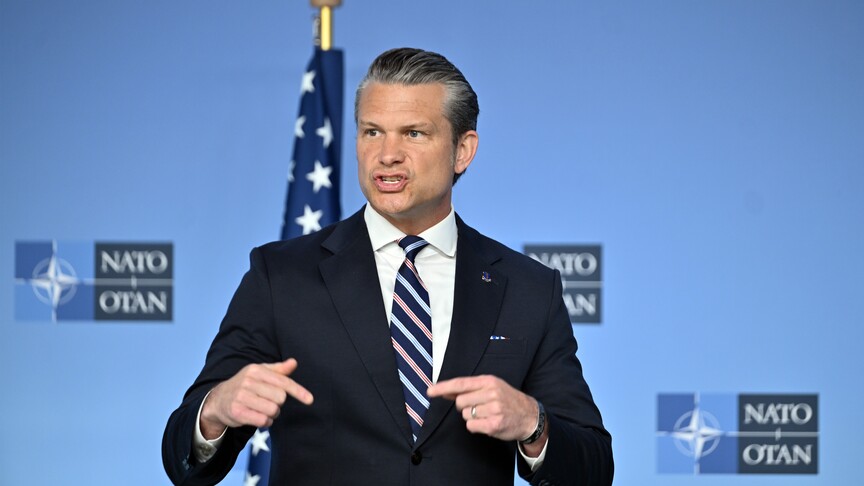
US Defense Secretary Hegseth on Thursday faced protesters while hosting the Trump administration’s DC Safe and Beautiful Task Force ceremony in Washington DC.
During the ceremony at Meridian Hill Park, which saw the gathering of National Guardsmen, dozens of demonstrators gathered near the park to protest Hegseth.
Footage shows the demonstrators chanting a short distance away from where Hegseth and roughly 200 members of the National Guard had gathered in the park
In social media posts, one protester was seen holding a Palestinian flag, while another person was holding a sign that reads “arrest Hegseth.” The protesters want a “Free DC,” according to social media posts.
In his address to the National Guard, Hegseth said that “this background noise is perfect,” referring to the protests.
“It’s the sound of ingrates, of ingratitude—of people who are so blinded by ideology they can’t see law and order and common sense in front of them,” he said.
Meridian Hill Park was repaired by the National Park Service and the Interior Department as part of a larger initiative to restore and enhance federal parks and public spaces throughout the nation’s capital in preparation for America’s 250th anniversary, which falls on this Saturday, July 4.
Though such beautification projects are typically popular with the public, the current initiative has been controversial both for its choice of projects and the use of no-bid contracts to hire firms to do the work, sometimes with disappointing results.
The work aligns with President Donald Trump’s DC Safe and Beautiful Task Force, established by a March 2025 executive order that directs federal agencies to coordinate public safety and beautification efforts across Washington.
-

 Health21 minutes ago
Is Skipping Breakfast Bad? The Weight-Loss Truth May Surprise You
-
 Lifestyle35 minutes ago
Nearly half of Americans surveyed don’t know what America 250 commemorates
-

 Technology46 minutes ago
Amazon updated 2023’s Fire HD 10 tablet with 4GB of RAM
-

 World51 minutes ago
Interpol issues red notice for Ukrainian woman wanted for Monaco apartment bombing targeting oligarch
-

 Politics58 minutes ago
Mamdani blasts ICE agents, Elon Musk and ‘supremacy’ in America 250 speech ahead of July 4 weekend
-

 Health1 hour ago
What killed Americans in 1776? The answer is dramatically different from today
-

 Sports1 hour ago
Knicks champion says he hopes ‘truth comes out’ after leaving team for Eastern Conference rival
-

 Technology1 hour ago
Cheap streaming box could hijack your home internet

