LAS VEGAS — Terik Parascak picked up a standout nickname right off the bat in his first season with the Prince George Cougars.
Washington, D.C
Capitals take winger Terik Parascak with 17th pick in NHL draft


With 43 goals and 62 assists in 68 games, Parascak led all rookies in the Western Hockey League in scoring and was second on Prince George in goals. Zac Funk, whom Washington signed as an undrafted free agent in April, led the team with 67 goals.
“I kind of went on a little bit of a tear at the start and was hot, and I think they started calling me that after that broadcast,” Parascak said. “It just caught on. Everybody calls me that now. … Definitely got a little bit old after a while. I don’t love the attention that much like that, but obviously super cool to have a nickname like that.”
Macklin Celebrini went first overall to the San Jose Sharks. Celebrini, who turned 18 just two weeks before the draft, won the Hobey Baker award as the top player in college hockey — and the youngest — with a 64-point season in 38 games at Boston University.
About 90 minutes later, Parascak heard his name called. His 105-point season was something of a revelation. As a 16-year-old, he was sent back to the Edge School for another year of prep hockey rather than joining the WHL full time as most high-end prospects do at 16. Parascak got a taste of the WHL that season, playing five games scattered throughout the campaign, but didn’t record a point in those four games. At Edge, he averaged more than a goal per game, with 32 goals and 34 assists in just 30 games.
“Really intelligent player. Really, really smart player,” said Washington assistant general manager Ross Mahoney, who oversees amateur scouting. “Sees the ice really well. Has a really good touch around the net. … Hard-working kid. Really like the hands and the hockey sense.”
Looking back now, still processing everything that has happened in the past 12 months, Parascak believes he wouldn’t have become a first-round pick without that extra year of prep hockey.
“Understanding what it takes to jump to a junior level like that,” Parascak said of his leap this season. “I got a little taste for it the year before and just kind of took that information and took it into that last year there. … I wasn’t in a position where I would get enough ice time to really develop my skills and didn’t want to really kind of ruin my development that way. Got them to send me back and build tons of confidence, so I was able to come into this season and do what I did.”
Parascak was projected to go later in the first round or even early in the second in most mock drafts, making his selection at No. 17 potentially a bit of a reach, but the lack of consensus in this draft class opened the possibility of teams taking swings on players for whom they had a particular affinity.
When Parascak heard his name called by General Manager Brian MacLellan, the look of surprise on his face was evident across the enormous screen at the Sphere.
“Just the whole experience of everything, I didn’t really know what to expect,” Parascak said, noting that he had several meetings with the Capitals ahead of the draft. “It was all kind of, just play everything by ear. That was my whole year, just go with the flow of everything. I was definitely surprised but couldn’t be more excited.”
Parascak’s awareness of the game is perhaps his biggest strength, according to scouting reports, which highlight his off-puck positioning and understanding of how to put himself — or his linemates — in positions to score. Whether he’s shooting the puck himself or setting up a teammate, Parascak seems to have a keen grasp of where the scoring areas are, and how to get there.
“Parascak’s off-puck timing and spatial awareness have defined his game, as he regularly gets into the right spots at the right time to bang home rebounds, tap in backdoor passes or get out in transition to give his D a stretch option on outlets (without really cheating for it),” wrote the Athletic’s Scott Wheeler, who had Parascak as the 20th-ranked draft prospect. “He anticipates play offensively and defensively at a very high level, knows how to get open and play to his linemates’ strengths, has a great wrister and one-touch shot from midrange, always goes to the net when the play funnels there instead of hanging out wide, and has skill around the net and in tight to his body when challenged by defenders.”
The next step of Parascak’s development will be to add muscle to his 6-foot, 179-pound frame, which he believes will help improve his skating and give him another gear to reach.
And after taking a slightly unconventional route to being a first-round pick, Parascak views that route as additional motivation to reach the NHL.
“Everything I’ve been through so far has been a learning experience,” Parascak said. “Definitely been cut from quite a few teams growing up and taken that all as a learning experience. That’s kind of shaped me into the person and player I am. Nothing’s ever going to be given to you. You have to earn everything. Everything happens for a reason. Just taking all those things and being able to face adversity like that and hopefully get to where I want to be one day.”



Washington, D.C
What’s that noise? What you need to know about D.C. flyovers Friday and Saturday – WTOP News

Reagan National Airport will close for America 250 flyover rehearsals Friday and celebrations Saturday featuring the Thunderbirds, Blue Angels and more.

Reagan National Airport will close from 10 a.m. to 1 p.m. Friday for rehearsals ahead of this weekend’s America 250 celebrations, meaning people around D.C., Arlington and Alexandria may hear and see low-flying military aircraft.
According to Freedom 250 event organizers, Friday’s “Wings of Freedom” demonstrations over the National Mall will feature parachute teams, helicopters and military aircraft, including the U.S. Marine Corps’ MV-22 Osprey and F-35B, the Navy’s F-18F and F-35C, the Air Force’s F-22 Raptor, the Thunderbirds and a tri-bomber formation.
On Saturday, the FAA will close the airport from noon to midnight for the full celebration. All arrivals and departures at Reagan National are scheduled to end before noon.
Flyovers and demonstrations are scheduled throughout the afternoon and evening along the National Mall and Washington Monument grounds, including appearances by Air Force One, the Thunderbirds, Blue Angels, military aircraft fleet reviews, parachute demonstrations and B-2 stealth bombers.
Highlights include an Air Force One flyover scheduled for 7:03 p.m., a Thunderbirds demonstration beginning at 6:25 p.m., a tri-bomber formation at 6:02 p.m. and a stealth aircraft flyover at 7:38 p.m.
Friday’s schedule of flyovers and demonstration rehearsals along the National Mall and Washington Monument
- 10 a.m.: Golden Knights, Leap Frogs
- 10:15 a.m.: Army Helo Flyover
- 10:20 a.m.: USMC V-22 Osprey Demo
- 10:35 a.m.: USMC F-35B STOVL Demo
- 10:50 a.m.: USN F-18F Demo
- 11:10 a.m.: USN F-35C Demo Team
- 11:30 a.m.: USAF F-22 Raptor Demo
- 11:50 a.m.: NASA F-5s
- 12 p.m.: HUGE (1) Formation
- 12:05 p.m.: USAF Thunderbirds
- 12:55 p.m.: USAF Tri-Bomber
Saturday’s schedule of flyovers and demonstration along the National Mall and Washington Monument
- 1:14 p.m.: – NASA F-5 Flyover
- 1:24 p.m.: -NASA Fleet Review
- 1:44 p.m.: USCG Helo Flyover
- 1:54 p.m.: USCG Fixed Wing Flyover
- 2:09 p.m.: Golden Knights, Leap Frogs
- 2:29 p.m.: Army Helo Flyover
- 2:44 p.m.: USAF Fleet Review – Wave 1 – Heavies
- 2:54 p.m.: USAF Fleet Review – Wave 2 – AFSOC
- 3:04 p.m.: USAF Fleet Review – Wave 3 – Fighters
- 3:29 p.m.: Executive Rotary Wing Airlift
- 3:39 p.m.: USMC Fleet Review – Wave 1 – Rotary
- 3:49 p.m.: USMC Fleet Review – Wave 2 – Fixed Wing
- 3:59 p.m.: USN Fleet Review – Wave 1 – Rotary
- 4:09 p.m.: USN Fleet Review – Wave 2 – Fixed Wing
- 4:19 p.m.: USN Fleet Review – Wave 3 – Fighters
- 4:21 p.m.: USN F-18F Demonstration
- 4:59 p.m.: USN Blue Angels
- 5:26 p.m.: USMC MV-22 Osprey Demonstration
- 5:44 p.m.: USAF Fleet Review – Fighters
- 6:02 p.m.: USAF Tri-Bomber Formation
- 6:05 p.m.: USN F-35C Demonstration
- 6:25 p.m.: USAF Thunderbirds Demonstration
- 7:03 p.m.: Air Force One Flyover
- 7:07 p.m.: USAF Thunderbirds Delta Break
- 7:17 p.m.: HUGE 1 Flyover Led by the Newly Renovated Air Force One
- 7:38 p.m.: U.S. Stealth Airpower Flyover
- 7:39 p.m.: F-22 Raptor Demo
- 7:53 p.m.: F-22 Raptor in Afterburner
- 7:59 p.m.: B-1 Flyover
- 8:07 p.m.: B-1’s in Afterburner
- 8:11 p.m.: HUGE ONE Fly Over Review
- 8:22 p.m.: Golden Knights Twilight Jump
- 10:36 p.m.: B-1 Afterburner Night Pass
Get breaking news and daily headlines delivered to your email inbox by signing up here.
© 2026 WTOP. All Rights Reserved. This website is not intended for users located within the European Economic Area.

An Air Force major was arrested in uniform on the steps of the Capitol after he called for the impeachment of President Donald Trump.
U.S. Capitol Police arrested Jason Watson, an active-duty service member, on Wednesday afternoon following remarks at a news conference where he said Trump and Vice President JD Vance should be removed from office.
The event was organized by the Removal Coalition, a group that lobbies members of Congress to impeach Trump, and attended by Rep. Al Green, D-Texas, who has repeatedly introduced articles of impeachment against Trump.
“I’m here with him because Rep. Green is the only member of Congress that has demonstrated the courage and conviction to … force a vote on articles of impeachment,” Watson said at the event. “If Congress followed his example, we could remove the entire Trump administration, but Congress remains unconvinced of the urgency and necessity for them to honor their oaths, so we must persuade them with our unrelenting, uncompromising civil resistance.”
Watson said he is not a Democrat and does not share policy positions with Green, who lost his re-election bid this year. Green’s office did not immediately respond to a request for comment on Watson’s arrest.
Capitol Police said in a statement that it “is generally against the law for the public to demonstrate on the House Steps unless they are with a Member of Congress.”
“Yesterday afternoon, a man was escorted to the House Steps by a Member of Congress,” the statement said. “When the Member of Congress left the area, our officers gave the man lawful orders to stop the illegal demonstration or he would be arrested. The man refused our lawful orders.”
Capitol Police identified the man as Watson, adding that he was arrested on charges of “Crowding, Obstructing, and Incommoding” and that it is legal to protest in other spots on the Capitol grounds.
Service members are subject to stricter laws than the average citizen when it comes to protesting. The Uniform Code of Military Justice prohibits officers from “using contemptuous language towards the President, Vice president, the Secretaries of War and of a military department, Congress, and certain other officials,” according to an Air Force memo last year.
An Air Force spokesperson said in a statement Thursday: “Service members must comply with all laws, regulations and policies governing conduct and the wear of the uniform. All Department of the Air Force personnel are expected to uphold the highest standards of discipline and professionalism, both on and off duty.”
All service members, not just members of the Air Force, are prohibited from participating in “political activities” in uniform.
Watson’s criticism of Trump and Vance focused on the administration’s actions in Venezuela and Iran, calling them “an unconstitutional usurpation of Congress’ authority and a violation of the War Powers Clause.”
“These violations resulted in the deaths of 13 service members and injuries of hundreds more,” he said, referring to the number of U.S. military deaths tied to the Iran war. “For this, the president and vice president must be impeached, convicted and removed.”
Watson also called the administration’s immigration policies and tactics unconstitutional.
The Removal Coalition did not immediately respond to a request for comment, and Watson could not be reached.
President Donald Trump responded to criticism of a financial disclosure that listed $1.4 billion in crypto earnings largely driven by meme coins.
Berk Kutay Gökmen
02 July 2026•Update: 02 July 2026
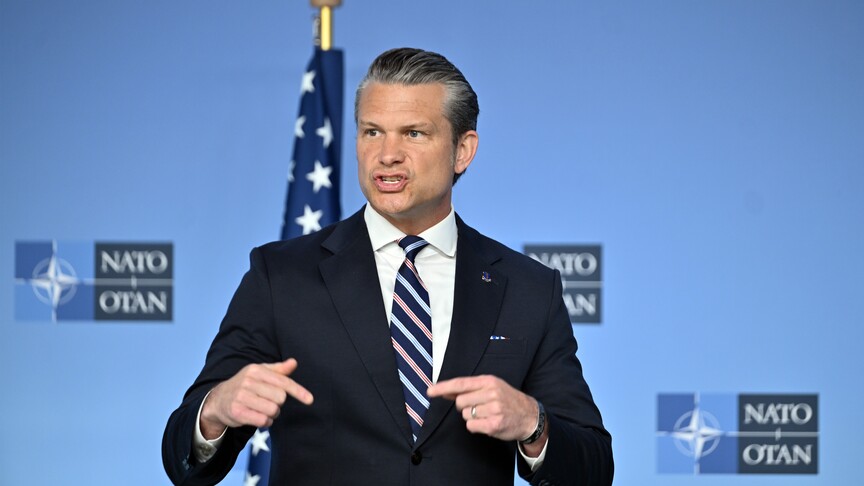
US Defense Secretary Hegseth on Thursday faced protesters while hosting the Trump administration’s DC Safe and Beautiful Task Force ceremony in Washington DC.
During the ceremony at Meridian Hill Park, which saw the gathering of National Guardsmen, dozens of demonstrators gathered near the park to protest Hegseth.
Footage shows the demonstrators chanting a short distance away from where Hegseth and roughly 200 members of the National Guard had gathered in the park
In social media posts, one protester was seen holding a Palestinian flag, while another person was holding a sign that reads “arrest Hegseth.” The protesters want a “Free DC,” according to social media posts.
In his address to the National Guard, Hegseth said that “this background noise is perfect,” referring to the protests.
“It’s the sound of ingrates, of ingratitude—of people who are so blinded by ideology they can’t see law and order and common sense in front of them,” he said.
Meridian Hill Park was repaired by the National Park Service and the Interior Department as part of a larger initiative to restore and enhance federal parks and public spaces throughout the nation’s capital in preparation for America’s 250th anniversary, which falls on this Saturday, July 4.
Though such beautification projects are typically popular with the public, the current initiative has been controversial both for its choice of projects and the use of no-bid contracts to hire firms to do the work, sometimes with disappointing results.
The work aligns with President Donald Trump’s DC Safe and Beautiful Task Force, established by a March 2025 executive order that directs federal agencies to coordinate public safety and beautification efforts across Washington.
-

 Texas1 minute ago
Tesla driver charged with manslaughter over crash into Texas home
-

 Utah6 minutes ago
3 Trade Scenarios for the Utah Jazz to Find a New Center
-

 Vermont14 minutes ago
4 Burlington beaches closed due to algae blooms
-

 Washington16 minutes ago
Indie Films Opening July 3: ‘Young Washington’ Marches Into Theaters
-

 Virginia17 minutes ago
Discarded cigarette butts spark $1.3M house fire in Virginia
-

 Wisconsin29 minutes ago
Southeastern Wisconsin severe weather; cleanup underway
-

 West Virginia32 minutes ago
America250 fireworks, events happening this weekend in North Central West Virginia
-

 Wyoming36 minutes ago
14 Wyoming Cowboys make Athlon All-Mountain West preseason team

