Virginia
Virginia Basketball ACC Tournament Seeding Scenarios


With just one game left in the 2024-2025 men’s college basketball regular season, let’s take a look at the possible seeding scenarios for the Virginia Cavaliers in next week’s ACC Men’s Basketball Tournament in Charlotte.
When we did this exercise last year, Virginia’s situation was quite simple. The Cavaliers had already clinched a double-bye in the ACC Tournament and could only finish as either the No. 3 seed or the No. 4 seed and only two other teams mattered for potential tiebreaker scenarios. Well, this year, not only are the Hoos nowhere near the double-bye, but their seeding scenarios for the ACC Tournament are very, very complicated.
We’re going to try to simplify things a bit and give you all some clarity on where Virginia is likely to end up and what other ACC teams UVA fans should be rooting for and against on Saturday while they are waiting to watch the Cavaliers’ regular season finale at Syracuse at 8pm.
First, let’s take a look at the current standings, with each team assigned a seed based on their conference record and applying relevant tiebreaking procedures as if the ACC Tournament started today.
- Duke (18-1)
- Louisville (17-2)
- Clemson (17-2)
- North Carolina (13-6)
- SMU (13-6)
- Wake Forest (12-7)
- Stanford (11-8)
- Georgia Tech (10-9)
- Virginia (8-11)
- Virginia Tech (8-11)
- Florida State (7-12)
- Notre Dame (7-12)
- Pittsburgh (7-12)
- Syracuse (6-13)
- California (6-13)
- NC State (5-14)
- Boston College (4-15)
- Miami (2-17)
Let’s also take a look at what the bracket would look like for the ACC Tournament if it started today (March 6).
As things currently stand, Virginia is tied for ninth place with in-state rival Virginia Tech at 8-11 in ACC play and the two teams split the regular season series against each other. If the season ended today, the Cavaliers would win the tiebreaker over the Hokies due to having a win over a higher-seeded ACC team (Wake Forest) and would get the No. 9 seed and, more importantly, the final first round bye in the ACC tournament. If both teams win on Saturday, they would still be tied for ninth place, but Virginia Tech would win the tiebreaker for the No. 9 seed as the Hokies would have the better win, having knocked off Clemson in that scenario.
So the simplest way forward for Virginia is to win at Syracuse on Saturday night and root for a Virginia Tech loss at Clemson (6pm ET on Saturday). If that happens, UVA gets the No. 9 seed. If both Virginia and Virginia Tech win, the Hokies get the No. 9 seed and the Cavaliers get the No. 10 seed.
That part is fairly straightforward and easy to keep up with. Where things get messy is the scenario where Virginia loses at Syracuse on Saturday, as that brings into the equation three other teams – Pittsburgh, Florida State, and Notre Dame – who could potentially finish tied with Virginia (and potentially Virginia Tech) in the standings, creating seemingly endless permutations of tiebreakers featuring two, three, four, or even five total teams.
Here is who each of those teams are playing on the final day of the regular season:
4pm: SMU at Florida State (ESPNU)
4pm: California at Notre Dame (ACC Network)
6pm: Virginia Tech at Clemson (ESPNU)
6pm: Boston College at Pittsburgh (ACC Network)
8pm: Virginia at Syracuse (ACC Network)
Now, ordinarily, we would go through each of these scenarios and look at every possible combination of outcomes for each of those five games to determine UVA’s resulting seed in each of those scenarios. There are 22 unique scenarios based strictly on the outcomes the four non-Virginia games listed above (assuming a UVA loss). But the problem is, there are scenarios where the first few tiebreaking procedures (head-to-head, record against the group of tied teams) do not completely break the ties and you then have to move to record against the highest-seeded teams in the ACC. Since we do not know what the final pecking order of the ACC standings will look like (even Duke could finish as low as the No. 3 seed), that means there are hundreds of permutations of scenarios for where Virginia could finish in the final standings.
So, rather than exploring those endless possibilities, we’re going to summarize Virginia’s position going into the final day of the regular season:
Scenario 1: Virginia beats Syracuse, Virginia Tech loses to Clemson
UVA finishes with a 9-11 ACC record and sits alone in ninth place in the final standings.
Outcome: Virginia clinches the No. 9 seed and the final first round bye in the ACC Tournament with no tiebreakers required.
Scenario 2: Virginia beats Syracuse, Virginia Tech beats Clemson
Virginia and Virginia Tech remain tied for ninth place with equivalent 9-11 records. Since the Hoos and Hokies split their regular season series, the next tiebreaker is record against the highest-seeded common opponent in the ACC. Virginia Tech would win that tiebreaker in this scenario due to its win over Clemson.
Outcome: Virginia Tech clinches the No. 9 seed, while Virginia gets the No. 10 seed in the ACC Tournament.
If Virginia loses to Syracuse, several scenarios regarding Virginia Tech (if the Hokies lose) and Pittsburgh, Florida State, and Notre Dame (if any/all of them win) come into play. Virginia went 1-1 against Virginia Tech and beat Pittsburgh and Florida State head-to-head and lost to Notre Dame. So should the Cavaliers lose at Syracuse, it’s still in UVA’s best interest for each of those other teams to lose, but the most advantageous scenarios for Virginia involve losses by Virginia Tech and Notre Dame.
As far as we can tell, Virginia can fall no lower than the No. 11 seed, while the ceiling for the Cavaliers remains the No. 9 seed and picking up that bye into Wednesday’s second round at the ACC Tournament.
Revisiting the Coaching Carousel: Who is UVA Competing With This Offseason?
What the ACC Tournament Bracket Would Look Like if It Started Today
Revisiting Potential UVA Basketball Head Coaching Candidates
Can Virginia Still Land Chance Mallory? Latest Recruiting Buzz
Virginia to Host “The Basketball Tournament”, Kyle Guy & Kihei Clark Set to Play


Residents of an Arlington community are banding together to help each other in the wake of a string of vandalism. The neighborhood of Arlington Mill in southwest Arlington has been targeted for the last week, and nearly three dozen cars have had their windows smashed out, county police said.
Residents say they’re frustrated, frightened and aggravated that no one has been caught.
Evidence of the damage is everywhere in the neighborhood, with glass all over the road and in the grass. So many cars have been damaged that workers from a local auto glass repair shop came through the neighborhood and stuck their business cards under windshield wipers.
“It’s just frustrating,” Jose Santos said.
He parks his car in a lot where multiple cars have had their windows smashed out.
“They put up signs inside all the buildings, right now, trying to tell people, ‘Hey, leave your belongings at home,’” Santos said.
Police say the first calls came in last week, reporting multiple windows smashed in Arlington Mill, up and down the intersection of 7th Road S. and S. Florida Street.
Then even more cars were damaged late Sunday into Monday.
One witness saw three males and guessed they were between 18 and 24 years old.
Arlington County police say they’ve increased patrols in the neighborhood.
“We’ve had three incidents in the Arlington Mill neighborhood over about the last week, in which suspects broke the windows to about 35 vehicles parked in the neighborhood,” Ashley Savage of the Arlington County Police Department said.
Police say it doesn’t appear anything valuable has been stolen from the cars, but the peace of mind that’s been taken from Arlington Mill is invaluable, and nearly three dozen people have car windows to replace.

Gov. Abigail Spanberger speaks at a press conference announcing there is a deal to authorize cannabis sales and put the legislation in the upcoming budget, Tuesday, June 16, 2026, in Richmond, Va. (Mike Kropf/Richmond Times-Dispatch via Getty Images)
Richmond Times-Dispatch via Getty Images
For the last five years, Virginia cannabis has existed in a strange policy gap.
Adults could legally possess it. They could grow it at home. They could gift it. They could consume it. But if they wanted to walk into a licensed adult-use dispensary and buy a tested, labeled product from a regulated business, Virginia still had no legal retail market.
That contradiction has defined the Commonwealth’s cannabis story since 2021, when Virginia became the first state in the South to legalize adult-use possession. The original promise was bigger than decriminalization. It was supposed to be the beginning of a regulated commercial market—one that would move consumers away from the illicit market, create room for small businesses and farmers, and finally give the state an enforceable framework for products already being sold and consumed.
Instead, Virginia legalized the front end of adult use without opening the front door of the industry.
Since then, the state has been caught in political limbo. Retail implementation stalled after the 2021 elections. Republican control of the House slowed the process. Former Gov. Glenn Youngkin later vetoed adult-use retail bills. Operators, investors and would-be applicants watched session after session with the same question: when would Virginia finally stop treating cannabis like something adults could legally have, but not legally buy?
The answer appeared close in 2026. With Gov. Abigail Spanberger in office and Democrats controlling the General Assembly, cannabis advocates expected the retail framework to finally move. Lawmakers sent the governor a bill that would have launched adult-use sales in 2027. Spanberger returned it with amendments, including a later sales date, a lower possession limit than lawmakers proposed, a higher future tax rate and tougher enforcement provisions. The legislature rejected those changes.
Then came the veto.
For many in the industry, Spanberger’s May veto landed as political whiplash. After years of delay, the state had once again stopped short of launching a legal adult-use marketplace. Worse, the veto came from a governor many advocates and operators expected to be more receptive than her predecessor.
For Brett Puffenbarger, CEO of Old Dominion Cannabis, the moment carried personal weight. Puffenbarger has spent nearly a decade in the cannabis industry and saw Virginia’s 2021 legalization as a chance to bring that experience back home.
“I have been in cannabis for almost a decade, and when Virginia first legalized adult use, it looked like an opportunity to build on that career in my home state,” Puffenbarger said via email. “I had been in Florida for years, but I was born and raised in Virginia. We moved back five years ago because we believed the Commonwealth would eventually open a regulated market. Now Old Dominion Cannabis is preparing to compete for cultivation and manufacturing licenses.”
That kind of long-range planning is common in cannabis. It is also risky. Markets can take years to open. Rules can change overnight. A state can legalize possession and still leave businesses waiting for a real path to licensure.
Virginia became a case study in that uncertainty.
The veto seemed to push the market another year down the road. But within weeks, the same framework came back in a different vehicle: the state budget. Spanberger, Sen. Lashrecse Aird and Del. Paul Krizek announced a compromise that would create a regulated adult-use retail market through budget language, with sales beginning July 1, 2027.
That turnabout changed the mood almost immediately.
“When the veto came down, we thought, ‘Here we go again—another year gone,’” said Jody Roun, COO of Old Dominion Cannabis, via email. “To see the conversation turn around this quickly through the budget process was surprising and exciting. For operators who have been planning around a moving target, it finally feels like there is a path.”
The compromise is not the same bill lawmakers originally passed. It reflects concessions to the governor, especially on timing, taxes, possession limits and enforcement. But it also preserves several priorities from legislators and advocates, including a larger retail cap, statewide access and a framework designed to give small businesses, farmers and microbusinesses a chance to participate.
Here are 10 key pieces of the framework Virginia is now poised to put into law:
1. Adult-use retail sales would begin July 1, 2027. The Virginia Cannabis Control Authority would begin accepting license applications on February 1, 2027, giving regulators time to write rules, establish testing standards and build the oversight structure before stores open.
2. Adults 21 and older would have a legal retail channel. Virginia already legalized adult possession and limited home cultivation, but this framework would finally allow consumers to purchase regulated cannabis from licensed retailers.
3. The adult possession limit would increase from one ounce to two ounces. That is less than the 2.5-ounce limit lawmakers originally sought, but higher than the current possession limit.
4. The state would allow up to 350 retail cannabis establishment licenses. Regulators would not be required to issue them all at once, but the cap is designed to create enough access to compete with the illicit market.
5. Localities would not be able to opt out of the market. That matters because local bans in other states have often left consumers with limited legal access and preserved demand for unregulated sellers.
6. Delivery services are expected to be allowed as part of the regulated market. Combined with the retail cap and no local opt-outs, delivery could become an important tool for statewide access, especially in rural areas.
7. The tax structure would start relatively low. Adult-use cannabis would carry a 6% state excise tax at launch, increasing to 8% beginning July 1, 2029. Local governments could add another 1% to 3.5%, in addition to existing retail sales taxes.
8. The Cannabis Control Authority would gain expanded oversight over intoxicating hemp products. The compromise is designed to close Virginia’s 25:1 hemp loophole and move intoxicating hemp regulation away from the Department of Agriculture and Consumer Services and under the cannabis regulator.
9. The framework includes stronger child-safety and advertising rules. It would require child-resistant packaging, ban cartoon advertising and prohibit products shaped like animals, fruits, vehicles or humans.
10. The state would add stronger compliance and enforcement tools. Retailers could face escalating penalties for failing to check IDs, including possible license revocation for repeated underage sales. Stores would also have to be at least 1,000 feet from schools, hospitals, playgrounds and drug treatment facilities, while the CCA could maintain a public licensee registry, create a tip line and audit ownership and financial relationships.
“The cannabis license application cycle goes through peaks and valleys,” said Justin Singer, a partner at Feuerstein Kulick LLP and chair of the firm’s Regulatory Compliance and Licensing practice via phone interview. “We have been in an extended valley for sought-after licenses for some time, and as a result we have seen a tremendous amount of interest in this upcoming application process.”
Put together, the framework signals that Virginia is trying to do more than open stores. It is trying to correct the imbalance created in 2021: legal adults, legal possession, legal home cultivation—but no legal commercial channel for most consumers.
The challenge now is execution.
Cannabis regulators across the country have learned that legal markets do not automatically beat illicit ones. Taxes that are too high, licensing that is too slow, limited access, lack of capital and burdensome rules can all keep consumers in the unregulated market. Virginia’s relatively modest starting excise tax may help. So could the 350-store cap, if the state issues licenses in a way that creates real geographic coverage.
But questions remain. How quickly will cultivation and manufacturing licenses be processed? How much room will there be for independent operators? Will microbusinesses and impact applicants have meaningful access to banking and capital? Will existing medical operators have a first-mover advantage? And can the state build a market that is regulated enough to protect consumers without being so expensive and slow that it recreates the same illicit-market incentives legalization was supposed to solve?
For companies like Old Dominion Cannabis, the answer will determine whether Virginia becomes a real opportunity or simply another tightly controlled market dominated by the best-capitalized players.
Still, after five years of waiting, the significance of this moment is hard to ignore. Virginia is no longer debating whether adults should be allowed to possess cannabis. That question was answered in 2021. The question now is whether the Commonwealth can build a functioning legal industry around that decision.
The budget compromise does not end the work. It starts it.
For operators, the next several months will be about applications, compliance, capital and partnerships. For regulators, it will be about writing rules that can survive contact with the market. For consumers, it could mean finally having a legal way to purchase tested cannabis products in the first Southern state to legalize adult use.
Virginia took the symbolic step five years ago. Now it may finally be taking the commercial one.

RICHMOND, Va. — Jerrod Buford first picked up a paintbrush as a kid, never imagining that same creative outlet would carry him through his darkest days in prison.
Buford, who grew up in Williamsburg, was convicted and arrested as a young man and spent almost a decade behind bars. During that time, he struggled deeply.
“Turning to drugs and alcohol to kind of shadow over emotions,” Buford said. “Looking for acceptance, approval. Not just from my parents, but from friends, from, you name it. I mean, I tried to commit suicide, I don’t even know how many times,” Buford said.
WTVR
It was inside prison walls that art became more than a hobby.
“Throughout my prison time, I learned, the freedom that I desired, I’ve always had it. I got, I found it, in a box,” Buford said.
More than three years after his release, Buford continues to advocate for art as a tool for healing. He describes his work as a gift he feels called to share.
“I received a blessing from God that just allowed me to display what he’s given me,” Buford said.
For Buford, creating art is also a way of processing his past.
“That’s what art has done for me. It’s given me the ability to look at parts of my life, all parts of my life, and find the good and the negative, learn from the negative,” Buford said.
He shares his story and artwork with a wide audience through social media, including live sessions on TikTok, and holds art classes with new communities.
The Story Cafe
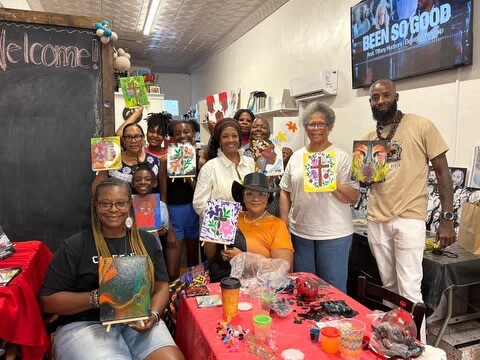
Buford said his mission is to help others find their own path toward healing — whatever form that takes.
“What I strive to do is guide this person to just create, man. Don’t care what people think about your creation, you just need to get it out,” Buford said. “Whether it’s with art, addressing your mental health, getting your life right — just do it.”
CBS 6 is committed to sharing community voices on this important topic. Email your thoughts to the CBS 6 Newsroom.
📲: CONNECT WITH US
Blue Sky | Facebook | Instagram | X | Threads | TikTok | YouTube

This story was initially reported by a journalist and has been converted to this platform with the assistance of AI. Our editorial team verifies all reporting on all platforms for fairness and accuracy. To learn more about how we use AI in our newsroom, click here.
-

 Maine3 minutes ago
Gov. Mills to decide on Maine school choice tax credit program
-

 Maryland6 minutes ago
Maryland Lottery Mega Millions, Pick 3 results for June 26, 2026
-
Michigan11 minutes ago
Michigan Lottery Daily 3, Daily 4 results for June 26, 2026
-

 Massachusetts18 minutes ago
As Mass. ballot initiatives multiply, critics want to limit them
-

 Minnesota21 minutes ago
Minnesota man accused in a $250M fraud scheme taken into custody in Somalia | CNN
-

 Mississippi26 minutes ago
10-year-old seriously injured in Mississippi County UTV crash
-

 Missouri33 minutes ago
First-generation-American students remind Missouri politicians why unity, freedom of speech are so important ahead of the nation’s 250th anniversary
-
Montana36 minutes ago
Montana Lottery Mega Millions, Big Sky Bonus results for June 26, 2026

