Virginia
#15 Virginia Tech drops second game to #9 Florida State


BLACKSBURG, Va. – It was Senior Day in Blacksburg as Virginia Tech honored five standout graduates: Trinity Martin, Rachel Castine, Cori McMillan, Emma Lemley, and Bre Peck—an elite group that helped turn Tech Softball into a powerhouse.
But the game didn’t go the Hokies’ way.
Top of the first, Jaysoni Beachum hit a sacrifice fly. Cori McMillan made the throw home, but Isa Torres scored to put the Seminoles up 1-0.
In the second, Hallie Wacaser launched a home run to center—FSU stretched the lead to 3-0.
The Hokies were able to hold Florida State scoreless for a few innings after that, but couldn’t find any momentum at the plate.
Florida State closed it out with an 8-0 shutout, spoiling Virginia Tech’s Senior Day.
Copyright 2025 by WSLS 10 – All rights reserved.



CHESTNUT HILL, Mass. — No. 23 Boston College Baseball will host Virginia Tech in a three-game series from April 10-12. On Friday and Sunday, the two teams will compete at Harrington Athletics Village with first pitch at 3:00 p.m. and 1 p.m., respectively, and both games will be streamed on ACCNX. On Saturday, the game will be played at Fenway Park for the 14th annual ALS Awareness Game. First pitch is scheduled for 2:00 p.m. and broadcast on ACC Network.
The 2026 ALS Awareness Game
The 14th annual Boston College ALS Awareness Game is coming to Fenway Park on Saturday, April 11, at 2 p.m., when the Eagles will face Virginia Tech in the second of a three-game series. The game has been played annually in honor of former BC baseball captain Pete Frates since his ALS diagnosis in 2012. This year marks the seventh time it has been played at Fenway Park. Frates passed away in 2019 at the age of 34.
Record vs Virginia Tech
Boston College is 26-35 all-time against Virginia Tech, including a 14-13 record at home. The Eagles were swept when the two teams last met in 2024. Six current players saw action in that series, with Nick Wang, Kyle Wolff, and Owen DeShazo seeing at-bats. Wolff was a combined 4-11 with five RBI, a home run, two doubles, and a triple in the series. Kyle Kipp, A.J. Colarusso, and Tyler Mudd all pitched, with Colarusso starting and going six innings with six strikeouts.
Scouting the Hokies
Virginia Tech is 15-16 this season and 6-9 in conference so far. The Hokies dropped their lone midweek contest, 11-4, to Liberty and lost two of three over the weekend to Miami. They won the finale against the Hurricanes, 6-3. Virginia Tech is hitting .256 as a team this season, but has three hitters above .300, led by Ethan Ball at .310. Ball leads the Hokies in hits and home runs with 35 and six, respectively. Hudson Lutterman is the team RBI leader with 23. The Virginia Tech pitching staff has four arms with over 20 innings, including Griffin Stieg, who has thrown 37 innings with 33 strikeouts. Brett Renfrow is the Hokies’ strikeout leader with 49 so far this season. The staff has an ERA of 7.68, but two arms with sub-5.00 ERAs: Luke Craytor and Chase Swift, with 3.77 and 4.24 ERAs, respectively.
The Matchups
The first game of the series will feature A.J. Colarusso against Logan Eisenreich. Colarusso is 3-1 on the year with a 2.88 ERA in 40.2 innings of work to go with 37 strikeouts. In his last outing, Colarusso went six innings against No. 6 North Carolina, allowing just one unearned run while matching his season high of seven strikeouts. Eisenreich is 0-1 this season with a 6.60 ERA in 15 innings of work to go with 18 strikeouts. His last appearance was three innings in relief against Miami, where he allowed an earned run while striking out two.
On Saturday, Brady Miller and Brett Renfrow will face off. Miller has yet to earn a decision this season in 27 innings of work. He has posted a 2.33 ERA to go with 27 strikeouts. His last outing saw him throw five innings against No. 6 North Carolina, where he gave up five earned runs with two strikeouts. Renfrow is 1-4 this season in 34.1 innings with 49 strikeouts and a 6.82 ERA. His last start came against Miami, where he allowed seven earned runs in five innings of work while striking out six.
Sunday’s starters are still to be determined.
Last Time Out
Boston College won both of its midweek contests, defeating UMass 11-1 in the Beanpot semifinals before beating Dartmouth 13-3. Against the Minutemen, Cesar Gonzalez, Luke Gallo, and Carter Hendrickson all had two RBI, while four guys had two hits each. On Wednesday, Wang paced the offense with three RBI. Julio Solier, Ty Mainolfi, and Jack Toomey all had three hits in the win. Jacob Burnham earned the win against UMass, while Peter Schaefer won against Dartmouth.
Up Next
The Eagles will host two midweeks next week, beginning on Tuesday at 6:00 p.m. with the championship game against Northeastern, followed by UConn at 3:00 p.m. on Wednesday. They will then host Duke for an ACC series.

ASHLAND, Va. — Eighth-grade students from Richmond Public Schools are getting a hands-on look at the stars at the Keeble Observatory at Randolph-Macon College.
The observatory, located on the campus in Ashland, is a research, outreach, and teaching telescope for the college’s Department of Physics, Engineering, and Astrophysics.
WTVR
It is the largest telescope of its kind between Washington, D.C., and the Blue Ridge Mountains.
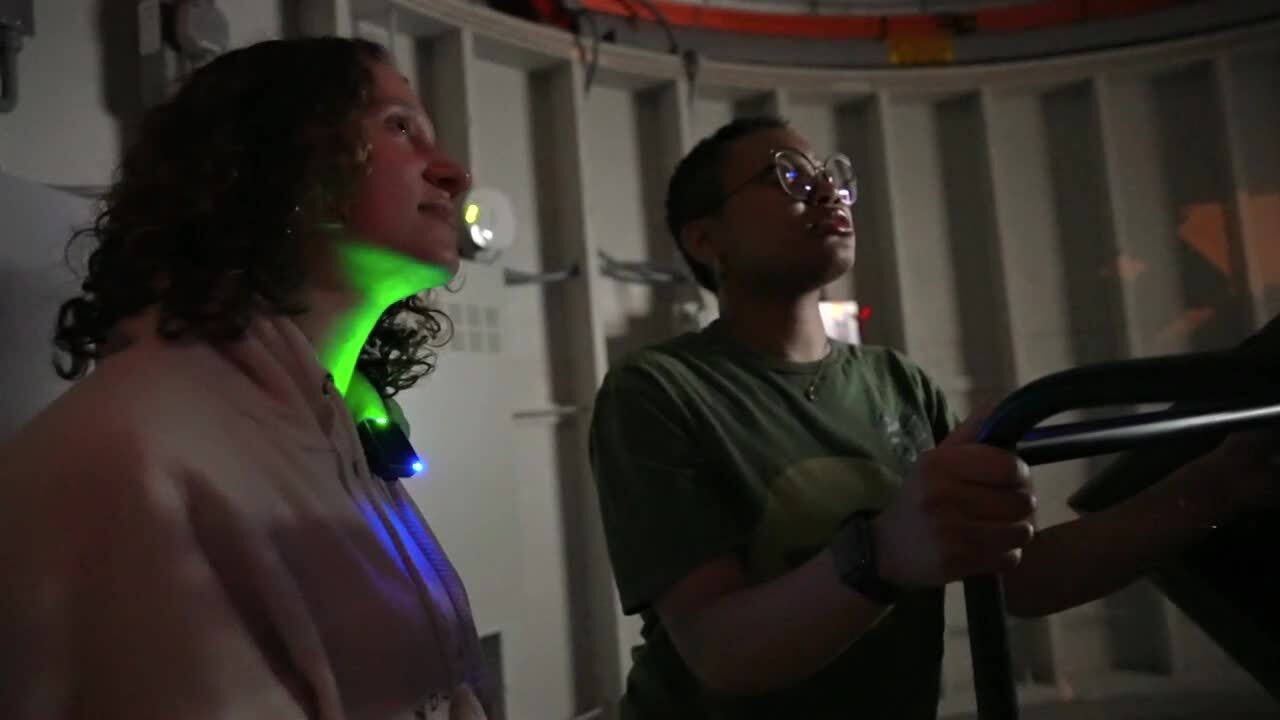
Earth Science teacher Chloe Tremper brought her class from Boushall Middle School to the observatory to learn about celestial objects.
“I think more people should know about it, especially when they have public nights on Thursdays. I’ll definitely be coming back with some folks,” Tremper said.
Randolph-Macon engineering and astrophysics students Brielle Baughman and Kamaya Wilson helped guide the middle schoolers during their visit.
“It never gets old. It’s beautiful looking at it every time. And then seeing others see how beautiful it is, and their reactions, it’s amazing,” Baughman said.
“We usually have something already up. Something cool, shocking. Typically, a planet. We can look at Saturn. That’s a really popular one. I personally think Saturn’s my favorite,” Wilson said.
WTVR
The telescope and lab provide hands-on learning for students of all ages.
The campus hosts weekly public stargazing sessions on Thursdays during the academic semester, weather permitting.
Visitors can even play a form of cosmic bingo, marking off cards with everything they see.
Physics professor Michael Rodruck knows not all the middle school students will become astrophysicists, but he hopes they all find an interest in discovering new things.
“I hope they just get amazed by the night sky. Usually when kids look through that telescope, it’s always ‘Wow, that’s so cool!’ And seeing that spark of curiosity. Seeing that spark of interest, that really is making it worth it,” Rodruck said.
CBS 6 is committed to sharing community voices on this important topic. Email your thoughts to the CBS 6 Newsroom.
📲: CONNECT WITH US
Blue Sky | Facebook | Instagram | X | Threads | TikTok | YouTube

This story was initially reported by a journalist and has been converted to this platform with the assistance of AI. Our editorial team verifies all reporting on all platforms for fairness and accuracy. To learn more about how we use AI in our newsroom, click here.

RICHMOND, Va. — Virginia Gov. Abigail Spanberger defended her administration’s policies and approach Wednesday during a question-and-answer session at Capital Square. She addressed Virginia’s budget negotiations, immigration enforcement and her approval ratings.
Legislative Action and Special Session
Spanberger said she has signed hundreds of bills in recent days, with many new laws addressing student and school safety as well as the high cost of housing, healthcare and utilities.
She has called a special session for April 23 to finalize the commonwealth’s budget.
The governor reiterated her support for public sector collective bargaining, saying it would give public employees the same choice to join or not join a union that private employees have.
‘Bumpy’ Budget Process
Gov. Abigail Spanberger addresses Virginia’s ‘bumpy’ budget impasse
Spanberger described ongoing budget negotiations between House and Senate Democrats as challenging but progressing toward the April 23 special session deadline.
“It’s a bumpy road, certainly, but in speaking with the chairwoman of the Senate Finance Committee [Sen. Louise Lucas] today, she assures me that we are on path towards getting that budget to me on the 23rd,” Spanberger said.
A key point of contention involves data center tax policy.
The Senate version of the budget eliminates the current sales and use tax exemption that data centers enjoy, which costs Virginia $1.6 billion in lost revenue annually even as the state has become the data center capital of the world. The House version keeps the exemption, creating a significant gap that must be resolved.
The governor said she maintains regular contact with House Appropriations Chair Del. Luke Torian and Sen. Lucas while respecting the legislative process.
“I am endeavoring to be very engaged. But I still need them to a conclusion of the bill that they want to send to my desk,” she said. “They both know where I stand on a variety of issues and certainly what my priorities are.”
Immigration Clarification
Gov. Abigail Spanberger on immigration: ‘Virginia is not a sanctuary state’
Spanberger pushed back against characterizations of Virginia as a “sanctuary state.” She said her executive orders on immigration enforcement maintain levels of cooperation between Virginia State Police and federal immigration officials.
“Virginia is not a sanctuary state. Full stop,” she said. “My executive orders [are that] Virginia state agencies would no longer and principally state police, as the largest of the state law enforcement agencies, would no longer put their police officers, their troopers, under the supervision and direction of ICE agents.”
The governor said Virginia State Police continue coordinating with Immigration and Customs Enforcement on warrant-related activities.
“If ICE comes to [Virginia State Police] and says, ‘Here’s a warrant. We need your support on something.’ Yes, they’re going to support them,” she said.
Polling and Cost-of-Living Concerns
Gov. Abigail Spanberger addresses recent approval poll numbers in Virginia
Addressing a recent Washington Post poll showing her 47% approval rating trailing the average Virginia governor’s approval by 13 points, Spanberger emphasized her 2025 election victory margin.
“When I was elected, really, frankly, that’s the only poll that mattered. My election, a 17-point swing,” she said.
On cost-of-living issues, Spanberger said the many bills that will address the high cost of housing, healthcare and utilities will become law and take effect on July 1. She also blamed federal policies for rising gas prices above $4 per gallon, criticizing what the Trump administration’s war against Iran.
CBS 6 is committed to sharing community voices on this important topic. Email your thoughts to the CBS 6 Newsroom.
📲: CONNECT WITH US
Blue Sky | Facebook | Instagram | X | Threads | TikTok | YouTube
This story was initially reported by a journalist and has been converted to this platform with the assistance of AI. Our editorial team verifies all reporting on all platforms for fairness and accuracy. To learn more about how we use AI in our newsroom, click here.

Missing man’s body found in retention pond in Elk Grove Village, police say

Indiana expands emergency advisories for high water on northern lakes

Iowa State women’s basketball team adds transfer guard from Kent State

Kansas Governor vetoes property tax bill, backs alternative plan

Collin Chandler releases statement on transfer from Kentucky

Florida High School Football Rankings: Top 25 teams – Oct. 21

How old is Bo Nix? What to know about Oregon quarterback ahead of 2024 NFL Draft

Cleary's 21 help Le Moyne down Central Connecticut State 69-64 in OT

99th annual Pony Swim held in Virginia

Indiana Members Credit Union announced as new anchor tenant at Bottleworks District

Video: How Trump’s Advisers Felt About Going to War With Iran

Unearthed clip exposes shocking claim by Newsom’s wife about inmates at violent California prison

Gaza journalists mourn Al Jazeera’s Wishah, killed by Israel

Exclusive: Trump weighs pulling some US troops from Europe amid NATO strains, official says

Video: The Fragile Cease-Fire in Iran
-

 Atlanta, GA5 days ago
1 teenage girl killed, another injured in shooting at Piedmont Park, police say
-

 Education1 week ago
Video: We Put Dyson’s $600 Vacuum to the Test
-

 Movie Reviews1 week ago
Vaazha 2 first half review: Hashir anchors a lively, chaos-filled teen tale
-

 Georgia3 days ago
Georgia House Special Runoff Election 2026 Live Results
-

 Pennsylvania3 days ago
Parents charged after toddler injured by wolf at Pennsylvania zoo
-

 Education1 week ago
Video: YouTube’s C.E.O. on the Rise of Video and the Decline of Reading
-
 Milwaukee, WI3 days ago
Potawatomi Casino Hotel evacuated after fire breaks out in rooftop HVAC system
-
 Entertainment1 week ago
Inside Ye’s first comeback show at SoFi Stadium