Kansas
Kansas Governor vetoes property tax bill, backs alternative plan


TOPEKA, Kan. (KCTV) – Kansas Governor Laura Kelly vetoed a property tax bill and threw her support behind a three-part relief plan partially introduced by Sen. Ethan Corson (D-Prairie Village).
What Happened
Gov. Kelly said she vetoed Senate Substitute for House Bill 2745 on Wednesday, April 8, rejecting a measure that would have allowed residents to petition against local government budget increases exceeding 3%.
Kelly said the bill fails to deliver real property tax relief and instead strips locally elected officials of the flexibility they need to manage their communities.
“Instead, the truth is that this bill will only restrict the ability of locally elected officials to be nimble enough to adjust to the unique needs of the communities they serve,” she added.
The Bill’s Impact – Before the Veto
Kelly said the damage from the bill’s passage had already begun – even before she signed the veto.
According to the Governor, multiple school districts and local governments were notified that bond deals set to close within days had been terminated by underwriters, citing financial uncertainty created by the legislation.
“This means that projects which have already been approved at the local level have been stopped dead in their tracks, as their funding source has been removed due to the passage of this bill,” she said.
What the Bill Would Have Done
Senate Substitute for HB 2745 set a 3% cap on property tax revenue growth for local governments.
Any budget exceeding that threshold – adjusted for inflation – would trigger a public protest petition process.
If at least 5% of registered voters in a taxing subdivision signed a petition by Sept. 15, the budget increase would be blocked, forcing the governing body to revert to the prior year’s levy.
The bill passed the House 76-45 on Feb. 26 and cleared the Senate 22-18 on March 27 under emergency final action.
Three-Part Relief Proposal
Rather than simply vetoing the bill, Kelly urged the Legislature to take up a three-part property tax relief package introduced by Corson before the 2026 session ends.
1) Immediate Vehicle Tax Credit – SB 378
Senate Bill 378, introduced by Corson in January, would provide a one-time, nonrefundable $250 vehicle tax credit applied at the time of registration for eligible vehicles.
That would include cars, trucks, motorcycles, buses, trailers and RVs.
The credit would be funded through the state’s budget stabilization fund and would take effect in FY 2027.
However, the credit is nonrefundable. If a vehicle owner’s tax liability is less than $250, they will not receive the difference as a refund.

The Senate Committee on Taxation held hearings on Feb. 4 and Feb. 5. No opponents testified against the bill.
However, SB 378 has stalled in the Senate with no movement since the second hearing – making Kelly’s public push a potential lifeline for the legislation.
2) Incentive Fund for Fiscally Responsible Local Governments
Kelly said the plan proposes a new state fund to reward cities and counties that keep annual budget growth at or below 3%.
According to the Governor, the state would deposit $60 million into the fund in the first year, growing by 2% annually.
She noted that distribution would be based on population and total assessed value, giving both rural and urban communities equitable access.
3) Doubling the 20-Mill School Finance Exemption
Lastly, under current Kansas law, the first $75,000 of a home’s appraised value is exempt from the 20-mill levy used to fund public education.
The proposal would double that exemption to $150,000, providing annual relief to more than 700,000 Kansas homeowners, Kelly said.
A demand transfer from the State General Fund would ensure public schools continue to receive full constitutional funding, she added.

“I’m laying out a fiscally responsible property tax relief plan that I invite the Legislature to debate and take action on to finally give Kansans some real relief,” Kelly stated.
Republican Response
Republican leaders pushed back sharply, framing the veto as a political move that leaves Kansas families behind.
“Laura Kelly and the Democrats have proven they are not serious about solving the property-tax crisis that is driving Kansans out of their homes,” said Senate President Ty Masterson (R-Andover). “Enough is enough. When I’m Governor, the runaway appraisals and out-of-control local spending will come to an end.”
House Speaker Dan Hawkins (R-Wichita) said the fight is not over.
“Kansans didn’t send us to Topeka to play political games; they sent us here to deliver results. Kansas families are being crushed by rising property taxes,” Hawkins added. “Across the state, they are being forced into tightening their budgets and making smarter, more fiscally responsible choices. Local government should be doing the same. This conversation is not over and we will continue to fight to put Kansans who are suffering under out-of-control property taxes back in the driver’s seat.”
Majority Leader Chris Croft (R-Overland Park) called the veto a betrayal of Kansas voters.
“The people of Kansas deserve a voice in how their hard-earned dollars are taxed, and this veto ignores their needs and the will of the people,” Croft said.
Local Government Reaction
Local governments and organizations were split on HB 2745, but seemed to mostly oppose the legislation.

Opposed – City of Overland Park
Overland Park City Representative Mike Koss testified against the bill, warning it would threaten the city’s financial stability and its ability to fund public safety.
He noted that $98 million of Overland Park’s budget is dedicated to public safety – more than 90% of which is personnel costs.
Koss argued the 5% protest petition threshold was too low, saying it would allow a small majority to override the will of the majority.
He asked the Legislature to restore the threshold to 10% and reinstate a $60 millin property tax relief fund that was stripped from the bill during House floor debate.
In Favor – Kansas Farm Bureau
Jon Donley, representing the Kansas Farm Bureau and it smore than 30,000 farm and ranch families, testified in support of the bill.
He said the measure would slow the growth of local government spending and reduce long-term pressure on property taxes for all classes of property.
“KFB feels that HB 2745 provides the proper policy directives to encourage local taxing jurisdictions to be fiscally responsible,” Donley added.
What’s Next
The Legislature has until the end of the session to consider an override of Kelly’s veto or to take up the new plan – including stalled SB 378.

Republicans hold a supermajority in both chambers, giving them the votes needed to override without Democratic support.
However, the number of supporters in the initial votes would not be enough to override the veto.
Kelly is urging lawmakers to act before the session closes.
“It is time for Kansans to hear the truth from their elected officials and to have their elected officials deliver realistic results for them,” she concluded.
Copyright 2026 KCTV. All rights reserved.



We recognize you are attempting to access this website from a country belonging to the European Economic Area (EEA) including the EU which
enforces the General Data Protection Regulation (GDPR) and therefore access cannot be granted at this time.
For any issues, contact news@kake.com or call 316-943-4221.

KANSAS CITY, Mo. (KCTV) – A house fire broke out early Tuesday morning in the 3300 block of Bales Avenue in Kansas City.
Firefighters arrived to find heavy smoke and flames coming from a two-story home and two people stranded on the roof. Both were brought safely to the ground.
The fire was under control within about 18 minutes after crews arrived. No injuries were reported.

The cause of the fire is under investigation.
Copyright 2026 KCTV. All rights reserved.

KSHB 41 reporter Rachel Henderson covers neighborhoods in Wyandotte and Leavenworth counties. Share your story idea with Rachel.
—
I first told you two weeks ago about the Love Lot at 3306 Main St., in Kansas City, Missouri.
Some of the food trucks there are still capitalizing on World Cup traffic as others move in to capture new business for their trucks.
Tameisha Martin, the owner of Love Is Key, has been welcoming vendors to the space.
Al Miller/KSHB 41
“We’re calling it the Love Lot,” Martin said on June 10. “Come show these different food trucks some love.”
With month-to-month agreements in place, there are already some new trucks on the lot.
One of them is Pancake Dreams, a brand founded in Kansas City, Kansas, by Julia Abuoun and her 10-year-old daughter, Amirah.
The two created the concept about two years ago, and Monday was their first day at the Love Lot.
Abuoun spent more than 20 years in the restaurant industry before launching the food truck.
Rachel Henderson/KSHB 41
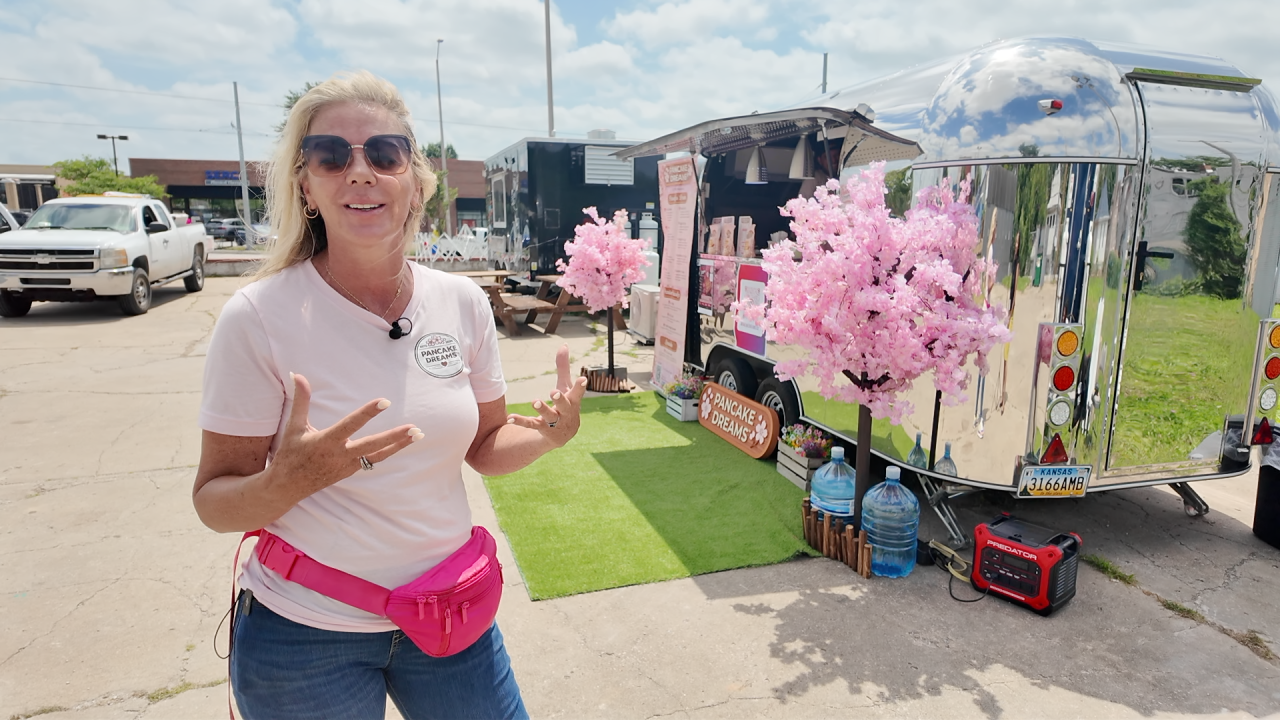
“Pancake Dreams was created based on love and family,” Abuoun said.
She said the goal was to stand out from traditional breakfast spots.
“We wanted to create something that was different than the mundane, regular breakfast restaurants, so that’s where we came up with Pancake Dreams,” Abuoun said.
The FIFA World Cup 26 in Kansas City made the Love Lot feel like the right fit.
“I was like ‘that’s the perfect fit for Pancake Dreams’ because you know the Love Lot, Pancake Dreams with the World Cup in town everybody with all the excitement going on, and we’re right here by the trolley stop, so hopefully that will get us some exposure,” Abuoun said.
Abuoun said the timing was intentional.
“Kansas City’s got a lot of excitement going on right now, so we wanted to get in on that excitement out there and get our name out there while we were up in with the World Cup and everything that’s going on,” Abuoun said.
The transition from a traditional restaurant building to a food truck has come with adjustments, especially the extreme heat their opening week.
“I’m used to being in a restaurant that has four walls and an air conditioner, so this is something new that we’re learning, but I mean hey, it is what it is and if you love what you do, then it doesn’t really affect you,” Abuoun said.
In addition to the Love Lot, Abuoun says Pancake Dreams is rolling out pancake batter this week at World Fresh Market at West 103rd Street and Metcalf Avenue.
The Abuouns hope to open a brick-and-mortar location in 2027.
Amirah handled the truck’s design, which features cherry blossoms.

Rachel Henderson/KSHB 41
She said one of the brand’s messages reflects the spirit behind it.
“One of these messages is, ‘A Dream in Every Bite,”’ Amirah said.
For Amirah, the venture means more than just business.
“Beauty, and it means memories, and these will always be memories to me and my mom,” Amirah said.
She also shared what she hopes visitors take away from the experience.
“I’m hoping that they can really see that we worked hard on this and that they enjoy,” Amirah said.
Pancake Dreams is not the only truck cooking up dreams at the Love Lot.
Jims Desauguste, the founder of Creole KC, is also set up on the lot.
It is the truck’s second week there.
Desauguste, who is from Haiti, said he asked about a spot after driving by the lot and seeing the trucks there.
Rachel Henderson/KSHB 41

“I’ve been dreaming about it, and then the opportunity came, and we just make that happen,” Desauguste said. “Cooking is my passion. I love cooking, I love doing it and just giving back to the community the Haiti cuisine flavor.”
I met Desauguste a week ago at his restaurant, Black Garlic, where he shared his disappointment over the lack of World Cup traffic there.
That prompted him to remove the 18% gratuity he charged during the World Cup.
“It did not happen for us very well,” Desauguste said on Tuesday.
His new truck has since seen its fair share of traffic, especially on weekends.
Creole KC is open Monday through Thursday from 11 a.m. to 10 p.m., and Friday and Saturday until 2 a.m. — or later, depending on the crowd.
Desauguste said he is also looking forward to more events, including the Reggae Fest.
While the World Cup brought energy to the lot, Desauguste said his long-term focus is closer to home.
“Definitely, we’re going to get some more business after the World Cup,” Desauguste said. “We’re not banking on that, no. But I’m banking on local Kansas Citians.”
His truck’s bright exterior is hard to miss.
“Right on the Main Street, you can see the bright-colored truck,” Desauguste said.
Martin says the list of trucks may change in July with the month-to-month agreements, but that the list should be updated by July at loveiskeykc.com.
This story was reported on-air by a journalist and has been converted to this platform with the assistance of AI. Our editorial team verifies all reporting on all platforms for fairness and accuracy.
—

-

 Alaska2 minutes ago
Alaska moves to award $350M contract to replace 62-year-old Tustumena ferry
-

 Arizona5 minutes ago
What areas are affected by the Pocket Fire near Oak Creek Canyon?
-

 Arkansas10 minutes ago
Northwest Arkansas-based Community Clinic aims to acquire multiple Baptist Health-Fort Smith clinics | River Valley Democrat-Gazette
-

 California17 minutes ago
Billionaire tax measure heads to California’s November ballot, with Kern County watching
-

 Colorado20 minutes ago
Smokey skies and critical fire danger conditions continue in southern Colorado
-

 Connecticut25 minutes ago
US Supreme Court to consider challenge to Connecticut assault weapons ban
-

 Delaware32 minutes ago
Delaware Fire Marshal Urges Fireworks Caution Ahead of July 4th – 47abc
-

 Florida35 minutes ago
New details in deadly Florida alligator attack

