North Carolina
In North Carolina, Democrats counting on young voters

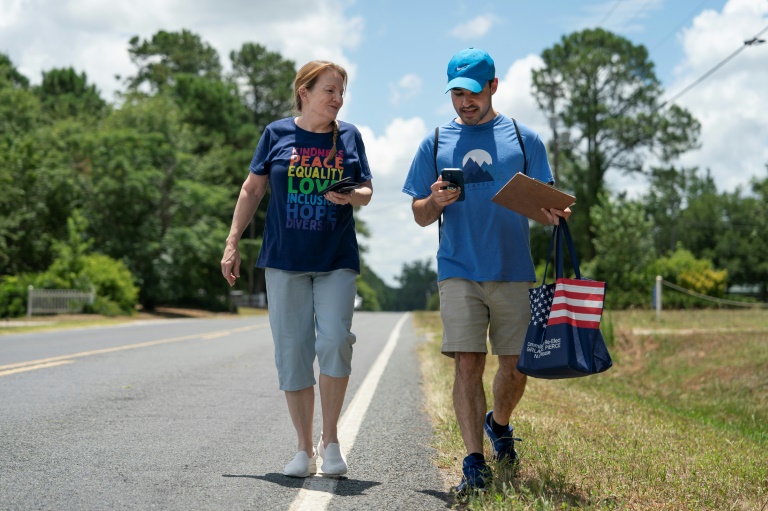
For several months, Yampiere Lugo has been going door to door, urging young people in North Carolina to vote in November.
With Joe Biden’s withdrawal from the race and Kamala Harris’s arrival atop the Democratic ticket, the party activist says his generation — a key voting bloc — is fired up.
“I’ve talked to a lot of people around my age who have sort of all expressed the same sentiment — that they’re just so much more excited to have someone who’s just younger, more energetic,” Lugo told AFP.
The 25-year-old, who works as an administrative assistant at a local school, says even people he thought might skip the election altogether have said the vice president has their support.
The enthusiasm marks a sharp contrast with the situation Lugo was facing just over a month ago, when he was canvassing for Biden in Laurinburg, the seat of Scotland County, not far from the border with South Carolina.
At the time, the activist admitted to AFP that young voters were “frustrated” with their options, facing a choice between the 81-year-old Biden and Donald Trump, the 78-year-old Republican former president.
Now, Lugo believes Harris, 59, can win North Carolina, one of a handful of swing states likely to play a pivotal role in the race for the White House.
Winning here will be an uphill battle — the southern state has not voted for a Democrat in the presidential election since Barack Obama in 2008.
“North Carolina is going to have something to say in November,” said Zach Finley, the president of the Young Democrats of North Carolina.
But for Harris to turn the state Democratic blue, the party needs to campaign “the right way, turning out the folks we need to,” added Finley, who is also 25.
– ‘Excited’ –
On a national level, voters between the ages of 18 and 39 favored Biden over Trump in 2020 by a margin of about 20 percentage points, according to the Pew Research Center.
Finley says the party needs to “turn out young people who, especially in the last couple of years, have been really disincentivized” by the political process.
Democrats are getting out the vote the old-fashioned way in Scotland County — knocking on doors and talking to people.
The rural area is one of the most hotly contested political battlefields in the country — Hillary Clinton bested Trump here in 2016, but the Republican bounced back to defeat Biden in 2020, by just 287 votes.
In November, “it’s all about turnout,” says Garland Pierce, a Democratic state representative and a Baptist pastor.
“That’s what everybody’s really depending on, is the young voters to really go to the polls.
The lawmaker says Harris’s somewhat surprise breakthrough into the race has galvanized voters in North Carolina.
“It appears that young people are really excited” about her candidacy, he said, adding that the economy will be a key issue in the contest.
– ‘Cost of things’ –
Pierce’s prediction about the economy is shared by a number of young voters AFP met in the streets of Laurinburg, which is home to 15,000 residents.
“Everything used to be cheaper,” laments Donnie Leviner, an 18-year-old student with his own home renovation business.
Before Biden won the White House, “gas prices used to be way lower,” said Leviner, who added that he would vote for Trump in his first-ever trip to a presidential voting booth.
For Lucas Wylie, a 26-year-old engineer having a coffee at an outdoor cafe with his dog, young voters are “very focused on the cost of things and affordability.”
Wylie cited expensive housing and high interest rates as evidence of soaring prices, and said both would be important to him in November.
Finley agreed.
“There’s just a lot of pent-up anxiety being a young person in this country, not even being able to afford a home,” he said. “It’s almost out of reach, especially in North Carolina.”
Finley said Democrats need to reassure young voters that they are attuned to their concerns, and ready to deliver solutions.
Harris will need to convince young people that they will ultimately be able to “achieve some form of the American dream” — and offer the same thing to the next generation, Finley said.
rle/sst/bfm



North Carolina
AG Jeff Jackson wants the president to negotiate change from Chinese apps that fund fentanyl

North Carolina’s top prosecutor is asking the president for
help in the fight against fentanyl. Attorney General Jeff Jackson says
criminals are using Chinese apps to launder millions of dollars which fund
the fentanyl epidemic in the US. He thinks the president can negotiate a
change.
The effort hits home for the Nash family. This past weekend
marked four years since Jeff Nash lost his daughter, Amanda.
“It was a tough weekend. It was. I don’t think it gets
any easier,” Nash told WRAL.
Nash is one of thousands of fathers who knows what it feels
like to lose a child to fentanyl. And he knows what people will say…
“His daughter should have known not to do it. No one
forced her to do it. She was a grown woman. She was an adult who made her choices
and this was the natural consequence of her choice. And to say that would be
right. I understand that. However, two things can be right. It also is right for
our federal, state and local governments to do everything they can to keep this
poison away from our people,” Nash said.
Fentanyl is the primary driver of the opioid crisis in North
Carolina, contributing to over 75% of fatal drug overdoses in recent years. But
a small change gives cause for hope. 2025 and early 2026 data from the state office
of the medical examiner indicate a potential decline in fentanyl-positive
deaths for the first time in years.
North Carolina Attorney General Jeff Jackson said there is
still work to do.
“We’re losing six people a day. I’ve spoken to a lot of families
who have lost people. I told them I’ll do whatever I can and one thing I can do
is go after the money. If you go after the profitability of a crime, you’ll
reduce the prevalence of that crime,” Jackson said.
More than $100 million a week flow through Chinese owned
apps to support the sales of fentanyl in the US, Jackson said.
Over the last year, his office got one app called WeChat
to agree to be more responsive with investigators and make encrypted spaces on
the app more hostile to fentanyl money laundering. But its sister app, Weixin is
not subject to US laws and wants the White House to take action.
In a letter to the president, Jackson and five other
attorneys general from Colorado, New Hampshire, New Jersey, Kentucky and South
Carolina urged the president to take action. It states that despite the agreement
with WeChat to work with investigators, neither it nor Weixin agree to share
data from the ap.
“In practice, this means that law enforcement can only see
one side of illegal transactions, shielding Chinese-based users from justice,”
the letter said.
Nash wondered why only six attorneys general would support
the effort. Jackson said the focus was to get a request to the president that
was not political, bipartisan and clear.
He believes President Trump has the ability to negotiate with the
Chinese to effect change when it comes to money changing hands through its
apps.
“I think we recognize that the Chinese government is
different than the American government and if the leader of China decided to
make a change, that change would be made,” Jackson said.
Nash was reluctant to revisit his pain discussing his
daughter’s death, but said it’s worth it if this letter gets people talking or
gets any government movement to reduce the flow of fentanyl into the US.
Nash was one of the subjects in the WRAL documentary, ‘Crisis
Next Door – The Fentanyl epidemic.’

ASHEVILLE – The Asheville Orchid Festival will return in all its showy glory for 24th time March 27-29.
The festival, hosted by the Western North Carolina Orchid Society and the North Carolina Arboretum, will have an “Orchid Kingdom” theme this year, and will be an American Orchid Society sanctioned judging event.
Festivalgoers can expect to experience world-class orchid growers and breeders, regional orchid societies displays and hundreds of orchids presented in displays.
Orchids will be for sale from across the United States and Ecuador and will include rare species and cutting-edge hybrids.
“The Asheville Orchid Festival has been recognized as one of the best orchid shows in the country today,” Mike Mims, past president of the WNC Orchid Society said. “A huge orchid festival that is unlike any other orchid event in the region and lures the best of the best in the orchid industry to come to Asheville for a few days to engage and show off.”
WNC Orchid Society President Graham Ramsey, and his wife, artist Leslie Keller, each year create a theme for the festival.
Last year the two created the “House of Orchids” theme to transport visitors to another time, with a Victorian-inspired model greenhouse.
“Usually we arrive at a theme, believe it or not, when we’re out hiking. We try to think of a theme that we can also come up with a neat display to match,” Ramsey previously told the Citizen Times.
In 2023, for the “Orchid Express” theme, Ramsey and Keller created a 24-foot-train that functioned as an eye-catching display for many orchids featured by the festival.
The Asheville Orchid Festival is one of the most important events of the year for the WNCOS. Beyond the opportunity for members of the society to “strut their stuff” as Ramsey put it, the event also provides crucial funding for the nonprofit’s operations.
Ramsey said the group welcomes any orchid enthusiast, “whether you have one orchid on your windowsill or 1,000 orchids in your greenhouse.”
He encourages anyone with even a passing interest in orchids to stop by the show this weekend.
“When you walk into the auditorium and see all the orchids on display, it’ll just blow your mind,” he said.
If you go
The Asheville Orchid Festival will be 4-7:30 p.m. March 27 and 9 a.m.-5 p.m. March 28-29 at the North Carolina Arboretum. Admission is $5 for attendees older than 12 and free for WNC Orchid Society members.
As of March 1, parking fees were increased to $25 for personal/standard vehicles. On the first Tuesday of every month, a $10 discount is offered for personal vehicle parking.
Admission fees include all orchid exhibits, programs and educational lectures and benefit the Western North Carolina Orchid Society to help expand the mission of “sharing the excitement and joy of cultivating orchids and promoting orchid conservation.”

Elina Aarnisalo had 21 points, Lanie Grant scored 20, and North Carolina used a strong fourth quarter to beat Maryland 74-66 on Sunday and reach the Sweet 16 of the women’s NCAA Tournament for the second year in a row.
Nyla Harris had 14 points and eight rebounds and Indya Nivar added 11 points to help the fourth-seeded Tar Heels (28-7) advance in the Fort Worth 1 Regional later in the week. They will play the winner of No. 1 UConn vs. No. 9 Syracuse.
“We just had to stay aggressive,” North Carolina coach Courtney Banghart said. “But you don’t go this long into the season and not trust your (players). These are close games. We know they’re going to be. We’re prepared for it. I trust them.”
Oluchi Okananwa, who helped eliminate North Carolina last March in the Sweet 16 when she played for Duke, scored 21 points for No. 5 seed Maryland (24-9). Addi Mack had 13 points and Mir McLean had 12 points and 14 rebounds. The Terrapins couldn’t overcome 3-for-23 shooting on 3-pointers.
“I felt like it was there for the taking for us,” Maryland coach Brenda Frese said. “We didn’t manage enough plays to take it.”
After briefly falling behind, the Tar Heels used a 13-4 run, sparked by six points from Nivar, early in the fourth quarter for a 63-56 lead.
“They gave us a good run, and we kind of just did a good job of absorbing that and not panicking, not trying to do too much, not getting away from the game plan,” Grant said.
Maryland pulled within three in the final two minutes, but freshman Nyla Brooks drained a 3-pointer from in front of the North Carolina bench.
“Nyla Brooks has been shooting those 3s all season,” Aarnisalo said. “She’s not afraid to take any shots.”
The Terrapins failed to convert as part of 30.6% shooting in the second half.
“We had a lot of uncharacteristic missed shots in this game,” Frese said.
North Carolina took a 42-33 halftime lead, shooting 56.7% in the half.
Nivar picked up her fourth foul with 7:06 left in the third quarter. Maryland was even at 50-50 by the final minute of the quarter.
North Carolina has reached the Sweet 16 in consecutive seasons for the first time since 2014 and 2015.
Board work
Maryland was relentless on the boards, tracking down 21 offensive rebounds. Eventually, Banghart was hoping some of those shots would just go in.
“I got to the point where I was praying Oluchi would make her free throws because I didn’t want to have to rebound it,” Banghart said.
The Terrapins scored 21 second-chance points.
Needing more assists
Maryland’s three assists were its fewest this season and lowest total in an NCAA Tournament game.
The 66 points marked the third-lowest total of the season for Maryland, which entered averaging 82.8.
Up next
The Tar Heels advanced to the Sweet 16 for the 20th time.

US Park Police officer shot in Washington, DC

ICE agents support Cleveland Hopkins International Airport TSA operations

Vice President JD Vance visits Austin for fundraising event

Lawsuit accuses University of Alabama of censorship in ending student magazines

Polar bear undergoes root canal at Alaska Zoo

Florida High School Football Rankings: Top 25 teams – Oct. 21

How old is Bo Nix? What to know about Oregon quarterback ahead of 2024 NFL Draft

Cleary's 21 help Le Moyne down Central Connecticut State 69-64 in OT

99th annual Pony Swim held in Virginia

Indiana Members Credit Union announced as new anchor tenant at Bottleworks District

See TSA Wait Times at Major U.S. Airports

Senate hopeful with deep Dem ties slapped with scathing complaint targeting alleged family payout ‘scheme’

How the Iran war is about to hit your wallet

Suspect in slaying of Loyola University student was in the country illegally, officials say

Video: Plane Collides With Vehicle at LaGuardia Airport
-

 Detroit, MI5 days ago
Drummer Brian Pastoria, longtime Detroit music advocate, dies at 68
-

 Oklahoma1 week ago
Family rallies around Oklahoma father after head-on crash
-

 Georgia1 week ago
How ICE plans for a detention warehouse pushed a Georgia town to fight back | CNN Politics
-
 Science1 week ago
Federal EPA moves to roll back recent limits on ethylene oxide, a carcinogen
-

 Alaska1 week ago
Police looking for man considered ‘armed and dangerous’
-

 Movie Reviews5 days ago
‘Youth’ Twitter review: Ken Karunaas impresses audiences; Suraj Venjaramoodu adds charm; music wins praise | – The Times of India
-
 Science1 week ago
Long COVID leaves thousands of L.A. county residents sick, broke and ignored
-

 Education1 week ago
Video: Turning Point USA Clubs Expand to High Schools Across America