North Carolina
In North Carolina, Democrats counting on young voters

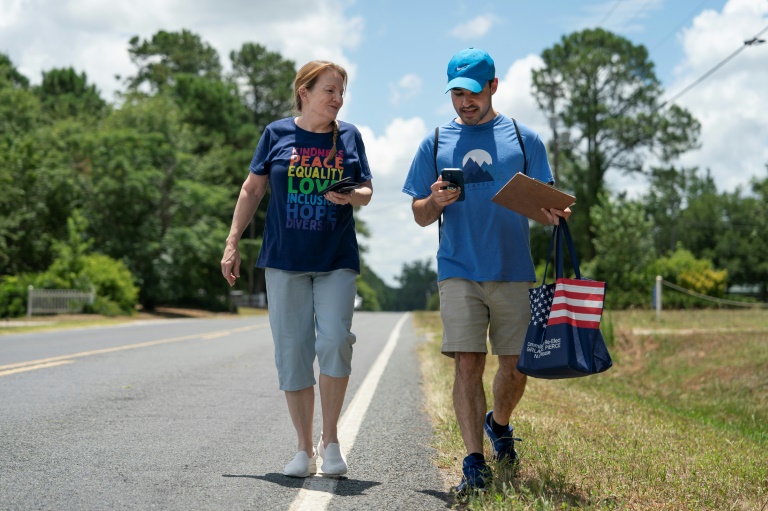
For several months, Yampiere Lugo has been going door to door, urging young people in North Carolina to vote in November.
With Joe Biden’s withdrawal from the race and Kamala Harris’s arrival atop the Democratic ticket, the party activist says his generation — a key voting bloc — is fired up.
“I’ve talked to a lot of people around my age who have sort of all expressed the same sentiment — that they’re just so much more excited to have someone who’s just younger, more energetic,” Lugo told AFP.
The 25-year-old, who works as an administrative assistant at a local school, says even people he thought might skip the election altogether have said the vice president has their support.
The enthusiasm marks a sharp contrast with the situation Lugo was facing just over a month ago, when he was canvassing for Biden in Laurinburg, the seat of Scotland County, not far from the border with South Carolina.
At the time, the activist admitted to AFP that young voters were “frustrated” with their options, facing a choice between the 81-year-old Biden and Donald Trump, the 78-year-old Republican former president.
Now, Lugo believes Harris, 59, can win North Carolina, one of a handful of swing states likely to play a pivotal role in the race for the White House.
Winning here will be an uphill battle — the southern state has not voted for a Democrat in the presidential election since Barack Obama in 2008.
“North Carolina is going to have something to say in November,” said Zach Finley, the president of the Young Democrats of North Carolina.
But for Harris to turn the state Democratic blue, the party needs to campaign “the right way, turning out the folks we need to,” added Finley, who is also 25.
– ‘Excited’ –
On a national level, voters between the ages of 18 and 39 favored Biden over Trump in 2020 by a margin of about 20 percentage points, according to the Pew Research Center.
Finley says the party needs to “turn out young people who, especially in the last couple of years, have been really disincentivized” by the political process.
Democrats are getting out the vote the old-fashioned way in Scotland County — knocking on doors and talking to people.
The rural area is one of the most hotly contested political battlefields in the country — Hillary Clinton bested Trump here in 2016, but the Republican bounced back to defeat Biden in 2020, by just 287 votes.
In November, “it’s all about turnout,” says Garland Pierce, a Democratic state representative and a Baptist pastor.
“That’s what everybody’s really depending on, is the young voters to really go to the polls.
The lawmaker says Harris’s somewhat surprise breakthrough into the race has galvanized voters in North Carolina.
“It appears that young people are really excited” about her candidacy, he said, adding that the economy will be a key issue in the contest.
– ‘Cost of things’ –
Pierce’s prediction about the economy is shared by a number of young voters AFP met in the streets of Laurinburg, which is home to 15,000 residents.
“Everything used to be cheaper,” laments Donnie Leviner, an 18-year-old student with his own home renovation business.
Before Biden won the White House, “gas prices used to be way lower,” said Leviner, who added that he would vote for Trump in his first-ever trip to a presidential voting booth.
For Lucas Wylie, a 26-year-old engineer having a coffee at an outdoor cafe with his dog, young voters are “very focused on the cost of things and affordability.”
Wylie cited expensive housing and high interest rates as evidence of soaring prices, and said both would be important to him in November.
Finley agreed.
“There’s just a lot of pent-up anxiety being a young person in this country, not even being able to afford a home,” he said. “It’s almost out of reach, especially in North Carolina.”
Finley said Democrats need to reassure young voters that they are attuned to their concerns, and ready to deliver solutions.
Harris will need to convince young people that they will ultimately be able to “achieve some form of the American dream” — and offer the same thing to the next generation, Finley said.
rle/sst/bfm



BUNCOMBE COUNTY, N.C. (WLOS) — Copper theft is becoming a growing problem across North Carolina, with AT&T officials warning that the crime can leave entire neighborhoods without phone or internet service and, in some cases, disrupt emergency communications.
According to AT&T, the company has recorded 215 copper theft incidents across North Carolina so far this year. Buncombe County alone has seen about 40 incidents over the past two years. Thieves often cut down or dig up communication lines, strip the copper from the wire and sell the metal for scrap.
“It’s problematic, largely from a public safety standpoint,” said Trey Rabon, president of AT&T North Carolina. “If folks need to call emergency services, need to call 911, they’re not able to access the infrastructure necessary to complete that call.”
“Sometimes we see instances where emergency communications are disrupted, communications between public safety agencies are disrupted,” Rabon added. “It has become an acute challenge, particularly in western North Carolina.”
5 CHARGED AFTER AT&T WIRE THEFTS CAUSED WIDESPREAD OUTAGES IN BUNCOMBE COUNTY
Rabon said thieves frequently target both residential and commercial communication lines, taking advantage of remote mountain locations where utility poles are often out of sight from nearby homes.
“In the mountains, oftentimes personal property is not in line of sight for other neighbors,” Rabon said. “Would-be thieves have the ability to climb a pole, disconnect a line, drive to the next pole and disconnect that line.”
In May, five people were charged in connection with multiple copper thefts across Buncombe County that investigators said caused widespread outages. Law enforcement also discovered several wire-stripping sites in Swannanoa and Leicester.
The thefts have also impacted local businesses.
SWANNANOA PIZZA SHOP SAYS INTERNET WIRES WERE STOLEN, FORCING A DAY CLOSURE
In early June, thieves cut and stole internet lines serving Good Pizza Company. Owner George Peyton said the outage forced the restaurant to close because employees could not access essential business systems.
“Nobody could clock in, couldn’t print tickets, couldn’t take phone orders, and that’s about 80 to 85% of the business,” Peyton said.
AT&T officials say one of the most effective ways to prevent copper theft is for communities to remain vigilant and report suspicious activity.
“They don’t like to operate in the light of day, and they certainly don’t want to operate with a hyper-aware and vigilant community,” Rabon said.
Anyone who suspects someone is stealing communication wire is encouraged to contact local law enforcement.

MYRTLE BEACH, S.C. (WPDE) — The Myrtle Beach Police Department announced Monday the arrest of a man wanted in North Carolina.
Officers arrested Leko Jones, 46, who was wanted by authorities in Burlington, North Carolina, according to the Myrtle Beach Police Department.
Jones is charged with attempted first-degree murder and assault by strangulation.
The arrest resulted from a coordinated effort between the Myrtle Beach Police Department’s Patrol Division and Investigations Division, working alongside the South Carolina Law Enforcement Division and the North Carolina State Bureau of Investigation.
Investigators said they safely located Jones and took him into custody.

A section of E. 4th Street in Washington will close next week for sewer line replacement work.
According to the city, E. 4th Street from Hudnell Street to Aycock Street will be closed to local traffic on Tuesday, July 14, and Wednesday, July 15, from 7:00 a.m. to 6:00 p.m.
-
 San Francisco, CA10 minutes ago
Supervisors urge California to expand S.F. speed-camera program
-

 Dallas, TX16 minutes ago
Five teens injured after crashing carjacked vehicle during Dallas police chase
-

 Miami, FL22 minutes ago
Tokyo-style Neapolitan pizza is coming to Miami, led by legendary pizzaiolo chef Bun
-

 Boston, MA28 minutes ago
SEE THE GOOD: Roxbury center reminds young adults ‘You got this’ – Boston News, Weather, Sports | WHDH 7News
-
Denver, CO34 minutes ago
Five Points affordable housing building honors Dr. Justina Ford | Rocky Mountain PBS
-

 Seattle, WA40 minutes ago
Seattle weather: Hot and sunny day Wednesday, highs in the 80s
-

 San Diego, CA46 minutes ago
Gibraltar ushers in a new era as British territory’s border fence with Spain is removed
-

 Milwaukee, WI52 minutes ago
City funding awarded for redevelopment at 2618 N. Milwaukee


