North Carolina
Health system drops $320M plan to buy 2 North Carolina hospitals


Just two weeks after Novant Health secured a legal victory in its bid to buy two North Carolina hospitals, another court ruling has spurred the health system to abandon its plans.
Novant Health has dropped its bid to buy Lake Norman Regional Medical Center, above, and Davis Regional Medical Center from Community Health Systems. The FTC secured an injunction from a federal appeals court.
Novant had planned to buy two facilities from Community Health Systems in a $320 million deal, but the Federal Trade Commission has been working to block the acquisition. On Tuesday, the U.S. Court of Appeals for the Fourth District narrowly granted the FTC’s petition for an injunction, delaying the deal.
With the deal being stalled, Novant Health announced Tuesday that it was abandoning its plans to buy Lake Norman Regional Medical Center and Davis Regional Medical Center, The Charlotte Observer and other media outlets reported.
“Despite our vision to restore services the area has lost and deliver high quality, remarkable care, we have been met with opposition from the Federal Trade Commission at every step,” Novant said in a statement. “We are steadfast in our belief that these facilities and their patients would have greatly benefited from joining Novant Health, but with the FTC’s continued roadblocks we do not see a way to finalize this transaction.”
The appeals court ruled 2-1 in favor of the FTC’s move for an injunction. The brief opinion from the majority states “the court grants the motion and enjoins the acquisition of Lake Norman Regional Medical Center by Novant Health, Inc. pending appeal.”
In his dissenting opinion, Judge J. Harvie Wilkinson III cited a federal district judge’s argument that the deal would benefit the public.
“The district court was not wrong to think the public interest would be facilitated by helping these hospitals find the financial infusion they need to survive,” Wilkinson wrote.
Wilkinson also noted that allowing the matter to return to additional FTC review and an administrative law judge would possibly delay the transaction by more than two years.
“Hospitals such as Davis and Lake Norman Regional may not provide a full menu of advanced procedures, but they do tend to increase access to vital healthcare for underserved populations,” Wilkinson wrote. “I am reluctant to place all this in jeopardy.”
Novant’s decision represents a remarkable reversal from the court victory earlier this month, which buoyed the health system’s efforts to buy the hospitals. Novant hailed that earlier ruling as “a victory for the area” and pledged to expand more services for patients when the deal was finalized.
Novant argued that the sale should move forward because if the transaction falls apart, it’s possible that Davis Regional would close. CHS closed the hospital in 2022 for financial reasons and converted it into a behavioral health facility.
In his ruling issued earlier this month, U.S. District Judge Kenneth Bell cited the prospect of Davis Regional’s closing, and Novant’s pledges to expand care and services for patients.
The FTC has argued that if Novant was allowed to purchase the hospitals, consumers would see higher prices and could lose services since there would be reduced competition. Federal regulators said the deal would give Novant nearly 65% of the market for inpatient acute care in North Carolina’s Eastern Lake Norman area.
In the district judge’s ruling earlier this month, Bell wrote that there would be sufficient competition in the region. Bell noted that Atrium Health, part of Advocate Health, is building a new hospital near Lake Norman, a fast-growing area in the Charlotte region.
Novant expressed disappointment in the appeals court ruling that granted the FTC an injunction delaying the transaction. The health system said it had “worked tirelessly for more than a year to create a path forward for Lake Norman Regional Medical Center and Davis Regional Medical Center.”
“The communities served by these facilities deserve better than the fate they’ve been dealt by the FTC so we will look for other ways to support patients and clinicians in these communities,” Novant said in its statement Tuesday.
Novant, which operates 19 medical centers and more than 850 healthcare sites, has been expanding recently. In February, Novant completed the $2.4 billion purchase of three South Carolina hospitals from Tenet Healthcare Corp.
Federal regulators have applied more scrutiny to hospital mergers under President Biden’s administration. Some hospitals have pulled the plug on planned deals due to FTC opposition.
John Muir Health had planned to purchase San Ramon Regional Medical Center from Tenet Healthcare Corp. last year. But shortly after the FTC sued to block the deal, the systems dropped their plans.
In addition, SUNY Upstate Medical University dropped its plans to acquire Crouse Health System in Syracuse, N.Y. last year, following the FTC’s objections to the deal.



North Carolina
‘Infuriating, heartbreaking’: Raccoon recovering after getting caught in leg trap at Mecklenburg County park

The video above is a live stream of WBTV and affiliated programming, and may not be directly related to the article below.
CHARLOTTE, N.C. (WBTV) – A raccoon is fighting for its life after it got caught in a leg trap at a Mecklenburg County park this week.
North Carolina Wildlife Rehab said a group of children found the raccoon stuck in a leg trap at a Mecklenburg County park on Thursday, June 18, but did not specify which park.
“This is absurd, infuriating, and heartbreaking,” a spokesperson said. “Just think about how many animals may have already been harmed—and how many babies may have been orphaned because of this.”
Raccoon had heat stroke, front legs trapped
Wildlife Rehab said it’s unclear how long the raccoon was trapped, but both of his front legs were caught.
Thankfully, his legs were not broken; however, he suffered heat stroke and had a body temperature of 105.4 degrees.
“Please keep this sweet boy in your thoughts and prayers as he fights to recover,” a spokesperson said.

Multiple traps found on property
The children reportedly found the trap attached to a fence on an adjoining property, and investigators said officers found several more during their search.
“Thankfully, the kids did not attempt to free the raccoon themselves, though that easily could have happened,” a spokesperson said. “Instead, they immediately got their parents, who then contacted Animal Control.”

Officials said the raccoon was the second animal caught in a leg trap, and both incidents occurred at parks in Mecklenburg County.
Wildlife Rehab said the traps are illegal and cited animal cruelty. In North Carolina, however, foothold traps aren’t entirely illegal, but they’re strictly regulated by state law. They can be used in Mecklenburg County if they comply with state guidelines for trap size, jaw type, and proper tagging.
–> Also read: Trio stole donated blankets, beds from Cabarrus County animal shelter, director says
As of this writing, no arrests have been made, and no charges have been filed.
Copyright 2026 WBTV. All rights reserved.

CHARLOTTE, NC (WCNC) – North Carolina is becoming a leader in artificial intelligence adoption among businesses – ranking ninth in the nation, according to a new LendingTree report. Over 22% of businesses in the state already utilize AI, with many more planning to incorporate it in the near future.
“I’m not surprised at all that North Carolina ranks high on the list in part because it’s a tech-forward state,” said Matt Schulz, chief consumer finance analyst with LendingTree. “There is a lot of financial institutions in that state and no one should be surprised that NC is on the cutting edge with using AI in businesses.”
The report also sheds light on the implications of AI for the workforce. Generative AI usage makes up around 85% of overall AI business usage. Most companies are using the technology for repetitive tasks such as summarizing information, analyzing data, drafting content, or assisting with customer service.
Large companies are leading the way in AI usage. Businesses with over 250 employees use AI at a rate of 37.3% while companies with fewer than five employees use AI at a rate of 19%.

Charles Gaddy was tuna fishing with his dad on Sunday, more than 40 miles northeast of Oregon Inlet, when he saw something he’d never seen before.
“I was just looking in the water, seeing if, you know, any birds or anything, and I see this big gray fish with white dots,” said Gaddy. “Just from reading books and watching movies as a kid, I was like, ‘that’s got to be a whale shark.’”
The 18-year-old said they circled it. He grabbed his GoPro camera and started recording.
“It’s just sitting there, swimming beside us. It really, truly was amazing,” said Gaddy.
Whale sharks are the world’s largest fish. They’re currently listed as endangered by the Union for the Conservation of Nature.
In the Western Atlantic, whale sharks are primarily found in the Gulf and throughout the Caribbean, according to Eric Hoffmayer, a research fishing biologist with the National Marine Fisheries Service. He said they’ve seen numerous whale sharks make their way up the Gulf Stream, ending up in the New England area in late summer and early fall.
“We had an animal last year that we tagged off Tampa and within a month was off New York, and cruised right past North Carolina about this time of year,” said Hoffmayer. “It’s not unheard of, but it’s not real common either.”
Gaddy recognized how lucky he was to experience a sighting.
“To be able to see one in person, especially locally, it’s very truly amazing,” said Gaddy. “It’s no doubt a once-in-a-lifetime experience, and I’m no doubt very blessed.”
If you do encounter a whale shark in the wild, Hoffmayer said, you need to be careful if you’re in a boat because they spend a lot of time at the surface. If you get in the water, keep a safe distance.
“Most people I’ve talked to who have encountered whale sharks, it’s like a life-changing experience,” said Hoffmayer. “It’s really cool to see an animal that large in the wild doing its thing.”
You can report whale shark sightings to the University of Southern Mississippi’s Center for Fisheries Research and Development. If you’re able to capture a good picture of a whale shark, you can see if it matches one already in a database by uploading the photo and information about the sighting online.
-
 Science5 minutes ago
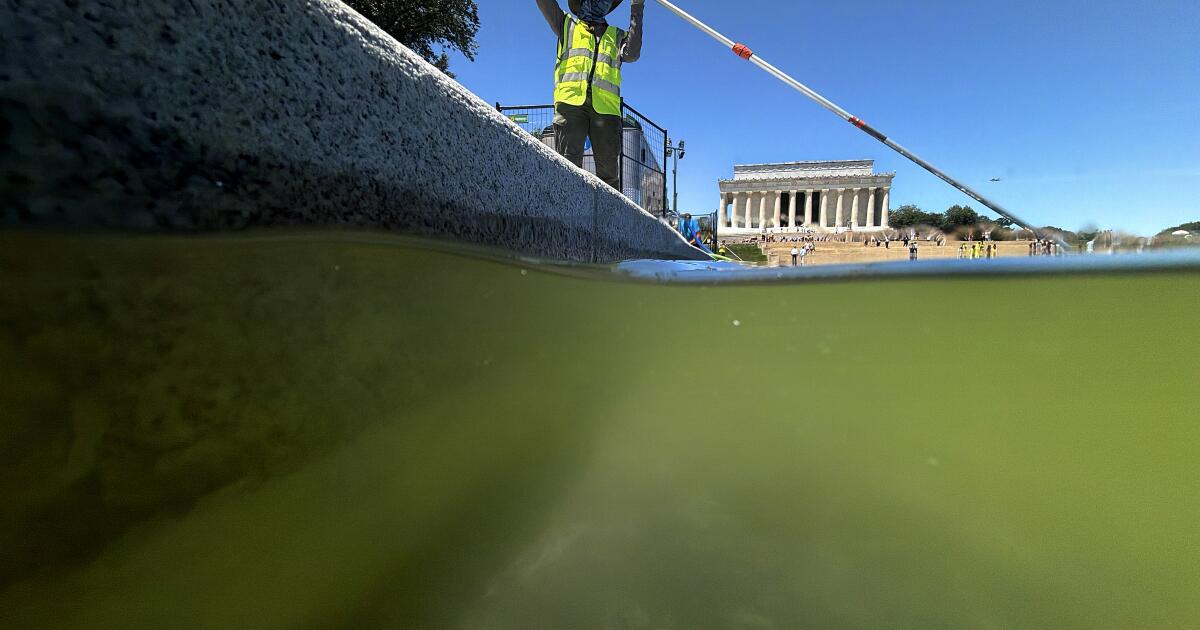
Here’s why the Lincoln Memorial Reflecting Pool went green so fast
-
 Sports8 minutes ago
Shohei Ohtani out of Dodgers’ lineup vs. Orioles for birth of his second child
-

 World20 minutes ago
Lebanese influencer organises World Cup event amid Israel’s attack on Leban
-
 News43 minutes ago
Air Force One, gifted to Trump from Qatar, arrives at Joint Base Andrews
-

 New York2 hours ago
Video: Fans Show Up to the Parade in Their Best Knicks-Themed Attire
-

 Los Angeles, Ca2 hours ago
Victims sought after man allegedly points gun at passing cars in Santa Clarita Valley
-

 Detroit, MI2 hours ago
Best barbershop in Metro Detroit: Finalists for this year’s Vote 4 The Best
-

 San Francisco, CA3 hours ago
How to watch San Francisco Giants vs. Miami Marlins

