Louisiana
Louisiana passes bill to outlaw protests near residences • Louisiana Illuminator


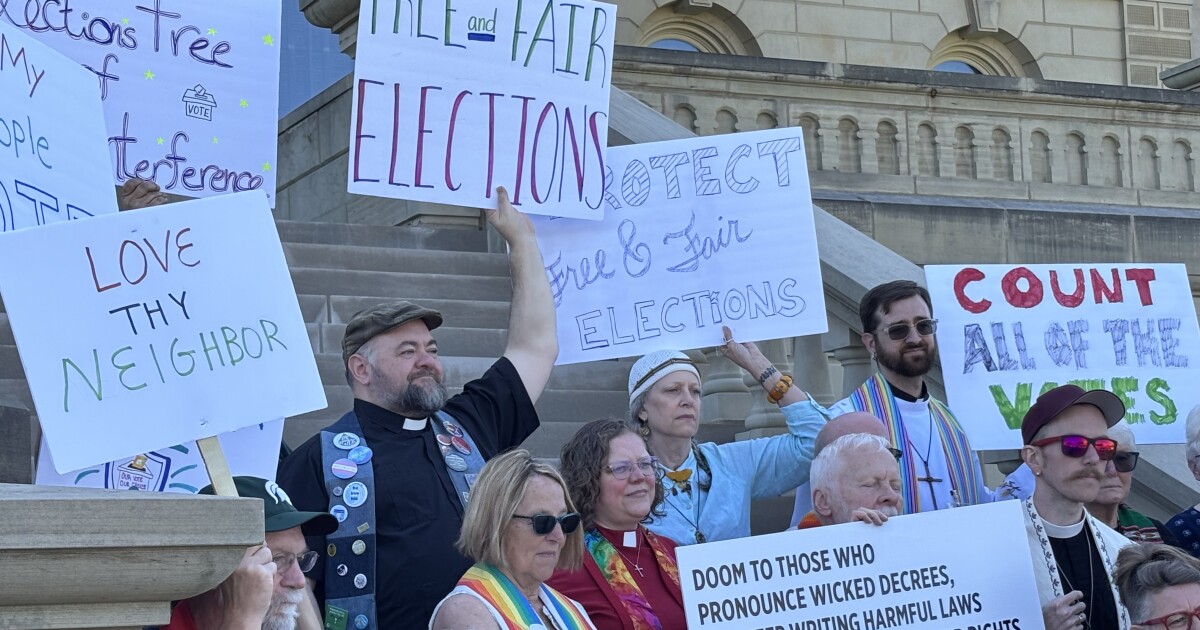
In another measure that could run afoul of the First Amendment, the Louisiana Legislature approved a bill Wednesday to outlaw protests, demonstrations or any other gatherings within 50 feet of anyone’s home — even on a public street — if it threatens to disrupt a person’s use of their home.
House Bill 737, sponsored by Rep. Kellee Hennessy Dickerson, R-Denham Springs, received final passage in a 72-14 House concurrence vote on a Senate amendment that narrowed the proposal.
The measure prohibits anyone from petitioning, picketing or assembling with others within 50 feet of a home in a manner that interferes with or “threatens to disrupt” a person’s right to control or use their home. This could apply to gatherings as small as two people.
The bill is silent on whether the person living in the residence would need to file a complaint or if police could simply enforce the law based on their own belief that a gathering threatens to disrupt a nearby residence.
Anyone who violates the provision would face a fine of up to $500 per day.
Lawmakers held Wednesday’s vote with no discussion of the measure. Most of the debate occurred during a previous floor vote in April during which Dickerson, a freshman lawmaker and former TV news anchor, struggled to see any issues with what was then a much broader bill.
Louisiana could outlaw protests near residences, despite First Amendment concerns
At that time, Dickerson told her colleagues the law would apply only to protests directed at an individual in a way that makes the person feel unsafe or uncomfortable, but the wording in her bill included none of those limitations. Instead the wording would have prohibited any gatherings that interfere with an individual’s right to “enjoy his residence,” leaving that phrase open to interpretation.
The original version of the legislation also had no proximity limitations and would have applied to any gatherings “near” someone’s home. The Senate amended it to apply only to protests within 50 feet of a residence.
Dickerson’s bill is the latest among several the Legislature has passed this year involving First Amendment rights. On Wednesday, lawmakers passed House Bill 383 to make motorists immune from lawsuits if they run over or kill protestors because they feel threatened.
That same day, Gov. Jeff Landry signed House Bill 173 into law, making it a crime to come within 25 feet of a police officer upon command. On Tuesday, lawmakers approved House Bill 127 to establish harsher punishment for anyone who organizes a protest that ends up disrupting traffic.
Dickerson’s bill will head to the governor for executive approval. Landry has signed similar legislation and has long criticized political demonstrations, even peaceful ones. He has also called for harsh punishments against protestors with the exception of those involved in the violent Jan. 6, 2021, attack on the U.S. Capitol.
GET THE MORNING HEADLINES DELIVERED TO YOUR INBOX





The future North Lafayette library will expand learning opportunities while honoring the lifelong impact of the Louisiana education and civil rights leader.

Watch Lafayette Parish Schools break ground on Paul Breaux K-8 School
Groundbreaking for $50M Paul Breaux K-8 in North Lafayette — with 1,300 students, 66 classrooms and an 18-month timeline.
Lafayette Consolidated Government (LCG) has officially designated the Northeast Regional Library as the Norman C. Francis Library, recognizing the lifelong legacy of one of Louisiana’s most influential educators and civil rights leaders.
The Lafayette Parish Council approved the naming, cementing a tribute to the late Francis, whose decades of leadership in higher education and public service helped shape opportunities for generations of Louisianans.
The new library will serve as the cornerstone of North Lafayette’s ongoing revitalization efforts through the Holy Rosary Redevelopment initiative while expanding access to educational resources, technology and community programming.
“By bringing a new chapter of opportunity for residents on the Northside of Lafayette, this library stands as a fitting tribute to one of the most influential educators and civic leaders in Louisiana’s history,” Lafayette Mayor-President Monique B. Boulet said.
Boulet added that Francis dedicated his life to expanding access to education and creating opportunities for others.
“It is only fitting that this library, a place of learning, discovery, and community, bears his name for generations to come,” Boulet said.
Norman C. Francis’ legacy honored in Lafayette
Born in Lafayette in 1931, Francis dedicated his life to expanding educational access and advancing social justice.
In 1952, he became the first African American to enroll at Loyola University New Orleans College of Law. After earning his law degree, he joined Xavier University of Louisiana in 1957 before serving as the university’s president from 1968 through 2015, making him one of the longest-serving university presidents in the United States.
His influence extended far beyond higher education. Francis advised eight U.S. presidents, led the Louisiana Recovery Authority following Hurricanes Katrina and Rita, and received the Presidential Medal of Freedom from President George W. Bush in 2006.
Francis died in February 2026 at the age of 94, but community leaders say his impact continues to inspire future generations.
Northeast Regional Library’s Upgrades
Conceptual design plans for the new Northeast Regional Library were presented to the Lafayette Public Library System Board on June 29.
The planned facility will encompass 20,533 square feet on a 6.5-acre site and include:
- Space for 44,000–53,000 library materials.
- 37 public computer stations.
- Children’s and teen areas.
- STE(A)M learning and maker spaces.
- Study rooms and quiet reading areas.
- Walking paths and music garden.
- Interactive displays.
- 119 parking spaces, including six ADA-accessible.
Community leaders celebrate library naming
State Sen. Gerald Boudreaux said the designation reflects years of work by local leaders and residents to bring the long-planned Northside library to fruition.
“I would like to thank the Boulet Administration, the Lafayette City and Parish Councils, and most importantly the many community members and organizations that remained committed for years to making this vision a reality,” Gerald Boudreaux said. “Dustin Cravins and the Holy Rosary Redevelopment Committee have developed a master plan that will positively transform this historic property while honoring the remarkable legacy of Dr. Norman C. Francis.”
City Council Chair Kenneth Boudreaux said the project represents a decades-long investment in North Lafayette.
“Seeing this library become a reality is deeply personal. I was honored to help secure the initial funding for this project years ago because I believed the north side of Lafayette deserved a first-class library that would serve generations to come,” Kenneth Boudreaux said. “To now see it bear the name of Dr. Norman C. Francis, a man whose life was defined by education, opportunity, and service, is a powerful reminder of what can happen when a community refuses to stop believing in its future.”
Parish Councilman Abraham “AB” Rubin Jr. called the naming a symbol of perseverance.
“There were times when this project faced real uncertainty, but our community never gave up because we knew this library was worth fighting for,” Rubin, Jr said. “Dr. Norman C. Francis spent his life opening doors for others and believing in possibilities that many thought were out of reach. Naming this library in his honor reflects that same spirit of perseverance and hope to future generations.”
City Councilman Elroy Broussard said the library will become an educational anchor for North Lafayette.
“As a former member of the Lafayette Parish School Board, I know that libraries are not just brick and mortar, but are gateways to learning and opportunity,” Broussard said. “This library will touch countless lives across the northern parts of Lafayette, and there is no more fitting namesake than Dr. Norman C. Francis, whose extraordinary legacy will remind every young person who will walk through its doors that education has the power to transform lives.”
For additional information about the Northeast Regional Library project and design plans, visit the Lafayette Public Library’s Northeast Regional Library information page.
Aaron Gonsoulin is the General Assignment/Trending Reporter for The Daily Advertiser. Contact him at AGonsoulin@theadvertiser.com.

ST. MARTIN PARISH — As the Mega Millions jackpot climbs to an estimated $604 million, excitement is growing in St. Martinville, where a quick stop at a convenience store has many imagining what they would do if they won.
The jackpot, the largest Mega Millions prize offered so far this year, drew plenty of attention at Simmis Mart. Some customers were ready to buy tickets, while others simply enjoyed thinking about the possibilities.
Charlotte Wilson said she has noticed that major lottery jackpots often seem to be won outside Louisiana, but that has not stopped her from hoping.
“When they do hit it’s always out of state. It’s never in Louisiana in a little small town, but if you do hit and I win!” Wilson said.
The excitement extended beyond customers. Store employee Vicky Williams admitted she would not mind seeing some of the jackpot come her way.
“I need to get some of that. I could use some of that money,” Williams said.
Among those purchasing a ticket was Shakina Hart, who said playing the lottery is something she has done before, “I’ve played it in the past, but never won the Mega Millions, so yes, I’m hoping I’m winning on this,” Hart said.
For Wilson, hitting the jackpot would be about more than the money. She already knows exactly how she’d put it to use.
“First of all, I’ll buy me a house and a nice car, and I’ll take care of the homeless people because they have a lot of those that need somewhere to live who are hungry and homeless,” Wilson said.
Hart said her priorities would center on her family, especially her children’s education.
“I have one that wants to be a lawyer and one that wants to be a doctor, so the money would definitely help with their school funding and basic care needs,” Hart said.
The next Mega Millions drawing is scheduled for Friday July 10th. While the odds of winning remain long, the growing jackpot has many people holding onto the same thought: What if their numbers are the ones called?
Louisiana
Leadership Louisiana Health Fellows Welcomes Inaugural Class – Leaders for a Better Louisiana

Nearly 40 years after launching Louisiana’s premier statewide leadership development program, Leaders for a Better Louisiana is proud to announce the inaugural class of Leadership Louisiana Health Fellows, marking an important new chapter in the organization’s longstanding commitment to developing informed, connected leaders equipped to address the state’s most pressing challenges.
Building on the proven model and legacy of Leadership Louisiana, the Health Fellows program brings together leaders from across healthcare, business, public policy, higher education, philanthropy, and community organizations to gain a deeper understanding of the systems, opportunities, and challenges shaping health outcomes across Louisiana. Throughout the year, fellows will participate in immersive sessions across the state, engaging directly with healthcare providers, researchers, policymakers, workforce leaders, and innovators while exploring the issues that influence the health and well-being of Louisiana’s people and communities.
“The strength of Leadership Louisiana has always been its ability to bring together accomplished leaders from different sectors and regions to learn from one another while developing a broader understanding of our state,” said Sheree Blanchard, Director of Leadership Louisiana. “The Health Fellows program extends that tradition by focusing on one of Louisiana’s most significant opportunities for improvement. We are excited to welcome this outstanding inaugural class.”
The inaugural class represents a broad cross-section of Louisiana’s healthcare and civic leadership, with participants serving in hospitals, health systems, higher education, business, nonprofit organizations, public agencies, and community-based organizations throughout the state. Together, they bring diverse expertise and perspectives that will strengthen dialogue and collaboration around Louisiana’s health challenges and opportunities.
“From the beginning, our vision was to create a program that mirrors the excellence and impact of Leadership Louisiana while taking a comprehensive look at the many factors that influence health outcomes,” said Blanchard. “This first class reflects the caliber of leadership we hoped to attract, and we look forward to watching these fellows build lasting relationships and develop new ideas that will benefit communities across Louisiana.”
Leadership Louisiana has graduated more than 1,600 leaders over nearly four decades, creating one of the state’s strongest cross-sector leadership networks. Leadership Louisiana Health Fellows builds on that foundation by providing participants with a focused exploration of Louisiana’s healthcare landscape while reinforcing the program’s longstanding commitment to collaboration, informed leadership, and service to the state.
The 2027 Health Fellows class will begin its yearlong experience this summer with sessions held in multiple regions of Louisiana.
View the complete roster of the Leadership Louisiana Health Fellows inaugural class.
-

 Pittsburg, PA2 minutes ago
John Valentine wants to start a Downtown Chamber of Commerce
-

 Augusta, GA5 minutes ago
Stabbing at Augusta McDonald’s leaves 1 hospitalized
-

 Washington, D.C10 minutes ago
Metro Red Line Summer Shutdown: Changes to shuttle bus service after concerns
-

 Cleveland, OH17 minutes ago
Guardians Lose Another Horrific Game
-

 Austin, TX20 minutes ago
Austin cannabis shop: THC ban would “hurt everybody”
-

 Alabama25 minutes ago
Alabama football fans invited to pep rally at River Market
-

 Alaska32 minutes ago
Did I Find a Cure for Male Loneliness? No, But I Found a Way to Embrace Solitude in the Wild.
-

 Arizona34 minutes ago
Arizona is among the worst states to move to, study says. Here’s why

